PART 1
The wedding party continued to shine in the garden of the Salgado residence in San Pedro Garza García when Mariana heard a cry coming from behind the bathroom on the third floor.
Downstairs, guests toasted with champagne, musicians played elegant boleros, and Doña Teresa smiled like a queen at a society gala.
But upstairs, locked inside, Diego, a ten-year-old boy, bit down on a towel to stifle his screams.
Mariana hadn’t married Alejandro Salgado for love. He needed to clean up his construction company's image after several scandals involving fake permits, and she, an expert in public relations, agreed to a cold, calculated wedding, almost like a contract.
She thought she could handle that family with intelligence.
Until she opened the bathroom door.
Diego was sitting on the floor, barefoot, his torn shirt clutched in his hands. When Mariana saw his back, the air caught in her throat.
He had new marks and old scars.
The boy quickly tried to cover himself.
“Please, don’t say anything. If you get involved, they’ll fire you too.”
Mariana knelt down in front of him. She didn’t scream. She didn’t cry. She simply asked who had done this to him.
Diego lowered his gaze.
“My grandma says that’s how you raise a Salgado.”
He told her that his mom had died three years ago and that since then, Doña Teresa punished him every time he cried, forgot an assignment, or spoke of her.
That afternoon, she had hit him for wearing an old shirt that his mother had given him before she died.
Mariana felt rage, but also a buried memory. When she was ten, her stepfather's son had pushed her down the stairs. Her mother had hugged her, but remained silent to not jeopardize her marriage.
That night, watching Diego tremble, Mariana vowed she would not repeat that cowardice.
She bandaged his wounds, let him sleep, and went down to the kitchen. There, she overheard a maid muttering that “Doña Teresa had a heavy hand, but it was for the good of the heir.”
Mariana found a bamboo stick hidden above a cupboard.
Then she walked straight to the private chapel.
Doña Teresa was praying before the Virgin of Guadalupe, dressed in silk, as if she hadn’t just shattered a child.
“A newcomer doesn’t just walk into my house like this,” she said without turning around.
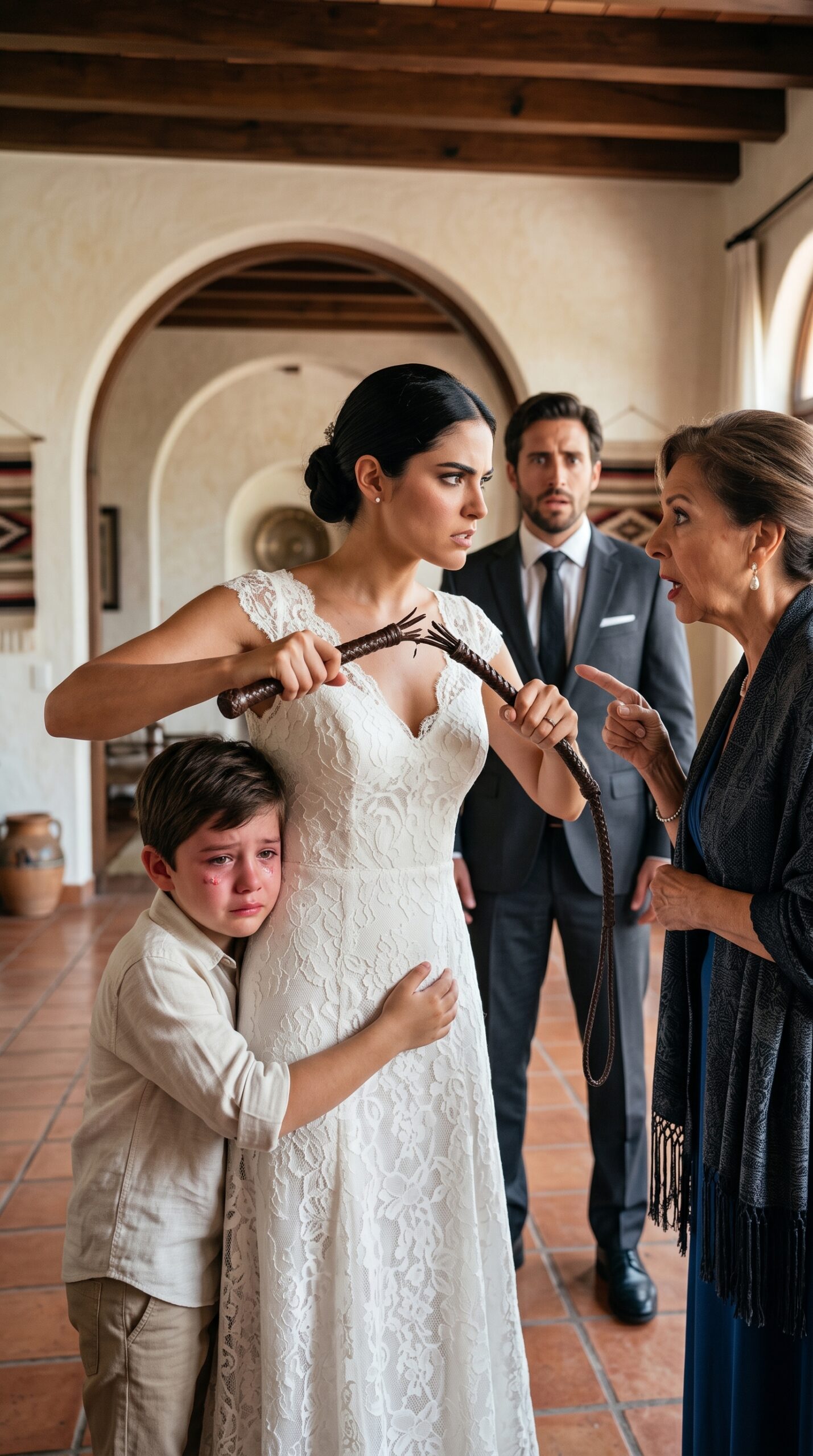
Mariana raised the stick.
“A woman who hits her grandson cannot speak of respect.”
Doña Teresa smiled with contempt.
“That boy turned out weak like his mother. Alejandro was also corrected this way, and look where he is now. You’re just a hired wife, dear. Don’t get confused.”
Mariana snapped the stick in two.
“If you touch him again, there won’t be a surname, money, or lawyer to save you.”
When Alejandro came upstairs, furious because his mother claimed to feel unwell, Mariana confronted him in the hallway.
“Your son doesn’t need discipline. He needs a father.”
Alejandro paled.
Then Mariana uttered the sentence that split the night in two:
“You married me to save your family’s name, but maybe I came to save Diego from you.”
No one knew that, behind the door, the boy had heard everything.
And what he did before dawn left the Salgados on the brink of an uncontainable scandal.
PART 2
The next morning, Diego didn’t show up for breakfast.
Doña Teresa sat at the head of the table, sipping coffee as if nothing had happened. Alejandro checked work messages, trying to pretend the previous night had only been an awkward argument.
Mariana went up to the boy's room.
The bed was empty.
On the pillow lay a torn sheet from a school notebook. The handwriting was shaky, with stains from tears.
“I left so you wouldn’t fight because of me.”
Alejandro ordered the house to be shut down. He called drivers, bodyguards, and employees. Doña Teresa insisted that no one should be notified to avoid making a “circus.”
Mariana, however, remembered something Diego had told her while she was tending to his back.
His mom used to take him to a small park next to an old parish, where there were jacarandas and corn vendors.
They found him there, hugging the shirt that had triggered the punishment.
When Alejandro tried to approach, Diego hid behind Mariana.
That gesture was worse than any insult.
Alejandro froze, as if for the first time realizing that his son didn’t see him as a refuge, but rather as part of the danger.
Back at the residence, Mariana called in an independent doctor. Doña Teresa wanted to impose the family doctor, the same one who had “examined” Diego for years without reporting anything.
Mariana refused.
“Here, private favors are over.”
The new doctor documented recent injuries, old scars, signs of repeated beatings, and pain from a poorly treated rib.
When he requested X-rays, the family doctor became nervous.
Hours later, cornered by questions, he admitted that Diego had had two fractured fingers months earlier and a rib fracture. He had never been taken to a hospital.
Everything was dealt with in secret.
Doña Teresa had paid to ensure there was no record.
Alejandro listened from the living room, jaw clenched. Mariana hoped he would explode, that he would defend his mother once more.
But he said nothing.
And that silence, for the first time, didn’t sound like complicity but rather like shame.
Mariana also went to the school. Diego’s teacher admitted she had seen bruises, fear, mood swings, and anxiety attacks.
The administration asked her to keep quiet because the Salgado family funded scholarships and renovations.
“Well, now they’re going to learn another lesson,” Mariana said. “A child is worth more than a donation.”
That afternoon, she took Diego to eat hamburgers in a simple place, far from marble and bodyguards.
The boy accidentally knocked over a soda glass.
As soon as he heard the plastic hit the floor, he raised his arms to cover his head.
“I’m sorry, I’m sorry, I won’t do it again.”
Mariana crouched down in front of him.
“No one hits you for making a mistake here.”
Diego looked at her with watery eyes.
“Did my mom die because I was bad?”
Mariana felt that question shatter something inside her.
She hugged him in the middle of the restaurant while people glanced over. She didn’t care.
“No, Diego. Your mom loved you. Very much.”
That night, Alejandro handed Mariana a document signed by a notary. It gave her authorization to make decisions regarding Diego’s health, schooling, and therapy.
In exchange, she had to relinquish any financial benefits from the marriage.
Mariana let out a dry laugh.
“Do you really think your son can be negotiated like a piece of land?”
She signed anyway.
Not for Alejandro.
For Diego.
Then she demanded to move with the boy to the guest house on the other side of the garden. Alejandro agreed, although he warned her that his mother wouldn’t stay quiet.
He was right.
Doña Teresa cut off the internet. Suspended meals. Withdrew the staff. Ordered that no one bring them groceries.
But in that small house, Diego began to breathe differently.
They cooked soup, watered plants, watched cartoons, and dined without glancing at the door in fear.
One night, Alejandro showed up with grocery bags, a new refrigerator, and a box of books.
He didn’t ask to enter as the owner. He knocked on the door.
Diego came down the stairs cautiously. He looked at him for a long time and then offered him a cookie he had made with Mariana.
Alejandro took it as if it were an immense apology, even though it wasn’t yet.
It seemed like the beginning of something.
But two days later, Doña Teresa arrived with a lawyer and two folders.
She laid out bank statements, copies of contracts, and an old photograph of Mariana’s mother.
“Your family isn’t holy either,” she said. “Your mother received 3 million pesos from a company linked to us. If you don’t return Diego to me, I’ll report her for fraud.”
Mariana knew that story. It had been a loan paid years ago, used for her grandmother’s surgery.
But Doña Teresa wasn’t seeking justice.
She was seeking fear.
Mariana pulled out her own folders: photos of injuries, medical records, messages from the family doctor, recordings from the wedding night, and school reports.
“Go ahead and report,” she replied. “I will report too.”
Doña Teresa lost her smile.
Before leaving, she leaned towards her and whispered:
“You still don’t know who let Diego’s mother die.”
Alejandro, who had just entered, dropped his keys.
The darkest secret of the Salgados had just peeked out.
That same night, Mariana and Alejandro sifted through boxes stored in the main house’s storage. Files, medical receipts, printed emails, invoices from a private clinic that no longer operated.
The official version claimed that Laura, Diego’s mother, died from an infection after minor surgery.
But nothing added up.
There were two different surgeon names. The time of death varied between documents. Studies were missing. And every month, for nearly three years, the Salgado construction company had transferred money to a ghost medical services company.
Alejandro sat on the floor surrounded by papers.
“My mother told me Laura was stable. I was in Querétaro inaugurating a project. When I returned, she had already been cremated.”
Mariana looked at him with rage.
“You didn’t just lose your wife. You left your son alone with the woman who hated her.”
The next day, they sought out Ernesto, Laura’s former driver. He lived in Apodaca, in a humble house.
At first, he denied knowing anything.
But when Mariana showed him a photo of Diego’s back, the man began to cry.
He told them that Laura wanted a divorce and to take the boy away. She had discovered money diversions, bribes to inspectors, and false documents in several works.
A week before she died, she had argued with Doña Teresa.
“The lady told her that no woman without a surname would destroy the Salgados,” Ernesto confessed. “Then they ordered me to take her to that clinic. She went in conscious but scared. She asked me to take care of Diego if anything happened to her.”
There was no direct evidence of murder.
But there was evidence of concealment, negligence, and manipulation.
A retired nurse confirmed that Laura was isolated in a private room, that several medications were not correctly recorded, and that Doña Teresa pressured the staff to alter clinical notes.
The nurse had kept copies out of fear.
With that, Mariana went to the Prosecutor’s Office and the Child Protection Agency. She also hired a lawyer with no ties to the family.
Doña Teresa counterattacked.
She gathered the company’s board and accused Mariana of manipulating Alejandro to take his fortune. She claimed Diego was unstable and that his new wife wanted to destroy a respected surname.
Then she did the cruelest thing.
She sent an anonymous report claiming that Mariana was holding the boy against his will.
When social workers arrived at the guest house, Mariana didn’t hide.
She provided therapy records, medical reports, school evidence, and recordings.
Diego spoke in a protected interview.
“My grandma said that crying was for cowards. My dad didn’t defend me. Mariana was the first to ask me if it hurt.”
Alejandro listened from outside.
He covered his face and cried silently.
The judge issued protective measures. Doña Teresa could not approach Diego or communicate with him. The family doctor was under investigation for omission and forgery.
The Salgado’s perfect image began to crumble.
Then Alejandro did something no one expected.
He convened the media, employees, and investors. Doña Teresa arrived convinced that he would clean up the scandal.
But Alejandro stepped up to the podium without a speech.
“For years, I confused obedience with respect. My son was hurt while I chose not to see. I have no excuse. I will submit documents, cooperate with the investigation, and step down from the company’s management.”
Doña Teresa stood up furious.
“You owe me everything you have!”
Alejandro looked at her.
“And everything I almost lost too.”
The phrase went viral.
The audits uncovered irregular payments, altered permits, and inflated contracts. Doña Teresa was charged with family violence, forgery, and concealment. Due to her age, she was placed under house arrest, but prohibited from approaching Diego.
Alejandro moved to the guest house.
Mariana did not welcome him as a husband.
“Apologizing doesn’t erase three years of silence,” she told him. “Here, you will prove yourself, not promise.”
And Alejandro began from the ground up.
He learned to prepare breakfasts. To take Diego to therapy. To attend school meetings without sending assistants. To remain silent when his son didn’t want to hug him.
One morning, Diego spilled milk on the table. His body went rigid.
Alejandro grabbed a cloth and cleaned up.
“It’s okay. I spill things too.”
Diego looked at him suspiciously.
“Aren’t you angry?”
“I’m angry at myself for making you think you should be afraid.”
That day, the boy didn’t smile.
But he also didn’t apologize.
And that was huge.
Months later, Mariana opened a foundation with the case's lawyer to guide teachers, doctors, and family members on how to report child abuse.
Alejandro sold properties to pay compensations and support therapies for abused children.
Diego turned eleven with a barbecue in the garden. He asked for chocolate cake, detective comic books, and permission to get muddy.
When it began to rain, he ran joyfully through the puddles.
Alejandro hesitated to approach.
Mariana told him:
“Go. And if he doesn’t want to play with you, you respect that.”
Diego saw him, grabbed a ball, and threw it at him.
Minutes later, father and son were soaked, laughing as if the lost time could be reclaimed in pieces.
A year after that wedding, Diego entered Mariana’s room with a drawing.
It showed three people holding hands in front of a small house. Above, he wrote:
“My family is where I am not afraid.”
Then he looked at her shyly.
“Can I call you mom?”
Mariana felt her throat tighten.
“You can call me whatever makes you feel safe.”
Diego hugged her tightly.
Alejandro, from the door, cried without hiding.
The marble mansion remained almost empty. The powerful family that everyone admired had been broken long before Mariana arrived.
Some said she destroyed the Salgados.
The truth was different.
Silence had already destroyed them.
Mariana just opened the door to let in the light.
And since then, whenever someone asked Diego how his life had changed, he responded with a simple phrase:
“Because someone stopped looking the other way.”