PART 1
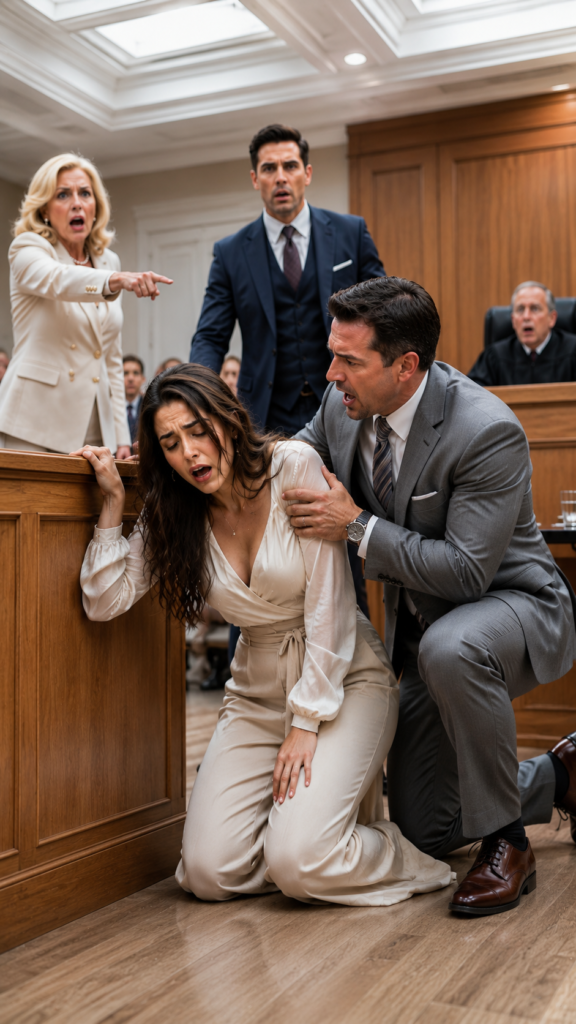
—She’s faking, Your Honor. She does this every time she doesn’t get what she wants.
Doña Teresa's voice rang in the Family Court of Guadalajara like a death knell. She didn’t shout. She didn’t dramatize. She spoke with that venomous calm of someone who had spent months crafting a lie.
Claudia Ramírez stood by the wooden railing, pale, her hands cold, and her knees shaking. At 34 years old, she had been fighting for custody of her daughter Valeria for 7 months, and her entire life had been spent trying to get someone to believe her.
On the other side, her husband, Mauricio Salcedo, smiled faintly.
—You know her, Your Honor —he said in a voice of patient authority—. Claudia faints, cries, or gets dizzy when she wants to manipulate. My mom and I just want to protect the girl.
Valeria was 7 years old. And for months, she had been throwing up before going with her dad.
Claudia had reported this in documents, messages, audio recordings, and letters from the school psychologist. She had also explained that Mauricio took her phone, hid the car keys, and told their daughter that her mom was “crazy.”
But in that courtroom, everything sounded like exaggeration.
Mauricio’s lawyer had submitted prescriptions, medical consultations, and emergency room visits as if they were evidence of instability. Each page of the file seemed to turn Claudia's pain into a weapon against her.
Judge Octavio Medina leafed through the papers with the weariness of someone who had witnessed too many families falling apart in public.
—My daughter is scared —Claudia managed to say—. She doesn’t want to stay with him.
Mauricio lowered his gaze, feigning sadness.
—Valeria is scared because her mom fills her head with ideas. I just want to spend time with my daughter, honestly.
Doña Teresa nodded.
—My granddaughter needs stability. No scenes.
Claudia wanted to respond, but the air thickened. The white lamps buzzed. The floor seemed to shift beneath her. She felt a sharp blow to her chest, followed by an emptiness that sank down to her feet.
—Your Honor… I need to sit down.
Mauricio sighed.
—Here we go again.
The judge looked up.
—Ms. Claudia, can you continue?
She opened her mouth.
Nothing came out.
Her fingers slipped from the railing. Her legs stopped obeying her, as if someone had turned her body off from the inside.
—She’s faking —Doña Teresa repeated, louder—. Don’t fall for her act.
Claudia saw Mauricio’s twisted smile.
Then she fell.
The thud against the floor sent several people screaming. A chair scraped. Someone covered their mouth. Mauricio took a step forward, but not to help her.
—Don’t touch her —he said angrily—. As soon as she sees it’s not working, she’ll get up.
Then, from the last row, a man in olive green uniform rushed toward her. He knelt by her side and took her pulse.
His badge read: Colonel Dr. Arturo Beltrán.
—Ma'am, can you hear me?
Claudia blinked, lost.
Mauricio let out a dry laugh.
—Doctor, don’t waste your time. My wife does this all the time.
The colonel didn’t even look at him.
—Shut up.
The room fell silent.
Doña Teresa stood up indignantly.
—How dare you?
The doctor lifted one of Claudia's eyelids, checked her breathing, and changed his expression.
—Her pulse is irregular, she’s cold, disoriented, and not responding well.
The judge stood up.
—Doctor, what’s happening?
—I can’t diagnose here, but this is no act. It could be a cardiac or neurological event. She needs immediate attention.
Doña Teresa clicked her tongue.
—What a coincidence that this happens right now.
The colonel raised his voice.
—Call 911 now!
And when the judge ordered that no one leave the courtroom, Mauricio stopped smiling.
PART 2
The process officers cleared the hallway while a clerk called for emergencies. The murmur in the room changed tone. It was no longer curiosity. It was shame. Several people had just realized they might have been witnesses to a cruel act in real time.
Colonel Beltrán leaned over Claudia.
—Claudia, blink if you can hear me.
She blinked once.
—Very good. Breathe slowly. You’re not alone.
You’re not alone.
That phrase hit her harder than the pain in her chest.
For months, Claudia had been alone even in her own home. Mauricio was kind in front of neighbors, teachers, and family. Privately, he would block her from the doorway to argue until 3 AM. He would take her phone. He told their daughter that no one would believe a woman who broke down over everything.
Doña Teresa would show up on Sundays with food for Valeria and poison for the girl.
—Your mom is sick, my love. One day you’ll understand why your dad has to protect you from her.
Valeria started biting her nails. Then she began hiding in the bathroom with the lights off. Then she would say that her stomach hurt every time Mauricio came to pick her up.
Claudia brought evidence to court. But Mauricio’s lawyer claimed it was “emotional interpretations.”
Now, lying on the floor, Claudia heard the judge approaching.
—Ms. Claudia, do you feel safe returning to your husband today?
Mauricio reacted immediately.
—Your Honor, that’s inappropriate.
The judge didn’t even look at him.
—One more word and I’ll have you removed.
Claudia couldn’t speak. She just shook her head.
No.
It was a small gesture.
But everyone saw it.
Doña Teresa clutched her bag to her chest.
—She was trained. She’s acting.
The colonel spoke without letting go of Claudia’s pulse.
—Ma’am, if you interfere with a medical emergency again, I will ask for you to be removed.
The paramedics arrived. They put oxygen on her, attached electrodes, and lifted her onto a stretcher. Mauricio stepped forward with a worried husband face.
—I’m her husband. I’m going with her.
Claudia turned her face in panic.
The judge noticed.
—No. You stay here.
—She’s my wife.
—She’s an emergency patient. And this court has just heard that she doesn’t feel safe with you.
The mask slipped from Mauricio’s face.
At the Civil Hospital, Claudia underwent tests, analyses, and an electrocardiogram. She had low potassium, severe dehydration, extreme exhaustion, and chest pain. The cardiologist, Dr. Irene Castañeda, entered later with the file in hand.
—Claudia, you had a stress-induced cardiomyopathy. Many people know it as broken heart syndrome. It can mimic a heart attack. Your body reached its limit.
Claudia covered her mouth.
—So… I wasn’t faking?
The doctor looked at her firmly.
—No. Your body was begging for help.
Claudia cried silently.
That same night, a social worker called the DIF and the Public Ministry. A nurse named Marisol documented old bruises on Claudia's arms. She also noted what Claudia finally dared to say.
—He doesn’t hit me in the face —Claudia whispered—. He grabs me hard. He locks me up. He takes my phone. He tells my daughter I’m crazy.
Marisol didn’t interrupt her.
—Thank you for saying that.
The court issued urgent measures. Mauricio couldn’t approach Claudia or pick up Valeria from school. Doña Teresa couldn't have contact with the girl either.
But the real twist came the next morning.
Mariana, Claudia's sister, entered the hospital with Valeria's hand in hers. The girl had a stuffed rabbit and red eyes. Mariana carried a USB stick in a transparent bag.
—I found it in Vale's backpack —she said, trembling—. She recorded something at Mauricio's house.
Claudia felt her heart sink.
Valeria hid behind her aunt.
—I recorded Grandma —she whispered—. She said what they were going to do to you in court.
The USB was small, blue, with a star sticker. It looked like any school item. But when the social worker handed it over to the Public Ministry, Claudia understood that this tiny thing could change everything.
They reviewed it with the child psychologist to avoid further exposing Valeria.
First, Doña Teresa’s voice was heard, clear, calm, cruel.
—Your mom will cry in court, but don’t believe her. Your dad has already talked to his lawyer. We’re going to say she fakes illnesses. If she falls, better. That way the judge will see she’s crazy.
Then Mauricio's voice.
—Mom, don’t say that in front of the girl.
Doña Teresa replied:
—Let her learn. Weak women lose their children.
After that, Valeria’s crying was heard.
Claudia couldn’t go on.
The school psychologist submitted reports. Dr. Castañeda explained the medical episode. Marisol documented injuries. Mariana submitted 6 audios where Doña Teresa threatened her.
—Tell that useless woman she won’t keep my granddaughter. My son should have locked her up long ago.
The evidence didn’t scream.
It just piled up.
A week later, Claudia returned to court. This time she didn’t arrive alone or trembling. Mariana walked beside her. A victim support lawyer was also present. The social worker was summoned. The school psychologist was there too. In the back, in impeccable uniform, stood Colonel Arturo Beltrán.
Mauricio entered wearing a gray suit, well-groomed beard, and an offended man’s face. Doña Teresa donned pearls and dark glasses, as if elegance could cover up the rot.
Mauricio’s lawyer tried to regain control.
—Your Honor, a medical emergency should not distort a family process. Ms. Claudia has a history of anxiety.
Claudia’s lawyer opened the file.
First, Dr. Castañeda spoke via video call. She explained that the collapse was real, that extreme stress could trigger a severe condition, and that Claudia showed no signs of faking.
Then Marisol testified about the bruises and the emergency report. The social worker explained the safety plan. Valeria’s psychologist talked about the drawings of closed doors, the vomiting before visits, and a phrase the girl repeated:
—Dad gets mad if I say I love Mom.
Mauricio stared straight ahead, rigid.
Doña Teresa moved a leg under the seat.
Then they called Colonel Beltrán.
Mauricio’s lawyer approached.
—Colonel, you were not the treating physician for Ms. Claudia, correct?
—Correct.
—You couldn’t diagnose her in the courtroom.
—Correct.
—Then your intervention was based on a momentary impression.
The colonel stared at him unblinking.
—My intervention was based on observable clinical signs: irregular pulse, pallor, disorientation, loss of strength, and possible cardiac compromise. I also observed that 2 direct family members attempted to prevent her from receiving help.
A murmur rippled through the room.
The lawyer insisted:
—Couldn’t it have been anxiety?
—Anxiety doesn’t make a person collapsed on the floor any less urgent —the colonel replied—. Sometimes what’s dangerous isn’t the symptom, but the people who choose to ignore it because it suits them.
Doña Teresa murmured something.
The judge pointed at her with his pen.
—Mrs. Teresa, one more word and I’ll have you removed.
Then Claudia stepped up to the stand.
Her legs were still weak, but she walked. She didn’t need to seem invincible. She just needed to speak the truth.
She talked about the hidden keys, the taken phone, the sleepless nights. She spoke of Valeria hiding behind the couch. She talked about Doña Teresa telling the girl that a sick mother didn’t deserve to raise her.
Mauricio shook his head.
Then the lawyer played the audio from the USB.
Doña Teresa’s voice filled the room:
—We’re going to say she fakes illnesses. If she falls, better.
Claudia felt her hands turn cold.
Then Valeria’s cries were heard.
At that moment, the court changed. It was no longer a dispute between adults. It was a child trapped in a war she never asked for.
Next came another audio. Mauricio spoke to Claudia 3 days before the hearing.
—Do your act, Claudia. Cry, shake, throw yourself on the ground if you want. No one is going to believe you. My mom and I already know how to end this.
When the recording ended, the silence was brutal.
The judge looked at Mauricio.
—Do you recognize your voice?
Mauricio swallowed hard.
—It’s taken out of context.
—I asked if you recognize your voice.
—Yes, but—
—Enough.
Doña Teresa stood up.
—My son only wanted to defend himself. That girl is my blood.
The judge looked at her with a coldness that left her motionless.
—And she is not your property.
In the end, the judge granted Claudia provisional physical and legal custody of Valeria. Mauricio would have supervised visits, conditional on psychological evaluation and compliance with measures. Doña Teresa was prohibited from approaching the girl, the school, and Claudia’s home. The Public Ministry was also notified for domestic violence, psychological manipulation of a minor, and possible threats.
Mauricio exploded.
—This is an injustice!
A process officer stepped forward.
Mauricio sat down.
The judge closed the file.
—We are not punishing an illness, Mr. Salcedo. We are responding to the evidence. There’s a huge difference.
Claudia didn’t smile.
She didn’t feel triumph.
She felt air.
In the hallway, Valeria ran to her and hugged her gently, as if her mom were made of glass.
—Are we going home now? —the girl asked.
Claudia held her slowly.
—Yes, my love. To a peaceful home.
Colonel Beltrán approached.
—I’m glad to see you standing, Ms. Claudia.
—Thank you for believing me.
He gently shook his head.
—I believed what I saw. Sometimes that’s enough to start.
The following months weren’t magical. There were therapies, statements, overdue payments, and nights when Valeria woke up crying. Claudia found part-time work at a library in Zapopan. Mariana helped her move into a small apartment, with cream-colored walls and a window where sunlight came in every morning.
Valeria picked a purple comforter and taped paper stars above her desk.
Mauricio attended some supervised visits and missed others. He asked more about what Claudia said than about their daughter’s school. The reports didn’t help him. Doña Teresa tried to request visitation as a grandmother, but lost when she left another threatening audio, this time at the wrong court number.
6 months later, the final ruling confirmed Claudia as the primary caregiver. Mauricio would continue with supervised visits until he demonstrated real changes. Doña Teresa was out of Valeria’s life indefinitely.
That night, Claudia, Mariana, and Valeria had pancakes for dinner.
—Court days should end with breakfast —Valeria said very seriously.
Mariana burned the first pancake, and the three laughed until their stomachs hurt.
Later, Valeria fell asleep watching a documentary on turtles, her head resting on her mom’s lap. Claudia turned off the television and listened to her steady breathing.
For a long time, she believed that justice would feel like thunder.
But it didn’t.
That night, justice sounded like a girl sleeping without fear.
Like a closed door that no one knocked on.
Like a weary but steadfast heart, beating in the dark.