PART 1
"If you walk out that door tomorrow, don’t ever say you’re my wife again."
Mariana Larios stood frozen in the kitchen of her apartment in Coyoacán, a glass of water trembling in her hands, her heart pounding against her ribs.
It was nearly 11 PM.
On the dining table lay her eight years of life: the printed thesis, two USB drives with her presentation, a folder full of recommendation letters, and an old notebook filled with handwritten ideas from the days when she could barely afford to print.
The next morning, she would defend her doctorate at UNAM.
She had imagined that moment countless times.
Nervously, yes.
With excitement, too.
But never with her husband blocking her path and her mother-in-law staring at her as if studying were a sin.
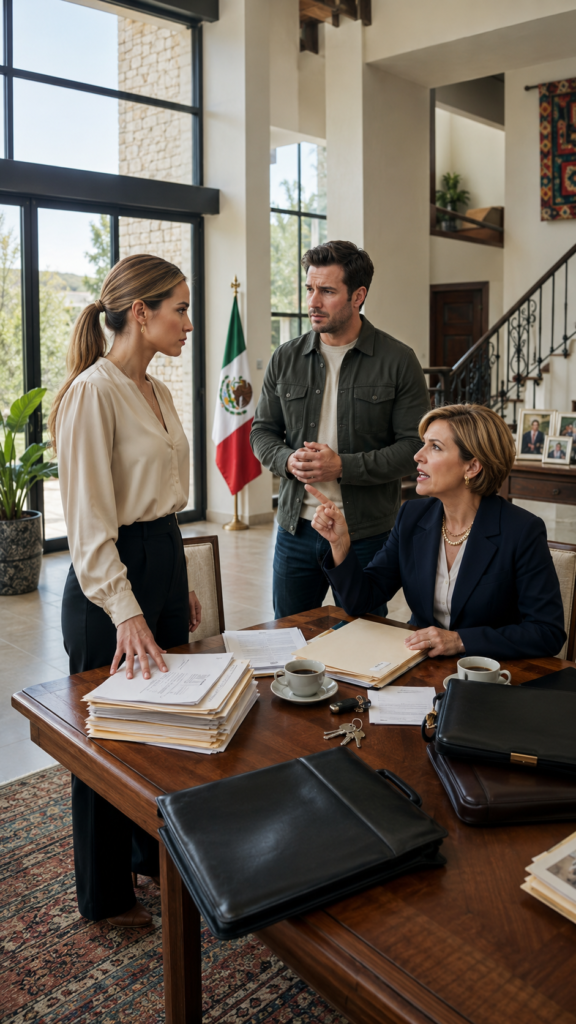
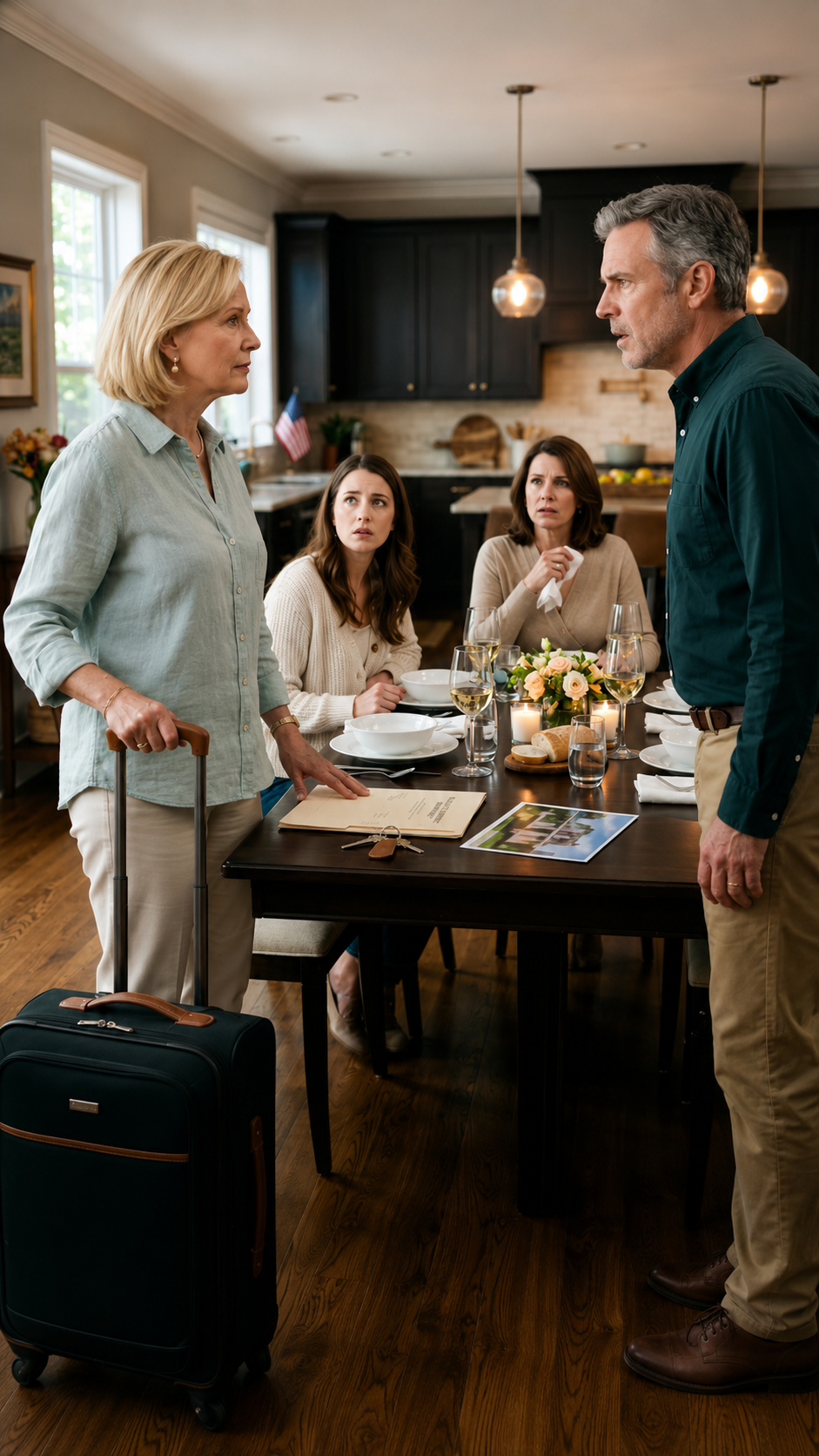
Julián, her husband, leaned against the bar with a hardened expression. Next to him, Doña Rebeca, his mother, held a cup of tea as if she were on a pleasant visit, not in the midst of a threat.
The woman had arrived from Querétaro two days earlier, unannounced.
From the moment she entered the apartment, she hadn’t stopped spewing venomous comments.
“A married woman doesn’t need to flaunt titles.”
“Doctors don’t change diapers.”
“Your husband looks bad while you play at being important.”
Mariana had remained silent out of exhaustion.
Not because she accepted it.
But because she had spent weeks sleeping four hours, correcting chapters, preparing answers for the committee, and trying not to break before the big day.
Yet that night, when she heard Julián and Rebeca whispering in the kitchen, she understood it was more than just disdain.
It was a plan.
"You’re not going tomorrow," Rebeca said, her voice calm. "Enough of embarrassing this family."
Mariana set the glass down on the bar.
"Tomorrow I’m defending my thesis. I worked eight years for this. Neither you nor anyone else will take that from me."
Julián let out a dry laugh.
“Do you hear how she talks, Mom? As if she were better than us.”
Mariana looked at him with a sadness that hurt more than anger.
That man had been there for her first publication, her first conference, during her miserable scholarship nights and cheap coffee. She thought he was proud of her.
Now it was clear: he had only waited for her to tire out so he could belittle her.
“I’m not going to argue,” she said, trying to get past him.
She barely took two steps.
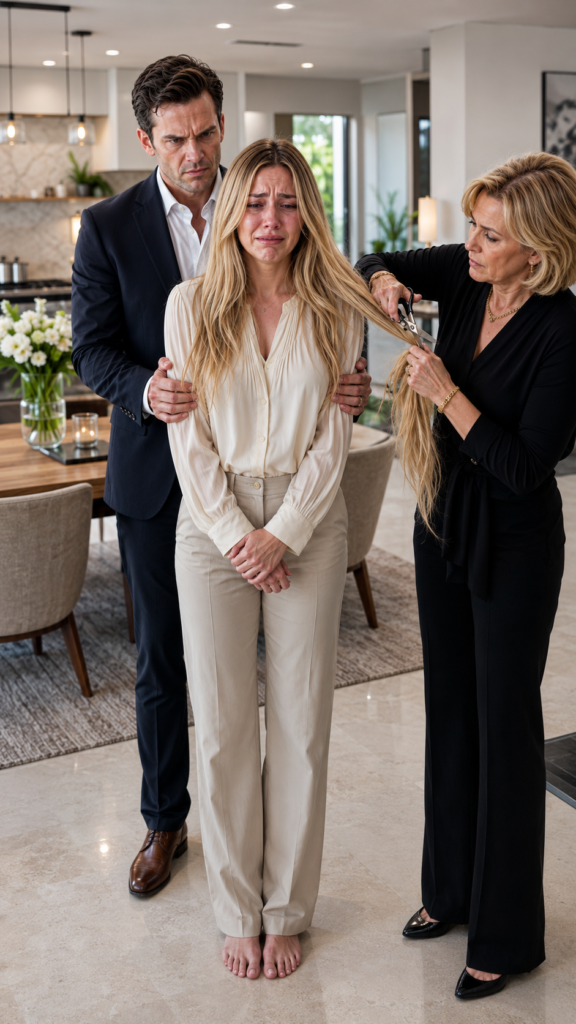
Julián grabbed her arms with such force that his fingers dug into her skin.
“Let go of me,” Mariana demanded.
But he wouldn’t let her go.
Then she saw Rebeca open the drawer.
She pulled out a large pair of kitchen scissors.
Mariana felt her body go cold.
“Don’t you dare.”
The cold metal brushed against her nape.
The first lock fell to the floor.
Mariana screamed.
Rebeca whispered in her ear, slowly, with a cruelty that felt rehearsed.
“Let’s see if this helps you understand your place. Decent women belong at home, not in a university full of men.”
Another lock fell.
Then another.
Julián held her against the bar as she kicked, cried, begged, and cursed. Rebeca cut with no hurry, leaving long parts, almost bald spots, as if she wanted to manufacture a visible shame.
“No jury will take you seriously like this,” Julián said. “Tomorrow you stay here.”
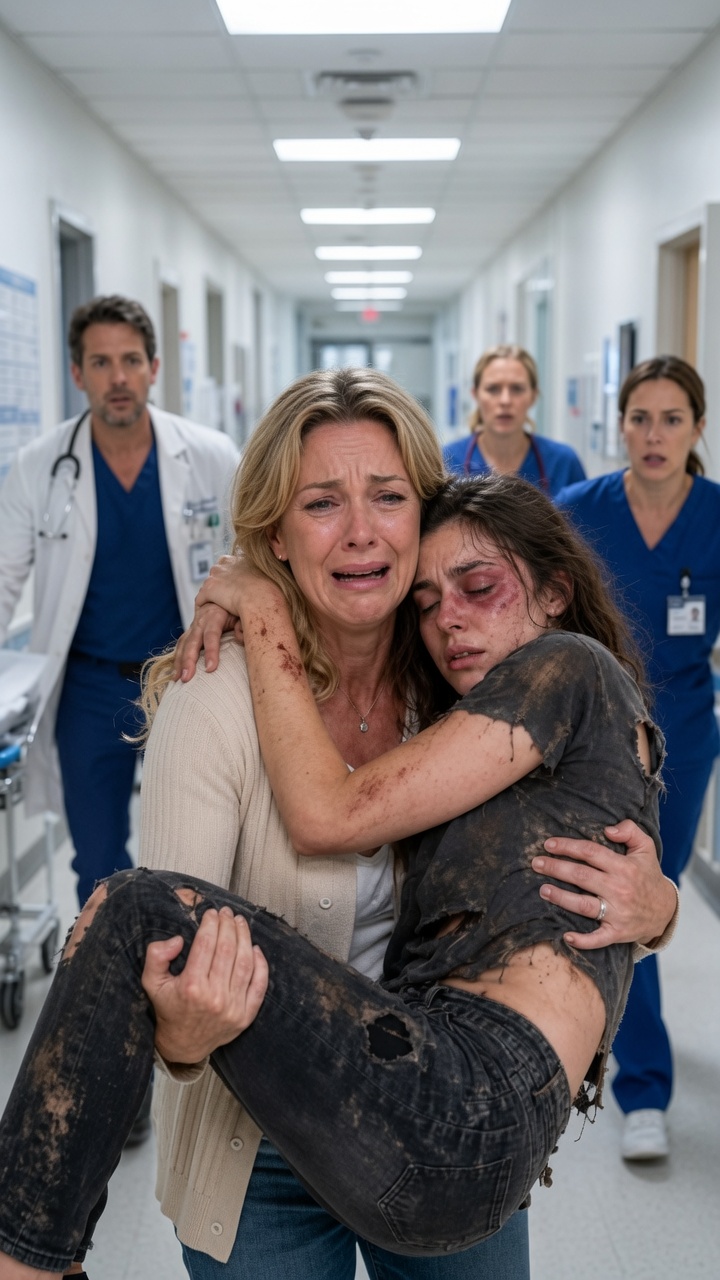
When they let her go, Mariana fell to her knees.
The floor was covered in black hair.
Her thesis remained untouched on the table.
She was not.
She ran to the bathroom, locked the door, and looked in the mirror.
Her head was a wreck.
Her eyes, red.
Her mouth, trembling.
For a few minutes, she cried silently.
Then she breathed as best as she could, ordered a taxi through an app, stuffed her papers into a backpack, and left without looking back.
Julián shouted that she was making a fool of herself.
Rebeca said that no broken woman could win anything.
Mariana descended the stairs with her head covered by a hoodie, got into the taxi, and went to a cheap hotel near Tlalpan.
She slept barely three hours.
Before dawn, she asked for scissors at the reception and tried to fix the impossible in front of a stained mirror.
Then she put on a black blazer, tucked her USB drives away, hugged her thesis, and walked toward Ciudad Universitaria without knowing that that morning, she wouldn’t just defend her doctorate.
She would also uncover a betrayal that no one in that room could believe.
PART 2
The morning was cold, one of those that in Ciudad Universitaria makes the air seem cleaner than normal.
Mariana crossed the plaza with her backpack slung over her shoulder and a scarf covering her head. She walked straight, but inside she was at war.
Every step reminded her of the scissors.
Every metallic noise from a door took her back to the kitchen.
Every accidental glance made her think everyone could see what they had done to her.
In the bathroom of the graduate building, a student named Paola recognized her.
“Professor Mariana… are you okay?”
Mariana tried to smile.
She couldn’t.
Paola stared at the misplaced scarf, the uneven locks escaping from the sides, and the swollen eyes of the woman who months earlier had convinced her not to drop out of the master’s program.
Without saying more, Paola removed an elegant scarf from her neck.
“Here. This one looks better on you. You helped me when I was falling apart. Now it’s my turn to help you.”
Mariana wanted to refuse, but her hands trembled.
She accepted.
That small gesture was like a chair in the middle of a fire.
At 8:14, her phone vibrated.
It was Julián.
“Come back. We can still fix this.”
Then another message.
“My mom got upset, but you provoked her.”
And then the worst.
“If you show up like this, they’re going to think you’re crazy. No one respects a woman who looks destroyed.”
Mariana turned off her phone.
They had already tried to take her hair, her calm, and the night.
She wouldn’t give them her voice too.
When she entered the small auditorium, her thesis advisor, Dr. Valeria Solís, froze.
“Mariana… what happened to you?”
The question shattered something.
Mariana took a deep breath.
“My husband held me while his mother cut my hair so I wouldn’t come.”
Dr. Solís closed her eyes for a moment.
When she opened them, there was no surprise left on her face.
There was a cold fury.
“We can postpone the defense. No one can demand this from you after an assault.”
Mariana shook her head.
“If I don’t go in today, they win. And I’m not going to gift them eight years of my life.”
The doctor took her shoulders.
“Then you go in. Defend your work. And when you’re done, we’re going to the Public Ministry. You’re not alone, do you hear me?”
At 8:55, the committee was ready.
Dr. Barragán was there, famous for tearing apart theses with one question.
Dr. Samira Haddad, respected and feared alike.
There were also researchers, students, colleagues, and some relatives of other presenters who had stayed to watch.
Mariana didn’t want to look up.
She just wanted to reach the microphone before fear climbed up her throat.
But then she saw him.
In the front row, standing, was her father.
Don Esteban Larios.
He wore a gray suit, his face serious, and his eyes fixed on her.
Mariana felt the air leave her.
They hadn’t spoken in nearly three years.
The last time they had a horrible fight. He told her that marrying Julián was shrinking herself to fit into a life that didn’t deserve her. She responded that she was tired of him acting like the owner of her destiny.
Since then, silence.
No birthdays.
No Christmas.
No calls.
And there he was.
Mariana swallowed hard.
Don Esteban didn’t smile. He didn’t make a scene. He didn’t open his arms.
He simply stood up with a solemnity that made the whole room fall silent.
Then Dr. Solís stood up.
Then Paola.
Then Dr. Haddad.
Even Dr. Barragán stood up.
It wasn’t pity.
It was respect.
Mariana pressed her thesis against her chest and understood that, though they had tried to make her enter with her head down, that room was receiving her standing tall.
She began her defense with a hoarse voice.
At first, one word broke.
Then another came out more firmly.
By the third slide, she was herself again.
She explained her methodology, defended her files, connected data, answered objections, and held the committee’s gaze as if each question were a stone she knew how to turn into a step.
Dr. Barragán interrupted her three times.
She answered all three.
Dr. Haddad asked her to justify a theoretical decision that few dared to touch.
Mariana did so with such clarity that several students began to take notes.
Each slide was a blow against the kitchen.
Each answer was a lock that began to grow back inside.
When she finished, the committee requested a private deliberation.
Mariana stepped out into the hallway with cold hands.
Dr. Solís hugged her.
Paola squeezed her fingers.
Then Don Esteban approached.
“Mariana,” he said softly. “Julián called me last night.”
She felt a void in her stomach.
“To say what?”
“That you had lost your mind. That you were dangerous. That they needed to prevent you from making a public embarrassment.”
Mariana closed her eyes.
“Did you believe him?”
Don Esteban shook his head.
“No. It sounded too rehearsed. Like a guy setting up his alibi before someone asked him anything.”
She didn’t say a word.
“Then his mother called me,” he continued. “Crying. Saying you were aggressive, that you had threatened them, and that they needed my help to cancel your defense.”
Mariana felt nauseous.
“Your help?”
Don Esteban opened a portfolio and pulled out a folder.
“They wanted me to sign a letter for the academic committee.”
Mariana took the papers.
There it was.
A letter addressed to the committee.
It stated that Mariana suffered from emotional instability, that her family was worried about her behavior, and they recommended suspending the defense for her own good.
But the worst part wasn’t that.
The worst part was in a chain of emails that Julián had sent by mistake.
Rebeca had written:
“With her hair like that, she won’t dare.”
Julián replied:
“If she goes in, my father-in-law must help sink her.”
Rebeca added:
“Make her look crazy. No one believes a disheveled and crying woman.”
Mariana stopped reading.
Not because she couldn’t.
But because she had understood everything.
They didn’t just want to humiliate her.
They wanted to destroy her credibility.
They wanted the world to think her pain was madness.
Dr. Solís took a copy and clenched her jaw.
“This is domestic violence, assault, threats, defamation, and attempted professional sabotage.”
Don Esteban lowered his gaze.
“I should have been here sooner, daughter.”
Mariana looked at him for a long time.
There was too much history between them.
Too many words said with pride.
Too many years without seeking each other.
"Yes," she replied. "You should have."
Don Esteban didn’t defend himself.
He didn’t make excuses.
He simply nodded.
And that silence, for the first time, didn’t sound like pride.
It sounded like regret.
The door to the auditorium opened.
Everyone returned inside.
Mariana walked back in with her thesis in one hand and the folder of evidence in the other.
Dr. Barragán adjusted his glasses.
"Candidate Mariana Larios has successfully defended an outstanding doctoral thesis."
The auditorium fell silent.
"The committee's decision is unanimous. Approved with honors and recommendation for the annual research award."
For one second, Mariana didn’t understand.
Then the applause came.
First soft.
Then huge.
Someone said:
“Doctor.”
Another voice repeated it.
“Dr. Larios.”
And then the entire room seemed to fill with that word.
Doctor.
Mariana had won.
With her head wounded.
With her heart trembling.
With the night clinging to her skin.
But she had won.
Then, at the side entrance, Julián appeared.
He looked pale, disheveled, with his shirt buttoned wrong. Behind him entered Doña Rebeca, made up as if she were going to an elegant mass.
Julián scanned the room.
He looked at the applause.
He looked at his wife turned doctor in front of everyone.
And for the first time, he didn’t know where to hide his face.
"Mariana," he said, stepping forward. "Please, we need to talk."
Don Esteban stepped in front of him.
“Don’t come near.”
Julián tried to smile.
“Sir, you don’t understand. It was a family problem. My mom got upset, that’s all.”
Mariana walked toward him.
She didn’t shout.
She didn’t cry.
She didn’t look down.
“Your mother cut my hair,” she said. “And you held me so she could do it.”
The room fell silent.
Julián opened his mouth, but nothing came out.
“Then they tried to get my father to sign a letter to make me appear unstable before the committee.”
Dr. Solís lifted the folder.
“We have emails, messages, and witnesses.”
Rebeca stepped forward, red with rage.
“How shameful! A wife doesn’t expose her husband like this in public.”
Mariana looked at her with a calm that hurt.
“No. A wife doesn’t. But a free woman does report those who violate her.”
Rebeca froze.
University security approached. Dr. Solís asked that they not let anyone come close. Don Esteban called a lawyer, but this time not to protect appearances, but to protect his daughter.
That same afternoon, Mariana went to the Public Ministry.
She brought the messages, the emails, the hotel receipt, the testimony of the building’s guard, and photos of her cut hair.
Julián called her 27 times.
She didn’t answer any.
Doña Rebeca sent voice messages crying, saying everything had gotten out of control.
Mariana didn’t respond either.
Because some apologies don’t arise from regret, but from fear of facing the consequences.
Two weeks later, Mariana filed for divorce.
The university opened an investigation for the attempt to interfere with her doctoral defense. Julián lost his position at a firm where he boasted of being a man of values. Rebeca had to testify before a lawyer as to why she had used scissors to humiliate her daughter-in-law.
And the scandal, of course, reached the family.
Aunts, cousins, neighbors.
Some said Mariana exaggerated.
Others said finally someone had put a stop to it.
On Facebook, the story became a conversation in women’s groups, among students, mothers, and professionals tired of hearing that growing up is betraying family.
Months later, Mariana’s hair began to grow unevenly.
Sometimes she wore scarves.
Sometimes hats.
Sometimes she went out with her hair just as it was.
Every morning, when she looked in the mirror, she remembered that night.
But she no longer saw defeat.
She saw proof.
Proof that they tried to break her, and they couldn’t.
The day she officially received her diploma, Don Esteban was in the front row.
He didn’t try to hug her without permission.
He just stood up and applauded, his eyes filled with a guilt that no longer asked for easy forgiveness, but for an opportunity.
After the ceremony, Mariana approached.
“I don’t know if we can fix everything,” she said.
Don Esteban nodded.
“I know. But I can learn to be there, if you still let me.”
Mariana didn’t respond immediately.
She looked at her diploma.
She felt the warm air of the afternoon.
And she thought of the woman who one night left her home with a shattered head and a backpack full of papers.
That woman thought she was going alone.
But she wasn’t alone.
She was accompanied by all the versions of herself that never gave up.
And from that day on, Mariana understood something that many Mexican women later commented with rage, pain, and pride:
when someone tries to clip your wings so you obey, perhaps the only thing they achieve is to teach you to fly without asking for permission.