PART 1
—If you came to cry for money, Valeria, you’re on the wrong floor. Today we only sign the end.
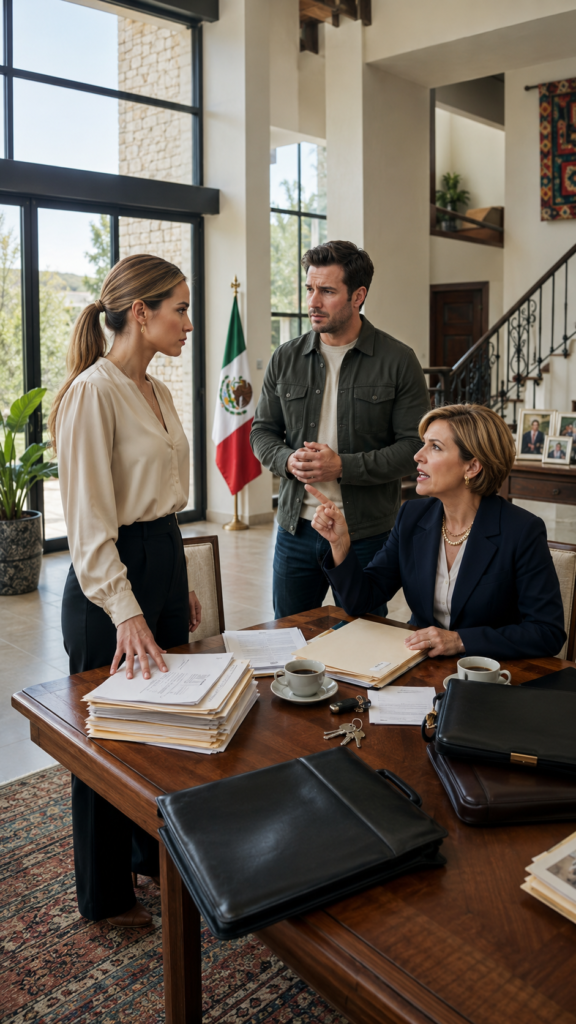
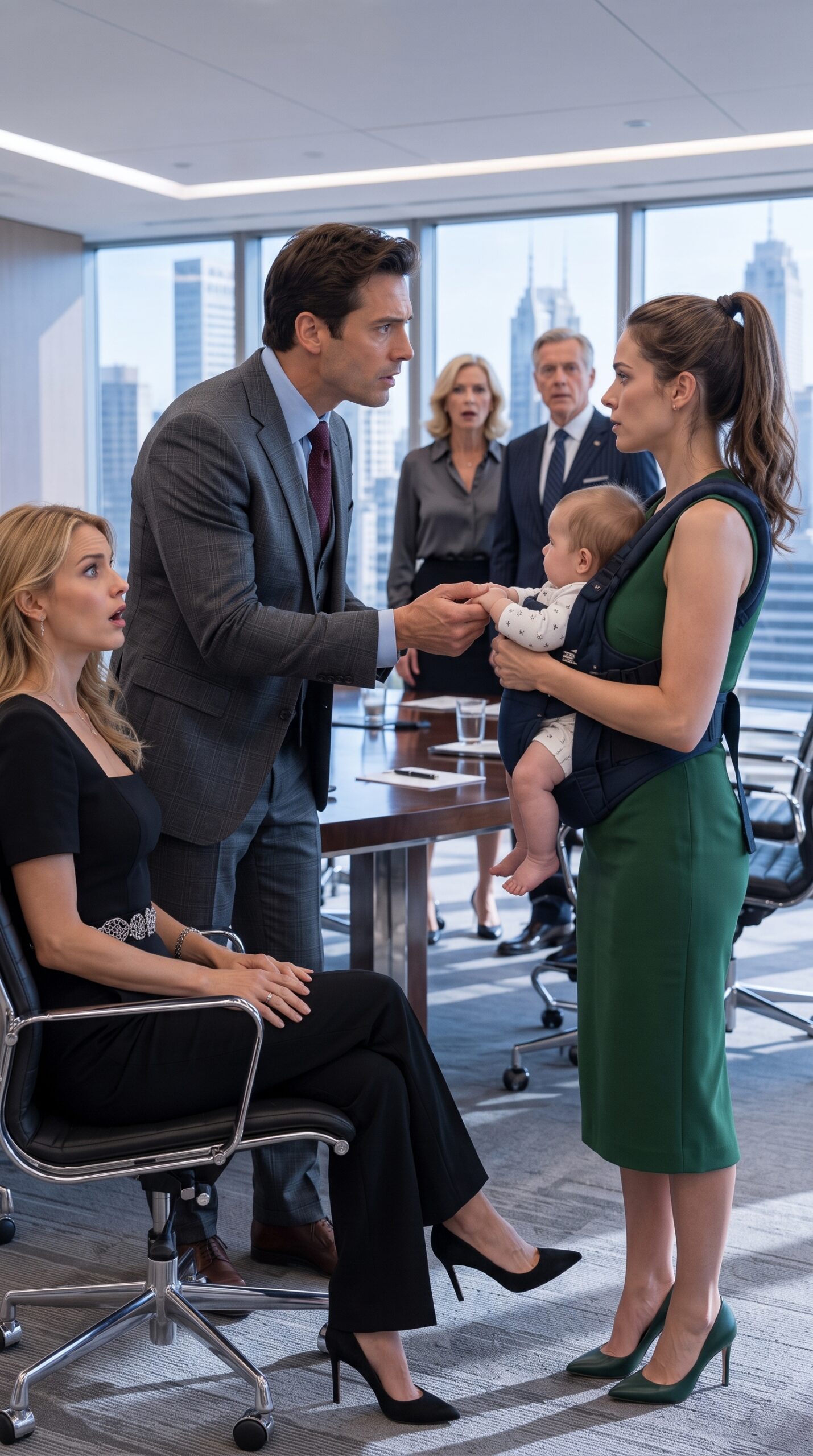
Rodrigo Aranda's voice filled the private room on the 38th floor of a tower in Reforma, facing the Angel, as if even the windows had to obey him.
He wore a gray suit, a black tie, an expensive watch, and that cold businessman face that had already learned not to look at anyone for too long.
Valeria stood by the door, drenched from the rain, with a sleeping baby against her chest. The girl was wrapped in a green blanket, one of those sold outside the subway, because Valeria could no longer afford luxuries, not even to choose colors.
The lawyers stopped talking.
A secretary looked her up and down, as if her wet sneakers were an affront to the Italian marble.
Lawyer Castañeda, Rodrigo's attorney, pushed the documents towards her.
—Mrs. Valeria, this meeting isn’t for drama. If you wish to claim something, do it through the proper channels.
Valeria let out a tired laugh.
—Proper channels? Like the emails that bounced back? Like the blocked calls? Or like when I came here eight months pregnant and security kicked me out through the service elevator?
Rodrigo raised his gaze.
—What are you talking about?
No one said a word.
The baby stirred slightly, gripping Valeria's cheap blouse with her tiny hand.
Valeria took a deep breath, swallowing months of humiliation.
—I didn’t come to ask you for money, Rodrigo. I came for you to see your daughter before you sign like we never existed.
Silence fell like a blow.
Rodrigo frowned.
—My daughter?
Valeria pushed aside the blanket.
The baby opened her eyes.
Rodrigo dropped the pen.
The girl had the same almond-shaped eyes, the same slightly raised right eyebrow, and a small mole under her left eyelid. This wasn’t a resemblance people invent out of obligation. It was a truth standing in the middle of the room.
—It can’t be… —he said, almost voiceless.
Valeria pulled out a battered folder from her bag. The corners were damp, but the papers remained legible: birth certificate, receipts from Hospital Balbuena, prenatal studies, printed messages, email captures, and a DNA test she paid for by pawning the earrings her grandmother left her.
—Her name is Lucía. She’s five months old. Born on January 12, at 4:27 in the morning. I was alone, Rodrigo. Completely alone.
Rodrigo looked at the documents as if they were a sentence.
—I didn’t know.
—I already know that —Valeria replied—. The question is who made sure you didn’t know.
The sentence made the secretary lower her gaze.
Rodrigo stood up.
—Everyone out.
—Rodrigo, that’s not prudent —Castañeda said.
—I said out.
The lawyers hurried out. The secretary closed the door slowly, avoiding looking at Valeria.
Rodrigo took a step toward the baby, but Valeria stepped back.
—From there.
He obeyed.
Lucía looked at him seriously, with that strange calm of babies that seems more like judgment than innocence.
—She has my eyes —Rodrigo murmured.
—And my sleepless nights, my debts, and my trips to the pharmacy counting coins.
He lowered his head.
—Valeria, if I had known...
The door opened without a knock.
Don Esteban Aranda entered with his silver cane, immaculate suit, and slicked-back white hair. He didn’t seem surprised to see the baby.
He just said:
—I warned you not to bring her.
Rodrigo slowly turned around.
—you knew?
Don Esteban placed a yellow envelope on the table.
—I knew enough.
Valeria felt her hands freeze when she saw the name written on the front.
It was her mother’s handwriting.
Dead for three years.
PART 2
Valeria didn’t take the envelope.
She tightened her grip on Lucía against her chest, as if the air in that room could tear the baby away from her.
—If that envelope has anything from my mom, it opens with my lawyer present —she said.
Don Esteban let out a joyless smile.
—Your mother was always good at raising dramatic women.
Rodrigo stepped forward.
—Don’t talk to her like that.
Valeria glanced at him sideways.
In four years of relationship and two years of marriage, she had never seen him confront his father that way. Rodrigo could buy buildings, close deals in Querétaro, and send 200 employees with a call, but in front of Don Esteban, he became a child waiting for permission to breathe.
Valeria called lawyer Mariela Ríos, a family attorney who took her case even though Valeria paid her in tiny installments, sometimes late.
—Tell me you didn’t sign anything —Mariela replied.
—I’m at Aranda Capital. Don Esteban has an envelope from my mom.
There was a brief silence.
—Put me on speaker. Nobody touches that envelope without me listening to everything.
Rodrigo pulled up a chair.
Valeria hesitated, but sat down because Lucía began to whimper softly.
Don Esteban pushed the envelope with two fingers.
—Your mother gave it to me before she died.
—Why would my mom give you anything? —Valeria asked.
—Because she knew my son was going to repeat history.
Rodrigo clenched his fists.
—Speak clearly, Dad.
Valeria opened the envelope with trembling hands.
Inside was a folded letter, four old photos, and a yellowed notarized copy. In the first photo, her mom, Irene, was young, in a nurse's uniform. Next to her stood an elegant, very thin woman with sad eyes, holding a child around six years old.
That child was Rodrigo.
Valeria lifted her gaze.
—Who is she?
Rodrigo stood frozen, as if someone had opened a tomb within his memory.
—My mom… Mariana.
Don Esteban hardened his jaw.
Valeria began to read.
“My girl, if you ever have this letter in your hands, forgive me. I remained silent thinking I was protecting you, but silences also have teeth. They bite late, but they bite hard.”
Valeria's voice broke.
“Before you met Rodrigo, I already knew the Arandas. I worked as a private nurse for Mariana, his mother, when he was a child. Rodrigo was made to believe that Mariana abandoned him for another man, but that was never true.”
Rodrigo stepped back.
—No...
Valeria continued reading, even though each word hurt.
“Mariana wanted to take her son from a house where everything was bought, even smiles. Don Esteban accused her of being unstable, paid doctors, hired lawyers, and blocked her letters. I kept copies because she begged me that one day Rodrigo would know she never stopped loving him.”
Rodrigo slammed his palm on the table.
—You told me my mom left because she didn’t love me!
Don Esteban didn’t blink.
—I told you what was necessary for you to move on.
—You left me broken my whole life!
Lucía began to cry louder.
Valeria adjusted her on her shoulder, murmuring “there, my life, it’s okay,” but the baby’s wailing filled the room as if she too were demanding.
Mariela spoke from the phone.
—Valeria, continue. I need to know if she mentions names, witnesses, or documents.
Valeria returned to the letter.
“If the Arandas ever try to make you disappear like they did with Mariana, seek Amparo Salcedo. She has the blue box. No one in that family knows who she really is, except Esteban. Amparo is Mariana’s daughter. Rodrigo has a sister.”
Rodrigo turned pale.
—A sister?
Don Esteban advanced toward Valeria.
—Give me that letter.
Rodrigo stepped in.
—Don’t you dare.
The old man looked at him with disdain.
—You have no idea what you’re doing.
—For the first time, I do.
Valeria tucked the papers into her bag.
Mariela was firm.
—Valeria, get out of there. Don’t accept a car, escort, or help from anyone. Send me your live location. Now.
Rodrigo looked at her with guilt.
—Let me take you home.
—No —she replied—. You start by figuring out who you are without your dad dictating your memories.
He didn’t insist.
Valeria went down to the lobby with Lucía in her arms. Outside, the rain pounded Reforma, and the car lights shattered on the wet pavement.
She took a rideshare taxi and returned to her apartment in the Algarín neighborhood, a small place with peeling walls, a borrowed crib, and a neighbor who sometimes left soup at her door without asking questions.
Upon arrival, she laid Lucía down and checked Mariela’s message.
It was an address.
It was five streets away.
Below was a photo.
Amparo Salcedo.
Valeria recognized her instantly.
It was the lady from the pharmacy who two months earlier had gifted her a can of formula when her card was declined in front of the entire line.
At that moment, there was a knock at the door.
Three soft knocks.
Valeria looked through the peephole.
Amparo was outside, holding a blue box to her chest.
—Your mom said you would come when you could no longer carry so many lies —the woman said.
Valeria opened just a crack, with the chain on.
Amparo had her hair tied back, a black jacket, and the same eyes as Rodrigo, but more tired.
—Who are you? —Valeria asked.
—I’m Mariana’s daughter. I’m Rodrigo’s sister. And that girl is also my blood.
The word blood sounded different.
Not as a threat.
As an old debt seeking restitution.
Valeria undid the chain.
Amparo entered and placed the blue box on the table. Inside were letters, recordings, medical prescriptions, transfer receipts, manipulated psychological reports, and photos of Mariana carrying Rodrigo in a garden in Tepoztlán.
—My mom died eight years ago —Amparo said—. She died believing Rodrigo hated her.
Valeria felt a lump in her throat.
—He believed she abandoned him.
—That’s what Esteban wanted. First, he took his wife. Then he tried to take you. And now he wanted to erase Lucía before she could say dad.
The next day, Mariela arranged a meeting in a simple café in Narvarte. No private rooms, no bodyguards, no waiters pretending not to listen. Just coffee, sweet bread, and wooden tables.
Rodrigo arrived alone.
Without a suit. Without a watch. With two days of stubble and deep dark circles under his eyes.
When he saw Amparo, he froze.
She stood up.
—Hello, brother.
Rodrigo opened his mouth, but nothing came out.
Amparo handed him a letter.
—Your mom wrote this when you turned eleven.
Rodrigo took it with trembling hands. He read in silence. Valeria saw how something broke inside him without making a sound.
It wasn’t an immediate cry. First, he remained still, pressing the paper against his chest, as if he wanted to imprint those words in the exact place where his father had left a void.
—I waited for her —he finally said—. I waited for years. Really, years.
Amparo lowered her head.
—She also waited for you.
No one spoke for a while.
Sometimes justice doesn’t arrive with sirens or judges banging the table. Sometimes it arrives in an old letter that shows a man that his entire childhood was a well-managed lie.
Rodrigo looked at Valeria.
—My dad did the same to me that he wanted to do to Lucía.
—Yes —she said—. But you also closed too many doors. I knocked until I was tired. I called, wrote, went to your company, endured humiliations. You chose to believe I was a problem before asking if I was okay.
Rodrigo nodded.
—I know. And I’m not here to ask for forgiveness as if that would erase five months of abandonment.
He pulled out a folder.
Mariela checked it first.
—What is this?
—I canceled the divorce papers. Those documents were prepared with hidden information, family pressure, and abuse of power. I want to start a new process under Valeria’s conditions.
Valeria looked at him suspiciously.
—What conditions?
—Voluntary acknowledgment of paternity. Immediate medical insurance for Lucía. Provisional alimony. Secured educational fund. Supervised visits. And a notarial restriction so my father can’t approach you or use company personnel against you.
Mariela raised an eyebrow.
—That sounds nice on paper. In real life, it gets tested.
Rodrigo looked at Lucía, who was in the stroller sucking on her sleeve.
—I just want a chance to be her dad without turning it into a war.
Valeria didn’t respond quickly.
She had spent too many nights hating him. Imagining him dining in Polanco while she counted diapers, begged for credit at the pharmacy, and swallowed the fear of not being able to pay rent.
But she had also just discovered that Don Esteban had built a cage around his son with money, lawyers, bodyguards, and the oldest wounds of his childhood.
That didn’t make Rodrigo innocent.
But it explained part of the monster he had been taught to be.
—You’ll start with one hour on Saturdays —Valeria said—. In a public place. With me present. If you fail once, everything stops.
—I accept.
—No ridiculous statements about “family unity.” No photos. No using my daughter to clean your name.
Rodrigo let out a sad smile.
—I hate those statements, even if it sounds late to say so.
—Your family lives off them.
—Not anymore.
Mariela looked up.
—What does that mean?
Rodrigo took a deep breath.
—Last night I called a board meeting. I presented evidence that my father used company personnel to block calls, intercept emails, prevent Valeria's entry, and expedite a divorce without telling me I had a daughter. I also requested an audit of documents related to my mother.
Amparo looked at him, surprised.
—That’s going to cost you a lot.
Rodrigo clutched Mariana’s letter.
—Obeying him already cost me more.
The following weeks were a scandal.
Not one of those cheap gossip stories on social media, although many tried to turn it into that. It was a legal investigation that began to uncover things buried for years.
It was proven that Don Esteban ordered security to deny Valeria access when she was pregnant. Internal emails surfaced calling her a “reputational risk.” There were also instructions to block her number, return letters, and notify the lawyer before Rodrigo if she showed up again.
Then came the documents about Mariana.
Manipulated medical reports. Returned letters. Payments to specialists who declared her unstable without examining her. Contracts signed to make a mother seem dangerous for wanting to reclaim her son.
Don Esteban didn’t go to jail immediately. In Mexico, people with too much money rarely fall that fast.
But he lost something that mattered to him more than any sentence: he lost control.
The board removed him. The partners distanced themselves. Rodrigo signed before a notary that no decisions regarding Lucía would go through the Aranda family.
The first visit was in Parque Hundido.
Rodrigo arrived twenty minutes early, with a new diaper bag, three incorrectly sized bottles, and a huge bear that didn’t even fit on the bench.
Valeria looked at him.
—That bear is bigger than the baby.
—I messed up, didn’t I?
—A lot.
—I’m learning.
Lucía watched him seriously.
Rodrigo didn’t try to hold her until Valeria nodded. When he finally took her, he did so with such care that it seemed he was holding a fragile promise.
—Hello, Lucía —he whispered—. I’m Rodrigo.
Valeria corrected him gently.
—You’re her dad.
He swallowed hard.
—I’m your dad.
The baby touched his beard with her fingers.
And Rodrigo cried.
It wasn’t an elegant cry of a powerful man. It was a clumsy, silent cry of someone who understood that life wasn’t giving back what was lost. It was just lending him an opportunity.
Months passed.
Valeria didn’t return to his arms as if nothing had happened. Nor did she use Lucía as punishment. She set limits. Demanded therapy. Asked for consistency. There were arguments, accusations, uncomfortable days, and apologies that didn’t always come complete.
Rodrigo learned to change diapers, warm milk, stay awake when Lucía had a fever, and not disappear when something scared him.
Amparo became part of the little girl’s life. Mariela too, although she swore she was just the lawyer and then showed up with clothes “because they were on sale.”
One year later, Lucía took her first steps in Amparo's house, during a meal with mole, red rice, warm tortillas, and soft music.
Rodrigo sat on the floor, without a cell phone.
Lucía walked towards him.
He opened his arms but didn’t move.
When the little girl arrived, she grabbed his shirt and said one small word:
—Dad.
Rodrigo closed his eyes.
Valeria stood still, her heart filled with something that wasn’t forgetfulness, but rather rest.
That afternoon, while Lucía slept, Rodrigo approached.
—I don’t know if you’ll ever be able to trust me like before.
Valeria glanced at the blue box on the table. There were Mariana’s letters, Irene’s photos, and the truth that arrived late but had arrived.
—I don’t want to trust like before —she said—. Before, I trusted with my eyes closed. Now I want to trust by looking everything in the face.
Rodrigo nodded.
—That’s fair.
And it was.
Because not all stories end with a wedding, a kiss, and pretty music. Some end with a mother who stops begging, a father who learns to stay, a daughter who won’t have to beg for love, and a powerful family discovering that no fortune buys what breaks when silence is used as a weapon.
Valeria entered that room believing she was going to lose her marriage.
But she left with something more important.
She left with her voice.
And that, neither the Arandas nor anyone else, would take from her again.