PART 1
When Doña Lupita called, crying, Marisol felt the world crashing down around her.
—Mija, Ernesto crashed. He’s in emergency. Get to the IMSS in Tlalnepantla, quick.
Marisol stumbled out of the house, her keys clumsily grasped, cellphone in one hand, and her heart pounding in her throat. She drove with shaky hands gripping the wheel, praying softly, begging that her husband was still alive, even though their marriage had been gasping for air for years.
Doña Lupita was more than just her mother-in-law.
For eight years, she had called her “daughter.” She’d saved mole for her on Sundays, defended her when Ernesto got heavy-handed, and brought her sweet bread when she looked sad.
When Marisol couldn’t get pregnant, Doña Lupita never pressured her. She never asked, “When will it happen?” Instead, she squeezed Marisol’s hand and said:
—There are pains a woman shouldn’t have to carry alone, mija.
Marisol believed that phrase was love.
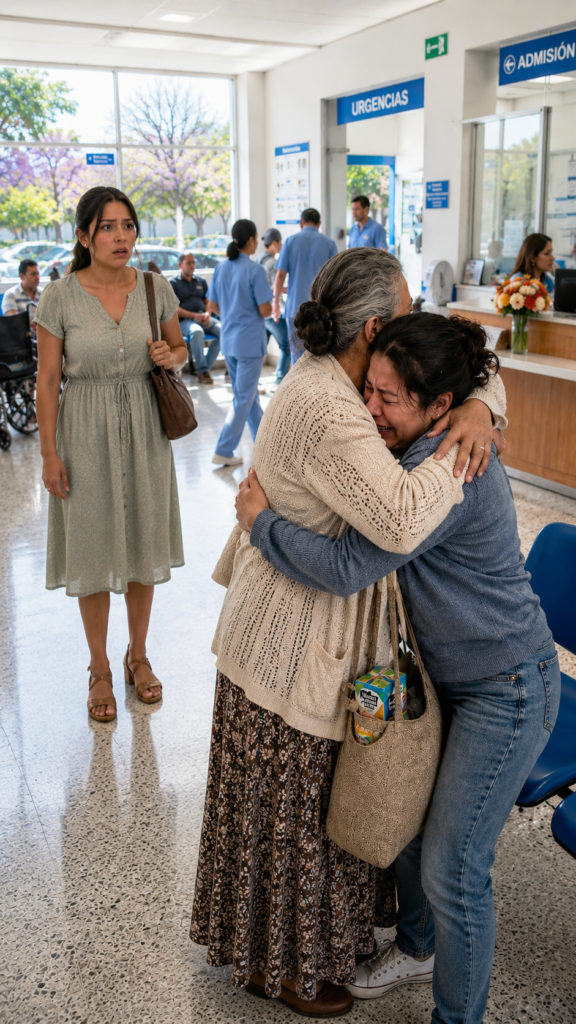
So when she arrived at the hospital and saw her sitting on a plastic bench, pale but calm, she rushed toward her, seeking an embrace.
But before she reached her, another woman entered.
Disheveled, with a wrinkled blouse and swollen eyes, she approached the emergency desk, asking for Ernesto Salgado with a desperation that didn’t seem to belong to someone just acquainted.
Marisol froze.
She thought Doña Lupita would stand up to ask who she was, to put her in her place, to defend her like she always said she would if someone hurt “her daughter.”
But Doña Lupita didn’t do that.
She got up, walked toward that woman, and embraced her first.
Embraced her like you embrace family.
The woman broke down in her arms.
—I was told Ernesto crashed —she sobbed—. I didn’t know who to call.
Marisol felt something snap inside her, but she still wanted to cling to a foolish explanation. A cousin. An employee. A friend.
Then the woman turned to her.
—Sorry… are you Marisol?
The question tasted like betrayal.
—I am his wife —Marisol replied, her voice dry.
The other woman looked down.
—I’m Daniela. Ernesto told me you two were separated.
Separated.
Marisol had spent that very morning washing Ernesto’s shirts and brewing coffee for two.
They had been married for eight years. They slept in the same bed. They fought, sure. They ignored each other, too. But they were not separated.
Daniela covered her mouth, embarrassed.
—We’ve been together for a year and a half.
A year and a half.
A year and a half ago, Marisol had cared for Ernesto after gallbladder surgery. She’d changed his dressings, made him broth, rubbed his back when he couldn’t sleep.
And while she healed his body, he broke her life.
Marisol turned to Doña Lupita.
—Did you know?
Doña Lupita didn’t lower her head.
That was what hurt the most.
Before she could respond, a little boy appeared behind Daniela. He looked about three years old. He wore a blue sweater, held a plastic car in his hand, and had a small bandage stuck to his forehead.
The boy looked down the hallway filled with stretchers, nurses, and screams.
Then he let go of Daniela’s hand.
He ran straight to Doña Lupita, clung to her legs, and said:
—Grandma.
Marisol felt the IMSS floor open up beneath her shoes.
Doña Lupita lifted him up with a familiarity that felt ancient. She adjusted his sweater, wiped his nose, and pulled out an apple juice with a straw from her bag.
She hadn’t looked for him.
She already knew where he was.
She had it ready.
Marisol looked at the boy. He had the same dark eyes as Ernesto. The same raised eyebrow. The same serious expression when something scared him.
—How long have you known? —Marisol asked.
Doña Lupita held the boy tight against her chest.
—Since he was born, Marisol.
Marisol.
Not mija.
Not daughter.
Marisol.
—You lied to me for three years?
Doña Lupita took a deep breath.
—I lied to keep this family from falling apart.
Daniela was crying against the wall, the boy was sipping his juice without understanding anything, and Marisol felt an awful embarrassment slicing through her chest: she had cried for eight years for not giving that family a grandchild, while that very family already had one hidden away.
—Why did you call me today? —she whispered—. If you could keep quiet all this time, why today?
Doña Lupita looked at her with dry, tired, almost hard eyes.
Then she put the boy in front of her, as if showing her a debt long overdue.
—Because I can’t handle him anymore, Marisol. You take him.
PART 2
Marisol didn’t understand at first.
She thought she had heard wrong. She thought the noise of the emergency room, the footsteps of orderlies, and the announcements over the loudspeaker had scrambled the words.
But no.
Doña Lupita repeated it softly, with the boy still in her arms.
—I’m old. I’m 68 years old. Santiago needs a mother, not a grandmother who tires easily climbing stairs.
Santiago.
That was the name of the boy who had been living just a few neighborhoods away from her house for three years, hidden in fake Thursdays, in clean lies, in visits that Doña Lupita called “going to see a friend.”
Marisol recalled all those Thursdays.
Doña Lupita would get ready early, put on cheap violet perfume, pack things in her bag, and say she was off to Azcapotzalco to play bingo with a friend.
Marisol never asked.
She thought it was nice that her mother-in-law had her own space.
Now she understood the ready juice, the animal cookies, the wet wipes she always carried even though there were no babies in the family.
—Santiago was in the car with Ernesto —Doña Lupita explained—. In the back, in his seat. The impact wasn’t severe, thank God. He got three stitches in the forehead. But when I saw the blood, when I heard him cry, I realized I can’t keep doing this.
Marisol looked at Daniela.
Daniela approached the boy, adjusted the bandage with trembling hands, and he said:
—Mom, it hurts.
Mom.
Not aunt.
Not ma’am.
Mom.
Then Doña Lupita turned her face as if that word didn’t exist.
Marisol felt rage, but not just toward Daniela.
Toward everyone.
—Is he your son? —she asked her.
Daniela shook her head, broken.
—not by blood.
The phrase fell like another bomb.
Santiago wasn’t Daniela’s child.
The truth emerged in pieces, the three of them sitting in a corner of emergency, beneath an old television showing a cartoon without sound.
Santiago’s mother was named Valeria. She had worked for a while at a car dealership where Ernesto handled paperwork. One drunken night of partying and cowardice ended in a pregnancy he chose to deny.
Valeria raised the baby alone for the first few months.
When Santiago was four months old, she died from a stroke in her sleep. Her sister called Ernesto because his name was on the hospital papers as the father.
Ernesto went to the wake, saw the baby, said he couldn’t take responsibility, and left as if he’d been asked to carry someone else’s furniture.
Doña Lupita was the one who took him in.
—I wasn’t going to leave my grandson in the hands of strangers —she said, with a dignity that no longer suited her well.
—And you could leave me as an idiot? —Marisol asked.
Doña Lupita pressed her lips together.
—If I had told you, you would have left Ernesto.
—Of course I would have left.
—That’s why I didn’t tell you. You held the house together. You kept him in check. You were the one making him look like a decent man.
That phrase sickened her more than any infidelity ever could.
Marisol then understood that they hadn’t protected her.
They had used her.
Doña Lupita didn’t hide Santiago to spare her feelings. She hid him to preserve the image of a clean family, so Ernesto wouldn’t lose his wife, home, and business, so he could have a good daughter-in-law waiting for the day another woman would be needed to care for the child.
Marisol stood up and walked toward the coffee machine.
She felt like vomiting.
For eight years, she had prayed for a child. She had bought pregnancy tests at pharmacies where they already recognized her. She had cried in restaurant bathrooms every time a sister-in-law announced another baby.
Ernesto would awkwardly hug her, uncomfortable, as if the pain were solely hers.
And while she blamed herself, he had a child.
One he didn’t want.
One his mother had hidden.
One that Daniela, the mistress, had raised better than any of them.
Because Daniela wasn’t innocent either.
She confessed that at first, she didn’t know Ernesto was married. But then she did. She had known for eight months and stayed with him anyway.
—I wanted to leave —Daniela said, crying—. But Santi was already sleeping with me. I made him lunch. I took him to kindergarten. When he had a fever, he looked for me. How could I leave him?
Marisol wanted to hate her completely.
She couldn’t.
Daniela had entered her life through a lie, yes. But the boy looked at her like a mother. With trust. With need. With that love that can’t be bought or demanded.
And there emerged the ugliest thought for Marisol.
She wanted him.
She wanted Santiago.
Not nobly, not at first.
She wanted him because she was tired of the void in her belly, of the comments at meals, of other people’s cribs, of the children’s parties where she was always “Aunt Marisol.”
She wanted him because the boy had her husband’s blood, the surname of the family that had closed so many doors on her, and a little face that seemed to beg for a home.
But above all, she wanted him because she needed all that pain to mean something.
When Ernesto emerged from observation, with a neck brace and a swollen face, Marisol no longer cried.
He tried to explain himself. He said it was a mix-up, that everything got out of control, that he never meant to hurt her.
Marisol didn’t yell at him.
That frightened him more.
—You will sign the divorce —she told him—. And you will sign the provisional custody of Santiago in my favor while the judge resolves the adoption.
Ernesto looked at her as if she were crazy.
—What?
—You don’t want him. You never wanted him. Your mom can’t anymore. Daniela has no papers. I’m still your wife and can request adoption for family integration if you consent.
Daniela turned white.
—No, Marisol… don’t do that.
But Marisol kept looking at Ernesto.
—I won’t fight you for the house. I won’t touch the workshop. I won’t tell your clients that you hid an orphaned child for three years. I’ll sign a clean agreement.
Ernesto understood quickly.
He always understood quickly when it came to saving his own skin.
Doña Lupita said nothing.
That was her last betrayal.
Daniela knelt before Marisol in the hallway.
—I raised him. He calls me mom. Please, don’t take him from me.
Marisol felt that plea tear something inside her.
But she didn’t stop.
—You knew Ernesto was married and stayed —she said with a coldness even she didn’t recognize—. Now don’t ask me for justice when you lived off the lie too.
Daniela let out a wail that turned heads throughout the hospital.
Santiago, confused, started to cry as well.
That night, not everything was resolved. No judge hands over a child like a blender. There were procedures, interviews from the DIF, hearings, papers, signatures, and supervised visits.
But Ernesto cooperated in everything.
Not out of love for Santiago.
Out of fear of losing what was his.
He signed consents, acknowledged emotional abandonment, accepted that Marisol had economic stability and an adequate home. Doña Lupita declared she could no longer care for him due to health. Daniela tried to fight, but legally she wasn’t a mother, wasn’t a wife, wasn’t a guardian.
She was the woman who stayed up late.
And that, on paper, weighed less than a signature.
The day Marisol went for Santiago, the boy clung to Daniela’s leg.
—Mom! Mom, no!
Daniela hugged him so tightly it seemed she would break.
—My love, go with Mom Mari for a bit, okay? Behave.
But her voice convinced no one.
Marisol picked up the boy. He kicked, cried, and hit her chest with his little hands.
She didn’t let go.
In the car, she gave him an apple juice, just like the one Doña Lupita always carried in her bag. Santiago rejected it at first. Then he took it between sobs, exhausted.
He fell asleep with his face stained with tears.
Marisol drove with trembling hands, just like the day of the accident.
Only now, the accident was her.
Eight months passed.
Santiago already lived in Marisol’s house, in a light blue-painted room, with new toys and a bed shaped like a car. He went to kindergarten, ate well, laughed with the neighbor’s dogs, and sometimes ran to Marisol's arms saying:
—Mommy Mari.
The first time he said it, she cried silently in the kitchen.
Doña Lupita saw him on Sunday afternoons. She no longer called Marisol daughter. Marisol no longer called her mother-in-law. They treated each other with cold courtesy, like two women sharing a rotten secret.
Ernesto visited when he remembered.
He almost never remembered.
Marisol allowed Daniela to see him once a month on a Saturday in a park in Naucalpan. Not because a judge forced her, but because every night she still heard the echo of Santiago shouting “Mom” in the hospital.
Daniela arrived with a dinosaur backpack, jelly, extra socks, and a sweater in case the weather changed.
Details of a mother.
A true mother, even though the birth certificate said otherwise.
Each goodbye was a small death.
Santiago cried less than before, but Daniela cried the same. She stood by the swings, watching how Marisol took him by the hand.
Marisol knew what she was doing.
And yet, she didn’t undo it.
Her sister told her she had saved a child from a family of cowards.
Her sister-in-law stopped talking to her. She said Marisol hadn’t rescued anyone, that she had used a divorce as a sales contract, that she had ripped a child from the only woman who would wake up at dawn for him.
Both were right.
That was the punishment.
Because some nights, when Santiago slept hugging his red car, Marisol looked at him and convinced herself that she had given him a clean house, a routine, a legal mother, an opportunity his father denied him.
And other nights she remembered his tiny hands clinging to Daniela’s leg.
She remembered his cry.
Mom.
Then Marisol understood the truth that hurt her the most: Doña Lupita wasn’t the only monster in this story.
She had also found a beautiful way to call love keeping what she wanted.
And even if Santiago grew up happy, even if someday he called her mom without a surname, even if the law said everything was in order, Marisol knew there would always be a question following her:
Did she give a mother to an abandoned child, or did she take the only one he already had to fill a void that was only hers?