PART 1
"Your grandmother already paid, but that doesn't mean she has to come with us."
Mateo Rivera heard that phrase from behind the kitchen door and felt the floorboards open up beneath his feet.
She was 18 years old and lived in Puebla with her parents, Arturo and Marcela, in a beautiful, tidy house, as cold as an empty doctor's office. Her father was a civil engineer. Her mother did the accounting for several companies. In that family, everything was measured: grades, manners, clothes, friendships, the future.
The only thing that was never measured was affection.
Mateo received that gift from his grandmother Elena, a 74-year-old woman who lived in Atlixco, in a house with cream-colored walls, bougainvillea in pots, and a kitchen that always smelled of cinnamon, Mexican-style coffee, and freshly baked bread.
Elena had been a nurse for over 40 years. She raised Arturo and his sister Patricia alone after her husband abandoned them. She worked double shifts, sold jewelry, sewed uniforms, cared for the sick in the early morning hours, and still never let her children miss school.
But when Arturo became a professional and Patricia married a businessman from Querétaro, they both started visiting less frequently.
First, it was every month.
Then at Christmas.
After that, just quick phone calls.
Elena kept her plants, her old photos, and a notebook where she wrote down every peso she saved.
Mateo did return. Every summer he slept in the small room at his grandmother's house, went with her to the market, watched soap operas with her, and listened to her stories from the hospital.
"You have a doctor's hands," Elena would tell him, touching his fingers. "But more importantly: you have a heart."
When Arturo announced the family trip to Europe, Mateo believed that finally something good was going to happen.
“Madrid, Paris, Rome, and London,” her father said during dinner. “Three weeks. The whole family.”
“The whole family?” Mateo asked.
Marcela smiled too quickly.
“Of course. Your grandmother too.”
Mateo was thrilled. He pictured Elena in front of the Eiffel Tower in her comfortable shoes and blue sweater. He pictured her trying pasta in Rome, crying in an old church, buying cheap magnets for her neighbors.
But a few days later, the suspicious visits began.
Arturo went to Atlixco two weekends in a row. Patricia arrived with her husband, Rogelio, carrying flowers and a box of fine cookies. Marcela called Elena “Mom” with a tenderness she had never used before.
“This trip will bring us closer again,” Patricia told her. “You deserve to see the world.”
Elena hesitated.
“I’m grown up now, daughter. I don’t want to be a burden.”
“How could she be a burden?” Arturo replied. “You’re the reason this family exists.”
Mateo wanted to believe them.
Until one afternoon he overheard the conversation.
“Did she transfer the money yet?” Marcela asked.
“Yes,” Arturo answered. “30,000 dollars. She said it was for tickets, hotels, and tours.”
“Perfect,” Patricia said on the phone. “That’s enough to upgrade our hotels.”
Mateo felt a strange pang.
“And my mother?” Arturo asked quietly.
There was silence.
Then Patricia let out a dry laugh.
“Oh, Arturo. We’re not going to lug a 74-year-old woman all over Europe. It would be a nightmare.”
Mateo froze.
Marcela lowered her voice:
“At the airport, we’ll tell her there was a problem with her ticket. That for her health, it’s best if she doesn’t travel. Once she’s there, she won’t make a scene.”
Mateo slammed the door open.
The three of them stared at him.
"What did they say?"
His father stood up.
"Don't butt into adult conversations."
"My grandmother paid for the trip."
"She lent money to the family," Marcela corrected. "Don't make a big deal out of it."
Mateo couldn't sleep that night. He wanted to call Elena, warn her, but something inside him still hoped he was misunderstanding.
The next day, Elena called him excitedly.
"Son, I already bought some white sneakers. Do you think they'll be okay for walking around Paris?"
Mateo closed his eyes.
"Yes, Grandma. You'll look beautiful."
She laughed like a child.
"I never thought I'd see Europe at my age."
Mateo gripped his phone until his fingers ached.
Because for the first time, he understood that his family wasn't planning a trip.
She was plotting a betrayal.
PART 2
On the day of the flight, the family arrived at Mexico City International Airport before dawn.
Elena got out of the SUV with her red suitcase, a sweater folded over her arm, and a neatly arranged small bag of medicine. Her hair was pulled back, and she wore a faux-pearl brooch that Mateo had given her when she was 12.
"Do I look okay?" she asked nervously.
"Like a smart tourist," Mateo said.
She smiled.
Arturo, Marcela, Patricia, Rogelio, and the cousins hurried along, dragging enormous suitcases, talking about restaurants, photos, and shopping. No one helped Elena with her luggage. Mateo took the red suitcase.
In the check-in line, Elena started rummaging through her bag.
"Arturo, son, do you have my ticket?"
Her father's expression barely changed.
"We'll see, Mom."
When they arrived at the counter, Arturo spoke with the airline employee. Mateo watched as she feigned surprise, as she put a hand to her forehead, as she looked behind her with a rehearsed expression.
Then he came back.
"There was a problem."
Elena blinked.
"What problem?"
"Your reservation isn't showing up as confirmed."
"What do you mean it's not showing up?"
Patricia sighed, as if the news bothered her just because it would delay them.
"Mom, maybe it's a sign. The flight is very long."
Rogelio added:
"Besides, there's a lot of walking there. You could fall."
Elena looked at Arturo.
"Son, tell me the truth. Did you ever buy my ticket?"
The silence was louder than all the announcements in the airport.
Mateo felt anger rising in his chest.
"You didn't buy it."
Marcela grabbed his arm.
"Mateo, be quiet."
"They stole the money."
"Don't talk nonsense," Arturo said through gritted teeth. "Your grandmother helped us with a family trip."
"Family? They're leaving her here."
Elena didn't cry. That was the worst part. She just stood there, holding her bag with both hands, like a child punished for waiting too long.
"I paid because I thought we were going together," she whispered.
Patricia avoided looking at her.
"Mom, don't start. We're going to miss our flight."
Mateo looked at each of them. His uncle by marriage was checking his cell phone. His cousins pretended not to hear. His mother was looking toward security as if Elena were an obstacle in the way.
Then Mateo dropped the large suitcase he had brought for the trip.
"I'm staying."
Elena reacted.
"No, son. You go. Don't miss this for me."
"I'm not getting on a plane with people who might abandon you at an airport."
Arturo approached, furious.
"If you stay, don't expect me to pay for your university."
Mateo looked at her without lowering his gaze.
"Then I'll pay for it."
Marcela placed a hand on her chest.
"How ungrateful."
Mateo pointed at Elena.
"You're the ungrateful ones."
The flight announcement appeared on the screens. Patricia took her mother's arm as if to say goodbye, but only gave her a dry kiss on the forehead.
"Take care. We'll sort this out later."
Elena didn't respond.
One by one, they all walked toward security.
No one apologized.
No one looked back.
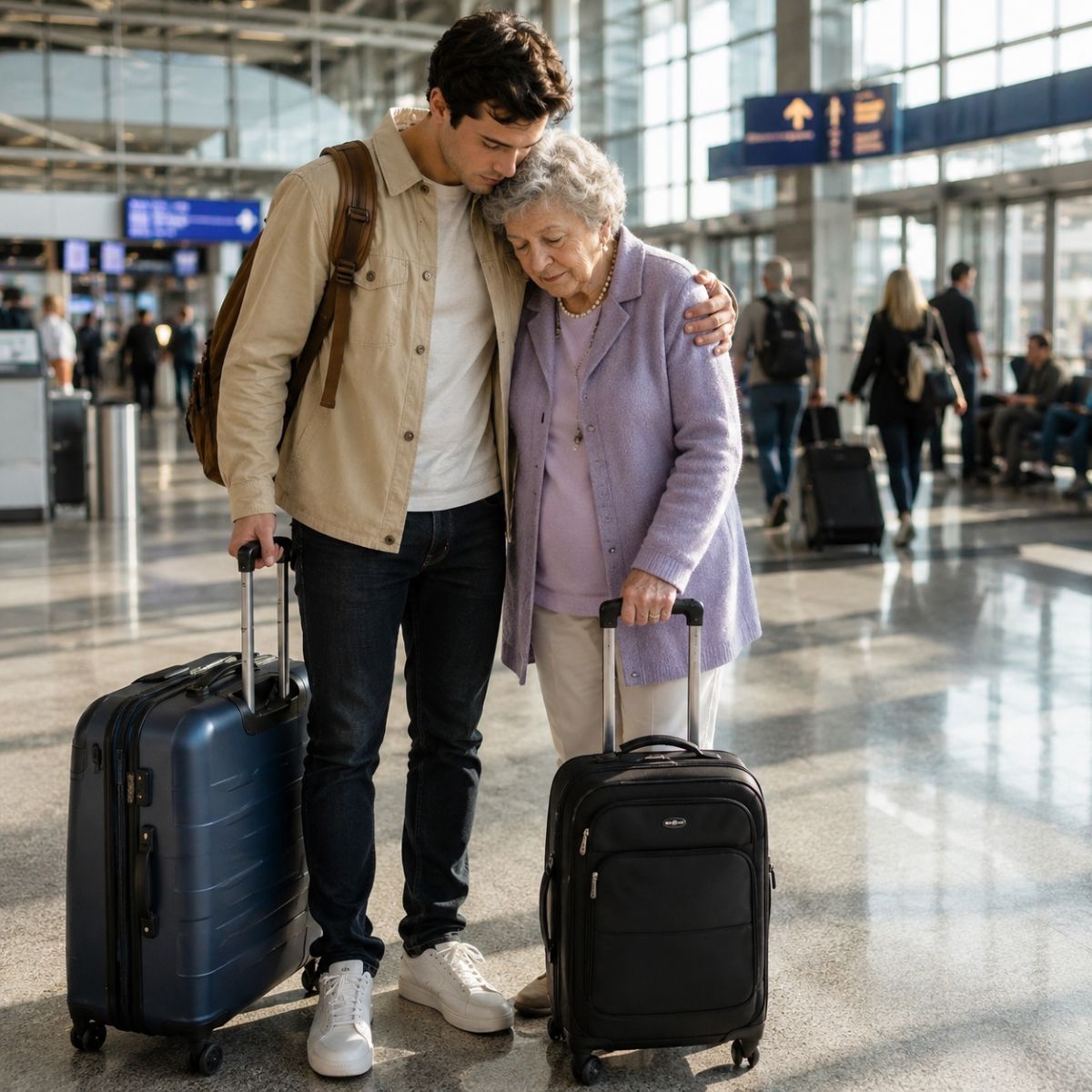
Mateo stayed with his grandmother in the middle of the airport, surrounded by families hugging before traveling, while his own disappeared without a care in the world.
On the way back to Atlixco, Elena stared out the window.
"Was it because I'm old?" she finally asked. "Or because I'm no longer good enough for your photos?"
Mateo felt something inside him break. “It’s because they don’t know how to love, Grandma.”
That night, while Elena slept with her white sneakers still by the bed, Mateo looked for help. He found information about the DIF (National System for Integral Family Development), counseling for senior citizens, and reports of financial abuse.
The next day he went with her to Puebla.
A lawyer named Lucía Castañeda heard everything, asked for account statements, messages, transfers and the name of the airline employee who had witnessed the scene.
"This is not a family misunderstanding," said Lucía. This may be property abuse against an older adult.
Elena was shaking.
—They are my children.
Mateo took her hand.
—And you were his mother. But that doesn't give them the right to destroy it.
3 weeks later, when the family returned tanned, loaded with bags and smiling at the airport, Lucía Castañeda was waiting for them with 2 legal notices.
Arturo lost the color in his face.
Patricia dropped a designer bag.
Mateo took a step forward.
—My grandmother did not report them.
He looked at them one by one.
—It was me.
PART 3
The case was not resolved at a family meal or with tears at a table.
It was resolved in a cold courtroom in Puebla, with files, signatures, account statements and a truth that could no longer be hidden under pretty phrases.
Elena did not want to attend the first hearing.
"If I see them, I'm going to break," he told Mateo. And I don't want them to see me broken.
So Mateo went for her.
Attorney Lucía Castañeda presented the evidence: the transfer of $30,000 from Elena's account to Arturo's, the messages where Patricia talked about the itinerary, the audios in which Marcela told her “you deserve this trip with us,” and the testimony of the airline employee, who confirmed that there was never a ticket in Elena Rivera's name for that flight.
The family's lawyer tried to disguise the cruelty.
"It was a voluntary contribution," he said. A mother wanted to help her children.
Mateo clenched his fists.
Lucia responded calmly:
—A voluntary contribution is not obtained by promising a trip that is never planned to be fulfilled.
When Mateo was called to testify, Arturo looked at him as if he could still give him orders.
But Mateo was no longer the boy trembling behind the kitchen door.
He told everything.
The sudden calls. The visits full of false affection. Elena's excitement buying white tennis shoes. The phrase he heard before the trip. The airport. The non-existent ticket. The way they all walked to security leaving a 74 year old woman with her red suitcase and her heart broken.
For the first time, Patricia looked down.
Marcela cried, but not for Elena. He cried when there was talk of returning the money.
Arturo tried to justify himself.
—My mother couldn't travel. It was for his health.
The judge interrupted him.
—Then they should not have received their money under another promise.
The sentence fell weeks later.
Arturo, Marcela, Patricia and Rogelio were forced to return the full amount, plus legal expenses. Measures were also established to prevent any of them from managing Elena's assets, accounts or property decisions in the future.
There was no applause.
There was no victory music.
Mateo left the courthouse with a folder under his arm and an old tiredness on his back.
When he arrived in Atlixco, he found Elena watering her bougainvilleas.
—Do we win? —she asked.
Mateo wanted to smile, but his eyes filled with tears.
—Yes, grandma. We win.
Elena turned off the hose.
—How sad that winning feels like that.
He hugged her silently.
After that, life began to slowly rebuild itself, like a house after an earthquake.
Elena got her money back, but she never trusted her children again. She didn't curse them. She didn't look for them. She didn't speak ill of them to the neighbors. She simply stopped waiting for them.
That was her strongest act.
Mateo moved to Atlixco and enrolled in university in Puebla. He got a scholarship, worked weekends at a pharmacy, and began studying medicine. He said he wanted to be a doctor because his grandmother had taught him that healing wasn't just about giving injections or prescribing pills.
Healing was also about staying.
On Tuesday afternoons, Elena took painting classes at the House of Culture. At first, she made fun of herself.
"Just look at me, son. My mountains look like squashed tamales."
But over time, she painted bougainvillea, hospital corridors, coffee cups, orange skies over Atlixco, and a red suitcase next to an airport bench.
Mateo hated that painting.
Elena loved it.
"I didn't paint it out of sadness," he explained. "I painted it because that's where you chose me."
Years passed.
Mateo became a doctor. Every achievement he brought to Elena first: his grades, his white coat, his first shift, the first patient who said, "Thank you, doctor."
She kept everything in a box: photos, letters, clippings, credentials, even a blank prescription he jokingly signed.
"For when I get sick with pride," she would say.
But one winter, Elena started coughing.
At first, she said it was the cold. Then she said it was exhaustion. Then came the tests, the appointments, the serious looks from other doctors.
Advanced lung cancer.
Mateo wanted to fight against everything: against the diagnosis, against time, against God if necessary.
Elena, on the other hand, received the news with a calmness that infuriated him.
“Don’t give up,” he pleaded.
“I’m not giving up,” she replied. “I’m choosing how I want to live the rest of my life.”
She chose to stay home.
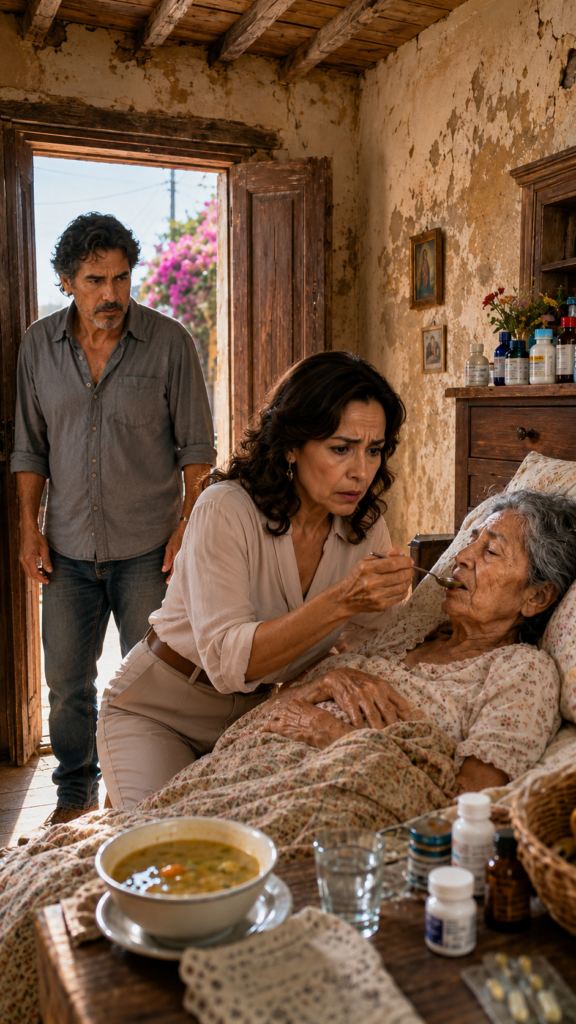
She chose her plants, her bed, her paintings, her neighbors coming in with soup, her afternoons listening softly to boleros.
Mateo rearranged his schedule to see her as much as possible. He read to her, cooked for her, checked her blood pressure, and combed her hair when she no longer had the strength to lift her arms.
One night, Elena took his hand.
“Promise me you won’t carry my story like a stone.”
“I can’t promise that.”
“Then carry it like a seed.”
Mateo wept openly.
“They should have taken care of you.”
Elena shook her head slowly.
“Perhaps. But you did. And that’s enough for me.”
On Mateo's graduation day as a doctor, Elena couldn't travel to Puebla. He received his diploma, had his official photo taken, and drove straight to Atlixco in his cap and gown, his voice cracking.
He entered the room.
“Grandma,” he said, kneeling beside her bed. “I’m a doctor now.”
Elena opened her eyes with effort. Her smile was small, but it lit up the whole room.
“My doctor,” she whispered.
That night she died in her sleep, one hand on the blanket and the other near an unfinished painting of bougainvillea.
The funeral was held in a small church in Atlixco.
It was filled with retired nurses, former patients, neighbors, painting students, market women, children whose falls she had once treated, and people Mateo didn’t even know.
Arturo wasn’t there.
Marcela wasn’t there.
Neither was Patricia.
None of them sent flowers.
Mateo wasn’t surprised. By then he had learned that some absences hurt less when they stop deceiving.
Years later, Mateo accepted a position at the hospital where Elena had worked as a young woman. In his office, he hung one of his paintings: vibrant bougainvillea next to a cream-colored house.
Patients would often look at it and say,
"What a cheerful painting, Doctor."
Mateo always smiled.
"It was painted by someone who knew how to survive without becoming bitter."
He never spoke to his parents again. Not out of revenge. Not out of pride. Simply because he understood that forgiving doesn't mean opening the door again to someone who has already shown they come in to take something.
Sometimes, when he passed a travel agency, he thought about Europe. About Paris. About Rome. About the white sneakers Elena never wore outside of Mexico.
Then he remembered something else.
He remembered that she didn't need a famous tower or an elegant photograph to leave her mark.
Her greatness lay in a kitchen smelling of coffee, in a tired hand holding a grandson's, in a red suitcase abandoned on a counter, and in the quiet dignity of not becoming cruel even when cruelty had visited her in the form of her own children.
Mateo learned that family isn't always about blood.
Family is about staying when staying is hard.
And when everyone walked toward a plane, leaving Elena behind, Mateo stayed.
Because many say "I love you" when there's money, travel, and convenience involved.
But true love is recognized in the simplest and hardest moment:
when someone takes your suitcase, looks you in the eyes, and decides not to abandon you.