PART 1
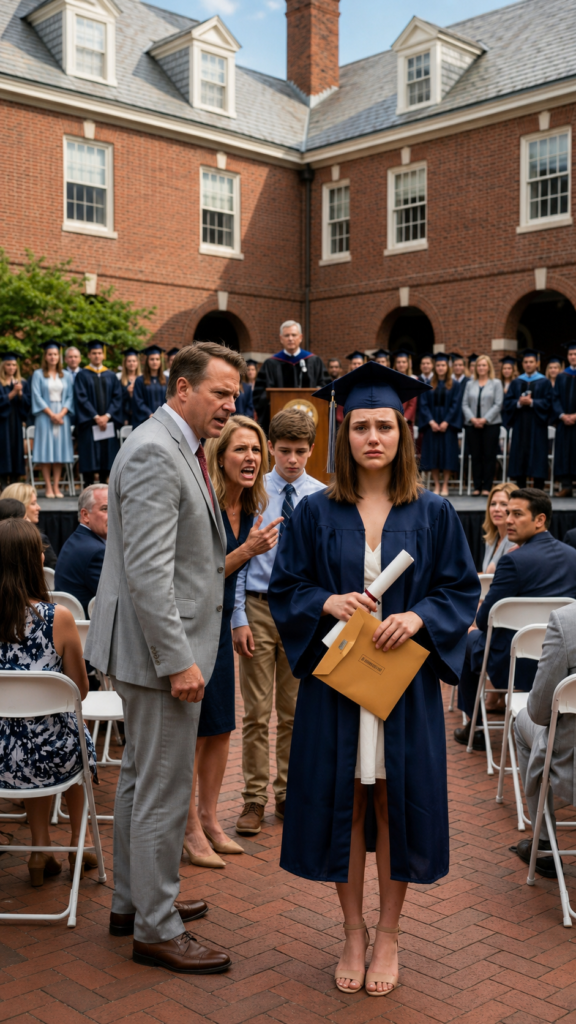
The slap rang out so loud that even the mariachis hired for the ceremony stopped playing.
Valeria's gown billowed in the air, her cap flew off and landed beside the folder where she kept her law degree.
The central courtyard of the university in Guadalajara fell into silence.
Her father, Don Ramiro, stood before her, hand still raised, face flushed with rage.
"You don't deserve that degree," he spat, as if each word burned his tongue. "You are a disgrace to this family."
Valeria felt the sting on her cheek, but she didn't lower her gaze.
A few steps away, her mother, Doña Patricia, pushed her way through the guests, her heels echoing against the floor.
"A failure in a gown, that's what you are!" she shouted. "Stop pretending to be important, you ungrateful brat!"
Some parents gasped. Others pulled out their phones. The professors watched, unsure whether to intervene.
Valeria's best friend, Renata, tried to approach.
"Vale, let's go, please..."
But Valeria didn't move.
Because this humiliation hadn't started that day.
It had begun four years earlier when her parents told everyone in the family that Valeria had dropped out because "she just wasn’t smart enough."
The truth was different.
Valeria had earned a full scholarship. She had worked in a café in the afternoons. She had sold desserts on weekends. She had slept three hours many nights to pass every class.
And all the while, her parents boasted about her younger brother, Diego, as the pride of the household.
Diego, who had failed university twice.
Diego, who drove a truck paid for with money that wasn't his.
Diego, who stood there, behind their parents, smiling as if he had just received the best gift of his life.
When Valeria heard her name at the ceremony, with honors, Diego's smile faded.
And then Don Ramiro walked toward her.
The security guard stepped forward, but Valeria raised a hand.
"Let him be," she said calmly. "Let him finish."
Don Ramiro blinked, surprised by his daughter's composure.
Valeria bent down, retrieved her cap, and wiped the folder with a slowness that made everyone nervous.
Then she looked at her parents.
"You’re right about one thing," she said. "Today, everyone needs to hear the truth."
Doña Patricia turned pale.
"Valeria, don't you dare."
Valeria walked toward the podium, where the rector was still holding the microphone, unsure of what to do.
She pulled out a thick yellow envelope, folded at the corners.
"Rector," she said firmly, "before I leave this university, I need to publicly denounce the people who stole the money from my scholarship, forged documents in my name, and tried to erase me as a student."
Don Ramiro let out a shout.
"Shut up, Valeria!"
But she had already opened the envelope.
And what she pulled out made Diego stop smiling.
PART 2
Valeria placed several copies on the lectern: bank statements, contracts, forged signatures, and a sealed complaint from the Attorney General's office.
The silence grew heavier.
No one understood yet, but everyone knew something very serious was about to break.
"For four years," Valeria said into the microphone, "my family told everyone that I dropped out. They said I was lazy, useless, that I left because I couldn’t handle it. But I never left."
She looked at her father.
"What happened was that my dad opened student loans using my name."
A murmur swept through the courtyard.
Doña Patricia clutched her purse to her chest.
"That's a lie," she whispered, though the microphone caught her voice.
Valeria raised a page.
"Here’s the loan application. My signature is forged. Here’s the deposit that was supposedly for my tuition. And here’s the transfer, two days later, to my brother Diego's account."
Diego stepped back.
"Come on, that proves nothing," he said, trying to laugh. "You’re crazy, Vale."
Valeria didn’t respond.
She pulled out another page.
"With that money, they bought your truck. They also paid for your private courses. They even paid for a party in Puerto Vallarta that my mom bragged about on Facebook, saying it was 'Diego’s reward for being such a good son.'"
Several people turned to look at Diego.
His expensive suit, his new watch, his shiny shoes.
Everything started to look different.
Don Ramiro approached the podium, furious.
"Get down from there, brat. You don’t know who you’re messing with."
The rector signaled the guard.
"Sir, maintain your distance."
But Valeria still hadn’t said the worst part.
"When I found out about the first loan, I went to confront them. I was 20 years old. My mom cried and told me not to make a scene, that Diego needed help, that I was a woman and could 'marry well' later."
An "oh no" was heard among the mothers present.
Valeria swallowed hard.
"My dad told me that if I reported it, he would say I was a liar, that I was unstable, that I liked to make things up to get attention."
Doña Patricia lowered her gaze.
For the first time, she didn’t shout.
"But I kept everything," Valeria continued. "Screenshots, receipts, audios, messages. I worked, studied, and paid lawyers with the little I earned."
Renata, from the crowd, cried silently.
She knew.
She had seen Valeria arrive to classes without breakfast. She had seen her worn-out shoes beneath the gown. She had seen how she turned down outings because every peso was for survival.
But no one else knew.
Valeria's family had always been experts at pretending.
Don Ramiro owned a small construction company. Doña Patricia presided over a group of women from the parish. Diego was the "good boy" who greeted everyone and spoke nicely.
Valeria was the uncomfortable daughter.
The one who asked too many questions.
The one who wouldn’t stay quiet.
"And there’s more," she said.
Don Ramiro paled.
"Valeria..."
His tone had changed. It was no longer a threat. It was fear.
Valeria pulled out a USB drive.
"Six months ago, my dad asked an employee at the university to erase records of my scholarship to make it seem like I was never formally enrolled."
The rector's face hardened.
"Do you have proof of that?"
Valeria nodded.
"Yes, sir. An audio file. And I also have the name of the employee."
The courtyard erupted in murmurs.
Don Ramiro looked around, seeking support, but people no longer saw him as an indignant father.
They saw him as a man exposed.
Doña Patricia approached the podium, trembling.
"Honey, please. Let’s fix this at home."
Valeria looked at her with sadness.
"Which home, Mom? The one where you hid me when visitors came? The one where you said I was a freeloader, even though you lived using my name?"
Doña Patricia began to cry.
But Valeria was no longer moved.
She had waited four years not to break.
She had waited for this day because she knew her parents chose to humiliate her in public over and over.
Now the truth would come out publicly, too.
Diego lost control.
"Yeah, I got money!" he shouted. "So what? You always thought you were better than everyone! Always with your little books, your scholarships, your saintly faces!"
Valeria turned toward him.
"No, Diego. I never thought I was better. I just wanted to study."
"Liar!" he spit out. "You wanted Dad to look like a useless man because he couldn’t pay for your education."
Don Ramiro glared at him with fury.
"Shut up."
But it was too late.
Diego, nervous and cornered, kept talking.
"You guys said to use her name! You guys said she was never going to do anything because she always just let things happen!"
The silence that followed was brutal.
Doña Patricia closed her eyes.
Don Ramiro clenched his fists.
And Valeria felt that, for the first time, the monster was biting its own tail.
Then another voice appeared.
"That was recorded too."
Everyone turned.
A gray-haired woman, dressed simply with a grocery bag in hand, walked toward the center of the courtyard.
It was Doña Elena, Valeria's aunt.
Don Ramiro's younger sister.
The same woman the family had treated as "the poor one" for years.
"I brought this," she said, raising her cellphone. "Because I knew they would do something to her today."
Don Ramiro stepped back.
"Elena, don’t interfere."
"I’m interfering because I want to, Ramiro. And because this girl is not alone."
Valeria stood still.
She hadn’t expected that.
Doña Elena climbed onto the podium with difficulty and handed the cellphone to the rector.
"There’s the audio of Patricia saying they were going to provoke her at graduation to make her look crazy if she spoke up. Also, there’s Ramiro saying that a slap in front of everyone would 'put her in her place.'"
Doña Patricia covered her mouth.
Diego muttered a curse.
Valeria felt her legs tremble, but not from fear.
It was rage. It was relief. It was everything at once.
The rector asked for the authorities to be called.
Don Ramiro tried to leave, but the guards blocked his way.
"This is a family matter," he shouted. "You have no right!"
Valeria stepped down from the podium and walked toward him.
Her cheek was still red.
Her gown was dusty.
Her cap was crooked.
But she had never looked more resolute.
"No, Dad," she said. "Family was when you left me hungry because I said I wanted to study. Family was when Mom called me a disgrace in front of my cousins. Family was when Diego spent my future and you cheered him on."
Don Ramiro opened his mouth, but nothing came out.
"This is no longer family," she continued. "This is a crime."
The police arrived minutes later.
The ceremony no longer felt like a ceremony.
The students were standing. Some were recording. Others were crying. Many looked at Valeria as if they had just understood that behind a gown, there can always be an invisible war.
Doña Patricia tried to hug her daughter when she saw the police talking to Don Ramiro.
"I’m sorry, Vale. I’m your mom."
Valeria didn’t move.
"A mom doesn’t ask her daughter to shrink so her favorite son can shine."
That phrase shattered her.
Doña Patricia collapsed into a chair.
Diego, desperate, tried to blame his father.
"I didn’t know it was illegal. I thought she didn’t need that money."
Valeria looked at him with a calm that hurt more than a scream.
"Of course, you didn’t think of me. You never had to."
Renata climbed onto the podium and hugged Valeria around the shoulders.
The rector took the microphone again.
"The University publicly acknowledges Valeria Mendoza's academic merit and will cooperate with the authorities in any way necessary."
Then the applause began.
At first, it was timid.
Then it grew.
Then it became a wave that filled the entire courtyard.
Valeria didn’t smile at first.
She just held her degree against her chest.
Because that applause didn’t erase the years of hunger, shame, fear, or loneliness.
But it marked something.
The exact moment she stopped carrying a guilt that was never hers.
Months later, Don Ramiro faced charges for fraud, forgery, and domestic violence. Doña Patricia lost her position in the association where she so proudly showcased her "exemplary family." Diego had to sell the truck and testify before a judge.
Valeria never lived with them again.
She moved to a small apartment near downtown, with used furniture, an old coffee maker, and a copy of her degree hung on the wall.
Doña Elena visited her on Sundays with sweet bread.
Renata helped her prepare for her professional exam.
And when Valeria started working at a firm that defended unjustly indebted students, many told her it was too painful to get involved in such cases.
She just replied:
"Precisely because of that, we must do it."
A year later, she received a message from her mother.
"Can we talk? I miss you."
Valeria read it several times.
She didn’t reply immediately.
Not because she hated her mother.
But because she understood something many people don’t want to accept: forgiving doesn’t always mean opening the door.
Sometimes it means stopping expecting that those who broke you know how to fix you.
That afternoon, Valeria turned off her phone, put on her black blazer, and headed to the courthouse.
At the entrance, a 19-year-old girl waited for her, crying, with a folder of falsified papers in her hands.
"I was told you could help me," she said.
Valeria looked at her, remembered her own graduation, and took a deep breath.
"Yes," she replied. "And this time, no one’s going to silence you."