PART 1
The rain fell on Lomas de Chapultepec as if it also wanted to wash away the shame.
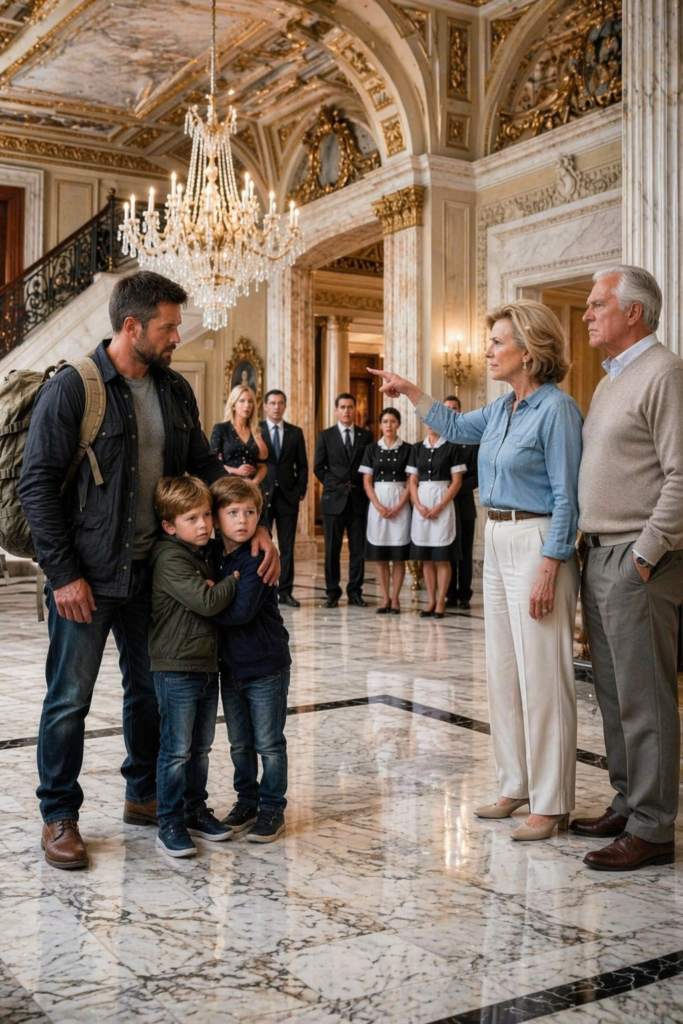
Héctor Rivas packed his twins' clothes into black garbage bags, one by one, without raising his voice. The two good suitcases were gone. Doña Amalia, his mother-in-law, had ordered them put away because, according to her, "those are things of the Herrera family, not of a freeloader."
Mateo and Leo, five years old, sat on the last marble step, hugging their dinosaur toys.
They didn’t cry.
In that house, they had learned that crying was bothersome.
Héctor was thirty-five, his eyes weary, with a scar across his side from an operation in Tamaulipas. He had been part of the Navy’s special forces. He had witnessed fear, betrayal, and death.
But nothing hurt as much as losing his wife, Camila, to a stroke seven months earlier.
Or hearing his mother-in-law say:
—Without my daughter, you mean nothing here.
Don Arturo Herrera, a real estate businessman, watched from the living room with a coffee cup in hand.
—Don’t take it the wrong way, Héctor. The kids need a stable life. You can barely take care of yourself. And that dog... that animal shouldn't be near my grandchildren.
Tango, a retired Belgian Malinois from the Navy, stood next to Héctor. He didn’t growl. He didn’t bark. He just stared at Doña Amalia with those still eyes that felt more threatening than any threat.
—Tango has taken care of my children better than many people in this house —Héctor said.
Doña Amalia let out a dry laugh.
—Don’t be spoiled. I gave you a roof because of Camila. She’s gone now. It’s over.
Héctor clenched his jaw.
He had 113 pesos in cash, an old truck, medical debts, and two kids who still asked when mommy would come back.
He wasn’t going to humiliate himself in front of them.
He loaded the bags, grabbed a small box with the kids' drawings, and called to Tango.
—Let’s go, champs.
Leo looked up at the stairs.
—Is grandma coming?
Doña Amalia didn’t even answer.
Outside, the rain hit their faces. Héctor strapped the twins into the truck. Tango hopped into the passenger seat, soaked and alert.
From the window, Doña Amalia watched them leave like someone watching employees leave after a bad day.
—Dad —Mateo whispered—, do we no longer have a house?
Héctor felt something break inside him.
—We have one, son. We’re just going to change places for a bit.
He lied because sometimes a father lies so his children can breathe.
They drove to a cheap hotel near the Central del Norte. The room smelled of dampness, chlorine, and stale cigarettes. There were two sagging beds, a TV with no signal, and a window letting in the noise of trucks.
Héctor bought two cold sandwiches, small juices, and a can of food for Tango.
The twins fell asleep hugging each other.
Héctor sat on the floor, his back against the bed, looking at the black bags.
For the first time since the funeral, he couldn’t hold himself together.
He covered his face with his hands.
Suddenly, Tango stood up.
He went straight to an old military backpack that Héctor had pulled from the service room before leaving. The dog sniffed a side pocket, let out a low whine, and began scratching the canvas desperately.
—Tango, stop.
The dog didn’t obey.
Héctor knew that look.
It wasn’t anxiety.
It was alertness.
He knelt down, opened the pocket, and reached in. His fingers brushed against a rusty plaque, a multi-tool, and a thick envelope sealed with red wax.
In the corner, it said: "Barragán and Associates, Monterrey."
Héctor froze.
He broke the seal.
Inside were documents, an old letter, and a figure so large that for a second he thought he was reading it wrong.
Then he saw his full name.
And understood that for three years, he had been the owner of something that could have saved them all.
PART 2
Héctor didn’t breathe for several seconds.
He read the first page again. Then the second. Then the letter. Each word fell on him like a wet stone.
"Sole heir."
"Irrevocable trust."
"Access granted."
"200 million dollars in assets, liquid accounts, properties, and a majority stake in Grupo Rivas del Golfo."
The envelope trembled in his hands.
Tango sat in front of him, motionless, as if he had completed a mission nobody asked him to do, but only he understood.
Héctor looked at his children sleeping in the hotel’s sagging bed. Mateo had one hand on Leo’s chest, as if protecting him even in sleep.
Camila had died believing they were poor.
That was what destroyed his soul.
For months, Héctor had sold everything he owned: his motorcycle, his service watches, a collection of coins from his father, and even his military graduation ring. He had taken out shameful loans to pay specialists, therapies, medicines, transfers, and tests.
In her last days, Camila had apologized to him.
—I’m sorry for being so expensive —she told him one night, her voice breaking.
Héctor remembered that phrase and felt nauseous.
The money had always been there.
Not because he was clever. Not because life was fair. But because his grandfather, Don Evaristo Rivas, an old port businessman from Veracruz, had named him heir before dying.
The problem was that Héctor had never opened the envelope.
He had received it three years earlier at a naval base, in the middle of an internal investigation after a failed mission. He thought it was just another useless family dispute. His grandfather had disowned his mother for marrying a shipyard worker, and Héctor wanted nothing to do with that surname.
He had kept the envelope in the backpack.
Then came Camila’s illness.
Then the hospitals.
Then the funeral.
Then the contempt from the Herreras.
Don Evaristo’s letter was written in shaky handwriting:
"I was wrong about your mother. I was full of pride and lacked heart. I don’t know if this money will fix anything, but I want my blood to never have to ask for permission to live with dignity."
Héctor pressed the paper against his chest.
He didn’t feel happiness.
He felt rage.
Rage for Camila. For his children. For that rainy night. For having accepted humiliations from people who confused money with worth.
At 8:20 AM, Héctor entered the Barragán and Associates office building on Paseo de la Reforma. He wore the same wrinkled shirt, had grown a beard, and held the twins by the hand. Tango walked beside him in his service vest.
The receptionist looked up and frowned.
—Sir, you can’t come in with that dog.
Héctor placed the envelope on the counter.
—I need to see Attorney Barragán. Now.
The woman saw the red seal. Then read the name.
Her demeanor changed in three seconds.
A gray-haired man appeared almost running from a hallway.
—Captain Rivas?
—I’m no longer a captain.
—We’ve been looking for you for years. Your records were protected, your addresses didn’t match, and when we located the Herrera house, they told us you didn’t live there.
Héctor raised his gaze.
—Who told you that?
The lawyer lowered his voice.
—A woman. Doña Amalia Herrera. She said you had abandoned your wife and didn’t want to receive documents related to your paternal family.
The silence was so heavy that even the twins stopped moving their toys.
Héctor felt his blood boil.
Doña Amalia hadn’t just disdained him.
She had blocked the envelope.
Maybe Camila could have had another treatment.
Maybe not.
But they hadn’t even had the right to try.
—I want immediate access —Héctor said—. I want a family lawyer. I want to recover my children’s belongings. And I want the Herreras to stay away from them without a court order.
Attorney Barragán didn’t ask unnecessary questions.
For five hours, Héctor signed documents, validated fingerprints, opened accounts, authorized transactions, and listened to figures that seemed from another life. Mateo and Leo built a fortress with empty folders. Tango lay by the door, keeping watch.
At the end, Barragán placed a folder in front of him.
—You have immediate liquidity. I also filed an urgent request with the family court. There’s a record of expulsion under conditions of vulnerability. And there’s one more point.
Héctor looked at him.
—Say it.
—If we prove that Doña Amalia received or rejected legal notifications on your behalf, that could open an investigation for falsification and possible property damage.
Héctor closed his eyes.
The betrayal didn’t come from an enemy.
It came from his children’s grandmother.
That afternoon, Héctor's old truck returned to the Herrera mansion.
But this time it wasn’t alone.
Behind it came a black truck with Attorney Barragán, two aides, a police patrol, and a moving unit.
Héctor left the kids in the truck with Tango.
—I’m going for mommy’s things. Don’t get out.
Mateo nodded.
—The blue box?
—Yes, son. The blue box.
Héctor climbed the steps.
He didn’t knock.
The door was open because an employee was taking out wilted floral arrangements.
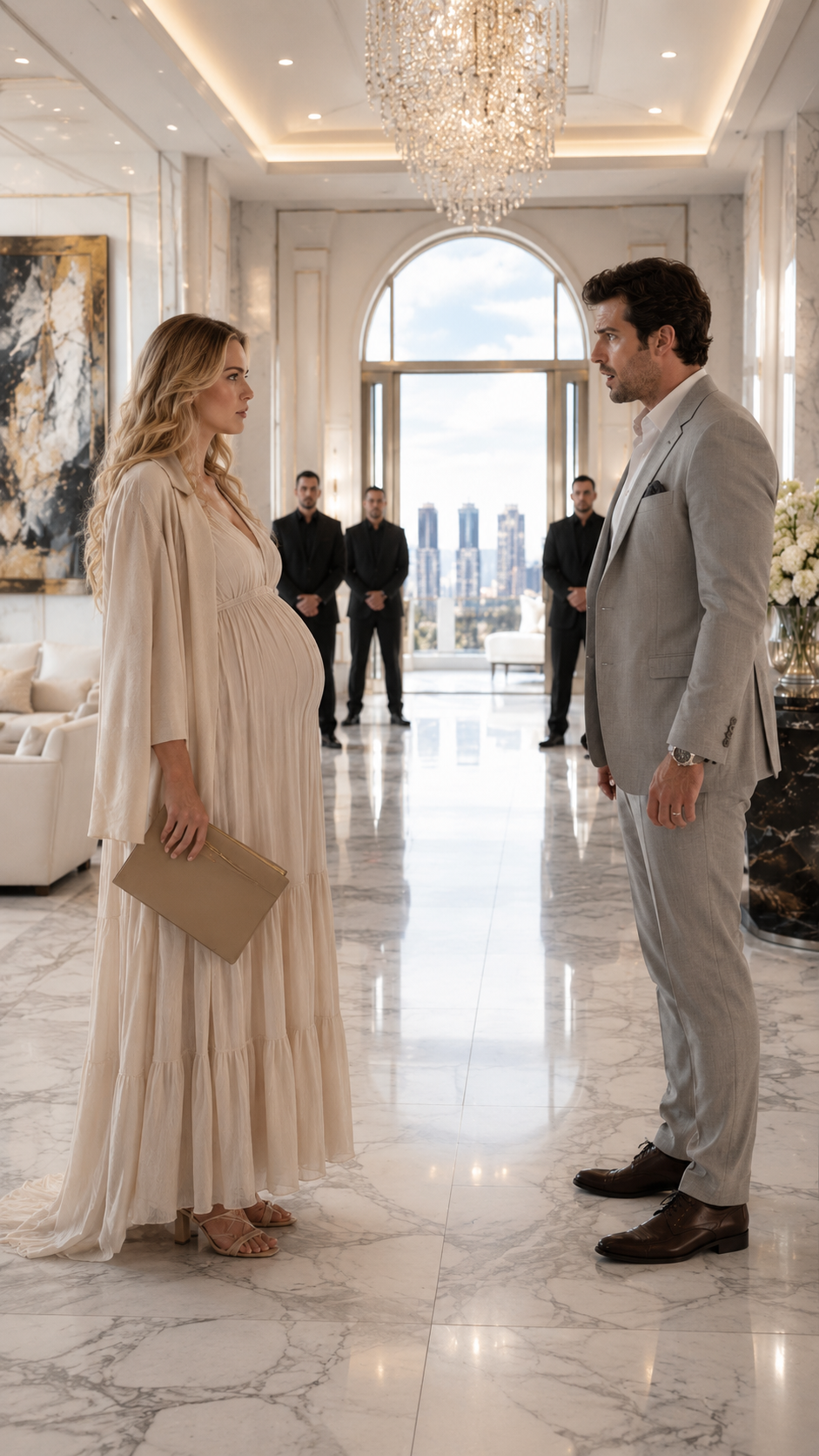
Doña Amalia appeared in the foyer wearing a pearl necklace and a perfectly indignant face.
—What are you doing here? I told you not to come back.
Don Arturo came out of the office with his phone in hand.
—I’m going to call security.
—Call them —Héctor replied—. Let everyone hear.
Attorney Barragán entered behind him.
—Herrera family, we come with an order to recover personal belongings of minors Mateo and Leonardo Rivas Herrera, as well as formal notification regarding contact restrictions.
Doña Amalia let out a laugh.
—Order? With what money did you pay for that, Héctor? You couldn’t even afford a decent grave for my daughter.
The punch was low.
But this time, Héctor didn’t look down.
—Don’t use Camila to spit venom again.
Don Arturo took the papers.
He read one line.
Then another.
His face changed color.
—Rivas… —he murmured—. Grupo Rivas del Golfo?
Héctor looked at him coldly.
—Yesterday I was a freeloader. Today you’re interested in my last name, right?
Doña Amalia snatched the documents from her husband. Upon reading the figure, she brought a hand to her chest.
—This is a lie.
—The lie was telling the office I had abandoned Camila.
Doña Amalia’s face hardened.
—I was just protecting my daughter.
—No. You were protecting your control.
Don Arturo looked at his wife slowly.
—Amalia… did you talk to those lawyers?
She didn’t answer.
And that was the answer.
Héctor felt a different cold. One that didn’t come from the rain, but from realizing that cruelty can also wear the elegant guise of a mother.
—I came for Camila’s blue box, the albums, the letters, and the drawings of my children —he said—. Nothing more.
—Camila’s things belong to this family —Doña Amalia spat.
—Camila was my wife. And those memories belong to her children.
The aides went upstairs to the storage room.
Héctor didn’t want to enter the bedroom where Camila would comb the twins’ hair or the balcony where she waited for him with coffee when he returned home in the early hours. He stayed downstairs, breathing slowly, as in the old drills.
Then Tango barked.
A sharp, single bark.
Héctor turned toward the stairs.
Mateo, from the truck, was pointing at the second-floor window.
—Dad! Grandma has the box!
Héctor ran.
Upon reaching the storage room, he saw Doña Amalia on her knees, opening the blue box with desperate hands. She had pulled out a bag embroidered with fabric.
—Leave that —Héctor ordered.
—Camila made this when she was a child. It’s mine.
—No. You’re hiding something.
The bag opened amid the struggle, and several letters fell to the floor.
A receipt also dropped, old and yellowed.
Héctor picked it up.
Date: Three years ago.
Recipient: Amalia Herrera.
Concept: legal documentation for Héctor Rivas Salazar.
Received by: A. Herrera.
The room went silent.
Don Arturo, coming up behind, saw the paper and leaned against the wall.
—My God, Amalia…
Héctor opened a folded letter with Camila’s name written on the outside. Inside was a handwriting he recognized instantly.
It was from his wife.
"Héctor, if one day my parents make you feel worthless, don’t believe them. My mom thinks love is control, and my dad thinks staying silent is being good. You are our children’s home. Even if you have no money, even if you feel broken, even if the world tells you you don’t measure up. Tango will take care of them when you can’t look after everything. And you will rise, because you always do."
Héctor broke down.
He didn’t cry loudly.
He just folded over the letter as if Camila could finally hug him from the paper.
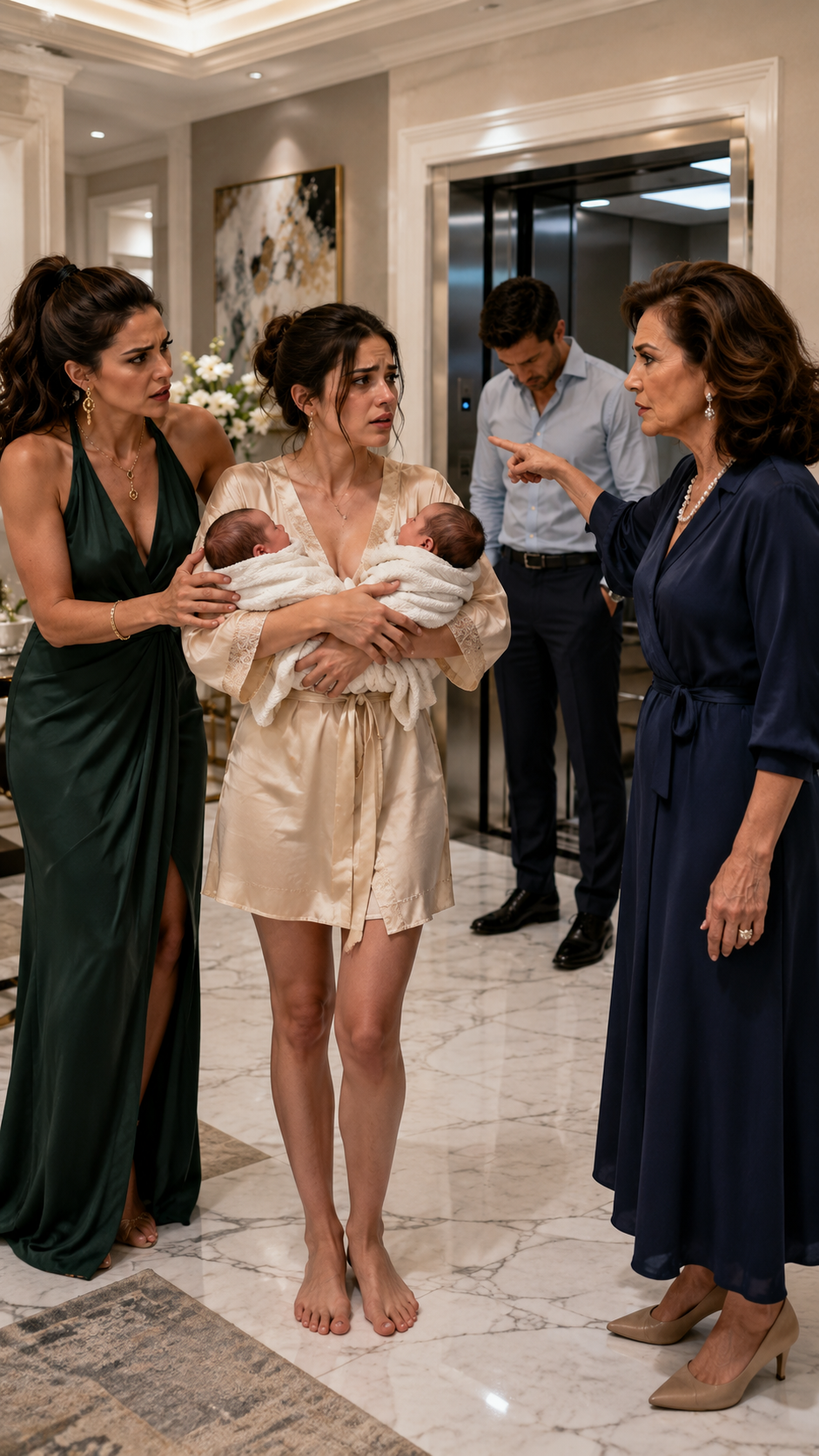
Doña Amalia began to cry.
—I thought he was going to take everything from Camila. I thought that if he knew about the inheritance, he would leave. I just wanted to secure her.
Héctor looked at her with a sadness that hurt more than the rage.
—You secured her so much that she died apologizing for needing medicine.
Doña Amalia covered her mouth.
Don Arturo said nothing. For the first time, he had no speech, no contacts, no money enough to buy silence.
Attorney Barragán lifted the receipt.
—This will be added to the case file.
—Do what you have to do —Héctor said.
Doña Amalia tried to approach.
—Héctor, please. They are my grandchildren.
He stepped back.
—No. They are Camila’s children. And Camila made it clear who should protect them.
That afternoon, they took out the blue box, the albums, the letters, a handwoven blanket, the children’s drawings, and an old video of Camila singing Las Mañanitas out of tune.
Before leaving, Héctor paused at the entrance.
The Herreras were in the middle of the foyer, surrounded by marble, expensive flowers, and an enormous loneliness.
—I will not teach my children to hate you —Héctor said—. But I will not teach them that blood gives the right to destroy. If one day you want to see them, it will be when a judge authorizes it and when you understand that being grandparents is a privilege, not a property.
Doña Amalia collapsed onto the step.
Héctor didn’t look back.
Months later, Héctor’s life didn’t turn into scandalous luxury.
It became dignified.
He bought a house in Coyoacán, with bougainvilleas at the entrance, warm floors, a patio for Tango, and bright rooms for Mateo and Leo. It didn’t have Italian marble, but it had toys in the living room, soup on the stove, and laughter that didn’t ask for permission.
He paid off all of Camila’s medical debts.
He bought a beautiful, simple, white tombstone, with a phrase the twins chose:
"Thank you for leaving us love."
He also created the Camila Rivas Foundation, dedicated to families of military personnel, widows, widowers, and children in urgent need of medical attention. He didn’t do it to clean his name or to appear in magazines.
He did it because no father should discover too late that there was a door, but someone kept it closed.
The investigation against Doña Amalia progressed slowly, as things often do when there are heavy last names involved. But it progressed. Don Arturo testified. The employee who received calls from the office also spoke. The delivery receipt didn’t disappear because Tango had found it first.
And that was the part everyone talked about.
The dog.
The "dangerous animal."
The same one Doña Amalia wanted to throw out into the street was the one who found the envelope, barked at the box, and sniffed out the truth where adults only hid pride.
A year later, Doña Amalia asked to see the children.
She didn’t send a lawyer.
She didn’t demand.
She sent a handwritten letter, without a letterhead, without perfume, and without threats.
Héctor read it several times.
He accepted a supervised visit in a Coyoacán park, in broad daylight, with Attorney Barragán nearby and Tango lying under a bench.
Doña Amalia arrived without jewelry.
She seemed smaller.
When she saw Mateo and Leo, she knelt down.
—I’m sorry —she said, crying—. I thought I was defending your mom, but I hurt what she loved most.
Leo hid behind Héctor.
Mateo asked:
—Are you not going to kick us out anymore?
Doña Amalia placed a hand on her chest.
—No, my child. Never again.
Mateo looked at her seriously.
—Dad says that forgiving isn’t forgetting.
Héctor lowered his gaze.
Doña Amalia nodded.
—Your dad is right.
That night, at home, Leo placed a photo of Camila next to the blue box.
—Mom knows we’re okay now —he said.
Héctor embraced his children in silence.
Tango rested his head on his legs.
Outside, it rained again, but it no longer sounded like punishment. It sounded like cleansing.
Héctor thought about the night in the hotel, the black bags, the 113 pesos, the hidden letter, and the dog who didn’t obey because he knew that obeying could also be cowardice.
The money didn’t bring Camila back.
It didn’t erase the humiliation.
It didn’t instantly heal two children who learned to be silent too soon.
But it returned something that no one should have ever taken from him: the ability to protect his home.
When Mateo, half-asleep, asked him:
—Dad, is this house really ours?
Héctor looked at the bougainvilleas, the scattered toys, the photo of Camila, and Tango watching the door.
This time he didn’t have to lie.
—Yes, champ —he said with a broken voice—. This one is our house.
And for the first time in a long time, Héctor Rivas didn’t feel like a soldier waiting for another battle.
He felt like a father.
He felt free.
He felt at home.