PART 1
In Room 7 of the family court in Mexico City, Julián Arriaga smiled as if he had just bought justice as well.
He wore a navy blue suit, a gold watch, and an unbearable confidence. Beside him was Renata, the woman he had cheated on his wife with for two years, dressed in white, with a saintly face and a designer bag.
On the other side of the room sat Isabel Mendoza.
Sitting.
Quiet.
In a gray coat buttoned up to her neck, even though it was warm outside.
Julián glanced at the judge, then at the reporters who had come to cover the divorce of one of Polanco’s most renowned medical entrepreneurs.
“The company, the Pedregal mansion, the cars, the accounts… everything’s in my name,” he said with a mocking grin. “Isabel won’t get a single peso. If she’s lucky, she’ll be able to rent a tiny room.”
Renata pretended to lower her gaze.
“Poor thing,” she whispered, loud enough for everyone to hear. “She looks so finished.”
An uncomfortable murmur swept through the courtroom.
Isabel didn’t respond.
She didn’t cry.
She didn’t plead.
She simply kept her hands clasped on the table, as if every word from Julián could no longer touch her.
Her lawyer, Mateo Robles, leaned toward her.
“Mrs. Isabel, you can still wait.”
She shook her head slowly.
She had waited ten years.
Ten years of smiling at charity dinners.
Ten years of appearing in photos alongside Julián as the perfect wife.
Ten years of hiding bruises under long sleeves, wounds under makeup, and fear behind a polite voice.
People thought the Pedregal mansion was a dream.
But for Isabel, it had been a prison of marble, cameras, and doors that locked from the inside.
Julián spoke again.
“Come on, Isa. Say something. Do your drama. You’ve always been good at that.”
Renata squeezed his arm, amused.
The judge called for order, but Julián was too comfortable in his role as the winner.
On paper, he was right.
Arriaga Biomed was registered solely in his name.
The mansion too.
The SUVs, the investments, and the main accounts had been moved three days before Isabel filed for divorce.
On paper, she had nothing.
And that’s why Julián was so sure.
Then Isabel stood up.
The room fell silent.
Cell phones went up.
Mateo opened a black folder.
Julián frowned for the first time.
“What are you doing?”
Isabel didn’t answer him.
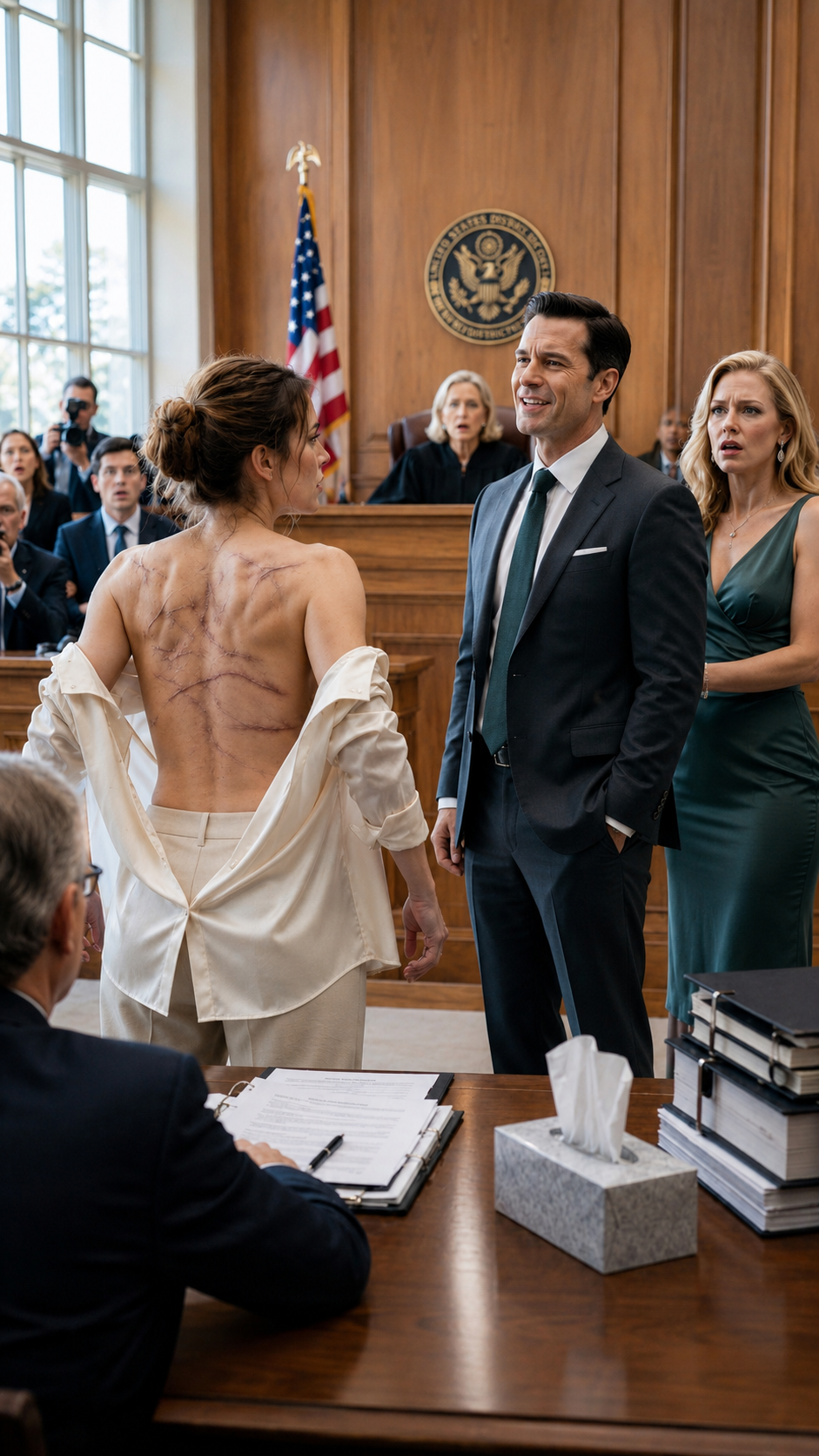
She looked at the judge, took a deep breath, and removed her gray coat.
The air seemed to vanish.
On her shoulders, arms, back, and ribs were long, visible scars, some old and some still red. They weren’t small marks. They were maps of pain, wounds that no amount of money, no expensive lawyer, and no last name could erase.
Renata opened her mouth.
Julián lost his color.
Julián’s mother, sitting in the back, placed a hand on her chest.
The judge leaned forward.
“Mrs. Mendoza…”
Isabel placed both hands on the table.
“This stopped being a divorce the moment the truth entered this room.”
Julián swallowed hard.
“Isabel, don’t be ridiculous.”
For the first time in years, she looked at him without fear.
“Today we’re not dividing a house. Today, we’re going to judge all the secrets you buried.”
Mateo pulled out a USB drive, 17 photographs, 9 medical reports, and a sealed recording.
And when the first video appeared on the courtroom screen, everyone understood that the worst was yet to come.
PART 2
The judge ordered that no one leave the room.
Julián stepped toward Isabel, but two judicial police officers stepped in front of him.
“You can’t approach the lady,” one said.
Julián let out a dry, false, trembling laugh.
“This is a show. She’s desperate because she knows she lost.”
But no one looked at him the same way anymore.
Mateo connected the USB drive to the court’s computer. The screen displayed a security recording from the Pedregal mansion.
Date: March 14.
Time: 1:27 a.m.
The image showed the main hallway. Isabel walked hunched over, one hand on her ribs. Julián followed behind, yelling. Not all the words could be heard, but it didn’t matter.
Then Renata appeared on the stairs.
Not as a confused guest.
Not as someone who had just found out.
But in a silk robe, watching from above, still, as Isabel tried to brace herself against the wall.
The entire room turned towards Renata.
She turned pale.
“I didn’t know what was happening,” she said.
Isabel looked at her with a calm that hurt.
“Yes, you did.”
Mateo opened the medical file.
“Your Honor, we present 9 reports issued between 2018 and 2025. All of them document injuries consistent with assault. In 6 instances, Mrs. Mendoza said she had fallen. In 3, medical staff noted suspicion of domestic violence.”
Julián gritted his teeth.
“And so what? Do some old bruises change who owns a company?”
Mateo looked up.
“No. But fraud does.”
The word fell like a stone in the middle of the courtroom.
Julián stopped breathing for a second.
Mateo pulled out another packet of documents.
“Arriaga Biomed wasn’t founded with money from Mr. Julián Arriaga. The initial investment came from the account inherited by Mrs. Isabel Mendoza after her father’s death. It was 8,700,000 pesos transferred on August 22, 2015.”
The judge took the documents.
Mateo continued.
“Three days later, Mr. Arriaga registered the company solely in his name. Mrs. Mendoza was legally excluded from a business financed with her inheritance.”
“Liar!” Julián shouted.
The judge banged the table.
“Mr. Arriaga, if you interrupt again, you will be removed.”
The murmurs grew.
Julián’s mother lowered her gaze.
Renata began to sweat, even though the room was cold.
Mateo projected an email.
From: Julián Arriaga.
To: Renata Solís.
Date: June 4, 2022.
The text read:
“As long as everyone believes Isabel is unstable, no one will take her seriously. Once she signs everything, we’ll sell Pedregal and head to Miami.”
Renata covered her mouth.
Julián turned to her furiously.
“You told me those emails were deleted.”
The silence was brutal.
Renata’s eyes widened, realizing too late that she had just betrayed herself.
Isabel didn’t smile.
She didn’t need to.
Mateo showed another message.
“If she shows the marks, we’ll say she did it herself. Her word doesn’t count against mine.”
Someone in the audience muttered a “no way” almost involuntarily.
The judge called for silence once again.
Isabel stood, her scars exposed, not hiding. Each mark seemed to speak for her.
Julián tried to regain his composure.
“My wife had emotional problems. Everyone knows it. I cared for her. I paid for doctors, therapies, medications. She’s manipulating everything.”
Mateo breathed calmly.
“We also have evidence of that.”
He pulled out medical prescriptions, bank statements, and a signed statement from a psychiatrist in Coyoacán.
“Mrs. Mendoza was prescribed medication without sufficient clinical diagnosis for two years. The prescriptions were requested by Mr. Arriaga through a doctor close to his family. The objective was to make her seem incapable of managing assets.”
Julián’s face hardened.
“That doesn’t prove anything.”
Then the door of the room opened.
A gray-haired woman entered, short, in a simple dress, clutching a blue folder to her chest.
Isabel saw her and her eyes filled with tears.
It was Teresa, the former domestic worker of the mansion.
For years, Julián had said Teresa left for the village because she was ill. In reality, he had fired her after finding her near his office.
Teresa walked to the front.
“Your Honor,” she said in a trembling voice, “I worked for 12 years in that house. I saw many things. I stayed silent out of fear, but I can’t anymore.”
Julián stood up.
“That woman is bought.”
The judge ordered her to sit.
Teresa opened the folder.
“I kept copies because I knew one day Mrs. Isabel would need them.”
She handed over receipts, photographs, a notebook, and a small memory card.
Mateo played the audio.
First, Julián’s voice was heard.
“Have her sign regardless. If she doesn’t sign, we’ll keep her locked up until she understands.”
Then Renata’s voice.
“And what if she shows the wounds?”
Julián replied:
“The wounds can be covered up. Money can’t.”
Renata began to cry.
The courtroom erupted in murmurs.
Julián’s mother stood up as if she were going to faint.
Isabel closed her eyes.
A single tear rolled down her cheek.
It wasn’t defeat.
It was relief.
Finally, someone else was listening to what she had carried alone for years.
But Teresa wasn’t finished yet.
“There’s something else,” she said.
Julián looked at her with true terror.
Teresa pulled out a certified copy of a private deed.
“Before he died, Mrs. Isabel’s father left a notarized letter. It stated that the inheritance money was to be used only for a project where Isabel retained at least 51% ownership.”
Mateo reviewed the document and presented it to the judge.
“This document was hidden. Mr. Arriaga’s signature appears as a witness of receipt.”
Julián stood frozen.
Renata looked at him as if she had just discovered a stranger.
“You knew from the beginning,” she whispered.
He didn’t answer.
Because this time there was no quick lie that could save him.
Mateo continued.
“Furthermore, we found an account in the name of a shell company in Querétaro. From there, hotels, jewelry, trips, and an apartment used by Mr. Arriaga and Miss Renata were paid for. The money came from Arriaga Biomed after altering medical invoices.”
The judge requested an immediate copy.
Julián began to lose control.
“You’re all a bunch of deadbeats! I built that company! I gave you jobs! I gave life to that woman!”
Isabel lifted her gaze.
“No, Julián. You took it away from me little by little.”
The phrase left everyone still.
Then she took the photograph of her father, which she had been holding in a folder, and placed it on the table.
“My dad died believing he was leaving me protected. I thought I was marrying a man who loved me. And you turned my trust into false papers, blows, and fear.”
Julián clenched his fists.
“If you talk, you’ll regret it.”
The judge heard the threat.
The police did too.
Mateo didn’t have to say anything.
Julián had just confirmed in front of everyone the type of man he was when he lost control.
The judge ordered to suspend the divorce proceedings regarding property and to notify the Public Prosecutor's Office immediately for domestic violence, threats, fraud, fraudulent administration, forgery, and possible money laundering.
Julián tried to leave, but the police blocked his way.
Renata stepped away from him.
“Renata,” Julián said, his rage subdued. “Don’t be an idiot. You’re involved too.”
She began to tremble.
“You told me she was exaggerating. You told me she just wanted to take your money.”
Isabel looked at her.
“You slept in my bed while I slept in the service room so he wouldn’t get angry.”
Renata couldn’t hold her gaze.
That was the difference between guilt and shame.
Guilt asks for forgiveness.
Shame only seeks to hide.
The case stopped being a rich people’s divorce that same afternoon.
By nightfall, the videos were already circulating on social media. Isabel’s full face wasn’t visible, but her voice, her gray coat on the chair, and the courtroom’s reaction when the evidence came to light were.
Arriaga Biomed was intervened.
The accounts were frozen.
The Pedregal mansion was secured.
The luxury cars were seized.
Employees began to testify.
The secretary confessed that Julián asked her to change dates on contracts.
The accountant admitted to moving money to accounts in Querétaro.
The driver stated that he took Isabel to the hospital four times in the early morning and that Julián ordered him to say it was a domestic accident.
Even the doctor who prescribed medications without properly evaluating Isabel ended up under investigation.
Renata tried to present herself as another victim, but the emails, trips, jewelry, and audios demonstrated she knew more than she wanted to admit. She hadn’t delivered all the blows, but she had enjoyed every privilege built on Isabel’s silence.
And that opened a huge discussion on Facebook.
Some said Renata had also been manipulated.
Others replied that a woman who sees scars and stays silent is not innocent.
But most repeated one question:
How many people around Isabel saw the signs and chose not to intervene?
Months later, Julián saw her again at a criminal hearing.
She no longer wore a gold watch.
Renata was no longer by his side.
He no longer smiled.
Isabel arrived in a simple blue dress, hair tied back, and arms uncovered. Her scars were still there, but they no longer seemed a shame. They seemed proof that she had survived.
Julián looked at her with hate.
“You ruined my life.”
Isabel breathed slowly.
“No, Julián. I just stopped protecting the lie that held it up.”
The phrase went viral.
Thousands of women shared it.
Some wrote: “I was also told that no one would believe me.”
Others told stories they had swallowed for years.
Isabel didn’t recover the lost time.
She didn’t recover the nights locked in a bathroom to cry quietly.
She didn’t recover the version of herself Julián tried to erase.
But she reclaimed her company.
She reclaimed her name.
She reclaimed her freedom.
And, above all, she reclaimed something that no sentence can fully return, but that justice can begin to repair: the certainty that she wasn’t crazy, she wasn’t exaggerating, and she didn’t have to apologize for having survived.
Because sometimes the greatest punishment for someone who boasts of having it all isn’t losing the house, the cars, or the money.
It’s having the whole world see the truth they tried to hide beneath the coat of a woman.