PART 1
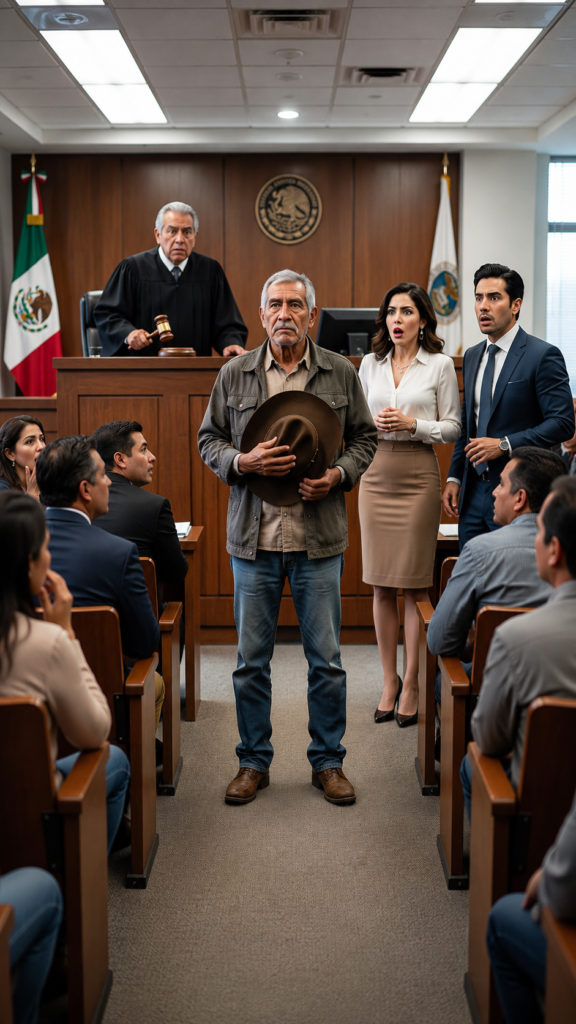
The morning Ernesto Salvatierra walked into the family court in Querétaro, his daughter Valeria was already smiling as if the sentence were written in stone.
He arrived in a simple shirt, dusty boots, and an old hat clutched tightly in his hands. At seventy, he looked like a tired rancher, the kind who speaks little and walks slowly because life has already extracted many debts from him.
Valeria sat next to Rodrigo, her husband, a man in an expensive suit, a shiny watch, and the smug gaze of a lawyer who believes everyone else is a fool.
"Look at him," Rodrigo whispered, not bothering to lower his voice. "He doesn’t even know where he is."
Valeria offered no correction.
She simply adjusted her designer bag over her legs and looked at her father with a mix of shame and annoyance, as if the man who had raised her was now a frail animal that needed to be caged before he caused a disaster.
Ernesto heard it all.
But he said nothing.
He had learned decades ago that the guilty speak more when they think they have already won.
The hearing was to decide if Ernesto should be declared legally incapacitated. Valeria insisted her father was hallucinating, forgetting important payments, leaving the stove on, and no longer able to manage the family ranch in Tequisquiapan, the home where he and Mercedes, his deceased wife, had lived for over forty years.
According to her, it was out of love.
According to Rodrigo, it was for safety.
The truth was something else entirely.
It had all started three months earlier, on a Thursday afternoon, when Ernesto found a notice in the mailbox from the municipality: property tax debt, penalties, and a threat of foreclosure.
It made no sense.
A month prior, Ernesto had transferred 600,000 pesos to Rodrigo to cover taxes, paperwork, and supposed regularizations of the land.
Valeria had insisted for years:
"Dad, you’re getting old. Let Rodrigo help you. He knows how to handle money."
Ernesto had trusted.
Not because of Rodrigo.
Because of Valeria.
That night, when he showed them the letter, Rodrigo didn’t even touch it.
"That’s a mistake from the municipality, Mr. Ernesto. You know how they are. Just bureaucracy."
"Then show me the receipt," Ernesto demanded.
Valeria sighed with exhaustion.
"Dad, here we go again with your ideas. Lately, you’ve been acting really strange. Yesterday, you left the stove on."
Ernesto looked at her in silence.
The stove had been turned off for months, ever since Mercedes died. It was impossible.
That’s when he understood that his own daughter was lying to him.
The next day, Valeria arrived with an unlabeled amber jar.
"These are memory vitamins. They’ll help you."
For two weeks, Ernesto felt trapped inside his own body. He woke up late, forgot words, his hands trembled, and he could barely walk without leaning against the wall.
One afternoon, pretending to be sleepy, he overheard Rodrigo say:
"It’s almost done. Once they declare him incapable, we sell the ranch and pay off my debts."
Valeria barely responded:
"Do it fast. I can’t stand seeing him like this anymore."
That night, Ernesto flushed the capsules down the toilet.
He paid for a private analysis at a roadside clinic and received the call the next day.
They weren’t vitamins.
They were strong antipsychotics, in dangerous doses.
Then Ernesto understood they didn’t want to care for him.
They wanted to erase him.
That’s why he walked into court with his head down, allowing everyone to think he was a confused old man.
Until the judge lifted his gaze, turned pale, and dropped the gavel on the desk.
"Holy God… Is this Mr. Ernesto Salvatierra?"
The entire room froze.
Valeria stopped smiling.
Rodrigo swallowed hard.
And the judge, trembling, stood before the man they had just called insane.
PART 2
For a few seconds, no one moved.
The silence in the room was so heavy that even the murmur from the hallway seemed to fade away.
Judge Raúl Cervantes slowly removed his glasses, as if needing to verify that his eyes weren’t deceiving him. He looked Ernesto up and down: the simple shirt, the worn boots, the hat in his hands.
But he wasn’t seeing a lost rancher.
He was seeing the man who, twenty-five years earlier, had led one of the largest investigations against financial fraud networks and property dispossession in Mexico.
"This court needs to understand something," the judge said, his voice firm, though still emotional. "Mr. Ernesto Salvatierra is not just any elderly man. He was a federal prosecutor for over thirty years. Many of us here learned from his case files."
Valeria went rigid.
Rodrigo glared at her with fury, as if she had concealed this fact on purpose.
But Valeria didn’t know the whole truth either.
To her, her father was just the silent widower who watered bougainvilleas at dawn, spoke to the chickens, and spent hours staring at Mercedes’ empty rocking chair on the porch.
She never wanted to wonder who he had been before the pain.
She never cared.
Valeria’s lawyer tried to rise.
"Your Honor, with all due respect, the gentleman’s professional past does not prove his current mental state."
"You’re right," the judge responded. "That’s why we’re going to hear evidence, not family gossip."
Then the door opened.
Julián Armenta, a civil lawyer with white hair, a gray suit, and the look of a man not willing to waste time, walked in. He strode up to Ernesto, squeezed his shoulder, and set a thick folder on the table.
"I appear as the legal representative of Mr. Ernesto Salvatierra," he said. "And I request that urgent evidence of financial abuse, forgery of documents, administration of substances without consent, and attempted fraudulent incapacitation be admitted."
Rodrigo jumped to his feet.
"This is a trap!"
An officer placed a hand on his shoulder.
"Sit down."
Julián turned on the screen.
First appeared the toxicology analysis. The doctor explained that the capsules Valeria handed out as "vitamins" contained strong psychiatric medication, capable of causing confusion, tremors, memory loss, and cardiac risk in a healthy person.
Valeria lowered her head.
Her designer bag slipped to the floor, but she didn’t bend down to pick it up.
Then came the bank statements.
The 600,000 pesos transferred to pay the property taxes never reached the municipality. They passed through three different accounts and ended up in a shell company linked to Rodrigo.
Next appeared copies of promissory notes.
Ernesto’s signature was forged.
His ranch had been used as collateral for illegal lenders in Celaya and San Juan del Río. Rodrigo owed millions due to gambling, failed businesses, and predatory loans.
"It wasn’t a family debt," Julián said. "It was a bomb. And they wanted Mr. Ernesto to pay with his home."
Valeria began to cry, but no one in the room was moved yet.
The worst was yet to come.
Julián requested to play a video.
On the screen appeared the ranch study. It was nighttime. Rodrigo entered slowly, believing Ernesto was asleep under the effects of the pills. He opened a hidden panel with a stolen key and photographed deeds, policies, identifications, and Mercedes’ documents.
His voice rang clear:
"With this, we convince the lenders. Valeria signs as guardian, we sell the ranch, and the old man won’t even notice."
Then Valeria’s voice could be heard from the doorway.
"What if he recovers before the hearing?"
Rodrigo laughed.
"Then we up the dose. After all, everyone thinks he’s crazy since he talks to your dead mother."
Ernesto closed his eyes.
Not out of surprise.
He already knew it.
What hurt was hearing it before everyone, transformed into public truth, without a corner to hide his shame.
Valeria covered her mouth.
"I didn’t want…"
The judge banged the gavel.
"Silence."
But Julián wasn’t done.
He presented messages:
"Keep my dad medicated until the hearing. If he gets lucid, we’re done for."
In another, Rodrigo replied:
"When you sign as guardian, the ranch is gone in 48 hours."
Valeria’s lawyer no longer looked at anyone.
He seemed to want to disappear beneath the table.
Then came the twist no one expected.
Julián played an audio recorded in Rodrigo’s truck. The voice of a lender threatened to take not only their assets but also Diego, Valeria’s eight-year-old son, if they didn’t pay.
Rodrigo responded desperately:
"Give me time. My father-in-law has land, accounts, livestock. The old lady is already convinced. We just need to declare him incapacitated."
Valeria lifted her face, shattered.
For the first time, she didn’t seem arrogant.
She appeared as a woman realizing that she hadn’t just betrayed her father: she had also placed her son in the middle of a criminal debt.
"Rodrigo told me that if I didn’t help, they would hurt us," she stammered. "He said Dad would never give us the money, that he was lost in his sadness, that the ranch was going to rot with him…"
Ernesto looked at her.
The entire room awaited his reaction.
He could scream at her.
He could insult her.
He could demand they handcuff her right then and there.
But Ernesto simply held his hat with both hands, as if clinging to the last thread of his patience.
"Valeria," he said with a calm that hurt more than a scream, "your mother and I built that ranch so you would have roots, not so you could use it as bargaining."
She cried harder.
"Forgive me, Dad."
Ernesto shook his head slowly.
"Forgiveness isn’t asked for while you’re still standing on the lie."
The judge ordered a brief recess.
Rodrigo tried to talk to Valeria, but she pulled away from him as if she finally found it disgusting to touch him. It was the first time she seemed to see him without the suit, without the watch, without the facade of a successful man.
Only a coward buried in debt remained.
When the hearing resumed, Judge Cervantes was decisive.
He denied the request for incapacitation.
He ordered protective measures for Ernesto, froze any transactions regarding the ranch, annulled documents signed under deceit or forgery, and immediately referred the case to the Public Prosecutor’s Office for fraud, forgery, financial abuse, criminal conspiracy, and administration of substances without consent.
Rodrigo was arrested as he exited the courtroom.
He didn’t make it to the door.
When the officers put the handcuffs on him, he turned to Valeria.
"Tell them you signed too! Don’t play innocent!"
Valeria broke down.
"I did sign," she said through tears. "And I’m going to tell everything."
That confession changed her situation, but it didn’t save her.
She agreed to cooperate with the investigation, handing over messages, accounts, and names of the lenders. She would face lesser charges, judicial measures, and the temporary loss of certain decisions regarding Diego.
What she lost forever was her father’s trust.
And that weighed more than any file.
When the hearing ended, Ernesto walked toward the exit without looking back.
Valeria ran after him.
"Dad, please. Don’t leave me like this."
He stopped in the hallway.
There were journalists, lawyers, curious onlookers, and court employees pretending not to listen.
Ernesto took a deep breath.
"When you were a child, your mother told me not to let go of your hand at the fair because you were afraid of getting lost in the crowd."
Valeria covered her face.
"Dad…"
"This time, it was you who let go of me."
She didn’t respond.
There was nothing to say.
Months later, Ernesto returned to the ranch in Tequisquiapan.
The house still stood, though somewhat altered. They had changed locks, reviewed accounts, updated deeds, and installed new cameras. Julián had secured legal support for elderly victims of financial abuse, and the judge had ordered that no one could move a single peso without Ernesto’s direct authorization.
But the hardest part wasn’t regaining the paperwork.
It was sitting back on the porch without feeling that each shadow hid a betrayal.
One Saturday afternoon, while watering Mercedes’ roses, he heard a truck stop in front of the gate.
It was Valeria.
She came looking thinner, without makeup, with her hair tied back and a folder in her hands. Beside her was Diego, her eight-year-old son, clutching a blue backpack.
The boy ran first.
"Grandpa!"
Ernesto set the watering can down and opened his arms.
Diego crashed into his waist with that pure force only children possess when they don’t yet fully understand the malice of adults.
"Mom says she hurt you a lot," the boy murmured. "But I don’t want to lose you."
Ernesto felt something break and mend within him at the same time.
He bent down with difficulty and hugged him.
"You’ll never lose me, kid. Don’t even think about it."
Valeria stood by the gate.
She didn’t cross without permission.
That small yet significant detail made Ernesto look at her.
"Dad," she said, "I’m not here to ask for your forgiveness today. I brought copies of everything I submitted to the prosecutor’s office. I also started therapy. And I got a job in a store in Querétaro. I don’t want a penny from you."
Ernesto didn’t reply immediately.
The wind moved Mercedes’ roses, and for a moment, it felt like the ranch was breathing with them.
"And Diego?" he asked.
"I want him to keep seeing you. If you agree. With whatever conditions you set."
The boy watched them, not entirely understanding, but with enough fear to remain silent.
Ernesto thought of Mercedes.
He thought of the little girl with braids running through the furrows.
He also thought of the adult woman who medicated him, humiliated him, and almost sent him to a clinic to take away his home.
Love didn’t erase that.
Blood didn’t either.
"He can come on weekends," he finally said. "You’ll stay at the entrance until I decide otherwise."
Valeria nodded.
She didn’t argue.
That was new too.
Over time, Diego learned to plant tomatoes, to feed corn to the chickens, and to listen to stories about his grandmother Mercedes. Ernesto taught him that a home isn’t valued by its walls but by the memories it holds.
Valeria took a long time to sit back at the family table.
There was no miraculous hug.
There was no movie-style forgiveness.
There was distance, shame, supervised visits, and awkward conversations where every word weighed heavily.
One day, while sorting through old books, Ernesto found a letter from Mercedes hidden between the pages of a recipe notebook.
It read:
"Ernesto, when I’m gone, don’t shut yourself away in pain. Life will still knock at your door. Open it, even if it arrives differently."
He sat on the porch with his hat on his knees.
He watched Diego run between the furrows and Valeria waiting for him outside the gate, still hesitant to enter.
Then he understood something no courtroom could dictate.
Justice could protect the ranch.
It could punish Rodrigo.
It could return his accounts, his signature, and his name.
But it couldn’t return to him the daughter he thought he had intact.
That part would have to be rebuilt with truth, time, and consequences.
Because there are families that don’t break due to a lack of love, but because they believe that love justifies everything.
And Ernesto, watching the sun set over the land they almost took from him, knew that surviving was also a way of winning.
They wanted to take away his home.
They wanted to take away his memory.
They wanted to take away even his dignity.
But they forgot one thing.
A man may seem old, alone, and defeated.
And still, hold within a truth capable of standing an entire court on its feet.