PART 1
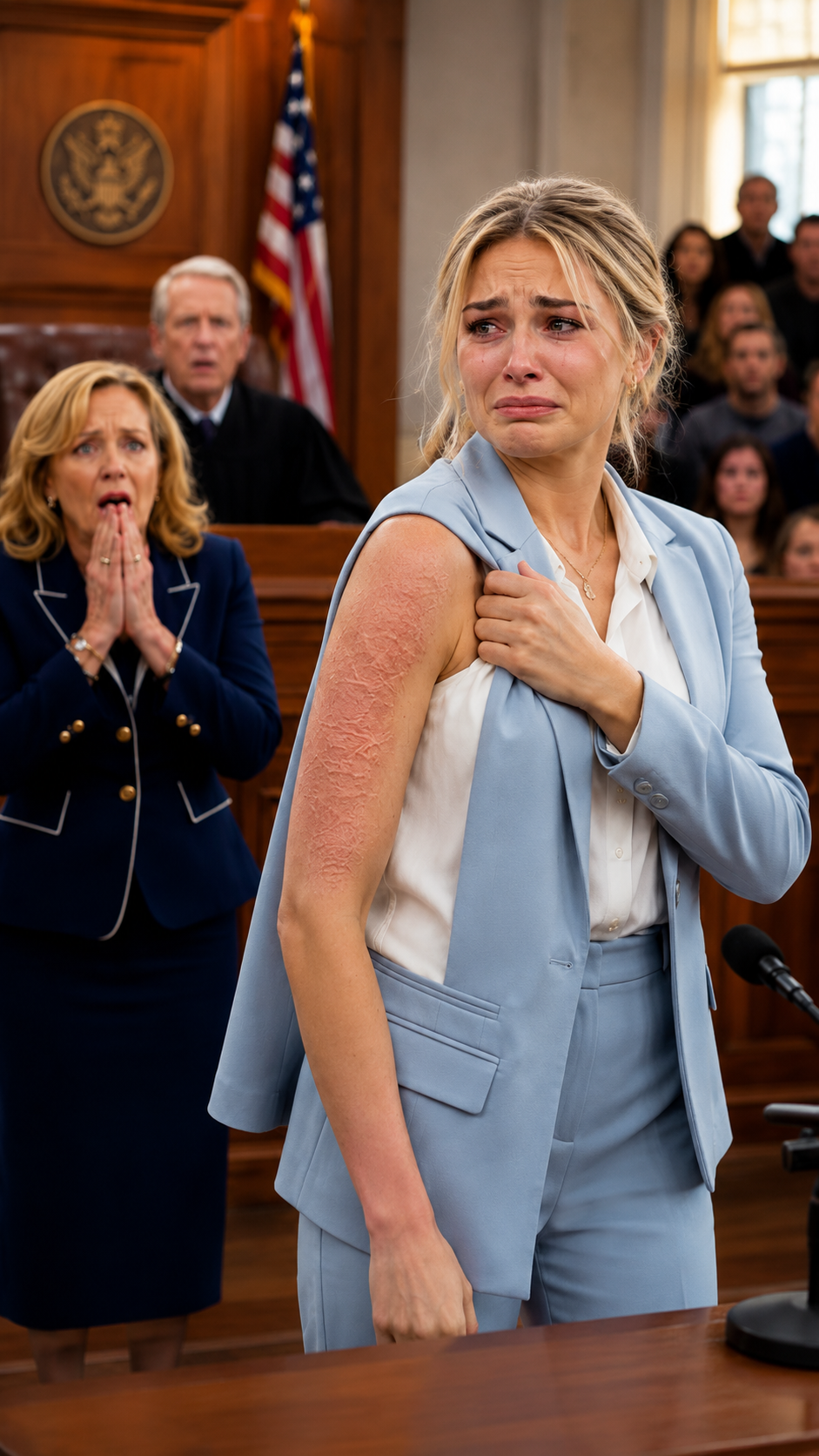
They called her a liar in a packed courtroom, and the one who drove the final knife in was her own mother.
With her right hand on the Bible, Elena Murillo looked at the judge with a calmness that felt rehearsed in front of a mirror and said:
—My daughter was never a soldier. The scars, the medals, all of it she made up to steal her father's company.
A chilling murmur swept through the courtroom in Mexico City.
Some turned to look at Valeria Murillo as if they were no longer looking at a woman, but an imposter using the pain of dead soldiers to get rich.
Valeria didn’t lower her gaze.
She gripped a pen between her fingers and kept her hands on the defense table. She wore a navy blue suit, her hair pulled back, and a thin scar peeked near her neck, just where her blouse failed to cover it.
Across from her, her younger brother, Bruno, hid a smile.
The lawsuit had begun three days after their father’s funeral, Don Ricardo Murillo, founder of Murillo Armors, a company that manufactured tactical gear for security forces.
Don Ricardo had left Valeria the controlling shares and appointed her as executor.
But Bruno showed up with a new will, supposedly signed six months before their father’s death, transferring everything into his hands.
When Valeria challenged the document, Bruno accused her of manipulating their father by pretending to have a military career that, according to him, never existed.
Then came the worst: allegations of fraud, forgery of official documents, and misuse of military decorations.
Her own mother took the stand as the star witness.
—Don’t react —her lawyer, Licenciado Carranza, whispered—. They want to provoke you.
—I won’t —Valeria replied without moving her lips.
That worried her lawyer more than if he had seen her cry.
The prosecutor displayed a showcase with three items: a Heroic Valor Medal, a Military Merit Medal, and a burned patch from a special unit.
—Mrs. Elena, do you recognize these items?
The woman grimaced in disgust.
—Yes. I saw them in her apartment. She bought them online. My daughter has always wanted to seem important.
Several attendees murmured under their breath.
—What a disgrace...
—Using the Army to steal...
Valeria felt the old burn in her ribs tighten beneath the fabric.
She remembered the dust, the screams, the smell of gasoline, the whirring of a helicopter slicing through the air, and the warm blood trickling between the fingers of a military doctor.
She remembered General Arturo Cárdenas dragging her from a burning truck while bullets pounded against the armor.
But she couldn’t say it.
Not yet.
Her file was classified for national security, linked to an operation in the Sierra Madre that never appeared in any official bulletin.
Bruno knew.
That’s why he’d chosen that lie.
Only her father knew the whole truth. Before dying of cancer, Don Ricardo warned her that Elena and Bruno were siphoning money through ghost suppliers.
—Protect the company, daughter —he told her, his voice breaking—. But don’t break the silence order. That mission saved lives that are still at risk.
Valeria promised.
And now that promise was leaving her alone before a judge.
Bruno’s lawyer approached with a triumphant smile.
—Miss Murillo, you claim that your records are sealed by the government.
—That’s correct.
—How convenient, isn’t it?
—For some, yes. For others, not so much.
Laughter erupted in the courtroom.
Judge Ramírez lifted his gaze.
—Explain that response.
—I can’t do that yet, Your Honor.
The prosecutor shot up abruptly.
—Your Honor, the accused has used that phrase for months to evade evidence.
Valeria glanced at the clock on the wall.
It was 11:47.
Thirteen minutes left.
Bruno’s lawyer projected several official searches.
There was no deployment under Valeria’s name. No medical evacuation. No order of commendation.
—Do all the Army systems lie? —he asked sarcastically.
—No —she replied—. Only the search you have permission to conduct is incomplete.
Elena sighed heavily from the stand.
—That’s what she always does. She talks weird so people think she’s special.
Bruno then asked to testify.
Under oath, he claimed he found the new will inside their father's private safe on March 9.
He described the golden knob, a blue folder, and even a coffee stain on the page.
Licenciado Carranza stood up.
—Did you personally open that safe?
—Yes.
—Did anyone give you that document?
—No one.
—Are you completely sure?
—Completely.
Valeria looked at the clock again.
11:56.
Carranza showed a photograph on the screen.
Don Ricardo’s office appeared destroyed by a fire suppression system leak. The safe was open, filled with black, crumpled, unrecognizable papers.
—This photo was taken on February 22 —the lawyer said—. Everything that was in that safe was destroyed 16 days before you, according to your statement, found that will.
Bruno turned pale.
The family lawyer shouted an objection, but it was too late.
Carranza took another step.
—Did you pay Delia Navarro, your father’s former assistant, 200,000 pesos to fabricate that document?
—No.
—Did your mother help you prepare the testimony?
—No.
—Did you plan to sell Murillo Armors as soon as Valeria was convicted?
—No.
Three lies were recorded in the courtroom.
Then a heavy noise echoed in the hallway.
Boots.
Firm footsteps.
The clock struck 12:00.
The doors of the courtroom opened, and as that impeccably uniformed man entered, Elena Murillo’s smile vanished as if her soul had been ripped from her.
PART 2
The man who entered had the bearing of someone used to no one blocking his way.
He wore a dress uniform, his chest adorned with insignias and a pale scar crossing his left temple. Two federal agents and a military lawyer with a black briefcase walked alongside him.
Judge Ramírez frowned.
—Identify yourself.
The man squared off with a precision that silenced even the reporters.
—Division General Arturo Cárdenas, Secretariat of National Defense. I appear with limited authorization to reveal classified information regarding Captain Valeria Murillo.
The courtroom exploded in murmurs.
—Captain? —whispered Bruno, his voice breaking.
The general looked at him as if he had just stepped in something dirty.
—Retired captain from a special operations unit.
Elena gripped the stand’s railing.
She knew him.
Years ago, when Don Ricardo was still alive, that same general came to the family home after midnight. Elena watched from the stairs as he handed over a folded flag and said:
—Your daughter saved 31 lives.
Elena knew the truth since then.
But the truth didn’t serve her.
Money did.
The military lawyer handed a sealed package to the judge. It wasn’t the complete file, just an authorized summary, with dates, ranks, commendations, and validation of combat injuries.
The judge read silently.
With each page, his expression hardened more.
The prosecutor stopped writing.
Bruno’s lawyer began to sweat.
The general took the stand and testified without revealing classified details.
He said Valeria had participated in an undercover operation in the mountains, where a convoy was ambushed during the extraction of civilian and military personnel.
He said that, although she was injured, Valeria crossed an open area under fire, dragged two wounded officers, organized the defense of the evacuation point, and refused to board the helicopter until the last survivor was safe.
—The scars are real —he said firmly—. The medals are real. Her silence was not a lie. It was an order.
Valeria didn’t cry.
But for the first time throughout the trial, she swallowed hard.
Elena tried to stand up.
—Arturo, please… don’t do this.
The general turned to her with a coldness that sent chills through the courtroom.
—You used your daughter's obedience as a weapon to destroy her before a court.
The phrase fell like a stone.
Then Carranza asked for permission to play audios provided by Delia Navarro, Don Ricardo’s former assistant.
Elena closed her eyes.
Bruno shook his head.
The first audio filled the courtroom with Bruno’s voice:
—Make it seem like my dad hated her. Say she pressured him when he was sick. My mom will swear to it.
Then Elena’s voice came through, clear, calm, poisonous:
—Once Valeria is detained, her actions become vulnerable. We sell before she can appeal. That girl was taught to obey, so she will stay quiet as always.
A brutal silence seized the room.
A woman in the audience murmured:
—Seriously, what a monster...
The second audio was even worse.
Bruno offered 200,000 pesos to falsify the will, alter internal consultations, and plant receipts for supposed purchases of medals in Valeria’s apartment.
Delia asked:
—And what if they discover that Mr. Ricardo never signed this?
Bruno replied with laughter:
—My mom will say yes. Who’s going to believe Valeria if even her file doesn’t exist?
The judge pounded the table.
—Enough.
The prosecutor stood up, pale.
—Your Honor, I request the immediate arrest of Bruno Murillo and Elena Murillo for false testimony, procedural fraud, fabrication of evidence, conspiracy, and attempted patrimonial dispossession.
Bruno pushed the chair and tried to run towards a side door.
He didn’t make it three steps.
An agent grabbed him by the arm and threw him against the wall.
—Mom! —he screamed, desperate—. Do something!
But Elena no longer had a performance.
No tears.
No Bible.
Only rage.
When an agent asked her to put her hands behind her back, Elena looked at Valeria as if she still expected obedience.
—You can’t do this to me —she whispered—. I’m your mother.
Valeria slowly stood up.
The entire courtroom watched her.
For years, she had carried wounds she couldn’t explain, medals she couldn’t defend, and a family that only respected her as long as she was useful.
She looked at Elena without hatred, but with not a drop of compassion.
—You remembered to be my mother too late.
Elena gritted her teeth.
—Tell them it was a family misunderstanding.
Valeria shook her head.
—It wasn’t a misunderstanding. It was a family operation. And it failed.
Judge Ramírez dismissed all charges against Valeria in that same act.
He also ordered the false will to be sent for criminal investigation and froze any movement of shares, accounts, and contracts of Murillo Armors.
But the hardest twist came when Carranza presented Don Ricardo’s last document.
It wasn’t a will.
It was a notarized letter, written two weeks before losing his voice.
The judge authorized its reading.
In it, Don Ricardo confessed that he had suspected Elena and Bruno for years. He had detected supplier companies created with false names, inflated invoices, and triangulated payments.
He also explained why he left control to Valeria.
“My daughter is not the toughest because of her medals. She is the most principled because she could use the truth to save herself many times and chose to protect others. If one day Elena or Bruno try to destroy her, I want everyone to know this: they are not fighting for justice. They are fighting for money.”
Valeria closed her eyes.
This time, a tear escaped.
Not from shame.
But from relief.
Eight months later, Bruno was sentenced to nine years in prison. Elena received five years for false testimony, procedural fraud, and conspiracy. Delia, for cooperating with justice and returning the money, received a reduced sentence.
Murillo Armors wasn’t sold.
Valeria kept the company but changed its direction.
She closed the lines serving corrupt suppliers and created a foundation to help veterans, injured police officers, and families of fallen personnel to correct files, recover pensions, and defend themselves against bureaucratic abuses.
On the day of the inauguration, General Cárdenas arrived with the restored display case of Don Ricardo.
Inside lay the medals, the burned patch, and an old photo of Valeria in uniform, barely smiling, covered in dust, but alive.
She hung it behind her desk.
Not to convince anyone.
Not to respond to insults.
But to remember that there are truths that take time to speak, but when they come through the right door, they shake even those who swore on the Bible to bury them.