PART 1
The Saturday when the house in the La Paz neighborhood collapsed, Valeria was 11 years old and carried a hidden certainty in her chest: if her mother ever had to choose, she wouldn’t choose her.
She didn’t say it out loud because it sounded ugly, ungrateful, even cruel.
But since she discovered her adoption certificate by accident in a box in the closet, that idea lodged itself in her like a splinter.
Patricia, her mother, never treated her any differently. She braided Valeria’s hair before school, bought her conchas after they returned from the market, and stayed up with her when she had a fever.
Still, Valeria looked at Emiliano, her one-year-old brother, and felt an odd void.
He had been born of Patricia.
He had her blood.
That Saturday, everything seemed normal. Javier, their dad, was fixing a faucet in the yard. Patricia was making noodle soup. Valeria was coloring a poster for school while Emiliano drooled on his crayons as if they were candy.
—Mom, your son is eating my homework —Valeria complained.
Patricia laughed.
—He’s your brother too, drama queen.
—Yeah, but he’s your favorite.
Patricia ruffled her hair.
—Both my children are my favorites.
Valeria grimaced, but inside, she didn’t fully believe her.
At 12:17, the floor roared.
First, the glasses vibrated. Then the pantry opened by itself. After that, the dining room lamp began banging against the ceiling.
—It’s shaking! —Javier shouted from the yard.
Patricia lifted Emiliano from the high chair. Valeria dropped her crayons and ran to them.
Then a beam fell between the kitchen and the dining room.
The crash raised a white cloud.
Valeria felt something push her down. A fierce pain bit into her leg. She tried to scream, but dust filled her mouth.
When she opened her eyes again, she was trapped under chunks of concrete and wood.
On the other side, Patricia held Emiliano against her chest.
Her face was smeared with blood.
—Mom! —Valeria sobbed—. Help me!
Patricia took a step toward her.
She did.
Valeria saw it.
But the ceiling cracked again. Emiliano cried with a tiny, desperate wail. From outside, Javier screamed something barely understandable.
—Patricia, get out! Everything’s going to collapse!
Patricia looked at her daughter.
Her eyes were filled with fear.
With love.
With a guilt Valeria couldn’t comprehend.
—Forgive me! —Patricia shouted.
Then she ran toward the exit with Emiliano in her arms.
Valeria stood frozen.
Not because of her trapped leg.
Not because of the dust.
But because the phrase she had feared for years became real in her head.
“She chose the child of blood.”
Then the house creaked again.
A second slab fell.
And Valeria stopped hearing her mother’s voice.
PART 2
When Valeria regained consciousness, everything was darkness and dust.
Her throat was burning, her leg was trapped, and she felt like the entire world was crushing her chest.
—Mom? —she whispered.
There was no answer.
—Dad?
Nothing.
Only something dripping near her face and, occasionally, a creak that chilled her blood.
Valeria thought of Patricia running with Emiliano.
She thought of that word.
Forgive me.
She repeated it so many times that it stopped sounding like an apology and began to sound like a farewell.
She didn’t know if 10 minutes or 3 hours had passed when she heard banging.
—Here! —a male voice shouted—. I think someone’s alive!
Valeria tried to respond, but only a whimper escaped her.
A light broke through the stones.
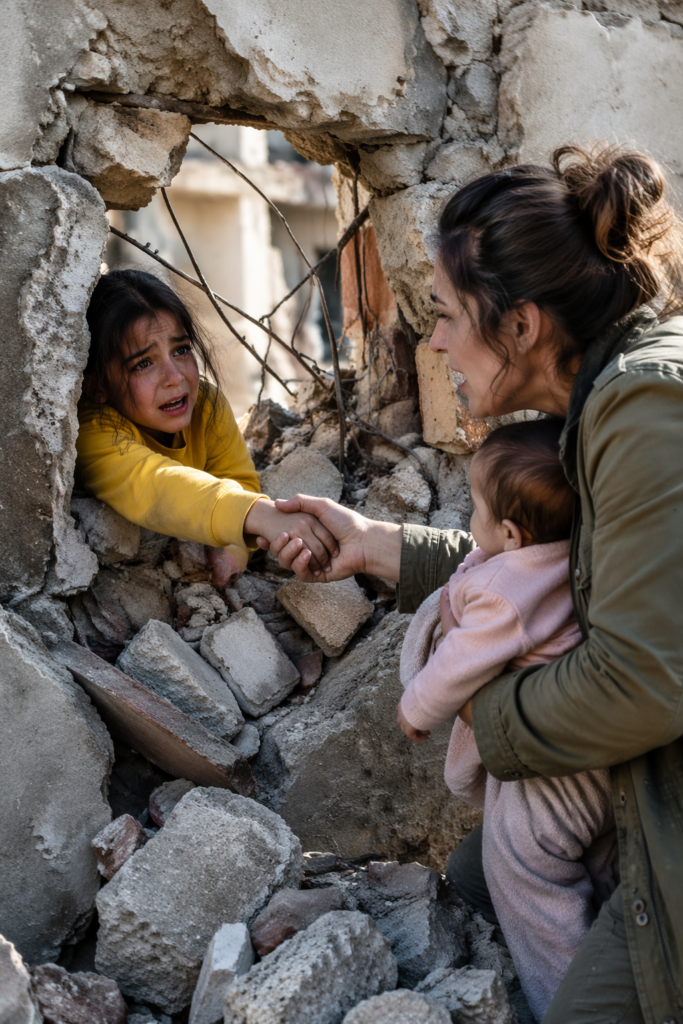
—Easy, little one. We see you. Don’t close your eyes, okay?
It was Don Rubén, a neighbor from the street behind. Valeria didn’t know him, but later she would remember his voice like a bell in the middle of hell.
—My mom left —she murmured.
Don Rubén didn’t answer.
He just put his hand through a gap and held her fingers.
—Hang on, Valeria. You’re getting out of here, no matter what.
It took them a long time to pull her out.
Every stone they moved felt like it was breaking her body. She screamed, cried, begged them not to touch anything else. But Don Rubén didn’t let go of her hand for a second.
When they finally got her out, the street looked different.
There were houses open like wounds, people praying on the sidewalk, sirens caught between cars, and neighbors carrying the injured on wooden doors because the ambulances couldn’t keep up.
Before she fainted, Valeria saw Patricia running toward her.
She no longer held Emiliano.
She came with her shirt torn, her face covered in blood, and a scream that shattered in her mouth.
—My girl! Valeria, my girl!
But Valeria closed her eyes before she could touch her.
She woke up in the General Hospital of Puebla.
Her leg was bandaged, her arm had an IV, and she felt pain that occupied her whole body.
Javier was by her side, with a bandage on his forehead and swollen eyes.
—Where’s my mom? —Valeria asked.
Javier swallowed hard.
—She’s with Emiliano. They’re examining him.
Valeria turned her face to the wall.
—Of course.
—Honey, it wasn’t like that.
—Yes, it was.
In the following days, Patricia tried to see her.
Valeria closed her eyes every time she entered. She pretended to sleep. Sometimes she heard her mother crying outside the room, begging the nurse for 5 more minutes, just 5.
One Wednesday, Patricia came in anyway.
She sat by the bed and touched Valeria’s hand.
Valeria pulled it away.
Patricia remained there as if she had been slapped.
—Vale…
—Is Emiliano okay?
—Yes, my love. He’s fine.
—That’s good.
The silence grew heavy.
Patricia took a deep breath.
—I came back for you.
Valeria let out a dry laugh, too old for an 11-year-old.
—Later.
—No, listen to me, please.
—I don’t want to.
—You’re my daughter.
Valeria looked at her for the first time since the quake.
Her eyes were hard, filled with fever, pain, and rage.
—But not for real.
Patricia paled.
—Who told you that?
—I know.
Javier, from the corner, froze.
—Valeria…
—I’m not your blood —the girl said—. And that day it showed.
Patricia covered her mouth with a hand.
She couldn’t respond.
That silence became the proof Valeria carried for 12 years.
She was discharged a month later. The house was uninhabitable, so they moved to a small apartment in Cholula, near her grandmother.
Emiliano grew up without remembering anything.
Valeria remembered everything.
She remembered the smell of dust, the light between the stones, Patricia’s scream, and that back walking away with the baby in her arms.
Patricia tried to win her daughter back with everything she could.
She left notes in Valeria’s backpack.
She made her hot chocolate.
She took her to therapy.
She bought her a purple drawing notebook because she knew it was her favorite color.
Valeria accepted the things but not the hugs.
When she turned 15, she didn’t want Patricia to accompany her to the entrance of the dance hall. She danced with Javier and then sat far from her mom all night.
When high school finished, she thanked her dad, her teachers, and her grandmother.
She didn’t mention Patricia.
When she left to study architecture in Mexico City, Patricia packed clean sheets, medicine, a Virgin of Guadalupe sticker, and a bag of cookies.
Valeria left almost everything in the trunk.
—You don’t have to do this —she said, cold.
Patricia smiled with wet eyes.
—A mom always does these things.
—You did other things.
Javier closed his eyes, tired.
Patricia said nothing.
Valeria left and answered fewer and fewer calls.
She became a brilliant, serious, almost impenetrable woman. She studied seismic structures because, as she said, she wanted to prevent tragedies.
But Javier knew that his daughter wasn’t just studying buildings.
She was also studying family collapses.
At 23, Valeria worked at a major firm in the capital. She reviewed schools, hospitals, and old buildings. She had a small apartment in Portales, 2 close friends, and one rule: never need anyone too much.
Patricia called every Sunday.
Valeria almost never answered.
Until one dawn, her phone rang.
It was Javier.
—Vale —he said with a broken voice—. It’s your mom.
Valeria sat up straight.
—What happened?
—She fainted. We’re at the hospital.
She drove to Puebla before dawn, her hands cold on the wheel.
When she arrived, she found Javier in the waiting room, aged overnight.
—She has a tumor —he said—. It’s advanced.
Valeria felt something sink in her stomach.
—Since when?
—Months.
—And why didn’t you tell me?
Javier looked at her with sadness that weighed heavily.
—Your mom didn’t want to bother you.
That phrase hurt her more than she expected.
She entered the room.
Patricia was sleeping. She looked thin, with deep dark circles and a light scarf covering her hair.
For the first time in years, Valeria didn’t see the woman who left her under the rubble.
She saw her mom.
Small.
Fragile.
Human.
On the table was an old metal box. Valeria recognized it immediately. Patricia kept photos, documents, and things she called "treasures" in there.
Javier stayed by the door.
—She asked me to give this to you.
—What’s in it?
—The truth.
Valeria opened the box in the hospital hallway.
There were pictures of her as a baby. Her first drawing. A bracelet from the day she arrived home. A lock of hair tied with a pink ribbon.
Underneath was a yellow envelope.
Inside, she found a Civil Protection report, a statement signed by Don Rubén, and a letter written in Patricia’s handwriting.
She read the report first.
Each line took her breath away.
Patricia hadn’t left to save herself.
She had taken Emiliano out because the baby was right under a loose slab that was about to fall. She left him in the arms of a neighbor on the sidewalk.
And came back.
Came back for Valeria.
But a second part of the ceiling collapsed before she could enter. A rebar pierced her side. She lost blood. Still, she tried to crawl back in.
3 neighbors had to hold her back because she screamed that her daughter was still inside.
Valeria moved to Don Rubén’s statement.
“Mrs. Patricia didn’t say ‘the girl.’ She said ‘my daughter.’ She kept repeating: ‘Valeria is my daughter, I have to get her out.’ She fainted when we stopped her, but when she woke up, she tried to go back in.”
Valeria felt the hallway sway.
She opened the letter.
“My Vale:
If you’re reading this, it’s probably because I couldn’t explain it to you while looking you in the eye.
That day, I didn’t leave you behind because I loved you less.
I left you for a few seconds because I had 2 children dying in front of me and only 2 arms.
Emiliano couldn’t walk. You were trapped, but you were breathing. He was under a slab that was coming loose.
I made the most horrible decision of my life: to get the baby out first and come back for you.
I came back, my girl.
I swear to God I came back.
But the house fell again.
Since then, I live with your gaze pierced into my soul.
I know you thought I chose blood.
But you didn’t come from my body, Valeria.
You came from my decision.
I chose you when I saw you for the first time.
I chose you when you had a fever and I slept sitting up to watch over you.
I chose you when you screamed at me that you hated me.
I chose you on every birthday, in every silence, in every Sunday you didn’t answer.
And that day, even though you didn’t see it, I also chose you.
Forgive me not because I abandoned you.
Forgive me because I couldn’t save you without breaking your heart.”
Valeria could no longer stand.
She crumpled to the hospital floor and cried like she hadn’t in 12 years.
She cried for the trapped girl.
For the bloodied mom.
For all the hugs she rejected.
For all the Sundays she let the phone ring.
For turning a wound into a sentence.
Javier sat beside her.
He didn’t say “I told you so.”
He didn’t scold her.
He just held her.
—She tried to explain it to you many times —he whispered—. But you weren’t ready.
—I punished her —Valeria said, trembling—. I punished her for something I didn’t understand.
—They all got trapped that day, honey. Just in different places.
That night, Valeria entered Patricia’s room and sat by the bed.
She took her hand.
It was warm.
—Mom —she whispered.
Patricia opened her eyes slowly, as if she feared she were dreaming.
—Vale…
Valeria’s voice broke.
—I read the letter.
Patricia’s lips trembled.
—I came back.
—I know.
A tear slid down to the pillow.
—I came back for you, my love.
Valeria leaned in and hugged her carefully.
Patricia smelled like the hospital, like soft soap, and that hand cream she had used forever.
—Forgive me you for me —Valeria said.
Patricia stroked her hair.
The same gesture from the kitchen.
The same gesture from childhood.
—I have nothing to forgive you for —she replied—. You were a scared girl.
—I hated you for many years.
—I loved you all those years.
Valeria cried against her chest.
And for the first time since the earthquake, something inside her stopped being buried under the rubble.
The following months were tough.
The treatment drained Patricia. There were days she couldn’t eat. Others when she woke up eager to gossip, scold Javier for the strong coffee, and ask Valeria if she had a boyfriend yet, “because it wasn’t like she was going to become a nun, dear.”
Valeria took a leave of absence from work and stayed in Puebla.
Emiliano, now 13, watched her shyly.
One afternoon, she found him sitting on the roof, looking at the volcanoes.
—Did you hate me? —he asked.
Valeria froze.
—No, Emi.
—But Mom saved me first.
She sat beside him.
—You were a baby.
—Sometimes I feel like it’s my fault you guys broke apart.
Valeria hugged him tightly.
—It wasn’t your fault. It was the quake. It was the fear. It was the pain. But not you.
Emiliano cried silently.
Then Valeria understood that she wasn’t the only one trapped that day.
Patricia had lived under guilt.
Javier under impotence.
Emiliano under a responsibility he should never have carried.
And she under a lie born from pain.
Patricia improved for a time.
It wasn’t a miraculous novel recovery, but it was a gift.
They had 1 year.
1 year to talk about what had never been said.
To see photos.
To laugh at Valeria’s unbearable adolescence.
For Patricia to tell her how the adoption day went.
—You came with your little fists clenched and a tremendous angry face —she said one morning.
—So I was already mad.
—Not mad. Just like me.
They laughed.
And that laughter repaired more than many apologies.
One Sunday, Patricia asked to go to the site where the house once stood.
There was hardly anything left. After the quake, the municipality turned the space into a small community park, with benches, bougainvilleas, and a plaque with the names of those who died in the neighborhood.
Patricia walked slowly, leaning on Valeria’s arm.
She stopped where the kitchen used to be.
—This is where it was —she said.
Valeria nodded.
She thought going back would destroy her.
But it didn’t.
The place didn’t seem like a tomb.
It looked like a closed scar.
Patricia took a little cardboard box from her bag.
Inside were 2 chewed crayons.
Valeria recognized them instantly.
They were the crayons Emiliano had been sucking on before the quake.
—They were found among the rescued things —Patricia said—. I could never throw them away.
Valeria took them in both hands.
She cried.
Not out of rage.
But out of tenderness.
Out of grief.
Out of late but real love.
—Mom —she said—, you chose me when you adopted me.
Patricia looked at her.
—Yes.
—But I also chose you. It just took me a long time to remember.
Patricia smiled with a tired light.
—Then we’re at peace, my girl.
3 months later, Patricia died at home.
There were no screams.
No chaos.
Javier held one hand. Emiliano the other. Valeria stroked her hair like Patricia had done so many times with her.
Before she left, Patricia opened her eyes.
Valeria thought she would hear the word that had chased her all her life.
Forgive me.
But Patricia didn’t say that.
With a thread of voice, she whispered:
—My daughter.
Valeria kissed her forehead.
—My mom.
And Patricia was gone.
At 30, Valeria continued working as an architect specialized in seismic safety. She reviewed schools, homes, and hospitals so that no little girl would ever be trapped in a poorly constructed house again.
On her desk was a photo of Patricia, another of Javier, one of Emiliano, and next to them, the 2 chewed crayons.
When someone asked why she kept them, Valeria smiled.
To anyone, they were trash.
To her, they were proof that a family could shatter, bury itself under tons of guilt, and still find a way to breathe.
For 12 years, Valeria believed her mom had left her beneath the rubble.
But the truth was different.
Patricia never left her.
It was Valeria’s pain that had kept her from seeing her return.