PART 1
When Doña Teresa called, sobbing, to tell her that Julián had been in a crash, Verónica drove to General Hospital with her hands gripping the steering wheel so tightly that her fingers ached.
The entire way, she imagined the worst: blood, sirens, a gurney covered with a sheet. What she never imagined was that the true blow wouldn’t be inside the operating room, but waiting for her in the hallway.
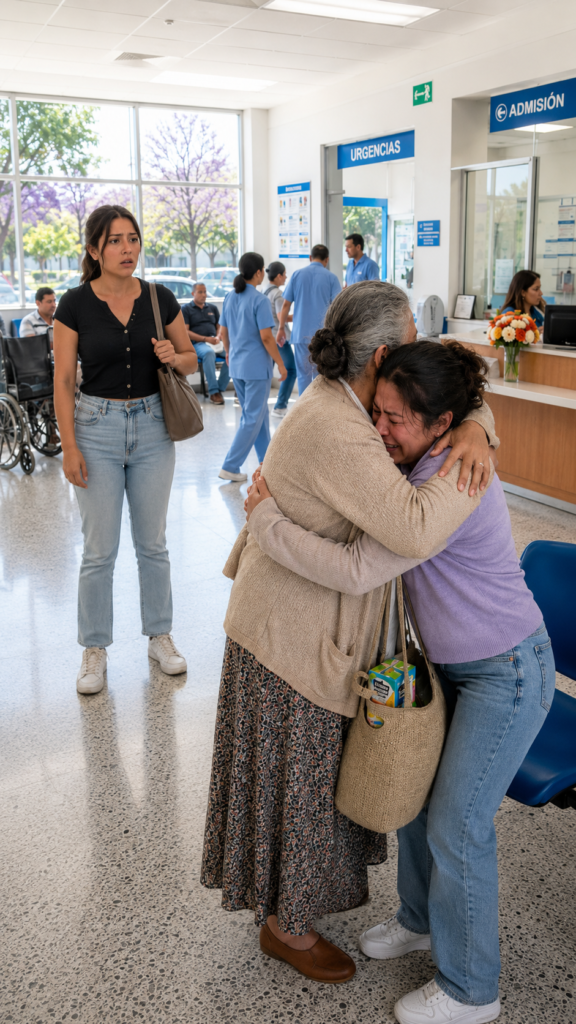
Doña Teresa was already seated in front of the emergency room. She clutched a bag against her chest, her eyes swollen as if she had been crying for hours.
Verónica barely got close when another woman rushed in. Her hair was a mess, her blouse was buttoned wrong, and she was desperately asking for Julián.
Verónica thought her mother-in-law would get up to demand an explanation.
But instead, Doña Teresa walked over to the stranger and embraced her first.
The woman’s name was Karla. Between sobs, she said she had been Julián’s partner for almost two years and that he had sworn to her he was separated.
Verónica felt the chill creep up her spine.
She had been married to Julián for nine years. For those same two years, she had prepared meals, cared for him after surgery, and even helped pay off the debts for the auto repair shop they had built together.
And she loved Doña Teresa almost like a mother. The woman saved mole for her on Sundays, defended her when Julián got stubborn, and never reproached her for not being able to conceive.
More than once, she had stroked Verónica’s hand while telling her that a family didn’t depend on having children.
Before she could react, a three-year-old boy dashed out from behind Karla.
The little boy looked around, saw Doña Teresa, and ran straight to her.
—Grandma!
Doña Teresa picked him up with a naturalness that left no room for doubt. She smoothed his hair, pulled an apple juice from her bag, and opened it without even looking.
She had it all ready.
Verónica felt the floor tilt beneath her.
That child had Julián’s eyebrows, the same chin, and Doña Teresa’s dark eyes.
—How long have you known about him? —Verónica asked.
Her mother-in-law didn’t lower her gaze.
—Since he was born.
She didn’t call her “mija.” She didn’t take her hand. She referred to her by name, as if suddenly the nine years of affection had been erased.
Verónica recalled every Thursday Doña Teresa crossed the city to visit “a sick friend.” She remembered the times she returned with hidden toys and claimed they were for a parish collection.
Everything clicked into place.
—I’ve been lied to for three years.
—That child is not to blame for anything —Doña Teresa replied—. I wasn’t going to leave him abandoned.
The statement seemed noble, but there was something strange in her voice. Something too calm.
Then Verónica asked why she had called her precisely that day, after keeping silent for so long.
Doña Teresa tightened the child against her chest and wiped her eyes, which no longer had tears.
—Because Santiago was in the car with Julián. He only needed three stitches, he’s fine… but I can’t continue taking care of him.
Then she placed the boy in front of Verónica, as if handing her a long-overdue responsibility.
—Take him. He needs a mother, and I need to rest.
PART 2
Verónica stood frozen.
For years, she had wanted to hear that a child needed her. She had endured treatments, tests, injections, delays that ended in disappointment, and intrusive relatives asking when “the baby” would arrive.
But not like this.
Not from the hands of a woman who had called her daughter while hiding her husband’s child.
—And his mother? —Verónica asked, looking at Karla.
The boy slipped from Doña Teresa’s arms, ran to Karla, and hugged her legs.
—Mom —he said.
Karla closed her eyes. Doña Teresa didn’t even turn.
The truth shattered into pieces, the three of them sitting on the hard hospital chairs, the smell of bleach lodged in their throats and an old TV running silent cartoons.
Karla wasn’t the biological mother.
Santiago’s mother was named Lorena. She had met Julián one night when he assured her his marriage was practically over. Months later, the child was born.
Lorena died from a stroke when Santiago was four months old.
That was when the hospital contacted Julián.
He refused to publicly acknowledge the baby. He said he couldn’t destroy his marriage, that Verónica would never forgive him, and that the scandal would sink the shop.
Doña Teresa went to the wake, held the child, and decided to take him with her.
For three years, she secretly cared for him with the help of a cousin who lived in Iztapalapa. Every Thursday, she crossed the city to see him, buy him diapers, take him to the doctor, and pretend in front of Verónica that nothing was happening.
Then Karla appeared.
She had started a relationship with Julián believing he was separated. When she discovered the truth, she had already been caring for Santiago for months, bathing him, taking him to kindergarten, and calming him when he woke up asking for a mother he couldn’t remember.
—When did you know he was married? —Verónica asked.
Karla hesitated before answering.
—Eight months ago.
—And you stayed with him.
—Yes —she admitted—. It was wrong. But Santiago was already calling me mom. I couldn’t leave him with a man who barely saw him.
Nobody in that hallway was innocent.
Julián had lied to everyone.
Karla had stayed with a married man.
Doña Teresa had turned the deceit into a family strategy.
And Verónica, though she still wouldn’t accept it, was on the verge of discovering the darkest part of herself.
—Why didn’t you ever tell me the truth? —she asked her mother-in-law—. You knew how much I wanted a child.
Doña Teresa sighed, annoyed, as if the question had come too late.
—Because you would have left Julián. And if you left, we would lose the house, the shop, and the family. I wasn’t going to let everything crumble because of a mistake.
Verónica looked at her, breathless.
She hadn’t protected her.
She had kept her.
Like a necessary piece to prevent the structure from collapsing.
—Besides —Doña Teresa continued—, I knew one day you could help with Santiago. You were always good with children.
There fell the last mask.
Doña Teresa hadn’t thought to tell her the truth when the child was born, nor when Lorena died, nor when Karla entered Julián’s life.
She had waited until she was tired.
Verónica was the retirement plan.
The barren, loving, responsible wife who, in her opinion, would one day be grateful for any opportunity to be a mother.
Verónica stepped out into the vending machine hallway. She needed air, even though there wasn’t any there either.
She thought about the nine years of marriage.
About the nights crying in the bathroom so Julián wouldn’t hear her.
About the times Doña Teresa embraced her and told her that being a woman didn’t depend on giving birth.
Now she understood that, while comforting her, she was assessing whether Verónica would ever accept raising the hidden grandson.
And then she felt something that made her ashamed.
It wasn’t compassion.
It was desire.
She desired Santiago.
She desired to take him home, buy him a bed, prepare him lunch, hear him call her mom. That child seemed to suddenly fill the void that had been swallowing her life for years.
Her conscience screamed that he already had someone.
Karla.
The woman who might have been her husband’s mistress, but also the only one who had done the work of a mother without blood or papers in her favor.
When Verónica returned, Karla was kneeling, tying the boy’s sneakers.
—Santiago is mine —Karla said, noticing her gaze—. Not by blood, but in everything that matters.
Verónica felt anger, jealousy, and a pang of guilt.
—In the documents, you are nothing —she replied.
Karla paled.
At that moment, a doctor came out. Julián was stable, with two broken ribs and a leg injury. They could see him one by one.
Verónica went in first.
Julián couldn’t hold her gaze.
She didn’t scream. She didn’t cry. She sat by the bed and asked him if Santiago was his son.
He nodded.
Then he confessed that he had thought about acknowledging him one day, “when everything was calmer.” The phrase churned her stomach.
Verónica already knew that the divorce could leave him trembling. The house was in both their names, but she had contributed her father’s inheritance.
The shop also depended on the accounts she managed and several contracts signed by her.
She could take a lot from him.
And Julián knew it.
That same night, she called a lawyer.
Not to seek justice.
To negotiate.
She offered Julián a discreet divorce. She wouldn’t claim the shop, wouldn’t fight for the house, and wouldn’t make public that he had hidden a child for three years.
In exchange, before signing the divorce, he had to legally acknowledge Santiago, consent for Verónica to start his adoption, and support the request for provisional custody while a judge reviewed the case.
Karla would be out because she had no kinship or documentation.
The lawyer fell silent before asking if she understood what she was doing.
Verónica replied that she did.
Julián accepted in less than 24 hours. The process took several weeks, with interviews and home visits, but he maintained in front of everyone that Verónica was the most stable person to raise the child.
He saved his business, his house, and his reputation by handing over the responsibility he had never wanted to assume.
Doña Teresa supported the deal. She even declared it was “best for the child.”
Karla found out when the request was already in process.
She came to Doña Teresa’s house crying, pleading not to be separated from Santiago.
—I raised him —she repeated—. I was there when he had a fever. I taught him to talk. I am his mom.
But in front of the law, she was neither a wife nor a relative and had no custody.
The day Verónica went for Santiago, the boy carried a blue backpack with dinosaurs.
Upon seeing her, he stepped back.
Karla crouched down to explain that he would live in another house. She didn’t get to finish.
Santiago clung to her neck and started screaming “mom” with a desperation that made even the neighbors cry.
Verónica could have stopped.
She could have looked at the child and recognized that he wasn’t being rescued, but torn away.
She didn’t.
She picked him up while he kicked, hit her shoulder, and stretched his arms towards Karla.
—You’ll get used to it —Doña Teresa told her.
Verónica hated that phrase.
Even so, she put the child in the car.
On the way, she gave him an apple juice, the same one his grandmother always had ready. Santiago cried until he fell asleep, his face wet and the backpack hugged against his chest.
Verónica drove with trembling hands.
Just like the afternoon of the accident.
Only now the accident was her.
Nine months passed.
Santiago began calling her “Mom Vero.” He entered a kindergarten near their home, learned to ride a bike, and stopped waking up every night looking for Karla.
Only sometimes did he look for her.
Verónica allowed him to see her twice a month in a park. Not because an authority demanded it, but because her guilt wouldn’t let her sleep when the child asked about her.
Karla arrived with cut fruit, stories, and a jacket in case it got chilly. Santiago ran to hug her with a joy that Verónica could never manage to provoke in the same way.
Every goodbye was a wound.
Karla cried in her car.
Santiago cried on the way home.
And Verónica pretended that time would eventually set everything right.
Doña Teresa saw the child on Sundays. She no longer called Verónica daughter, and Verónica never referred to her as mother-in-law again.
Julián showed up when it suited him. Sometimes he brought an expensive toy, took a photo, and disappeared for weeks.
Thanks to the agreement, he kept the shop and the house he claimed he deserved.
Verónica got what she had desired for nine years.
A child.
Her sister said she had saved an orphan from a family full of lies.
A sister-in-law stopped talking to her and accused her of using the divorce as a sales contract to snatch a child from the only woman who had truly raised him.
Both were partly right.
Santiago was cared for, went to school, ate well, and laughed again. Verónica loved him with a true strength, even if that love had been born mixed with selfishness.
But some nights, when she watched him sleep, she remembered his fingers clinging to Karla’s neck and his screams calling for his mom.
Then she understood that she resembled Doña Teresa too much.
Both had used pretty words to justify what they desired.
One called “protecting the family” hiding a betrayal for three years.
The other called “giving him a home” winning a child through negotiation.
Verónica knew she could no longer change the beginning of that story.
She could only decide what kind of mother she would be from that moment on.
And still, the question haunted her every time Santiago hugged Karla in the park:
Did she truly give a mother to a child who had none, or did she take away the only one he had chosen to fill a void that should never have to be paid for?