PART 1
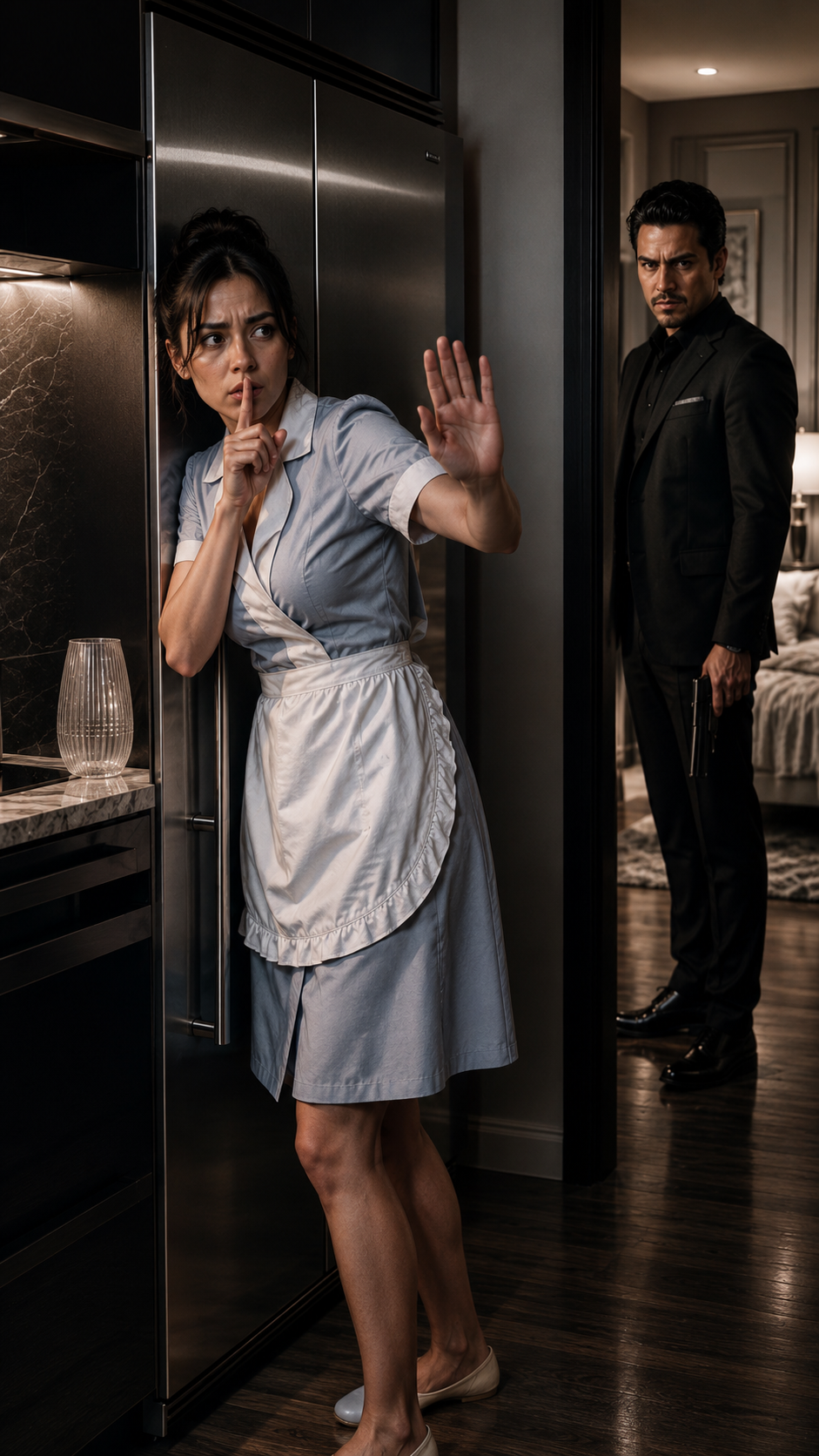
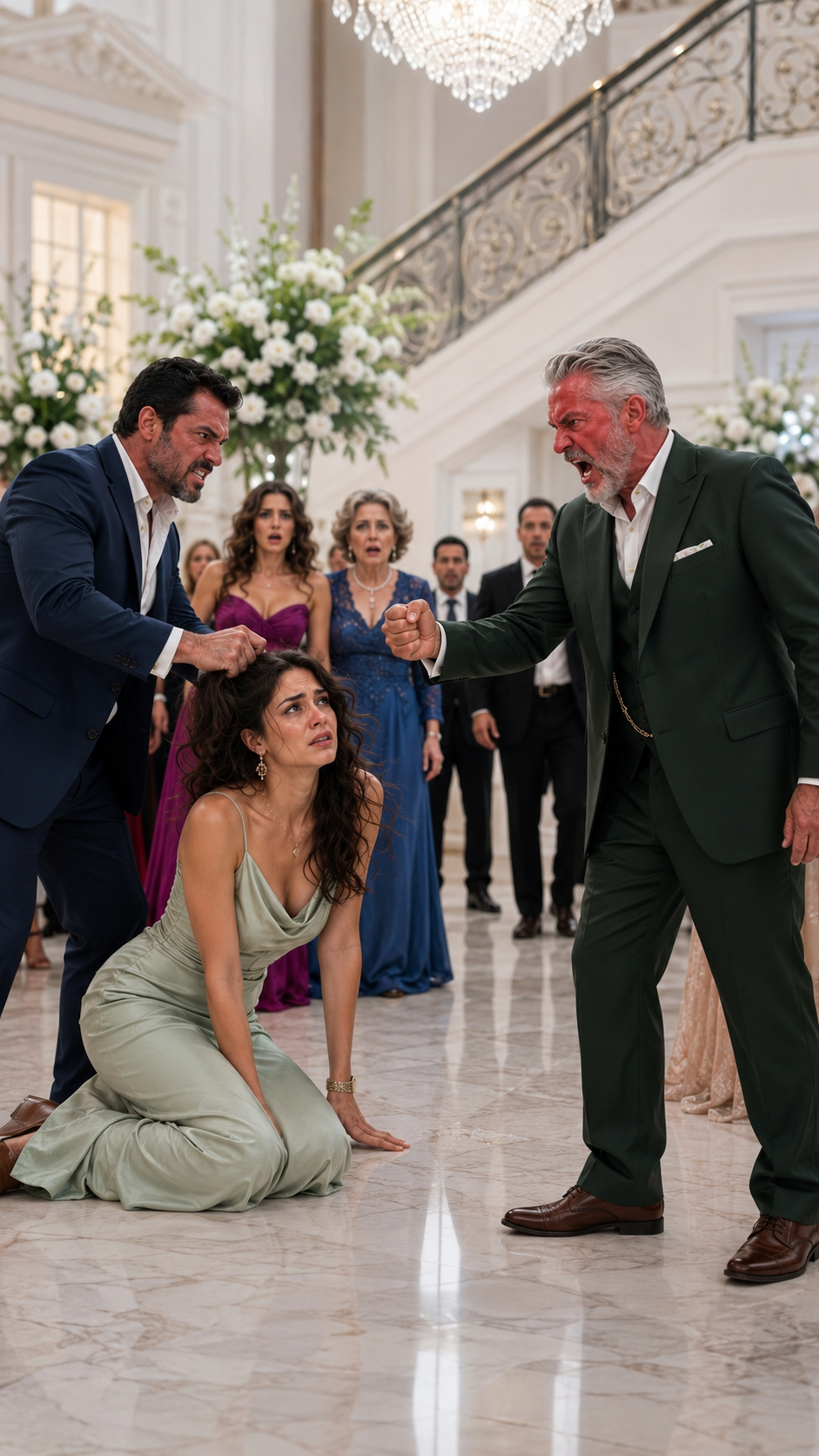
Mariana fell to the cold kitchen floor with such a thud that the air caught in her chest.
She didn't scream.
The pain shot up from her right leg to her throat like a white, brutal jolt, the kind that erases the entire world for a few seconds.
The rolling pin lay beside her body.
It still had flour stuck to it.
Doña Teresa, her mother-in-law, looked at it as if it were just another kitchen utensil. She wasn't trembling. She wasn't crying. She didn't seem sorry.
"So you learn," she said, adjusting her apron.
Mariana tried to move, but her leg twisted in an impossible way. The tile was stained with soup, dough, and blood. A few steps away, Don Rogelio, her father-in-law, stood leaning against the doorframe, his arms crossed.
He did nothing.
He didn't even look down.
Mariana was 30 years old, a risk analyst at a financial firm in Santa Fe, had single-handedly paid half the price of that house in Coyoacán, and earned more than Julián, her husband.
But that night, lying on the floor, she felt that all of that was for nothing.
"Julián…" she whispered when she saw him appear in his office shirt, cell phone in hand. "Please, take me to the hospital."
Julián didn't run.
He wasn't scared.
He didn't even look at her leg first.
He looked at the spilled mole, the broken dishes, and then at his mother.
"What did you do now, Mariana?" he asked wearily, as if she had made a scene for no reason.
“Your mother hit me… with the rolling pin,” Mariana said, barely breathing. “She broke something. I can’t move.”
Doña Teresa let out a dry laugh.
“She raised her voice in my kitchen. Nobody talks to me like that, least of all some young woman who thinks she’s so important because she has an office salary.”
Mariana wanted to explain that she had only asked them to stop checking her bank statements. That Doña Teresa had been saying for weeks that a wife shouldn’t have any money on the side. That Julián had demanded her passwords “out of trust.”
But the pain wouldn’t let her.
Julián approached slowly.
For a second, Mariana thought he was going to pick her up.
That she was finally going to see what her family was doing to her.
He bent down, grabbed her face tightly, and squeezed her jaw.
“I told you a thousand times,” he murmured. “In this house, my mother is respected.”
Mariana wept silently.
"Julian, please..."
He pulled his face away as if disgusted.
"Perhaps you should have thought about the consequences before disrespecting my mother."
Then he stood up.
"Let her stay there for a while. We'll see tomorrow if she really needs the hospital."
Mariana heard them leave the kitchen.
Then came the sound of the television.
A Liga MX match.
Cutlery.
Laughter.
Doña Teresa saying the rice had gotten cold because of “the drama queen.”
The house continued functioning as if there wasn't a broken woman lying on the floor.
Mariana looked at the back door.
It was raining hard outside.
On the other side of the patio lived Doña Elvira, a widowed neighbor who always left her sweet bread on Sundays.
Mariana understood something with terrible clarity.
If she stayed there until morning, she might not wake up.
So she dug her nails into the grout lines of the tile and began to crawl.
Inch by inch.
Her leg burning like fire.
She reached the back door, opened the rusty gate with an old hook, and stepped out into the patio in the rain.
Mud covered her clothes.
Her hair stuck to her face.
Every movement was torture.
But she kept going.
When he reached Doña Elvira's porch, he couldn't climb the three steps.
He just raised a trembling hand and knocked on the bottom of the door.
Knock.
Knock.
Knock.
The porch light flicked on.
The lock clicked.
And when the door opened, Mariana saw Doña Elvira bring her hands to her mouth while, behind the fence, Julián's kitchen curtain slowly swayed.
PART 2
Doña Elvira reacted in barely a second.
She came down the steps in slippers, knelt in the rain, and covered Mariana with a blanket that smelled of bar soap and lavender.
"Oh, my child… what did they do to you?"
Mariana tried to speak, but her teeth chattered from the cold and the pain.
"No… don't bring me back… please…"
Doña Elvira took her hand.
"No one is bringing you back, my child. No one."
She pulled her cell phone from her robe pocket and called 911 with a firmness that brooked no doubt.
“I need an ambulance. My neighbor crawled to my door. Her leg is shattered. It wasn’t a fall, it wasn’t an accident. She was beaten.”
Mariana wanted to tell her to lower her voice.
Fear still compelled her to protect them.
But Doña Elvira looked her straight in the eyes.
“Don’t cover it up, Mariana. Look what they did to you.”
That sentence hurt her almost as much as her leg.
Because Mariana had been covering everything up for two years.
She covered up the first time Doña Teresa told her that a married woman shouldn't buy clothes without permission.
She covered up when Julián checked her cell phone while she slept.
She covered up when Don Rogelio saw his wife throw a cup at him and just said, "Better not provoke her."
She covered up when Julián started repeating that independent women ended up alone because they didn't know how to obey.
And that night she understood that covering them up had left her completely exposed.
When the ambulance arrived, the paramedics found Mariana soaked, covered in mud, her right leg deformed, and her toenails broken from crawling.
One of them asked:
"Who did this to you?"
Mariana looked toward Julián's house.
The kitchen window was lit.
The curtain moved again.
Julián was behind it.
He didn't come out.
He didn't call her name.
She didn't ask for help.
She just watched until she was sure the ambulance was taking her away.
Then she turned off the light.
Mariana closed her eyes and said before fainting:
"Teresa Salgado. Julián Salgado."
She woke up in the hospital with her leg immobilized, an IV in her arm, and a young doctor reviewing her X-rays.
The pain was different now.
More controlled, but more real.
"Mariana," the doctor said, "you have a serious fracture. The pattern of the injury doesn't match a simple fall. This looks like a direct blow."
Mariana felt the room shrink.
"They're going to say I fell."
"We already know that," the doctor replied. "That's why social work is here."
A woman with her hair pulled back came in shortly after. Her name was Marisol Rivas, and she spoke with a calmness that didn't pressure her.
She didn't ask her to tell everything at once.
She offered her water.
She asked if she wanted Doña Elvira to come in.
She explained that she could request protection and that no one, not even her husband or her mother-in-law, could take her out of the hospital without her consent.
Mariana cried then.
Not from the pain.
But because someone had just reminded her that her body still belonged to her.
She told her what she could.
The steamroller.
The argument over their accounts.
Julian's comment.
Dinner.
The match.
The fence.
The mud.
The porch.
Marisol listened in silence.
Finally, she placed a folder on the table.
"Your neighbor has a camera on the porch."
Mariana's eyes widened.
"It didn't record the kitchen."
"It doesn't need to have recorded the kitchen to prove you were running for your life."
The video showed Mariana crawling in the rain, crossing the patio, falling twice, and banging on the door from the ground.
It also showed, in one corner, the kitchen window with the light on.
And a male silhouette watching.
Then, the light went out.
It wasn't everything.
But it was enough to make the word "accident" start to smell like a lie.
Over the next three days, Julián called 21 times.
The first call was gentle.
"My love, there's been a mix-up." My mom is very upset.
The third one already sounded annoyed.
"No way, Mariana. Are you going to make a scene over something family-related?"
The seventh call was a disguised threat.
"Remember you're married. Don't try to play the victim."
Marisol asked permission to listen to the next call on speakerphone.
Mariana hesitated.
She still felt that old guilt, the one that told her not to air her dirty laundry.
But she looked at her bandaged leg.
She looked at her broken nails.
She looked at the wheelchair next to the bed.
"Yes," she said.
The 22nd call was the one that opened the trap.
Julian didn't know Marisol was there.
He didn't know the doctor was taking notes.
He didn't know a prosecutor was waiting in the hallway.
"My mother just taught you a lesson," he said quietly. "If you had apologized, none of this would be happening. We left you in the kitchen to think, not to make a scene."
Mariana didn't answer.
For the first time, she understood that staying silent could also be effective.
Marisol picked up the phone.
"Mr. Salgado, Mariana is stable. If you and your mother would like to clarify what happened before she's discharged, you can come on Thursday at 11:00. The doctor needs to hear your side of the story."
Julian agreed immediately.
He thought he was going to enter the hospital the way he entered his own house: giving orders.
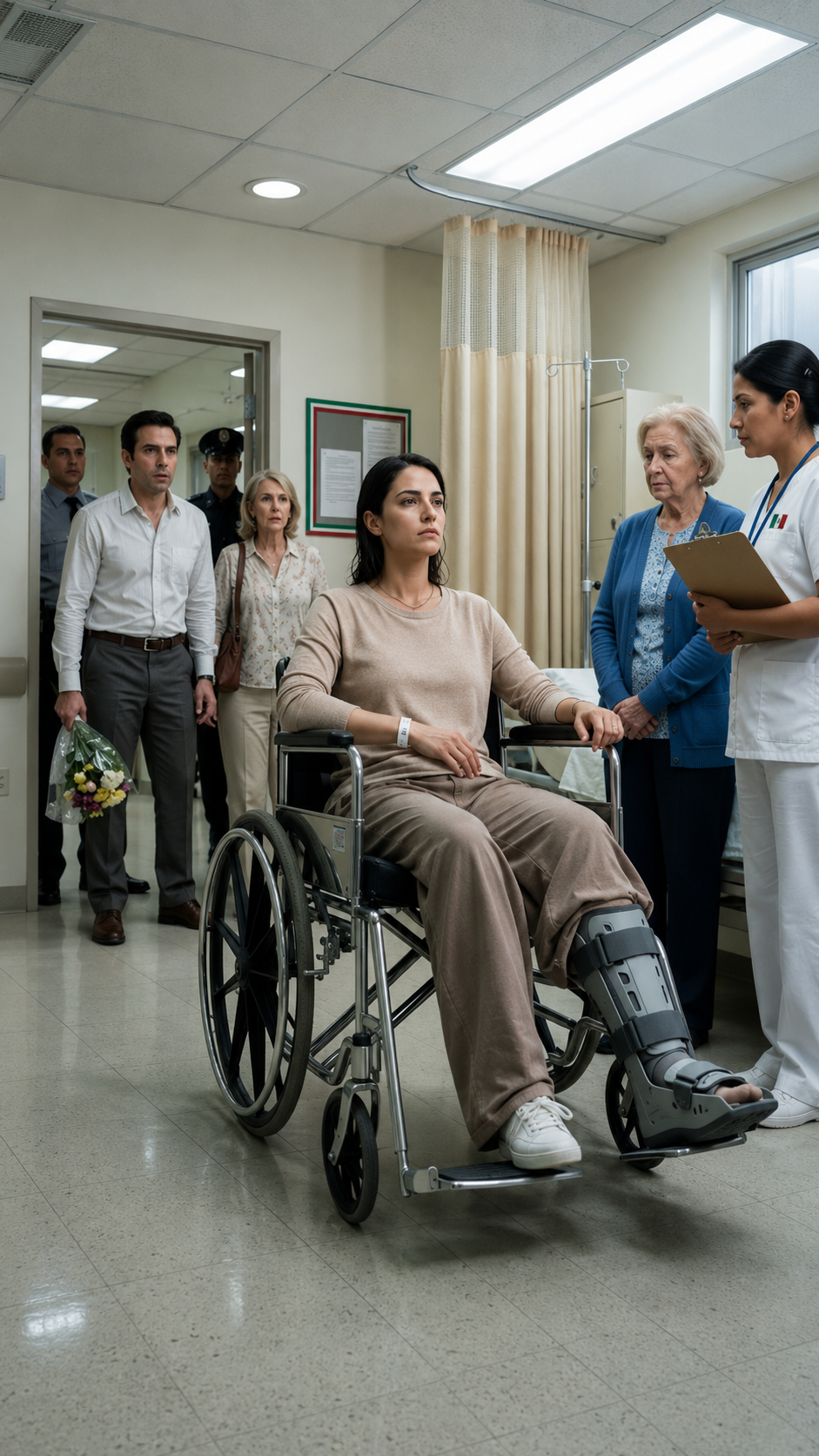
At 11:00 on Thursday, he arrived with Doña Teresa and Don Rogelio.
Julián was wearing a white shirt, an expensive watch, and carrying a cheap bouquet, probably bought at a traffic light.
Doña Teresa's hair was styled in a salon, her lips red, and she had a black bag pressed tightly against her chest.
Don Rogelio walked behind her, looking at the floor.
Mariana was sitting in a wheelchair.
Doña Elvira was beside her.
Marisol was beside her.
The doctor closed the door.
"Thank you for coming. We need you to explain exactly how the injury occurred."
Julián sighed with practiced sadness.
"Mariana fell. She was agitated. My mother tried to help her, but she became aggressive."
Doña Teresa lifted her chin.
"I'm an elderly lady. I would never hurt anyone. She's always been very arrogant."
The doctor reviewed the file.
"So they found her on the floor and decided not to take her to the hospital."
Julian blinked.
"We thought she was exaggerating."
"Did you know she couldn't walk?"
Doña Teresa clutched the bag.
Julian let out a nervous chuckle.
“Doctor, you don’t know her. Mariana uses her money and her job to humiliate my family. My mother only corrected a lack of respect.”
The room fell silent.
Sometimes, the truth doesn’t need to chase the liar.
It just waits for the liar to hurry up.
The officer opened the door.
A guard remained in the hallway.
The doctor played the audio recording of the call.
“My mother only taught you a lesson.”
“We left you in the kitchen so you could think.”
“If you had apologized, none of this would be happening.”
Doña Teresa went pale.
Julián dropped the bouquet.
The flowers shattered on the white hospital floor.
Mariana looked at them and thought that even beautiful lies made a sound when they broke.
The officer explained that there was a formal investigation for assault, domestic violence, and failure to render aid.
They also had the porch video, the medical report, Doña Elvira's testimony, and Mariana's initial statement.
Doña Teresa tried to stand up.
"She's my daughter-in-law! Family matters are settled within the family!"
Mariana spoke for the first time.
"I'm not your daughter-in-law. I'm the woman you left lying on the floor while you were having dinner."
Don Rogelio broke down right there.
He didn't cry beautifully.
He cried like cowards do when they discover that their silence also has consequences.
"I saw it," he murmured. "Teresa hit her. Julián said we should leave her there."
Doña Teresa turned to look at him with hatred.
"Shut up, Rogelio!"
But it was too late.
The man who had never defended her had just confirmed what everyone already knew.
The twist came that very afternoon.
Julián asked to speak with Mariana "alone to sort this out like adults."
Marisol asked if he wanted to.
Mariana agreed, but with the door open.
Julián went in without his mother.
He no longer looked like an offended husband.
He looked like a man who had finally understood that his authority was useless outside his home.
"Mariana, don't ruin my life over one bad night."
She looked at him from her wheelchair.
"My life was on the floor while you watched soccer."
Julian swallowed.
"What do you want?"
Before, that question would have sounded like a threat.
Now it sounded like surrender.
Mariana didn't ask for love.
She didn't ask for forgiveness.
She didn't ask him to change.
She asked for her purse, her documents, her computer, her cards, and the keys to an apartment in Narvarte.
Julián's eyes widened.
"Which apartment?"
Mariana took a deep breath.
"The one I rented a month ago, after your mother threw a cup at me and you said I provoked her."
That was the real blow for him.
Not that she filed a police report.
Not that there were security cameras.
Not that the hospital had caught them.
But discovering that Mariana had already started leaving long before the fracture.
She had clothes stored away.
Copies of documents.
A separate bank account.
A place where no one could tell her to obey.
Doña Teresa thought she broke it with a rolling pin.
But it only gave her the final proof that running away wasn't an exaggeration.
It was survival.
The case continued its course.
Julián tried to tell the family that Mariana had gone crazy for money, but the audio circulated first among the uncles, then among the cousins, and later in WhatsApp groups where everyone pretended to know nothing.
Doña Teresa stopped going to the neighborhood market because the neighbors no longer greeted her with "good morning."
They asked her:
"And what about your daughter-in-law's leg, ma'am?"
Don Rogelio gave an official statement.
Not out of bravery.
Out of fear.
But even so, his statement helped.
Mariana had surgery, rehabilitation, and endured horrible nights.
Because justice doesn't heal bones automatically.
There were days when the pain gnawed at her leg.
Days when the phone made her tremble.
Days when she wondered how she had allowed so much to happen.
Doña Elvira would visit her with chicken soup, gelatin, and neighborhood gossip.
"You don't have to forgive them to heal, my dear," she would tell her. "Sometimes healing is simply ceasing to open the door to them."
Mariana began to walk again, first with a walker, then with a cane.
She never hid the slight limp that remained.
She said it wasn't shameful.
It was proof she survived.
Months later, Julián texted her from another number:
“Everything got out of control. Honestly, I really did love you.”
Mariana read it only once.
She didn't reply.
She blocked the number.
She closed her apartment door.
She made coffee.
It was raining outside too, but this time the rain didn't smell of fear.
It smelled of the city, of open windows, of new life.
And as the rain battered the glass, Mariana understood something many women take years to accept.
Love doesn't leave you lying on the floor.
Family doesn't use silence as punishment.
And whoever breaks you to teach you obedience doesn't deserve to call it home.
Sometimes, the place where it hurts the most to fall becomes the exact spot where a woman finally begins to get back up.