PART 1
For three years, Mauricio Ledesma turned his wife's fear into a private pastime.
He didn’t hit her during explosive arguments, nor out of a loss of control. He did it out of boredom, after dinner, between phone calls, while soft music played in the living room of their home in Zapopan.
—That face you make before you break makes me laugh so much —he would say.
Then he'd pour himself aged tequila, adjust his luxury watch, and ask if she had learned to behave yet.
Renata learned many things.
She learned which stairs creaked, how long bruises took to change from purple to yellow, and how to smile during charity dinners without moving her injured rib too much.
She also learned to appear completely helpless.
Before marrying, Renata had worked as a forensic accountant for the Jalisco Prosecutor's Office. She investigated shell companies, fake invoices, and embezzlement.
Mauricio convinced her to quit.
—The wife of a Ledesma doesn’t go chasing criminals through spreadsheets —he mocked her.
What she never imagined was that Renata hadn’t forgotten how to build a case.
Mauricio recorded the assaults because he enjoyed replaying the videos. He stored them in a hidden folder on his phone, confident she didn’t know the password.
Renata did know it.
She also knew the passwords for his companies, his private accounts, and the children’s foundation where Mauricio appeared in magazines handing out huge checks in front of the cameras.
Each blow gave her not just a reason to escape.
It gave her a reason to destroy him with his own evidence.
On an old tablet linked to a cloud account Mauricio didn't even remember, Renata had copied videos, audios, and documents.
She also set up an automated send.
If she didn’t enter a code before 9:00 AM, everything would go to the Prosecutor's Office, two journalists, and a trusted former colleague.
One night, Mauricio attacked her until the bathroom began to spin in front of her eyes. Renata woke up for a few seconds on the cold floor while he wiped the blood from her lip with a wet towel.
—You slipped in the shower. Understand?
She couldn’t respond.
At the Santa Lucía private hospital, Mauricio entered carrying her like a desperate husband. He told reception that Renata was very clumsy. To the nurse, he assured her that she always ended up bruised over nothing.
But when Doctor Julián Herrera lifted the sheet and saw marks on her jaw, wrists, shoulders, and ribs, his expression changed.
—She fell in the shower —Mauricio repeated calmly.
The doctor observed the fingerprints around Renata's arm.
—No —he replied—. This wasn’t a fall.
He stepped into the hallway and called 911. Security positioned themselves at the door.
Mauricio leaned over the bed, smelling of mint and alcohol.
—If you say a single word, you’ll be left without a house, without money, and without anyone.
Renata opened her eyes wide.
He thought the police were coming to rescue her.
He didn’t know that the ambulance, the hospital, and his own cellphone were the last pieces of the plan she had been preparing for three years… nor that, in a matter of minutes, the Ledesma name would begin to rot before everyone.
PART 2
The first police officers arrived before Mauricio could invent another excuse.
His arrogant confidence remained intact until Dr. Herrera handed over photographs of every injury, every bruise mark, and every old blow that didn’t coincide with an accidental fall.
Mauricio let out a chuckle.
—My wife is very emotional. When we argue, she gets confused and exaggerates.
The doctor didn’t react.
Renata forced her swollen eyes to stay open and looked directly at Commander Abril Castañeda.
—Check his phone —she whispered.
Mauricio turned around so quickly that he finally revealed something he never showed: fear.
He tried to get closer to the bed, but two guards stood in the way. He began shouting that Renata was crazy, that she took medication, and that she wanted revenge because he was thinking of divorcing.
His voice echoed through the emergency room.
Nurses, family members, and patients peeked in.
The commander secured the phone as evidence and requested the urgent authorization needed. While waiting, she noticed the device receiving nonstop notifications from a storage app.
Renata provided another code.
—Album “Trips”. Code 0719.
Mauricio stopped shouting.
Inside a folder that looked like it held family photos were dozens of videos. In each one, he filmed the assaults, laughed behind the camera, and forced Renata to apologize.
The files were time-stamped with dates, times, and locations.
They were not isolated moments.
They were three years of premeditated violence.
One of the agents had to leave the room. Commander Castañeda turned off the screen and looked at Mauricio with a mix of disgust and fury.
—You are under arrest.
When they placed the handcuffs on him, he searched for Renata's eyes.
—Do you think you won?
She breathed through the pain.
—This has just begun.
Mauricio still didn’t understand.
As the police examined his phone, an internal alert detected movements linked to the Ledesma Children’s Foundation. The name was already appearing in an investigation for missing donations, nonexistent suppliers, and triangulated transfers to accounts in Panama.
Renata asked to speak privately with the commander.
She explained where to find two encrypted computers, a hidden memory in the cellar, and several false contracts stored inside a cigar box.
She also provided names, dates, and money routes.
The commander looked at her in surprise.
—How do you know all this?
—Because before I got married, I investigated fraud. And because he thought quitting my job meant stopping my thinking.
Mauricio listened from the hallway.
His face lost color.
—Did you know?
Renata held his gaze.
—I knew everything you were.
The domestic violence arrest turned, within hours, into an investigation for money laundering, tax fraud, and embezzlement of donations.
But then came the first twist.
The financial unit discovered that Mauricio didn’t control the main accounts. He had access, signed documents, and received a portion, but the final authorization belonged to someone else.
The registered name was Teresa Ledesma.
His mother.
Teresa was a respected figure in Guadalajara. Honorary president of the foundation, exemplary widow, frequent guest at DIF events, and known for speaking about "family values" with a hand over her chest.
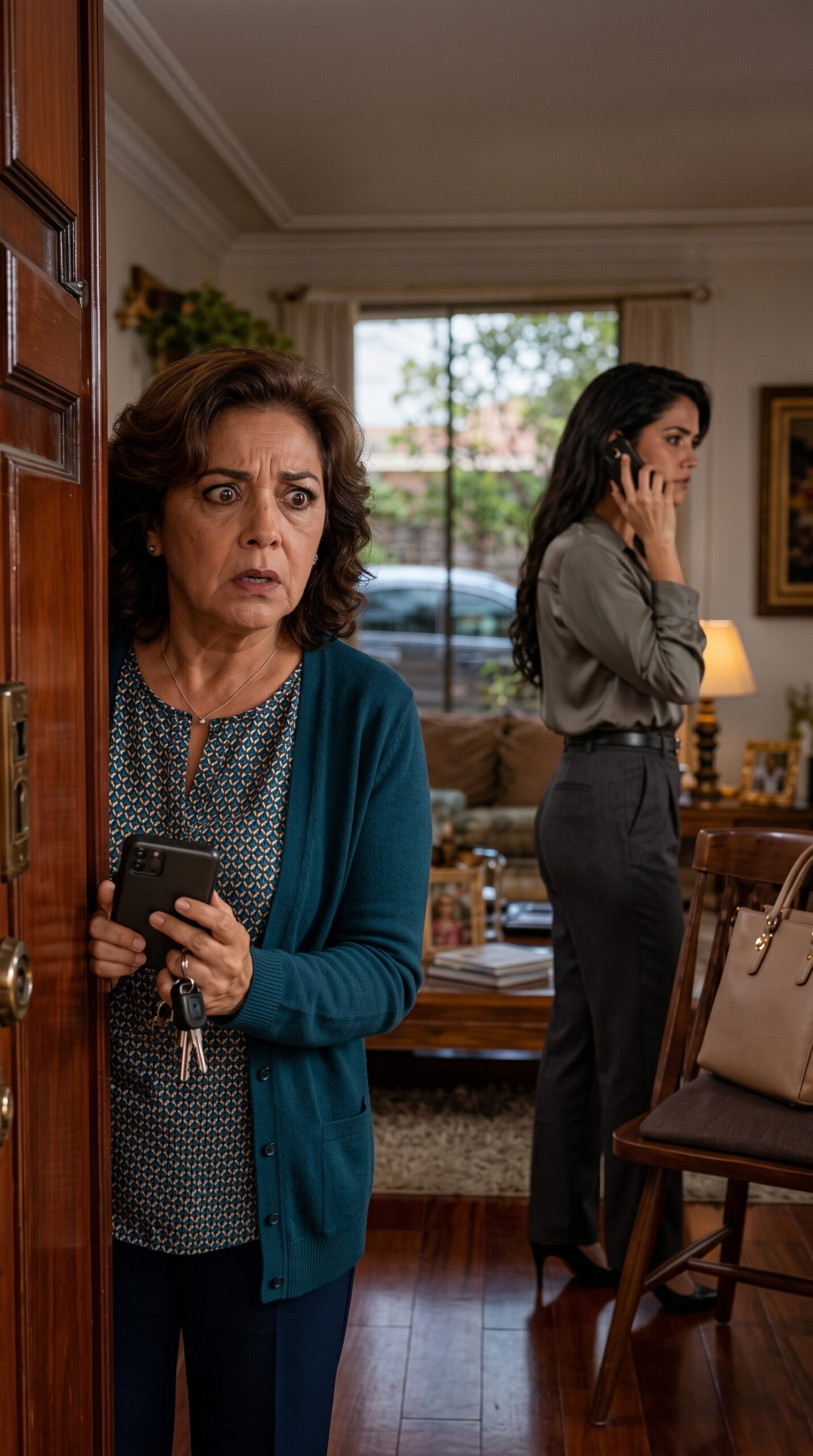
When she arrived at the hospital, dressed in white and accompanied by two lawyers, she didn’t ask about Renata.
She demanded to see her son.
—This is a private misunderstanding —she said—. Decent families resolve their problems at home.
Commander Castañeda informed her that Mauricio was in custody and that several accounts had been frozen.
For the first time, Teresa looked toward Renata's room.
She didn’t seem worried.
She seemed offended.
She entered without permission and closed the door.
—Just look at the scandal you’ve caused —she murmured—. After all this family has done for you.
Renata watched her from the bed.
—Did you also know he was hitting me?
Teresa adjusted her bag on a chair.
—I knew my son had a difficult temperament. You should have learned not to provoke him.
That answer confirmed something worse than financial complicity.
Teresa had seen the bruises.
She had hired makeup artists before galas. She had changed domestic staff when someone asked too many questions. She had even sent a trusted doctor to the house to avoid hospital reports.
She wasn’t just protecting Mauricio.
She was managing silence.
—He could have killed me —Renata said.
—But he didn’t —Teresa replied—. And now you intend to bring down hundreds of employees over couple problems. Seriously, how selfish.
Renata felt rage, but not surprise.
For months, she had kept a recorded conversation in which Teresa ordered the transfer of money from the foundation to pay a former employee who had reported assaults by Mauricio.
The recording was set to automatically send to the Prosecutor's Office if Renata hadn’t canceled the send before 9:00 AM.
It was 8:52.
Teresa leaned toward her.
—Give me the passwords and I will publicly say my son needs treatment. We’ll get you a house, an account, and a discreet exit. You can rebuild your life.
—And the other women?
Teresa’s face hardened.
—There are no other women.
At 9:00, the commander’s phone began to ring.
The automatic send had gone out.
It didn’t just contain account statements and videos. It included testimonies from four former employees, proof of payments made to buy silence, and audios where Teresa ordered the disappearance of medical records.
One of the files revealed that the foundation had used the names of sick children to justify treatments that never took place.
The money ended up in luxury properties.
The "lady of charity" had enriched herself using the pain of poor families.
Teresa lost her composure.
—You don’t know who you’re messing with!
The commander opened the door. Outside, agents from the asset recovery unit were already waiting.
Renata replied calmly:
—I do know. That’s why I kept copies in five different places.
Teresa was arrested in the same hallway where just hours earlier she had tried to protect Mauricio.
However, the hardest blow was yet to come.
During the search of the residence, they found a hard drive with videos of other women. Some had been Mauricio's partners. Others had worked in his house or in his companies.
One had been missing for six years.
Her name was Karla Méndez, and she had been Teresa’s personal assistant.
In one recording, Karla was seen arguing with both of them. She threatened to report the fraud and tell that Mauricio had been attacking women before they got married.
The video ended when Teresa said:
—Take her to the house in Tapalpa. I’ll take care of the rest.
The police located the property.
In a closed warehouse, they found Karla’s documents, clothes, and human remains that were later identified through forensic tests.
Mauricio stopped smiling.
His defense tried to blame his mother. Teresa insisted that her son acted alone. Both began to publicly destroy each other, revealing secrets, accounts, and crimes to reduce their own sentences.
The family that had boasted unity for years ended up accusing each other in front of cameras.
Mauricio confessed that his mother knew about every assault. Teresa revealed that he had threatened donors and hit two employees. Their lawyers leaked information. Their partners fled.
The Ledesma empire collapsed not because of a grand spectacular operation, but due to something they scorned: a silent woman who had learned to keep receipts.
Months later, the trial filled headlines across Mexico.
The videos proved the violence. The audios demonstrated the cover-up. The financial records connected the foundation with shell companies.
Mauricio received a long sentence for domestic violence, bodily harm, illegal deprivation of liberty, and participation in Karla's case.
Teresa was convicted of money laundering, fraud, concealment, and homicide.
Several accomplices also fell.
Renata took much longer to recover than people imagined.
Leaving the hospital didn’t mean feeling free. For weeks, she woke up at the sound of music from another room. She couldn’t stand the smell of tequila or the feeling of someone walking behind her.
Dr. Herrera remained attentive to her recovery, treating her not like a broken woman.
Commander Castañeda helped her enter a protection program while the processes concluded.
Over time, Renata returned to financial work, but not in a government office.
She created an organization that helped women document economic control, hide secure copies of evidence, and recognize signs of economic violence.
She never asked them why they hadn’t left sooner.
She knew that escaping wasn’t always about opening a door.
Sometimes it was about memorizing a password, hiding a memory stick, waiting for the right moment, and surviving one more day.
A year later, in front of a group of women in a support house in Tlaquepaque, Renata told a single sentence from her story:
—He thought my silence was obedience, but my silence was taking notes.
Some people said she should have reported from the first blow.
Others insisted she risked too much by waiting.
But those who had lived something similar understood the uncomfortable truth: from the outside, everyone believes they know the right moment to flee; from the inside, every exit can look like another trap.
Mauricio enjoyed watching her suffer because he thought fear had made her small.
Teresa treated her like an intruder because she believed the name Ledesma could buy doctors, employees, police, and silences.
Both were wrong.
Renata didn’t survive because she was invincible.
She survived because, even terrified, she never stopped observing.
And in the end, the question that divided the entire country wasn’t why she took three years to speak.
It was how many people saw her bruises during those three years… and decided it was none of their business.