PART 1
The first cry of her son didn’t make Mariana cry.
It woke her up.
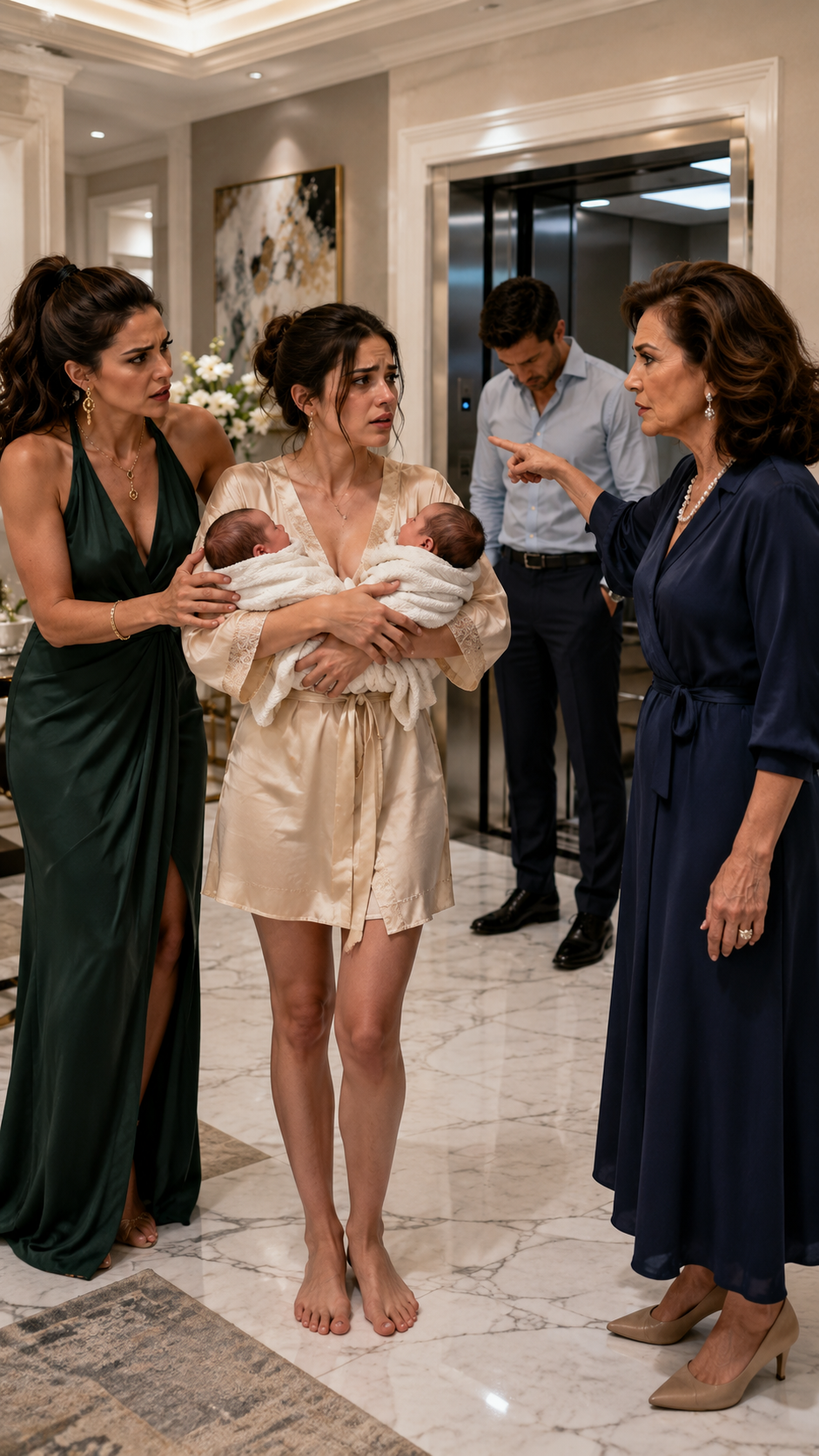
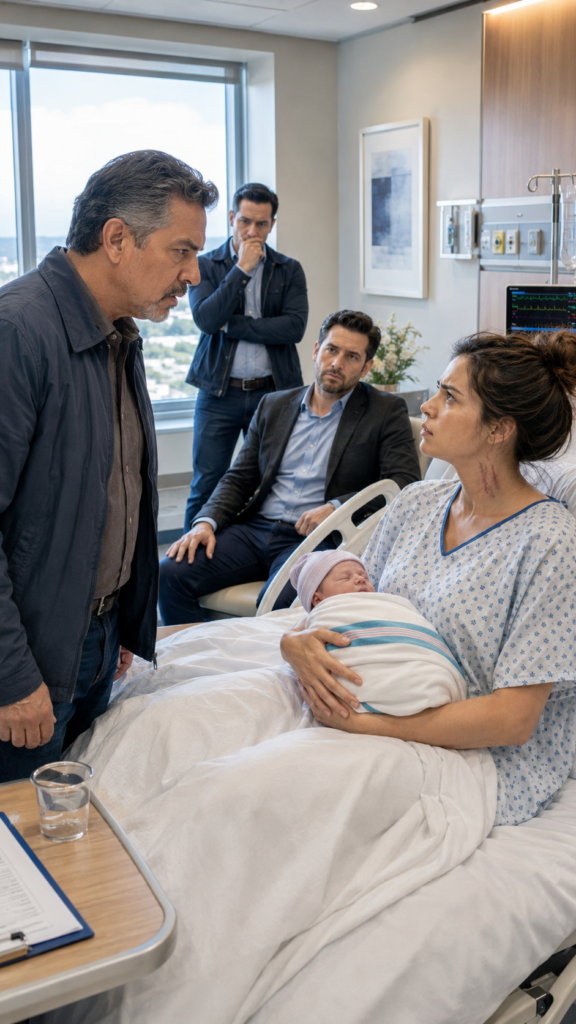
She was sitting on the bed in Hospital Ángeles in Puebla, her body shattered from childbirth, her arms trembling, with the newborn pressed to her chest as if he were the only clean thing in that room.
On her neck still marked five dark fingers.
They weren’t old bruises.
They were fresh.
Julián, her husband, leaned back in the chair, his shirt unbuttoned, his phone in hand, and a smile so calm it was terrifying.
—He understands who runs this new family now —he said, as if he were talking about organizing an office.
Her father, Don Rogelio Salvatierra, let out a dry chuckle by the window.
He was a 63-year-old man, owner of a transportation company, used to everyone lowering their gaze when he entered a room.
—Don’t exaggerate, Mariana —he said—. Women get intense after giving birth. Hormones, you know.
Mariana swallowed hard.
It hurt to breathe.
The silver balloon that read “WELCOME, CHAMPION” softly brushed against the ceiling. On the small table, huge flowers sent by Julián’s clients bloomed. He had already posted a smiling photo with the baby on social media, writing: “The happiest day of my life.”
No one saw the handprint marked on Mariana’s neck.
No one heard the fear behind her silence.
—He’ll be named Rogelio Julián —her husband ordered—. Like my dad and like me.
Mariana pressed the baby against her gown.
—His name is Mateo —she whispered.
Julián’s smile vanished.
—What did you say?
Don Rogelio straightened up, annoyed.
—Don’t start with your whims, girl. That boy is a Salvatierra.
Julián stood up from the chair.
Mariana closed her eyes for a second, thinking that again the hand would come, the pull, the low threat.
But then the door opened.
Her uncle Armando walked in.
He carried a bag of pastries from the bakery, a worn brown sweater, and his hearing aids in. At 72 years old, with a bad knee and a slightly hunched back.
To Julián, he seemed like just any old man.
To Mariana, he was the only man who had never let her down.
Armando took two steps and stopped.
His eyes fixed on her neck.
Then he looked at Julián.
Then at Don Rogelio.
The room fell so silent that even the baby stopped moving.
—Who did this to her? —Armando asked.
Julián let out a mocking laugh.
—Oh, uncle, don’t get upset. I was just teaching my wife who’s the boss of this family.
Mariana felt her blood turn to ice.
Armando didn’t shout.
He didn’t lunge at anyone.
He merely set the bag of bread on the table.
Then he slowly walked to the door, locked it, and pulled the white hospital curtains until they covered the entire window.
Then he took off his hearing aids and placed them next to the untouched food tray.
—Close your eyes, mija —he said with a calm that sent chills down her spine.
Mariana couldn’t.
Because at that moment, the sleeve of Armando’s sweater slid up a bit, revealing an old tattoo on his forearm: a black dagger piercing a broken crown.
Don Rogelio saw it.
His face drained of color.
The man who had humiliated drivers, employees, and lawyers for 30 years began to tremble like a scolded child.
—It can’t be… —he murmured.
Julián frowned.
—Dad? What’s wrong with you?
Don Rogelio tried to speak but could only cover his mouth.
Then he doubled over and vomited on the shiny floor of the hospital.
Armando didn’t look away.
And Mariana understood, with her heart pounding against her ribs, that Julián had just made the biggest mistake of his life.
PART 2
Armando stood still in front of Don Rogelio, as if he were seeing a ghost that had finally decided to come back from the dead.
—You remember me —he said.
Don Rogelio wiped his mouth with the sleeve of his fine jacket. His hands trembled.
—Armando Cárdenas —he whispered.
Julián glared at his father angrily.
—What the hell are you talking about? Do you know him?
Armando barely turned to him.
—Your dad knows well the men who don’t kneel.
Julián gritted his teeth.
—Look, sir, I don’t know what circus you want to start here, but this is my family. My wife. My son.
Mariana lifted her gaze.
For the first time in many hours, her voice didn’t come out broken.
—My son’s name is Mateo.
Julián took a step toward her.
—I told you not to challenge me.
Armando barely moved, but it was enough for Don Rogelio to grab his son by the arm.
—Shut up —he ordered in a low voice.
Julián looked at him indignantly.
—Now you too?
—Shut your mouth, idiot —Don Rogelio repeated, sweating cold.
That word changed everything.
Julián had never heard fear in his father’s voice.
Armando approached the bed and took an old cellphone from his pocket. He carefully placed it in Mariana’s hand.
—It’s time, mija.
She knew exactly what to do.
For months, Armando had asked her to keep evidence. He hadn’t pressured her to leave when she was still scared. He hadn’t judged her when she forgave false promises. He told her the same thing every Sunday:
—The abuser lives off the fact that no one can prove anything.
So Mariana had kept everything.
Photos of bruises.
Hidden audio files with fake names.
Messages where Julián demanded passwords.
Blocked transfers.
Screenshots of Don Rogelio writing: “A wife should be educated early, before she feels like the owner of the house.”
And that morning, before Julián arrived at the hospital, Mariana had spoken with the social worker.
The nurse had already photographed her neck.
Security had a copy of the video from the hallway where Julián stormed into room 314.
There was also a recording.
Julián’s voice sounded clear:
“If you ever say again that the child won’t carry my name, I’ll take him away from you. No one believes a crying old woman who just gave birth.”
Mariana opened the file and played it.
The room filled with her husband’s voice.
Julián froze.
—Delete that.
—No —Mariana said.
A single word.
Small.
But it returned her soul to her body.
Julián tried to snatch the phone from her, but Armando held his wrist. Not tightly. Not violently. Just precisely. Julián grimaced in pain.
—Not one step closer —the old man said.
The nurse knocked on the door.
—Is everything alright here?
Julián attempted to regain his charming businessman smile.
—Yes, ma’am. Just a family moment.
Mariana looked at the nurse.
—No. I need help.
The nurse saw her neck.
Then she saw the vomit on the floor.
Then she saw Julián clutching his wrist.
In less than a minute, two hospital guards arrived.
Julián turned red.
—Do you know who I am? My family donates money to this hospital.
Don Rogelio closed his eyes, as if each word from his son were a stone falling onto his own grave.
Armando put his hearing aids back on.
—Good thing you mention donations —he said—. Because your dad loves bought favors.
The guards exchanged uncomfortable glances.
Then two municipal police officers arrived. One of them, a commander with the last name Mena, recognized Don Rogelio and tried to soften his voice.
—Let’s see, Don Rogelio, surely we can clear this up without a scandal.
Armando fixed him with a stare.
—is the lawyer Morales still in Internal Affairs?
The commander grew serious.
—Who are you?
Don Rogelio spoke before anyone else.
—Don’t mess with him, Mena.
Mariana had never seen her father-in-law ask for anything.
But there he was.
Pale, humiliated, begging without using the words “please.”
Julián exploded.
—Enough! Why does everyone fear this old man?
Armando rolled up his sweater sleeve a bit more.
The tattoo appeared in full.
The dagger.
The broken crown.
A long scar crossing underneath.
—Because your dad didn’t build his company alone —Armando said—. He stole it from a dead woman.
Silence fell heavy.
Mariana blinked.
Not even she knew that part completely.
Don Rogelio leaned against the wall.
—Armando…
—My wife, Teresa Cárdenas, had 30% of Transportes Salvatierra —he continued—. She put up money, routes, contacts, and even her house as collateral. When she died, Rogelio forged documents, disappeared shares, and sent some cowards to warn me not to ask questions.
Julián shook his head.
—That’s a lie.
Armando pulled a folded folder out of his bag of pastries.
Among the conchas were certified copies.
Deeds.
Signatures.
Account statements.
A notarized power of attorney with scribbles.
—Your dad thought I was finished because I buried my wife and because I left the Army with a half-broken leg. But I wasn’t finished. I was gathering evidence.
Don Rogelio breathed as if he were short of air.
—These were other times.
—No —Armando said—. It was theft.
Mariana looked at her father-in-law and understood something terrible.
Julián’s violence hadn’t originated in their marriage.
It was inherited.
Like a surname.
Like a business.
Like poison served at the family table.
The social worker entered with a doctor and asked for Mariana to be examined. Julián tried to approach the baby, but the guard blocked him.
—I’m his father —he shouted.
—And she’s the victim —the doctor replied—. You leave now.
Julián was removed from the room amid threats of lawyers, influences, and lawsuits.
Don Rogelio wanted to go after him, but Armando spoke calmly:
—If you make one call to move your contacts, I’ll send all of this to the Prosecutor’s Office, to the SAT, and to every partner who still believes you’re honorable.
Don Rogelio stood still.
For the first time, he obeyed.
That night, Mariana testified with Mateo asleep on her chest. Her neck burned. Her body was exhausted. But something inside her was no longer kneeling.
Armando sat beside her and held her a glass of water.
—You did well, mija.
—I’m scared —she admitted.
—Of course you are. Courage doesn’t take away fear. It just keeps fear from driving.
In 48 hours, Mariana obtained an emergency protection order. Julián couldn’t approach her, the baby, or the house. The hospital provided photos, videos, and medical reports.
The provisional hearing was six days later.
Julián arrived in a blue suit, perfectly coiffed, with an expensive lawyer. In front of the judge, he spoke as if he were in a business meeting.
—My wife is unstable. She just gave birth. My family only tried to protect the child.
The judge opened a folder.
—Protect him from whom, Mr. Salvatierra? From the mother you gripped by the neck just hours after she gave birth?
Julián swallowed hard.
The attorney requested that the audios not be reproduced due to “family context.”
The judge refused.
The courtroom listened to Julián’s voice:
“My dad has judges, police, and doctors. You don’t have anyone, Mariana.”
Mariana clenched Mateo’s blanket.
Armando, sitting behind her, didn’t move.
Then came the second blow.
Mariana’s lawyer presented the documents of Teresa Cárdenas. The old fraud of Transportes Salvatierra was connected to phantom accounts, false signatures, and properties purchased under front names.
But the strongest twist came with an unexpected witness.
Doña Elvira, Don Rogelio’s former secretary, entered trembling with a yellow folder.
She had worked for the family for 22 years.
And had kept copies of everything.
—I stayed quiet because they threatened to take my son’s scholarship away —she said before the judge—. But when I saw on Facebook Mr. Julián carrying the baby like a saint, and then I learned what he did to that girl, I said: enough.
In that folder was a letter from Teresa, Armando’s deceased wife.
The letter stated that if anything happened to her, her shares should go to her husband and then to Mariana, the niece she had raised like a daughter during her early years.
Mariana covered her mouth.
—Me?
Armando looked down.
—Teresa adored you. I was going to tell you when you were ready. Not like this.
Julián heard that and turned pale.
Because the woman he called high-maintenance, exaggerated, and weak could end up having rights over the company his family boasted as an empire.
The judge ordered exclusive provisional custody for Mariana, supervised visits for Julián, and immediate protection measures. She also notified the Prosecutor’s Office for domestic violence, threats, and possible influence trafficking.
Don Rogelio didn’t walk out like a powerful man.
He left supported by his lawyer.
The following weeks were a slow, public downfall.
Transportes Salvatierra lost contracts.
The SAT froze accounts.
Three partners requested an audit.
Two former drivers reported payments under threat.
And when Teresa’s documents reached the company’s board, Don Rogelio was removed from his position.
Julián tried to play the victim on social media.
He posted an old photo of Mariana smiling and wrote: “Sometimes good men are destroyed by lies.”
It lasted 17 minutes.
Mariana’s cousin uploaded a censored screenshot of the five-finger bruises and wrote:
“Lies don’t leave five-finger marks.”
The post went viral.
Thousands commented.
Some asked why Mariana hadn’t left sooner.
Others replied what many women understood without explanation:
Because sometimes you don’t leave when you want.
You leave when you can.
Six months later, Mariana lived in a small house in Cholula, far from the Salvatierra mansion. Mateo laughed when Armando made faces at him and called him “my general.”
The divorce was still in process, but Julián was charged and only saw the child for one hour a week, under supervision.
Don Rogelio sold his ranch to pay lawyers.
It wasn’t enough.
The company had to legally recognize Teresa Cárdenas’s participation, and part of those shares were placed in a trust for Mariana and Mateo.
One afternoon, Armando carried the baby in the yard. The sun gently warmed the bougainvillea pots.
—Do you remember what that guy said? —he asked—. That he was going to teach who ran the family.
Mariana looked at Mateo, who was trying to bite the old man’s sleeve.
For the first time, she smiled without guilt.
—I remember.
Armando raised an eyebrow.
—Well, he was right about one thing.
Mariana looked at him confused.
He adjusted the baby in his arms.
—Someone’s in charge now.
Mateo let out a laugh.
So did Mariana.
And in that moment, she understood that justice doesn’t always arrive screaming.
Sometimes it enters with a bag of sweet bread, closes the curtains, takes off the hearing aids, and reminds an abuser that no family is built on fear without someday collapsing on top of it.