PART 1
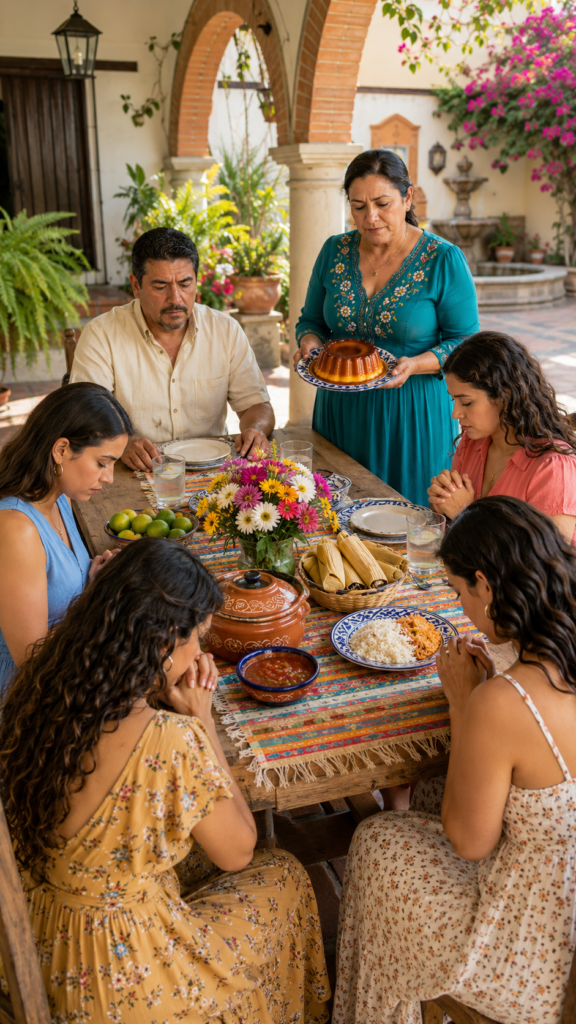
Mónica had spent all Saturday cooking as if that dinner could mend years of silence.
Since 8 in the morning, she had been in her kitchen in Coyoacán, preparing mole, red rice, salad, flan, and even hibiscus water with cinnamon, because Ricardo said his friends always showed up "hungry for a restaurant and with a fonda's budget."
She laughed when he said it.
She usually laughed to avoid answering.
At 8 PM, the guests arrived: Laura, Ceci, Brenda, and Andrea, her friend since their kids were in kindergarten. Andrea was more than an acquaintance. She was the woman who had accompanied Mónica to the IMSS when she had an anxiety crisis, the one who brought her broth when her mother died, the one who knew where she kept her medications and fears.
So when Andrea hugged her at the door and whispered:
—You look beautiful, Móni.
Mónica believed her.
She believed her, even though her hair was unkempt, even though the black dress was a little tight, even though she hadn’t wanted to look at herself in the mirror for months.
The dinner started quietly. School gossip, supermarket prices, the traffic on Insurgentes, how the kids didn’t respond to messages anymore.
But Andrea was acting strange.
She arrived more dressed up than usual, with red lips, dangling earrings, and an expensive perfume that Mónica didn’t recognize. She hardly touched her plate. She kept her phone face down next to her glass, lifting it occasionally to peek at the screen before hiding it again.
Mónica thought maybe she was waiting for news about her daughter Pamela.
You invent pretty explanations when you don’t want to see the filth yet.
The blow came with dessert.
Mónica had placed the flan on small plates, topped with cajeta and chopped nuts. Ricardo looked at his plate, picked up his spoon, and, without raising his voice, said:
—Honestly, Mónica, you should take better care of yourself. You’ve gained so much weight that you don’t even represent me anymore.
The table went silent.
Ricardo continued slowly, as if he had rehearsed every word in front of the mirror.
—A man has needs. And if his wife neglects herself, then the consequences are on her. It’s not cruelty; it’s reality.
No one breathed.
Laura lowered her gaze. Ceci squeezed her napkin. Brenda opened her mouth but said nothing.
Mónica felt something shatter inside her, but she smiled.
She smiled like women do when their dignity is being ripped away, not wanting to give the aggressor the satisfaction of seeing blood.
—Who wants more coffee? —she asked.
No one wanted.
The dinner ended quickly. Her friends hugged her tighter than usual as they left. Andrea was last. She looked at her with eyes full of something strange, something that didn’t seem like mockery or triumph.
It looked like fear.
—I’m sorry —she whispered, so low that Mónica thought she had misheard.
Then she left.
Mónica cleaned up the dishes alone. Ricardo had already gone into the bedroom, satisfied, as if he had just won an argument that no one had started.
While picking up the napkins, she saw a phone under the table, next to the leg of Ricardo’s chair.
She picked it up to take it.
The screen lit up.
There was a new message from a contact saved as "Andrés Plumbing."
"Tonight I’m dying of jealousy thinking you’re with her. Tomorrow you’ll tell me everything."
Mónica felt cold.
She unlocked the phone because she had known the password for years: Ricardo’s birth date, because he wasn’t even creative enough to hide.
She entered the chat.
The photo took a moment to load.
When it appeared, Mónica couldn’t breathe.
It wasn’t any plumber.
It was Andrea.
Her Andrea.
The woman who had told her an hour earlier that she looked beautiful.
PART 2
Mónica didn’t scream.
She didn’t cry immediately.
She sat in the nearest chair with Ricardo’s phone in one hand and the other clutching her chest, as if her heart wanted to leap out of her throat.
She started scrolling through the chat.
Months of messages.
First were favors. Then loans. After that, hotels. Deleted audios. Hearts. Photos Andrea should never have sent and phrases from Ricardo that Mónica read with disgust, as he spoke about her like she was an old piece of furniture in the house.
But the worst wasn’t discovering the infidelity.
The worst was finding the message from that very afternoon, while Mónica was sweating in the kitchen, stirring the mole to prevent it from burning.
Ricardo had written to Andrea:
"Don’t worry. Today I’ll destroy her in front of everyone, and you’ll see that the one who doesn’t belong is her, not you."
Mónica felt nauseous.
It hadn’t been a fit of rage.
It hadn’t been a rude outburst from a weary husband.
Her humiliation had been a gift. A show prepared so that the mistress would feel chosen at the same table where the wife served dessert.
—No way… —she murmured, her voice broken.
She took screenshots of everything with trembling fingers.
But as she scrolled further, something started to feel off.
The recent messages from Andrea no longer had hearts. They no longer held desire. They were filled with fear.
One said:
"Ricardo, I too was the woman humiliated at a table. Don’t make me participate in this."
Another said:
"Who’s the girl you posted on your story Saturday?"
And another, further down:
"If it’s Pamela, I swear you’re going to regret it."
Pamela.
Mónica dropped the phone on the table as if it were on fire.
Pamela was Andrea’s daughter. The girl Mónica had carried as a baby at kindergarten parties. The girl who had just turned 23 and was studying design in Roma.
Then she remembered something.
Andrea had sent her a message four days earlier, but Mónica hadn’t opened it. That week she had avoided her phone, photos, mirrors, everything that reminded her she felt dim.
She searched for her own phone.
There it was.
Message from Andrea. Tuesday, 11:07 PM.
"Móni, I’m sorry. I don’t know how to tell you this. Don’t let Saturday pass by like nothing. Ask him about his phone. Ask him about Pamela. I can’t keep quiet anymore. I’m sorry, truly."
Mónica read the line five times.
Andrea hadn’t written to brag.
She had written as a desperate mother.
The next morning, Mónica called Andrea.
She didn’t scream. That’s what many friends would later not understand.
—Come to my house —she said—. Ricardo is at the office. We need to talk.
Andrea arrived in less than 30 minutes. Without makeup, with a swollen face, hair tied up, and an old bag slung over her shoulder.
She sat in the living room where they had shared coffee so many times, but this time she looked like an accused woman awaiting sentencing.
—You’ve read it —Andrea said.
Mónica didn’t answer.
—I know about you and Ricardo. I know about the money. I know about a year and a half of lies. Now tell me about Pamela.
Andrea covered her mouth with one hand.
And there she broke down.
She explained that it all started when her husband lost the auto parts business in Iztapalapa. Their cards were maxed out. They owed tuition. They were about to lose the truck.
Ricardo lent her money.
Then he charged her with his presence.
Then with kisses.
Then with his body.
Andrea said she wanted to leave many times, but each attempt was accompanied by disguised threats.
"Do you want everyone to know how you pay your debts?"
"Do you want your husband to see the messages?"
"Do you want Pamela to find out what kind of mother she has?"
Andrea was crying silently.
Mónica listened with cold hands.
—That doesn’t make you innocent —Mónica said.
—No —Andrea replied—. But I didn’t come to ask you to forgive me. I came because he doesn’t want me anymore. Now he wants my daughter.
The air grew heavy.
Andrea explained that Ricardo had met Pamela at a gym in Del Valle. He told her he was divorced. That his wife had emotionally abandoned him. That he lived alone. That he was a good misunderstood man.
Pamela didn’t know that this man was Mónica’s husband.
And according to Andrea, maybe Ricardo did know that Pamela was his daughter.
—I don’t dare to assure it —she whispered—, because if he knew, then he’s a bigger monster than I thought.
Mónica stood up and walked to the window.
Outside, a man was selling tamales, shouting like any other Sunday. The world continued as normal while the lives of three women were breaking apart.
—Why did you go to the dinner? —Mónica asked—. Why did you sit at my table?
Andrea lifted her face.
—Because I wanted to look you in the eyes before you hated me. I wanted to tell you one true thing before everything got dirty.
Mónica remembered the hug.
"You look beautiful, Móni."
Andrea cried harder.
—And because I needed you to blow everything up. Pamela wouldn’t believe me. She would think it was jealousy, control, dramatic mom stuff. But if you exposed it, if you showed who Ricardo was, she would run.
Mónica looked at her with rage.
—So you used me.
Andrea didn’t deny it.
—Yes. I used you. And I would do it again if it saves my daughter.
That phrase didn’t sound like an apology.
It sounded like a sentence.
Mónica felt the urge to slap her. She also felt the urge to hug her. And that mix gave her more courage because simple betrayal can be easily hated, but betrayal with pain behind it becomes a labyrinth.
Andrea left behind a folder of screenshots, names, dates, and the account where Ricardo had deposited money for 18 months.
Before leaving, she said:
—Destroy me if you want. I earned it. But keep Pamela out of this.
Mónica was left alone.
She had two phones, dozens of screenshots, and a truth capable of igniting half the neighborhood.
She could send everything just to Pamela.
That would be enough.
Pamela would see that Ricardo was married, manipulative, cruel. She would distance herself. Andrea would be marked before her daughter, yes, but not destroyed before everyone.
Or she could do something else.
She could send everything to the group of friends, the kindergarten moms group, Ricardo’s family, Andrea’s husband, Andrea’s mother, the neighbors, everyone who had ever sat at a table with them pretending to be a decent family.
Mónica sat down in front of the dining room.
The same dining room where Ricardo had called her fat.
The same dining room where Andrea had lowered her head.
The same dining room where everyone had stayed silent.
And she chose to burn it all.
She sent 15 messages.
In each group she wrote:
"So you know who Andrea really is."
She attached screenshots. Dates. Photos. Deposits. Conversations.
She also included Pamela.
"To save her," she told herself.
But as she pressed send again and again, she felt something that terrified her to acknowledge.
It wasn’t justice.
It was relief.
The warm relief of finally being the good one in the story.
In less than an hour, the scandal exploded.
Andrea’s husband arrived home shouting. He kicked her out that very afternoon. Andrea’s mother, an 80-year-old woman, stopped answering her calls. The friends deleted her photos. In the kindergarten group, they wrote horrible things, those kinds of things people write when they want to feel moral without getting their hands dirty.
Pamela did leave Ricardo.
She sent one single message:
"You disgusted me since I learned the truth. Don’t ever contact me again."
That saved the girl.
But Andrea was left alone.
Ricardo, on the other hand, didn’t take long to find a new girlfriend. He posted stories in Polanco, dinners on terraces, phrases like "life goes on." Men like him usually have what it takes to start over.
Mónica got divorced.
The house was in her name because the lawyer found evidence of psychological violence, threats, and economic manipulation. Her friends called her brave. Her family said she had finally opened her eyes.
For weeks, Mónica believed she had won.
Until one night, while cleaning old photos, she found a screenshot she didn’t remember saving.
It was Andrea’s message from Tuesday.
The one that said "I’m sorry" four days before dinner.
The one that demonstrated Andrea had tried to warn her.
Mónica stared at it for a long time.
And there she understood the part she never told in the groups.
She had seen the notification that Tuesday night.
She didn’t open the full message, but she saw the beginning.
"I’m sorry. Don’t let Saturday…"
And she ignored it.
Because a part of her was already tired of Ricardo. Because she had wanted to leave for three years and didn’t have the courage. Because she needed a public scene, proof, a humiliation with witnesses so no one would judge her for leaving her marriage.
Saturday wasn’t just an ambush from Ricardo.
It was also a dinner that Mónica let happen.
Andrea betrayed her friend. That was true.
But Mónica buried Andrea’s attempt at forgiveness to turn her into a complete villain.
Because a villain desperate to save her daughter was uncomfortable.
A villain with guilt made people think.
And Mónica didn’t want them to think.
She wanted applause.
Months later, Andrea lived in a rented room in Nezahualcóyotl and cleaned houses for women who once offered her coffee. Pamela gradually started talking to her again, not with affection yet, but with a sadness that one day could resemble forgiveness.
Ricardo continued as if nothing had happened.
And Mónica kept receiving comments like "queen," "strong," "you deserve everything."
But at night, when the house fell silent, she would hear two phrases again.
Ricardo’s:
"Today I’ll destroy her in front of everyone."
And Andrea’s:
"I used you. And I would do it again."
Then Mónica understood that in this story, no one had come out clean.
Ricardo was cruel.
Andrea was treacherous.
But Mónica, when she had the power, also chose a public table to destroy another woman.
And that was the question that haunted her more than any infidelity:
Is justice still justice when you also use it to hide your own guilt?