PART 1
The storm fell on Querétaro as if the sky wanted to warn everyone of something.
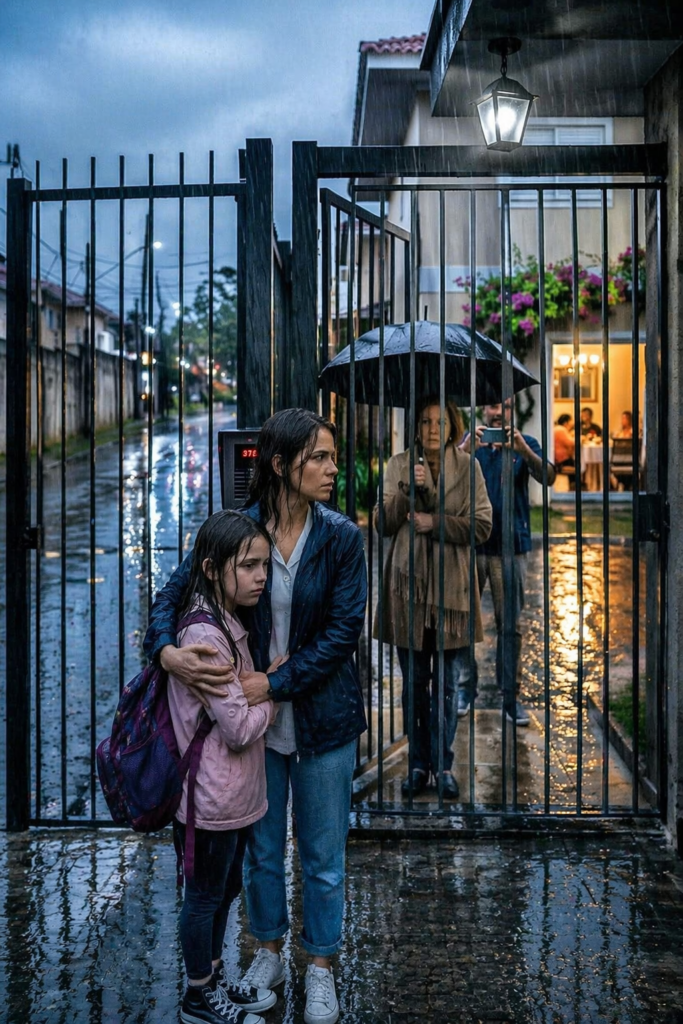
At 3:22 PM, twelve-year-old Sofía Ramírez arrived at the entrance of the residential Valle de los Encinos, her middle school uniform soaked, her sneakers caked in mud, and her backpack clutched tightly against her chest.
She pulled out her access card, swiped it across the reader, and waited.
Bip.
Red.
She tried again.
Bip.
Red again.
She did it 37 times.
The guard, Mr. Toño, watched her from the booth with uncomfortable sadness. He had known Sofía since she was little. He had seen her run through those streets with braids, a pink bicycle, and a lollipop in her hand.
But that afternoon, he did not open.
“My card doesn’t work,” Sofía said, her lips trembling.
Mr. Toño lowered his voice.
“It’s not the card, girl. You’ve been taken out of the system.”
Sofía didn’t understand.
Her mother, Carolina Mendoza, worked at a pharmacy near the La Cruz market. That day, she had taken on two shifts because she needed to make up for Sofía’s overdue tuition and her mother’s medications, Doña Amparo.
Yes, Doña Amparo.
Sofía’s grandmother.
The same one who lived in house 18 in the residential area.
The same one who said at mass that “grandchildren are a blessing.”
At 7:58 PM, Carolina received the call.
“Mrs. Carolina… I’m sorry, but your daughter is still out here.”
Carolina dropped a box of antibiotics behind the counter.
“What do you mean she’s still out here?”
“She was dropped from the system at 2:49 PM. The order was made by Doña Amparo and confirmed by her son, Mr. Óscar.”
Carolina felt her blood rush to her feet.
Óscar, her older brother, had been saying for months that she and Sofía were “a burden.” He claimed that a separated woman, without a husband and with a cashier’s salary, had no right to live in the family home.
Carolina ran out. She didn’t even ask for permission.
When she arrived, she found Sofía under the booth’s roof. She was still, too still. She wasn’t crying. She just stared at the wet street as if she had learned something horrible in an instant.
“My girl…”
Sofía clung to her waist.
“Mom, I thought my grandma was going to come out. I called her, but she didn’t answer.”
Carolina turned to house 18.
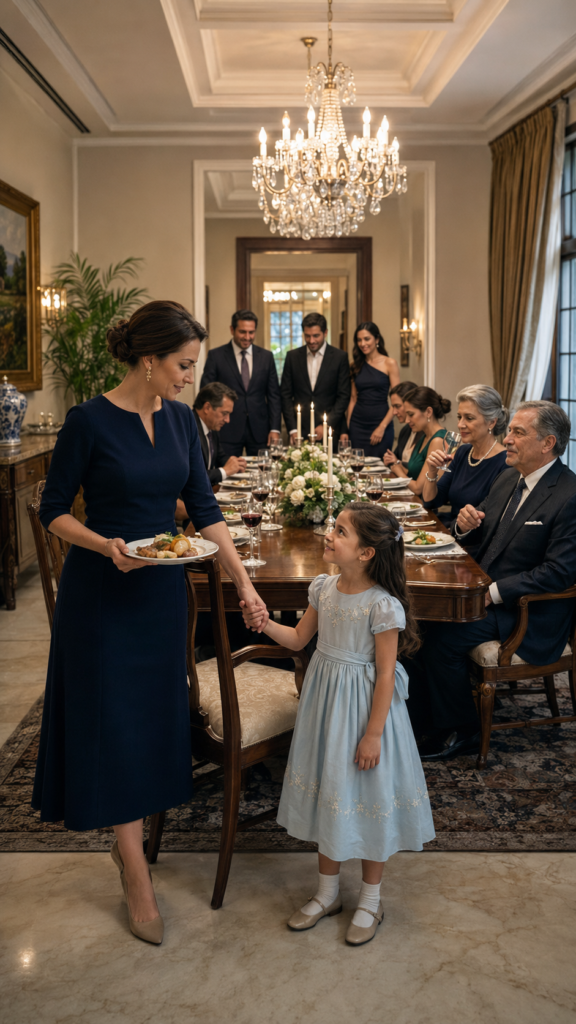
The dining room lights were on. Shadows moved through the window, dishes passing, people seated.
They were having dinner.
While Sofía had been outside in the rain for nearly 5 hours.
Carolina called her mother. She hung up.
She called Óscar. Same result.
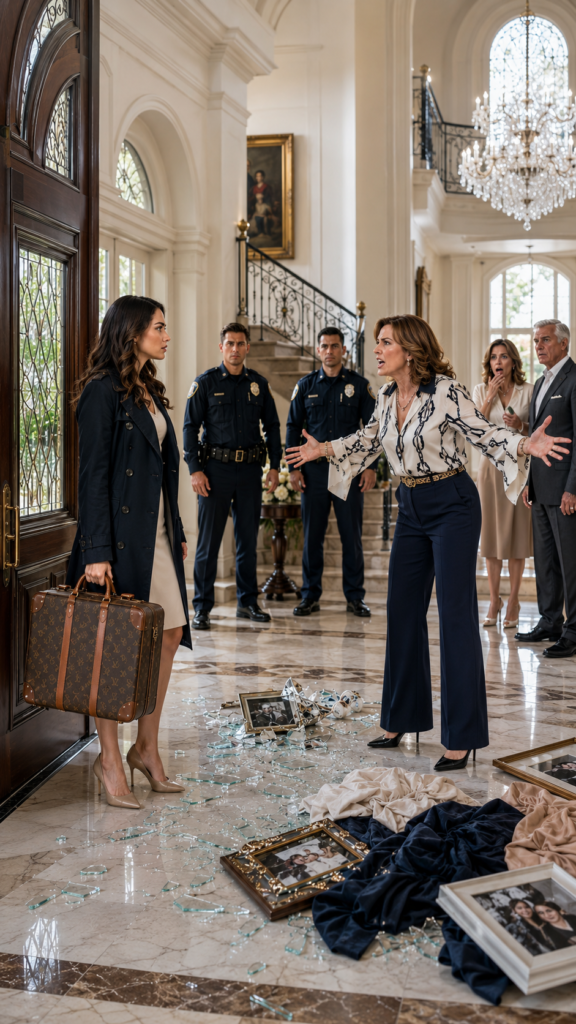
Then the pedestrian door opened.
Doña Amparo came out with a blue umbrella. Behind her was Óscar, dry, groomed, with his phone raised.
“Don’t come here to make a scene,” he said.
Carolina held Sofía tighter.
“Did you block my daughter’s entry?”
Doña Amparo didn’t even look at the girl.
“This house needs peace. From today, you and your daughter are leaving.”
Óscar smiled.
“Enough of living as parasites. We’re going to sell, and you’re not going to be a hindrance.”
Carolina looked at her brother’s phone. She understood.
They wanted to film her screaming. They wanted to make her seem crazy.
So she took a deep breath.
“Sofía, get in the car.”
Doña Amparo pursed her lips.
“Aren’t you going to beg for your things?”
Carolina looked at her without a single tear.
“No. I’ve understood.”
But as she got into the car, she received two messages.
The first was from Doña Amparo:
“The house isn’t yours. Don’t come back.”
The second, from Óscar:
“If you make a scene, we’ll say you abandoned your daughter to work who knows where.”
Carolina didn’t reply.
She started the car, took the wet avenue, and drove straight to urgent care.
That night, Sofía’s medical report became the evidence that would destroy her entire family’s lie.
PART 2
In urgent care, a young doctor received Sofía with a thermal blanket and a look that hardened as she listened to the story.
The girl had mild hypothermia, irritating cough, and the beginnings of bronchitis. Nothing that couldn’t be treated, but enough to make it clear that this had not been “a family fight.”
“Who allowed a minor to stay like this for so many hours?” asked the doctor.
Carolina didn’t sugarcoat anything.
She showed the messages. Gave the exact time. Named the residential area, house 18, her mother’s name, and her brother’s.
The doctor wrote it all down.
“Keep this report. And don’t let them tell you you’re exaggerating.”
Carolina nodded.
That night she didn’t return to Valle de los Encinos.
She took Sofía to Maribel’s apartment, a colleague from the pharmacy who lived in El Tintero. It was a small place, with a living room that barely fit a couch and a folding table, but it had dry clothes, hot soup, and a clean bed.
Sofía fell asleep hugging her soaked backpack.
Carolina sat on the floor, watching her breathe.
She didn’t cry.
She felt such a heavy sadness that she didn’t even have tears left.
At 7:15 in the morning, she called the residential administration.
The manager tried to wash his hands of it.
“Ma’am, we only follow instructions from owners.”
Carolina closed her eyes.
“A twelve-year-old girl was left in the rain from 3:22 PM until nearly 8:00 PM because you obeyed an order without verifying. I have a medical report, threatening messages, and the guard’s call.”
There was silence.
At 10:32 AM, the manager sent her a photo of the log.
“2:49 PM. Access removal for Carolina Mendoza and Sofía Ramírez. Requested by Doña Amparo Mendoza. Confirmed by Óscar Mendoza.”
“3:22 PM. Minor Sofía Ramírez attempts entry. Access denied.”
“4:40 PM. Minor remains in booth.”
“6:13 PM. House 18 informed. Indicate not to open.”
“7:58 PM. Contact mother.”
Carolina read that last line three times.
It wasn’t an accident.
It wasn’t a confusion.
They knew Sofía was there.
They knew she was cold.
They knew she was waiting.
And still, they kept eating.
That same afternoon, Don Julián, a neighbor from across the street, sent her an audio message.
“Kiddo, I don’t want to get into trouble, but I have a video. Your brother came out to the porch twice, saw the girl in the booth, and went inside laughing. Even his wife said something, and they both mocked.”
The video lasted two and a half minutes.
Sofía could be seen standing, clutching her backpack against her chest.
Then Óscar appeared on the porch of house 18. He looked towards the booth, said something inside, and let out a laugh.
Carolina felt disgust.
She saved the video on her phone, in her email, and on a USB drive Maribel lent her.
Then she went to the Public Ministry.
The officer who assisted her changed expression upon hearing “minor at risk.”
Carolina handed over the medical report, the messages, the log, and the video.
She also handed over receipts.
Many.
Electricity. Water. Maintenance. Waterproofing. Medications for Doña Amparo. Repair of the heater. Groceries. Even a payment of 21,500 pesos she had made for a debt of Óscar, when he swore he would pay her back “by Friday.”
He never did.
“Since when did you live there?” the officer asked.
“Since my dad died,” Carolina replied. “He said that house was also for us.”
The officer looked up.
“Do you have documents?”
Carolina remembered a green folder that her father, Don Ramiro, had given her one month before he died.
At that moment, she thought they were old papers.
But she remembered his words.
“Keep them safe, daughter. Your mom lets Óscar fill her head. If one day they want to kick you out, don’t fight. Go to the notary.”
Carolina felt a chill.
The folder was in Sofía’s room.
Inside house 18.
The next day, she requested accompaniment to recover personal documents. Óscar initially refused. He said Carolina was making everything up to steal furniture.
But when the administration informed him that if he didn’t allow supervised entry, they would add another report, he opened.
Carolina arrived with a patrol, a community representative, and Maribel as a witness.
Doña Amparo was sitting in the living room, rosary in hand and a hardened face.
“What a shame, Carolina. Bringing police to your mother’s house.”
Carolina looked at her without shouting.
“Shame was leaving your granddaughter in the rain while you all had dinner.”
Doña Amparo tightened her grip on the rosary.
Óscar intervened.
“You have 10 minutes. Don’t take anything that isn’t yours.”
Carolina didn’t reply.
She entered Sofía’s room.
The bed was unmade. Her notebooks were stuffed in black bags. Her sports uniform was thrown next to the trash can, as if it were trash too.
Carolina was grateful Sofía hadn’t been there.
She searched under the mattress, then in a shoebox, and finally found the green folder.
She clutched it against her chest as if it were a plank in the middle of the sea.
That afternoon she went to Notary 12 in the center.
The notary, an older man with white hair and a slow voice, opened Don Ramiro Mendoza’s file. Upon seeing Carolina’s name, he sighed.
“We’ve been waiting for you for almost three years.”
Carolina stood frozen.
“For me?”
“For you, or for whoever legally represents the minor.”
The notary turned the screen around.
Don Ramiro had left Doña Amparo the right to live in the house as long as she lived, as long as she didn’t attempt to sell it, rent it, or deny Carolina and Sofía shelter in case of need.
But the final ownership of the house was not Doña Amparo’s.
Nor was it Óscar’s.
It was Sofía’s.
The only granddaughter Don Ramiro had raised since she was a baby because he said that girl had brought him joy after his illness.
Carolina read the name three times.
Sofía Ramírez Mendoza.
Heir and owner of the property located in house 18 of the residential Valle de los Encinos.
She felt no triumph.
She felt a strange, deep pain.
Her father had known.
He had seen the betrayal coming before anyone else.
“Any attempt to sell without respecting these rights can be contested,” the notary explained. “And with a report of exposing a minor, the matter becomes quite serious.”
Carolina tightened her grip on the folder.
“Can you notify them?”
“Today.”
The letter arrived three days after the storm.
Doña Amparo received it thinking it was documentation from the buyer. Óscar was in the living room with a real estate agent, and his wife, Patricia, was serving coffee as if the sale was already closed.
Doña Amparo opened the envelope.
She read the first line.
“Notification regarding the testamentary rights of minor Sofía Ramírez Mendoza concerning the property…”
She went pale.
Óscar snatched the page away.
“What the hell is this?”
He kept reading.
“Any buying and selling operations are suspended by existing provision in favor of the minor.”
The real estate agent immediately stood up.
“Don’t involve me in legal troubles.”
But the phrase that sunk them was another.
“Furthermore, it is reported that the facts related to exposing a minor to risky conditions have already been reported to the relevant authority.”
Patricia dropped a cup.
Doña Amparo sat down as if her body no longer responded.
Óscar called Carolina 24 times that afternoon.
She didn’t answer.
Then he wrote:
“Carito, don’t mess around. This can be fixed within the family.”
Carolina read the message from Maribel’s apartment while Sofía did homework in a borrowed sweater.
She didn’t respond.
Then another message came from Doña Amparo.
“Daughter, don’t let lawyers destroy what’s ours.”
Carolina stared at that phrase for several minutes.
What’s ours.
When Sofía was soaked, it wasn’t “ours.”
When the guard gave her water, he was a stranger.
When the doctor covered her, she was a stranger.
When Maribel opened her apartment without asking for anything, she was also a stranger.
But when the will appeared, Carolina became a daughter again.
They summoned her a week later.
Óscar arrived in an ironed shirt and a rehearsed story. He said it had all been a misunderstanding. That he thought Sofía had gone with a friend. That the card had blocked by mistake. That Carolina wanted to take advantage of a girl to keep the house.
Then they played Don Julián's video.
On the screen appeared Sofía.
Small.
Wet.
Silent.
Then Óscar appeared on the porch. He looked towards the booth and laughed.
The room fell silent.
The agent paused the video.
“Mr. Óscar, why did you laugh?”
Óscar swallowed hard.
“I wasn’t laughing at her.”
“Then what were you laughing at?”
He didn’t answer.
The agent placed on the table the message where he threatened to blame Carolina for abandonment.
Óscar looked at Doña Amparo, hoping she would protect him.
But Doña Amparo said nothing.
For the first time, she understood that her favorite son had not only manipulated her. He had also used her as a shield.
The strongest twist came when they reviewed the sale papers.
Óscar wanted to sell the house immediately because he owed money. It wasn’t just any debt. He had lost thousands in sports betting, owed three credit cards, and had taken out a loan using his mother’s documents.
The buyer had already given him a cash advance.
And Óscar never mentioned the will.
Not to his mother.
Not to the agent.
Not to the buyer.
He had used Sofía to pressure Carolina, empty the house, and close the sale before anyone discovered the truth.
Doña Amparo asked to see Carolina a few days later.
Carolina agreed only in the offices of the DIF, with a social worker present.
Doña Amparo arrived without makeup, with her hair tied back and a sunken gaze.
“I didn’t think the girl would get sick,” she said.
Carolina looked at her firmly.
“What did you think a girl would feel when her grandmother closed the door on her?”
Doña Amparo opened her mouth.
Nothing came out.
Sofía was in another room with a psychologist. She had said a phrase that left everyone frozen:
“I could see the dining room light. I thought my grandma would come out when she finished dinner.”
The social worker noted that down.
Carolina never forgot it.
Because there are blows that leave no bruises but forever change the way a child looks at a door.
In the following days, everything crumbled.
The buyer canceled the operation and demanded the return of the advance. Óscar lost his job when they learned he attempted to sell a property with a testamentary conflict. Patricia left with her children to her mother’s house, tired of the lies and the debts.
Doña Amparo signed an agreement.
She could continue living temporarily in the house, but she couldn’t sell it, rent it, or prevent supervised access to recover belongings. She also couldn’t approach Sofía without authorization and without the girl’s acceptance.
Óscar was excluded from any paperwork and had to cover part of the initial legal expenses.
When he signed, his hand trembled.
Carolina didn’t feel joy.
She felt exhaustion.
Because justice sometimes doesn’t taste like victory. It tastes like accepting that the people who were supposed to protect you were the first to leave you out.
A month later, Carolina rented a small apartment near Sofía’s middle school.
It had no garden.
It had no large dining room.
It had none of the oaks her father had cared for so much.
But it had something worth more than any inheritance.
The key opened.
Always.
On the first afternoon, Sofía arrived before Carolina. She inserted the key into the lock, turned it, and entered. When Carolina arrived, she found her sitting on the floor of the empty living room, with her backpack beside her and her eyes filled with tears.
“What happened, my love?”
Sofía raised the key.
“It opened, mom.”
Carolina knelt in front of her and hugged her with all her strength.
This time Sofía cried.
Not out of cold.
Not out of fear.
Not out of shame.
She cried because, finally, a door didn’t ask anyone if she deserved to enter.
Months later, Doña Amparo was still sending messages. Sometimes she apologized. Sometimes she said the family shouldn’t end up in papers. Sometimes she blamed Óscar. Sometimes she blamed Carolina for “making it public.”
Carolina only replied once:
“Blood isn’t worth anything if a girl is left in the rain while you all have dinner.”
After that, Doña Amparo stopped insisting.
Every afternoon, when Carolina returned from the pharmacy, she heard the sound of Sofía’s key from the hallway.
A small turn.
A clean click.
A door opening.
To anyone else, it was a normal noise.
To Carolina, it was a promise.
The promise that her daughter would never again have to swipe a card 37 times to prove she was wanted.
And the promise that no family has the right to call “love” a closed door.