PART 1
Sofía Rangel had waited five long years to don the black gown, receive her law degree, and see her mother crying with pride in the front row.
That day, at the University of Guadalajara, everyone embraced her.
Her teachers told her she had a bright future.
Her classmates asked for photos.
Even her younger brother sent her a voice message shouting that she was a badass.
But amidst all the joy, there was one absence that weighed heavier than any applause.
Gerardo Rangel, her father, didn’t congratulate her.
He only gave her a cold kiss on the forehead and said:
—Don’t make a scene at the party, Sofía. There are important guests.
The party was that very night, at the family home in Puerta de Hierro, Zapopan.
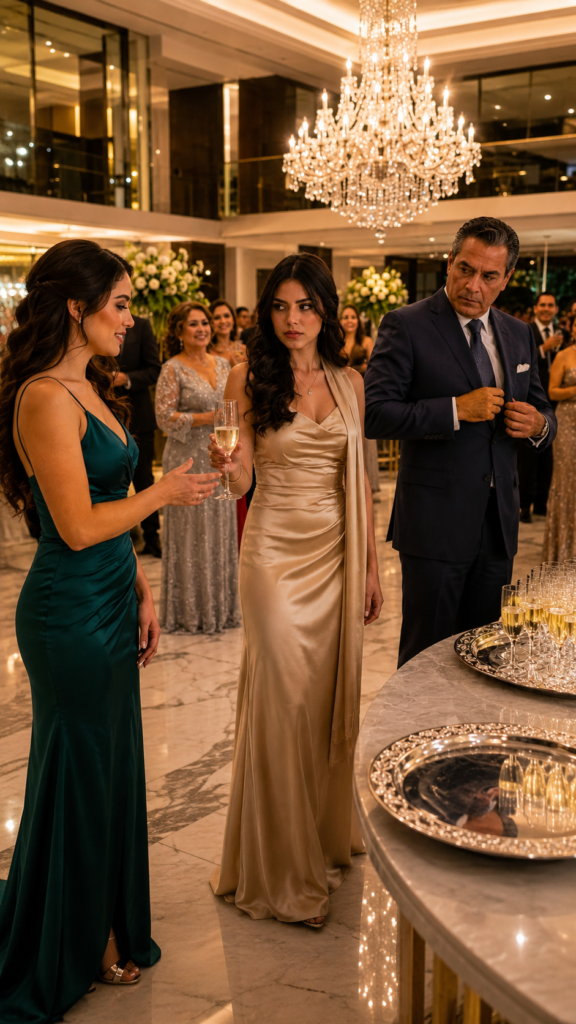
A massive residence, with a lit garden, waiters with silver trays, live music, and 180 guests including businessmen, local politicians, partners from the Rangel construction firm, and relatives who only showed up for expensive tequila.
Supposedly, the party was for Sofía.
But everyone knew that in that house, nothing revolved around her.
Everything revolved around Renata, her younger sister.
Renata was Gerardo’s perfect daughter.
The one who smiled like a display doll.
The one who studied management because he asked her to.
The one who never raised her voice.
The one who wore designer dresses and said, “yes, dad,” even when her eyes were breaking.
Sofía, on the other hand, had always been the problem.
She asked too many questions.
She reviewed papers.
She contradicted.
She didn’t accept orders disguised as advice.
That’s why Gerardo called her “intense,” “ungrateful,” or “just like your mother when she gets difficult.”
That night, Sofía tried to enjoy herself.
She wore a simple white dress, her hair pulled back, and a tired smile.
Her mother, Teresa, adjusted the cap for photos while saying:
—You look beautiful, sweetheart.
Sofía barely managed a smile.
Because across the room, she saw her father.
Gerardo wasn’t greeting guests.
He wasn’t toasting.
He wasn’t proud.
He was standing by the champagne table, staring at a specific tray.
The tray where a waiter had placed two glasses with name tags.
One said “Sofía.”
The other said “Renata.”
Sofía felt a strange discomfort in her stomach.
She didn’t know why.
Then she saw it.
Gerardo slipped his hand inside his navy blue blazer.
He pulled out a tiny white envelope.
He glanced around.
And poured a fine powder into the glass that bore Sofía’s name.
It wasn’t accidental.
It wasn’t quick.
He did it with a terrifying calm, like someone signing a check or closing a door.
Then he took a silver spoon, stirred the drink just twice, and left the glass exactly where it was.
Sofía froze.
The music continued to play.
An uncle laughed near the bar.
Some cousins argued over a photo.
No one had seen anything.
Only she had.
Gerardo lifted his gaze.
He found her looking at him.
For one second, his face showed no guilt.
It showed calculation.
Sofía felt her legs weaken, but she didn’t scream.
She didn’t run.
She didn’t cause a scene.
She pulled out her phone, pretended to check a message, and recorded 14 seconds of the glass, the empty envelope in her father’s hand, and his hardened expression.
Then she sent the video to Jimena, her best friend who was studying medicine.
The message was brief:
“If anything happens to me, it was my dad. Look at this glass.”
Then she walked toward the table.
Gerardo watched her from afar.
Sofía picked up the glass with her name on it.
She raised it slightly, as if to toast.
And just then, Renata appeared, radiant in a dark red dress and a magazine-worthy smile.
—Finally, graduate! —she said, hugging her—. Congratulations, Sofi.
Sofía looked at the glass.
Then at her father.
And then at the sister who had always been used to make her feel less.
She smiled.
—Renata, this glass is for you.
Renata blinked.
—For me?
—Yes. Dad said it was something special. And you’ve always been his special person.
Renata let out an awkward giggle, took the glass, and drank it entirely before Sofía could say another word.
Across the garden, Gerardo Rangel turned pale as a wall.
PART 2
For a few seconds, nothing happened.
The band continued playing an elegant version of a José José song.
The guests kept chatting as if a crack hadn’t just opened in that house.
Renata set the glass down on the table and wiped her lips with a napkin.
—That was strong, huh? —she said, trying to joke.
Sofía didn’t answer.
Her gaze was fixed on her father.
Gerardo walked toward them quickly, but tried not to look desperate.
That made him look worse.
His smile was stiff.
His jaw tight.
His eyes, for the first time in years, filled with fear.
—Renata, come with me —he ordered.
—What’s wrong?
—Come with me. Now.
Sofía stepped in the way.
—No.
Gerardo looked at her as if he had seen a stranger.
—Move aside.
—First tell us what you put in my glass.
The noise of the garden dropped abruptly.
It wasn’t complete silence, but something more uncomfortable.
That moment when everyone hears something serious, but no one wants to admit they heard it.
Teresa, Sofía’s mother, dropped a napkin.
—What did you say?
Gerardo let out a dry laugh.
—Your daughter already started with her theatrics.
Sofía raised her phone.
—This isn’t theater. I have video.
Several guests approached.
Renata looked at her father, confused.
—Video of what?
Sofía played the recording.
On the screen, Gerardo was seen by the table, pulling out the white envelope, pouring the powder, and stirring the glass.
The image wasn’t perfect, but it was enough.
Crystal clear.
The murmur exploded among the guests.
—What is that?
—Did he put something in it?
—No way…
Renata clutched her chest.
—Dad… tell me it wasn’t my glass.
Gerardo swallowed hard.
—It wasn’t for you.
The phrase fell like a stone.
Renata’s eyes widened.
Sofía felt the air grow colder.
Because that answer didn’t defend him.
It sank him.
—So it was for me —Sofía said.
Gerardo tried to touch Renata’s arm, but she recoiled.
—What did I just drink?
—Nothing serious.
—What did I just drink? —she repeated, louder.
Gerardo looked around.
His partners were watching.
His sisters-in-law were watching.
The waiters were watching.
Everyone who had greeted him as “Don Gerardo” for years now looked at him like a dangerous stranger.
—It was a mild sedative —he finally admitted.
Teresa gasped.
—A sedative?
Renata covered her mouth.
—Did you drug me?
—I told you it wasn’t for you.
Sofía took a step toward him.
—And that makes it better?
Gerardo lost control.
—It was to calm you! That’s all!
—Calm me from what?
—from your questions. From your suspicions. From that attitude of a newly graduated lawyer who thinks she can meddle in everything.
Sofía felt something inside her crack, but she didn’t lower her voice.
—In what exactly, Dad?
He didn’t respond.
Renata began to breathe rapidly.
An aunt rushed for water.
Jimena, Sofía’s best friend, appeared from the entrance with a backpack slung over her shoulder.
She had arrived in less than ten minutes.
Seeing Renata, she approached immediately.
—If she drank the whole glass, we need to know what substance it was and take her to the ER.
—Don’t exaggerate —Gerardo growled.
Jimena looked at him with disgust.
—Sir, you don’t get to decide if an intoxicated person is exaggerating.
Renata started to feel dizzy.
She didn’t fall, but had to sit down.
Her hands trembled.
Sofía knelt in front of her.
—Breathe. You’re not alone.
Renata looked at her with tears.
—It was for you, Sofi.
—I know.
And that “I know” hurt more than any insult from her childhood.
Because suddenly, there was no favorite sister or problematic sister.
Just two daughters staring at the same monster.
Gerardo tried to regain authority.
—The party is over. Everyone can leave.
No one moved.
An older partner from the firm, Don Ernesto Beltrán, crossed his arms.
—No, Gerardo. Now we want to hear.
Sofía seized the moment.
—Mom, tell me the truth. What papers did he want me to sign tomorrow?
Teresa paled.
Gerardo shot her a deadly glare.
—Teresa, don’t you dare.
The woman who had obeyed for 28 years, bowed her head, and apologized for things she didn’t do, lifted her face.
She had tears, yes.
But also rage.
—They were transfer documents.
The entire garden fell silent.
Sofía felt her stomach tighten.
—Transfer of what?
Teresa took a deep breath.
—Of your shares in Grupo Rangel.
Gerardo shouted:
—Shut up!
Teresa wouldn’t be silenced.
—Your grandfather Ignacio left 50% of his shares divided between both of you. 25% for Sofía and 25% for Renata. He didn’t do it for Gerardo. He did it for his granddaughters.
Sofía turned to her father.
—You told me it was a tax update.
—It was necessary.
—Necessary for whom?
Don Ernesto stepped forward.
—Ignacio told me about that will before he died. He also told me that if Gerardo tried to touch the girls’ share, I should speak up.
Gerardo was sweating.
—That has no validity.
—Maybe not —Don Ernesto replied—. But today’s video will certainly interest the Public Prosecutor’s Office.
Sofía then understood the whole plan.
Her father was going to sedate her at her own party.
People would see her clumsy, confused, maybe aggressive.
The next day, he would say that Sofía was emotionally unstable due to the pressure of graduating.
Then he would take her to sign documents “to protect her.”
And if she refused, he would use the previous night as proof that she wasn’t okay.
It wasn’t just a sedative.
It was a trap.
A way to rob her of her inheritance and destroy her credibility before she could defend herself.
Renata, pale in the chair, lifted her gaze.
—Were you also going to take away my share?
Gerardo changed his tone.
—You don’t understand, daughter. It was different with you.
—Different how?
—You know how to follow instructions. You were going to run the foundation, represent the family image. Sofía was just going to get in the way.
Renata let out a broken laugh.
—So you didn’t love me more. I was just more useful to you.
Gerardo pressed his lips together.
—I gave you everything.
—No. You gave me fear disguised as privilege.
Sofía looked at her sister.
For years, it pained her to see Renata receive dresses, trips, cars, and smiles that were denied to her.
But that night, she understood that Renata hadn’t been loved.
She had been trained.
Polished.
Used as a showcase.
And she, Sofía, had been punished for noticing the cracks.
Jimena checked Renata’s pulse.
—The ambulance is on its way.
Gerardo tried to approach again, but Sofía raised her hand.
—Not a step closer.
—I’m her father.
—No. Today you’re the man who put drugs in a glass with his daughter’s name on it.
That phrase made several people lower their gaze.
Because it sounded brutal.
Because it was the truth.
Minutes later, paramedics and two police cars arrived.
Jimena handed over the video.
Sofía delivered the empty glass inside a clean bag that a waiter got for her.
A lawyer guest recommended that no one touch the trays.
The waiters pointed to the exact spot where Gerardo had been.
Renata was loaded into the ambulance, conscious but weak.
Before leaving, she took Sofía’s hand.
—Don’t leave him alone in fear.
Sofía understood.
It wasn’t revenge.
It was justice.
Gerardo tried to talk to the police as he did with everyone: with his last name, money, and boss’s tone.
—Officer, this is a family matter.
The officer looked at the glass, the video, and Renata in the ambulance.
—No, sir. This is no longer a family matter.
When they asked him to accompany them, Gerardo refused.
Then Don Ernesto spoke loudly for everyone to hear:
—I’m going to testify too. And I’m going to deliver the emails where Gerardo requested to modify assembly minutes without Sofía’s signature.
Gerardo’s face crumbled.
Sofía turned to Don Ernesto.
—Emails?
—Your grandfather distrusted your father long before he died. That’s why he left me copies. Sorry for taking so long, girl.
Teresa covered her face.
—Oh my God…
The ambulance drove off.
The police cars followed.
The party was left transformed into a garden full of abandoned glasses, silent music, and relatives pretending not to have applauded for years for the wrong man.
That night, Sofía didn’t sleep.
She stayed in the ER with Renata until 4 in the morning.
The doctor confirmed that the sedative hadn’t been lethal, but it was enough to cause disorientation, deep drowsiness, and affect recent memory.
Renata cried when she heard that.
—If you hadn’t given it to me, everyone would have said you were crazy.
Sofía took her hand.
—And you would have believed them.
Renata didn’t deny it.
—Yes.
That honesty hurt, but it also opened a door.
The next day, Teresa brought Sofía a folder that had been hidden for weeks.
Inside were drafts of transfers, power of attorneys, psychological assessments prepared without real evaluation, and messages from Gerardo to a notary:
“After the party, she will be manageable.”
Sofía read that phrase three times.
She didn’t cry.
Not anymore.
She just took a deep breath and called the prosecutor’s office.
In the following months, Gerardo Rangel discovered that a last name doesn’t always buy silence.
The investigation revealed more things.
Irregular transfers.
Fake signatures.
Attempts to move his daughters’ properties to shell companies.
Payments to a private doctor to justify supposed “severe anxiety episodes” of Sofía.
And worst of all: Renata found in her father’s office a file on herself.
It also had documents ready to strip her of her share if one day she “stopped being convenient.”
That was the final blow.
The favorite daughter understood that she had never been safe.
She had just been waiting for her turn.
Gerardo was charged with improper supply of substances, document forgery, attempted fraudulent administration, and family economic violence.
His lawyers tried to say that Sofía had provoked everything out of jealousy.
But the video, the glass, the emails, and the testimonies of the guests spoke louder than any lie.
Teresa filed for divorce.
For the first time in her adult life, she signed something without Gerardo behind her telling her where to put her hand.
She sold her most expensive jewelry, rented a small house in Providencia, and started anew with a wooden table, three pots, and a freedom that scared her, but also brought her peace.
Renata left the firm.
She canceled her engagement with a man her father had chosen.
She entered therapy.
She learned to say “no” without apologizing.
Sofía began working at a firm specializing in corporate and estate law.
She didn’t want to take over the company right away.
First, she wanted to understand it.
To clean it.
To know what part of the family fortune had been built on abuse and what part could still be saved.
One year later, the two sisters met on a terrace in Guadalajara.
There were no waiters.
No politicians.
No silver trays.
Just two glasses of mineral water with lemon and a small box that Renata placed on the table.
—I brought you something —she said.
Sofía opened it.
Inside were two new glasses.
One said “Sofía.”
The other said “Renata.”
But beneath each name was an engraved phrase:
“Nobody decides for me anymore.”
Sofía smiled with wet eyes.
—Champagne?
Renata shook her head.
—Water. For now, it still makes me angry to see bubbles.
The two laughed.
A strange laugh.
Painful.
Necessary.
They toasted in silence.
Not for Gerardo.
Not for the company.
Not for the perfect family that never existed.
They toasted because the truth, even though it arrived in the cruelest way, returned to them something their father had tried to steal from them since childhood:
their voice.
And from that night on, in Puerta de Hierro, many learned one thing that is more uncomfortable than any scandal:
sometimes the monster doesn’t walk through the door.
Sometimes it already lives in the house, wears a fancy suit, smiles in family photos, and sits at the head of the table saying it does everything out of love.