PART 1
—Dad… Bruno hit me with the bat and said if I cried it would be worse.
The voice of Santino, barely 4 years old, struck Diego Herrera's chest like a direct blow.
Diego was in a conference room in Polanco, sitting before six executives discussing budgets, campaigns, and numbers that, five seconds before, had seemed important.
But upon hearing his son, everything vanished.
—Santi, my love, where are you? —he asked, standing up so fast that his chair toppled over.
On the other end, only a small, hitching breath was heard, like a child trying to cry silently.
—I’m in the living room… my arm hurts… Bruno is mad.
Bruno.
The new boyfriend of Valeria, Diego's ex-wife.
A 32-year-old guy, gold chains, expensive sneakers, a borrowed truck, and that smug smile of a guy who thinks he can boss the house just because he stepped inside.
Diego never trusted him.
He’d seen how Bruno looked at Santino: not as a child, but as an annoyance.
—Where’s your mom?
—She went to the salon with my aunt Paola… she said she’d be back soon.
Diego’s hands went cold.
Valeria had left Santino alone with Bruno.
—Listen to me, champ. Can you go to the bathroom and shut the door?
Santino didn’t get a chance to answer.
A booming male voice thundered in the background.
—Who are you talking to, you little brat?
The child let out a whimper.
—Give me that phone!
The call dropped.
For one second, Diego didn’t breathe.
Then he grabbed his keys and ran out.
—Diego! —his boss shouted—. Where are you going?
He didn’t answer.
In the elevator, he called 911 and then the only person who could get there before him: his older brother, Raúl.
Raúl lived in Narvarte, less than ten minutes from Valeria's apartment in Del Valle. He was a boxing trainer, as big as a wardrobe, with a heart that melted every time Santino called him “Uncle Rulas.”
He answered on the first ring.
—What happened?
—Raúl, go to Valeria's apartment now. Bruno hit Santi with a bat. I’m in Polanco, I won’t make it in time.
There was a heavy silence.
—Is he alone with him?
—Yes.
—I’m on my way.
—Raúl…
—First, I’m getting the kid —he said with a calmness that sent chills down Diego’s spine—. Then we’ll deal with the coward.
Diego drove like the city was against him. Insurgentes felt stalled. Cars weren’t moving. People honked their horns.
Nothing mattered.
On the line, Raúl narrated, his breath quickening.
—I’m arriving… I’m going up… don’t hang up.
Then there were bangs at a door.
—Bruno! Open up, you bastard!
Silence.
Another bang.
—Santino! It’s your Uncle Raúl!
Then a scream pierced the air.
A small scream, filled with panic.
Diego almost lost control of the wheel.
Then came a crash: wood splintering, glass shattering, furniture scraping.
—Let him go! —Raúl roared.
A sharp thud echoed.
Another.
An adult’s scream.
Diego no longer saw the street. He was inside that call, pleading to arrive before his son stopped crying.
—Diego —Raúl said, panting—. I have him.
—Is he alive? Is he okay?
—He’s awake. His arm is swollen, and there’s blood on his shirt. I’m going to get him out.
—And Bruno?
Raúl took one second.
—He won’t be getting up anytime soon.
When Diego arrived, a patrol car was behind him, and an ambulance was parking in front of the building.
The apartment door was broken. Neighbors watched from the hallway. A vase lay shattered on the floor.
Next to the elevator stood Raúl, carrying Santino against his chest.
The child had a red face, hair plastered to his forehead, his dinosaur shirt stained with blood, and his left arm pressed against his body.
Seeing his dad, he could barely say:
—Dad…
Diego took him carefully, fearing he’d break him further.
—I’m here, love. It's over. I'm here.
Santino clung to his neck and cried as if he’d been holding back the fear to survive.
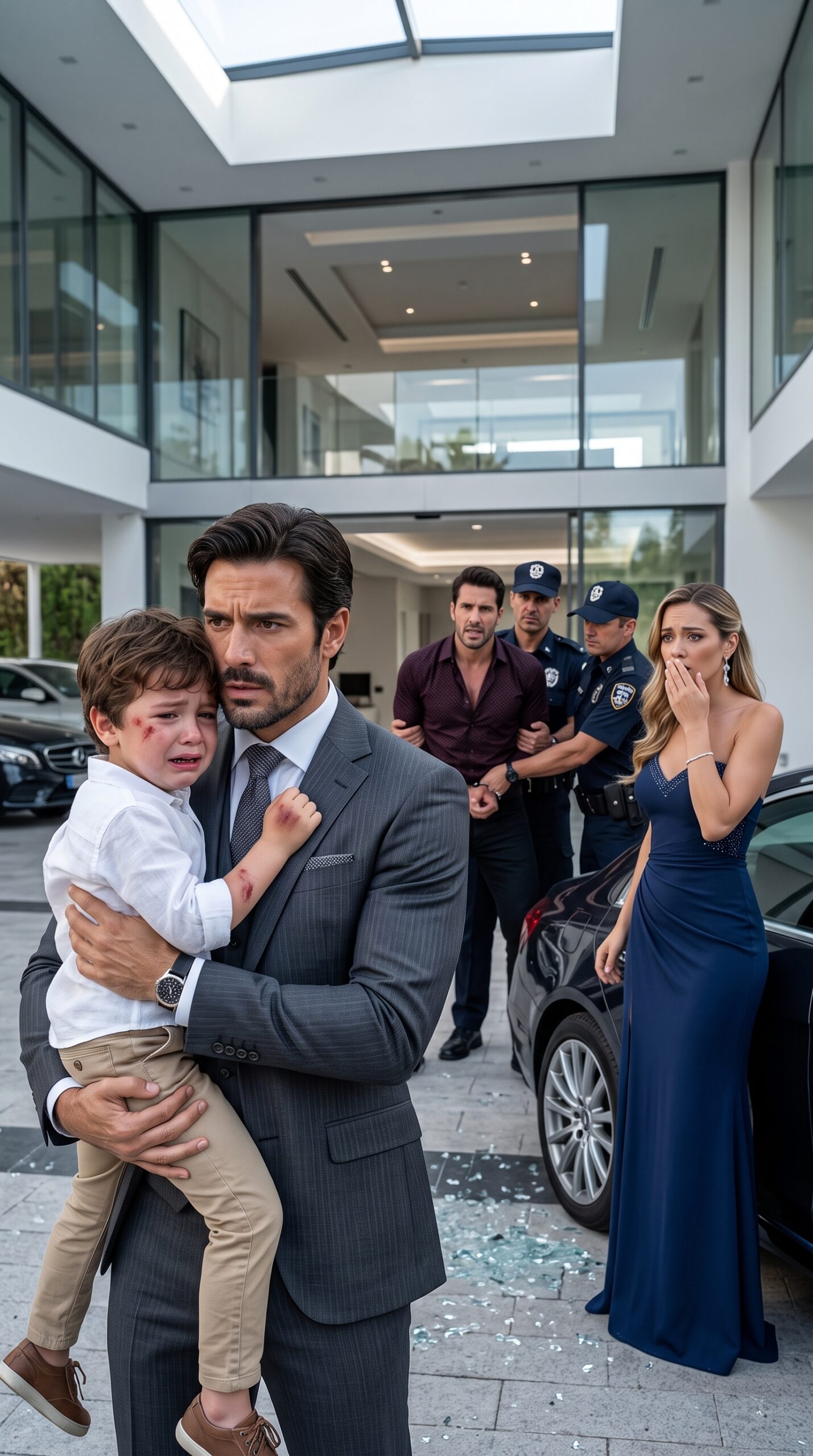
Paramedics lifted him onto the stretcher. Two officers dragged out Bruno in handcuffs, with a bleeding nose and a nearly closed eye.
Yet, upon seeing Diego, he smiled.
—Your kid's a crybaby —he spat—. He fell by himself.
Diego stepped forward, but Raúl blocked him.
—Not in front of the kid.
Bruno turned toward the stretcher and said:
—Let’s see if he learns not to touch my stuff now.
Santino began to tremble.
Diego didn’t hit him because his son was watching.
But when Valeria’s car screeched to a halt in front of the building, he still didn’t know that the most brutal thing hadn’t been the blow… but what she was going to ask first.
PART 2
Valeria got out of the car with freshly styled hair, perfectly manicured nails, and a boutique bag dangling from her arm.
She looked at the patrol car. She looked at the ambulance. She looked at the broken door. She looked at the neighbors.
And then she searched for Bruno before looking for her son.
—What happened? —she shouted—. Why are they taking Bruno away?
That question hurt Diego more than any insult.
Santino, from the stretcher, curled up. He covered his face with his good hand and murmured:
—I don’t want to go with Mom.
Valeria froze.
—Santi, my love, it’s me.
—I don’t want to —he cried—. I told you Bruno was bad, and you called me a liar.
The hallway fell silent.
Even the neighbors stopped murmuring.
Valeria shook her head, as if her son had just invented a tragedy to annoy her.
—No, Santino… you told me Bruno scolded you, not that…
—I told you he squeezed my arm when I spilled the juice —the child sobbed—. And you said I was throwing a tantrum because I didn’t want you to have a boyfriend.
Diego felt anger burning in his throat, but he didn’t shout.
Not yet.
A paramedic approached.
—We need to transfer him. Suspected fracture.
—I’m going with him —Diego said.
Valeria tried to climb into the ambulance.
Santino shouted.
—No!
It wasn’t a tantrum. It was terror.
The paramedic stopped her.
—Ma'am, only the father can go for now.
Valeria looked at Diego, seeking help.
She found nothing.
On the way to the hospital, Santino asked if Bruno was going to come for him, if he had been bad, if his mom would be mad because he called.
Each question ripped a piece from Diego.
—You didn’t do anything wrong —he kept repeating—. You were brave. Very brave.
At the ER, they confirmed a fracture of the forearm, bruises on his back, and a superficial cut on his side, likely from the glass of the coffee table.
When they put on the cast, Santino bit a sheet to avoid screaming.
Diego had to turn his face away.
No parent should witness so much pain in such a small body.
Raúl arrived close to midnight, with a torn shirt and swollen knuckles. He didn’t look proud. He looked shattered.
—The police found the bat —he said quietly—. And something else.
—What?
—A camera.
Diego lifted his gaze.
—Camera?
—Valeria had one on the bookshelf. Supposedly to watch the maid. It was aimed directly at the living room. The police took the memory card.
For the first time since the call, Diego felt the ground stop shifting.
Bruno could lie.
Valeria could justify herself.
But a camera didn’t throw tantrums.
Valeria arrived at the hospital with swollen eyes and her phone in hand. She stood in front of the room, watching Santino sleep with the white cast resting on his chest.
—Diego… please, let me see him.
He stepped into the hallway and closed the door slowly.
—No.
—I’m his mother.
—Today that didn’t protect him.
Valeria placed a hand on her chest.
—I didn’t know Bruno was capable of that.
—Santino told you.
—He’s a child, Diego. Sometimes he exaggerated. You know how he got when I dated Bruno.
Diego looked at her as if he didn’t recognize her.
—Do you hear what you just said? Your son was afraid of an adult, and you decided he was jealous.
Valeria began to cry.
—I was deceived too.
—No. You chose not to see.
Before she could respond, an officer approached with a folder.
—Mr. Diego Herrera. Ms. Valeria Montes. We need to speak with you.
Valeria wiped her tears.
—Did Bruno already testify?
The officer didn’t answer immediately.
—We reviewed part of the video from the apartment’s camera.
Diego tensed.
—Does it show what he did?
The agent looked down.
—It shows more than that.
He pulled out several printouts. They weren’t just from that afternoon. They were snapshots from different days, with dates and times.
In one, Bruno had Santino by the collar of his shirt.
In another, the child was hiding behind the couch.
In another, Valeria stood in front of Santino while he pointed to his arm, and Bruno loomed behind with his arms crossed.
The officer spoke carefully.
—The camera recorded with motion detection. There are earlier files. In one, the child clearly tells his mother that Mr. Bruno hurt him.
Valeria took a step back.
—No…
—And you also appear telling him to stop making things up because he could ruin your relationship.
Raúl clenched his fists.
Diego couldn’t breathe.
Valeria’s sobbing no longer sounded confused. It was now the weeping of someone who had just seen her guilt transformed into evidence.
Then the agent said the phrase that split the night in two:
—The Public Ministry will request immediate protective measures. The judge could temporarily revoke the mother’s custody.
Valeria looked at Diego desperately.
—Don’t let them do that.
But behind the door, Santino woke up screaming.
—Dad!
Diego rushed in.
He found his son sitting on the bed, trembling, pointing at the window.
—Dad… Bruno said if I talked, he would come back.
That phrase terminated any attempt to call it an accident, misunderstanding, or couple’s issue.
Bruno hadn’t just hit a child.
He had threatened him.
And Valeria, out of blind love, dependence, or arrogance, had turned her son’s fear into a convenient lie.
Diego hugged Santino until he stopped shaking.
—Are you going to get mad at me too? —the child asked.
Diego stroked his hair.
—Never for telling the truth, champ.
—Mom did get mad.
Diego didn’t know how to defend her without lying. And Santino had suffered enough from adults who preferred lies.
—Mom made a lot of mistakes —he finally said—. But you didn’t.
The next morning, the hospital sent the medical report to the Public Ministry: fracture, bruises, superficial injury from glass.
Everything sounded cold on paper.
Nothing explained how Santino flinched every time someone raised their voice in the hallway.
That afternoon, a social worker arrived. She asked questions about Diego’s job, his apartment, the school, safety, and the family network.
Valeria appeared during the interview, accompanied by her sister Paola. She came without makeup, as if she had aged ten years in one night.
—I want to cooperate —she said—. I will testify against Bruno. I will do everything.
The social worker looked at her calmly.
—That will be important. But now we are assessing the child’s safety.
—I’m his mother —Valeria said, breaking down—. I can take care of him.
Santino, who was coloring with his right hand, dropped the crayon.
He didn’t shout. He didn’t cry.
He simply hid behind Diego’s arm.
That gesture was worse than a sentence.
Valeria saw it and understood.
For the first time, she didn’t try to approach.
—Santi… I’m sorry.
The child looked down.
—I told you.
Valeria covered her mouth.
—Yes, my love. Yes, you told me.
—And you told me not to make things up.
—I know.
—And Bruno said if I talked, you wouldn’t love me anymore.
Valeria fell seated.
—That’s not true.
Santino looked at her with a sadness too big for his age.
—But you believed him.
Nothing more needed to be said.
The hearing was five days later.
Bruno remained in detention for injuries, threats, and domestic violence. His lawyer tried to claim it was all “a domestic accident,” but the video destroyed that lie.
The judge watched three clips.
In the first, Bruno shoved Santino against the couch because he had scratched a table with a toy.
In the second, Santino told Valeria:
—Bruno squeezed me hard.
And she, looking at her phone, replied:
—Enough, Santi. Don’t start with your drama.
In the third, it showed the afternoon of the call. Santino was on the floor, protecting his arm. Bruno had the bat in his hand.
He didn’t hit him playing.
He hit him punishing.
Then he crouched in front of the child, and the audio captured his voice:
—If you cry, it will be worse.
Valeria left the room before the video finished.
Diego didn’t leave.
He forced himself to watch because his son had lived that. If Santino endured it, he had no right to close his eyes.
The judge granted full temporary custody to Diego, supervised visits for Valeria after psychological evaluation, a restraining order against Bruno, and mandatory therapy for Santino.
Valeria didn’t fight.
Maybe she understood that fighting would have been another way of putting herself above her son.
As they exited the courthouse, she caught up to Diego in the hallway.
Raúl tensed, but Diego gestured for him to wait.
Valeria stood two meters away.
—I’m not going to ask you to trust me —she said—. I don’t have the right.
—You don’t.
Tears filled her eyes.
—I will declare everything. I will go to therapy. But when Santi asks… please, don’t tell him I don’t love him.
Diego felt a pang of compassion but didn’t let it confuse him.
—I won’t speak ill of you. But I won’t lie to him so you can sleep better.
Valeria cried silently.
—I lost him, didn’t I?
The answer was harsh but real.
—You lost his trust. And that isn’t recovered with tears. It’s recovered by listening to him when it hurts.
She lowered her head.
—Tell him I’m sorry.
—You tell him when he’s ready.
Diego left without looking back.
The following months weren’t cinematic.
Santino had nightmares. He woke up screaming that the bat was coming for him. He couldn’t watch baseball games. If a man got too close in kindergarten, he ran to hide behind the teacher.
Diego changed his entire life.
He requested a hybrid job, declined a promotion that required traveling twice a month, and rented a small apartment near the school.
He painted Santino’s room blue and stuck glow-in-the-dark stars on the ceiling because the child said the dark “made noise.”
Every night they repeated the same ritual.
Check the door.
Check the window.
Check beneath the bed.
Turn on the moon lamp.
—Does Bruno know where we live?
—No.
—What if he comes out?
—He can’t get close.
—Are you leaving?
—No.
—Dad’s promise?
—Dad’s promise.
Raúl visited three or four times a week. He brought tacos, toys, or any excuse. He never boasted about having arrested Bruno. To Santino, his uncle wasn’t a violent man. He was the big guy who made paper airplanes and monster voices.
One day, while they were building with blocks, Santino asked:
—Uncle, did you hit the bad guy?
Raúl carefully set down the block.
—I stopped him.
—Because he was going to hit me again?
—Because no one has the right to hit you.
Santino thought.
—Not even if I spill juice.
—Not even if you spill juice.
—Not even if I break something.
—Not even if you break something.
—Not even if I cry.
Raúl smiled just barely.
—Especially if you cry.
That night, Santino slept for six straight hours for the first time.
Valeria complied with everything. She testified against Bruno. She handed over messages where he manipulated her, saying that Santino was spoiled, that Diego was using him to separate them, and that she needed to “set boundaries” if she wanted a new life.
The first supervised visits were tough.
Santino agreed to see her at a family center, with a psychologist present. Diego took him but stayed outside. He didn’t want to contaminate him with his anger, even though he felt Valeria didn’t deserve a single minute.
After the first visit, Santino came out silent.
—How was it? —Diego asked in the car.
The child shrugged.
—Mom cried.
—And you?
—I didn’t.
—That’s okay.
He looked out the window.
—She apologized.
—What did you say?
Santino took his time.
—that I still got scared.
Diego gripped the steering wheel.
—That’s okay too.
He never forced him to forgive.
He learned that children suffer greatly when adults demand they heal quickly to feel less guilty.
Almost a year later, Santino could say Bruno’s name without trembling.
And one afternoon, at the kindergarten fair, he saw a game with a ball and a plastic bat.
He froze.
Diego crouched beside him.
—We can go to another game.
Santino shook his head.
—It’s plastic.
—Yes.
—It doesn’t hit hard.
—No.
The boy looked at him.
—Are you staying here?
—I’m staying here.
Santino picked up the bat with his now-recovered hand. The teacher gently tossed the ball to him.
He missed the first time.
Also the second.
On the third, he hit it, and the ball rolled a few meters.
Everyone applauded as if he had scored a goal at the Estadio Azteca.
Santino ran to Diego, laughing, with that laughter he thought he’d never hear the same again.
—I hit it, Dad!
Diego hugged him tightly.
—Yes, champ. You did.
A few meters away, Valeria watched with tears in her eyes. She didn’t approach. She didn’t interrupt.
She just observed.
And for the first time, Diego wasn’t bothered by her presence.
Maybe because he understood that the harshest punishment for her wasn’t the judge's resolution, but watching from afar the childhood she almost allowed someone to shatter.
That night, Santino asked to hear the story of “the time I called Dad” once more.
The therapist had explained to Diego that Santino needed to remember it not as a victim but as a child who did the right thing.
So Diego told him.
—Once upon a time, there was a very brave boy who was scared, but still asked for help. He called his dad. His dad called Uncle Raúl. And they came for him.
Santino hugged his blue dinosaur.
—Was the boy me?
—Yes.
—Was I brave even though I cried?
Diego felt a lump in his throat.
—You were brave because you cried and still spoke up.
Santino smiled sleepily.
—So crying isn’t for bad kids.
—No, son. Crying is for people who feel. And asking for help is for strong people.
Before falling asleep, Santino said something that left Diego staring at the stars on the ceiling for a long while.
—If someday another kid tells me something hurts, I will believe him.