PART 1
—Mom… Diego is knocking beneath the house.
Renata dropped the spoon into the pozole dish.
It wasn't the noise that froze the room.
It was how Valentina, five years old, said it: calm, serious, with her ear pressed to the shiny floor of Aunt Claudia's house.
The house was in an upscale neighborhood in Juriquilla, Querétaro. Everything smelled of new wood, expensive air freshener, and freshly brewed coffee. There were modern paintings, white sofas, and a huge rug that Claudia wouldn’t allow anyone to step on with shoes.
Sergio Almazán, Valentina's father, felt the blood drain from his face.
For ten months, he had searched for Diego, his seven-year-old son.
The boy had disappeared one afternoon in Guadalajara while the family was preparing a barbecue in the yard. His bicycle lay abandoned by the lemon tree. The back door had been found open. No one saw anything. No one heard screams. No one could explain how a child could evaporate in his own home.
The report was filed that very night.
There were flyers, searches, patrols, dogs, interviews, prayer chains, and neighbors swearing they had seen a suspicious truck.
Then came the silence.
That horrible silence that descends when people don’t know what to say to you anymore.
Claudia, Sergio's older sister, was the one who cried the most in public. She brought food, hugged Renata, organized rosaries with Doña Mercedes, Sergio's mother. She repeated that the family had to stick together.
Then, just three months later, she moved to Querétaro.
—I need to start over, brother —she said then—. Besides, I fixed up an old house and put in new floors. It turned out beautiful.
Now Valentina was on her knees on that same floor.
—It’s cold —the girl whispered—. He says he can’t come out.
Claudia appeared from the kitchen with a tray of coffee.
Seeing the girl, she froze.
—What are you doing down there? —she asked, too quickly.
Renata stood up trembling.
—Vale, my love, what did you say?
The girl didn’t look at her mother.
She put a finger to her lips.
—Shhh. If we talk loudly, Diego gets scared.
Sergio felt something shatter inside him.
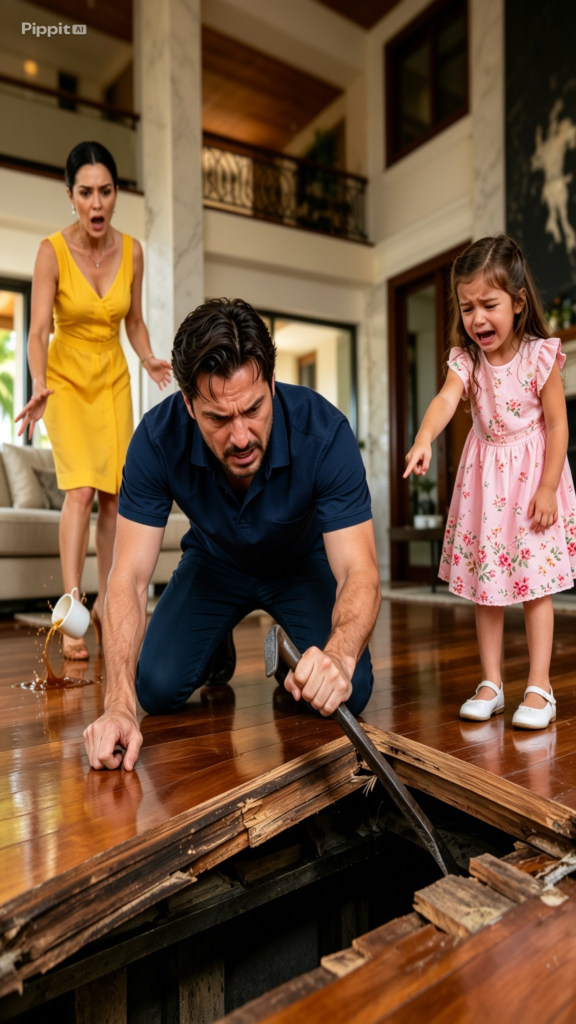
He knelt and pressed his ear to the floor.
At first, he only heard the refrigerator, a dog barking outside, and Claudia's short, shaky breath.
Then came three knocks.
Slow.
Weak.
Like small knuckles tapping from another world.
Sergio yanked the expensive rug aside.
Claudia grabbed his arm.
—Don't do something stupid, Sergio.
He looked at her.
She didn’t say, “There’s no one there.”
She didn’t say, “Your daughter is making things up.”
She said, “Don’t do something stupid.”
In one corner, next to the wall, a board was poorly sealed. Sergio saw a dark crack. Then something pale appeared between the wood.
A tiny fingernail.
Valentina began to cry silently.
Sergio grabbed a fireplace poker from the decorative chimney.
Claudia stood in front of him, white as paper.
—Please —she murmured.
Sergio lifted the iron.
And when the first blow cracked the floor, a small broken voice came from below:
—Dad…
No one could believe what was about to awaken beneath that freshly varnished floor.
PART 2
Sergio hit again.
The board creaked as if the whole house was complaining.
Claudia screamed his name, but it no longer sounded like a sister. It sounded like someone defending a grave.
Renata held Valentina against her chest and began to repeat:
—My God, my God, my God…
The third blow opened a hole.
A damp, sour, trapped smell escaped. It wasn’t the smell of plumbing. It wasn’t the smell of rotting wood.
It was the smell of fear.
Sergio shoved his fingers between the boards and pulled until his knuckles tore. He felt no pain. He only heard his son’s voice, weaker each time.
—Dad…
There was no basement beneath.
There was a narrow space between the old foundation and the new floor. A gap covered with black plastic, dirty blankets, and crossed boards.
Sergio shone his phone light.
Then he saw a hand.
Small.
Thin.
Covered in dust.
—Diego —he said.
But his voice cracked before he could finish the name.
He removed more wood, pushed through with his shoulders, and pulled him out slowly, as if he were carrying something made of glass.
Diego was alive.
Skinny.
Pale.
With long hair, cracked lips, and sunken eyes.
He wore the same red bracelet with his name that he had on the day he disappeared.
Renata let out a scream that sent the neighbors running.
Valentina crawled closer.
—I heard you —she told him.
Diego barely opened his eyes.
He looked at his sister.
Then he looked at Claudia.
And he began to tremble with a desperation that needed no words.
Claudia collapsed into the white sofa.
—I didn’t want to… I swear, I didn’t want it to happen like this…
Sergio looked at her with the child in his arms.
—Like this? What did you want, then?
She covered her mouth, but it was too late.
The neighbors called 911. In minutes, the private neighborhood that Claudia boasted was quiet filled with patrol cars, paramedics, and people filming from their windows.
A police officer tried to take Diego to examine him.
Sergio wouldn’t let go.
An older paramedic approached calmly.
—Sir, if you want him to live, let us help him.
Only then did Sergio loosen his arms.
Diego was placed on a stretcher. He was severely dehydrated, showed signs of malnutrition, had old wounds on his wrists and ankles, and a fear so profound that he didn’t even cry properly.
The police searched the house.
Claudia swore there was nothing else.
But one of the officers noticed something: she kept looking toward a closet in the hallway.
Behind boxes of new dishes, they found a false panel.
The panel led to a narrow entrance, with an improvised staircase that descended to the same space beneath the living room.
There were empty bottles, cookie wrappers, a bucket, sleeping pills, a baby blanket, and a notebook with marked dates.
Diego hadn’t fallen.
He hadn’t been trapped by accident.
Someone went down to see him.
Someone kept him alive.
Barely alive.
Claudia was handcuffed in front of everyone.
—Sergio, listen to me —she pleaded—. You don’t know the whole story.
He didn’t respond.
The story was already breathing in his arms, nearly dead.
In the Querétaro hospital, Renata broke down seeing Diego connected to IVs and monitors.
—My boy… my boy…
The doctor spoke carefully. He said slow recovery. He said severe psychological damage. He said Diego had survived by a hair’s breadth.
At six in the morning, the boy woke up.
Sergio and Renata were by his side.
—We’re here, champ —Sergio said—. No one’s going to lock you up again.
Diego moved his lips.
Sergio leaned closer.
—What did you say?
The boy squeezed his dad’s fingers with minimal strength.
—Aunt Claudia wasn't the only one.
Renata stopped breathing.
Sergio felt the hospital floor shift beneath him.
—Who else, son?
Diego looked toward the door, as if expecting to see a familiar shadow.
—Grandma Mercedes also locked me up.
Doña Mercedes arrived two hours later, rosary in hand, black shawl, and the face of a respectable widow.
—Where is my grandson? —she asked.
Renata stood in front of her.
—You can’t come near him.
The woman feigned offense.
—I’m his grandmother.
Sergio left the room.
He still had dust on his shirt, dried blood on his knuckles, and dirt on his shoes.
—Diego said you knew.
Doña Mercedes didn’t ask, “Knew what?”.
That silence betrayed her more than any scream.
She just tightened her rosary and said:
—Don’t make a scene here. People are watching.
Renata let out a bitter laugh.
—That’s what you care about? People? After keeping your grandson under a floor?
The police didn’t take long to uncover the truth.
First came Rogelio, the contractor who installed the floor. He had received cash payments from Claudia and messages where she asked him to leave “a discreet access in the back.”
Then a security camera appeared: Claudia’s truck entering her old house in Guadalajara late at night on the same evening Diego disappeared.
Then they found transfers from Doña Mercedes to Claudia over ten months.
But the motive shattered them completely.
It was all for money.
Sergio’s father, Don Ernesto Almazán, had died two years earlier. He left a house in Guadalajara, a plot of land near Chapala, and an investment account. In the will, there was a clear clause: part of the land would be in the names of his grandchildren when they turned eighteen.
Diego was the primary beneficiary.
Claudia was drowning in debt.
Doña Mercedes wanted to sell the land.
Sergio refused.
—That inheritance belongs to my children —he said one afternoon, three weeks before the disappearance—. I’m not touching it.
That night, Diego heard Claudia and his grandmother arguing in the kitchen.
He heard loose words: “forged signature,” “land,” “don’t let Sergio find out.”
The boy came out and asked:
—Are you going to trick my dad?
Claudia panicked.
Doña Mercedes said he was just a child, that he would forget.
But Diego didn’t forget.
That Sunday, during the barbecue, Claudia called him to the yard under the pretense of showing him a gift in the truck.
Doña Mercedes entertained Renata in the kitchen.
Sergio stood by the grill.
The back door was left open.
And Diego disappeared.
Claudia claimed she just wanted to scare him for a few hours, convince him to keep quiet. But when the police started to search, she panicked. Her mother went to see her the second night.
She called no one.
She didn’t save her grandson.
According to Claudia, Doña Mercedes said:
—If you let him go now, we’ll all sink.
That phrase turned a lie into a family crime.
For months, while Sergio and Renata distributed flyers, Claudia hid Diego in warehouses, empty rooms, and finally beneath the floor of the new house.
Doña Mercedes visited every so often.
Not to hug him.
Not to apologize.
She went to confirm that he remained silent.
Diego told everything in pieces. In drawings, in nightmares, in broken phrases. He drew the false closet. He drew Claudia’s beige shoes. He drew his grandmother’s rosary hanging at the entrance.
He also drew Valentina above the floor, with big ears and a blue heart.
—She heard me —he said one day.
Valentina changed after that.
For weeks, she walked barefoot around the house, stepping softly, as if beneath any tile there could be someone crying.
One night, Sergio found her lying in the hallway.
—What are you doing, my love?
—I’m checking that no one is down there.
Sergio didn’t tell her she was imagining things.
He lay down beside her.
Because he had learned what many adults forget: children can invent monsters, but they don’t invent that kind of fear.
The trial was brutal.
Claudia was charged with aggravated kidnapping, injury, unlawful deprivation of liberty, and forgery of documents. Doña Mercedes too. Rogelio agreed to testify to reduce his sentence.
The family split in two.
Some said Claudia was sick.
Others said Mercedes just wanted to protect her daughter.
An aunt asked Sergio not to destroy the Almazán name.
He replied:
—The name was destroyed the moment they chose land over a child.
The day they played an audio found on Claudia’s cell phone in the courtroom, no one defended them again.
You could hear Diego crying.
—Auntie, tell my dad. I’m not going to say anything anymore. I just want to go home.
Then came Doña Mercedes's voice, calm, cold:
—If you behave, one day.
Renata covered her mouth to avoid screaming.
Sergio closed his eyes.
Claudia cried.
Doña Mercedes did not.
When the sentence was handed down, Claudia asked for forgiveness.
—Brother, I didn’t think it would last this long.
Sergio looked at her without anger and without mercy.
That phrase disgusted him more than the silence.
Because Claudia still believed the horror lay in the time, not in the first second she decided to strip a child of his freedom.
Diego returned home slowly.
Not like in the movies.
There was no miracle.
He slept with the light on. He couldn’t stand closets. If someone walked above, he covered his ears. He didn’t want to hear the word “aunt.”
But one day he asked for chicken soup.
Another day he wanted his dinosaurs.
One afternoon, Valentina handed him a red crayon without saying anything.
Diego took it.
—Thank you for listening to me —he murmured.
Sergio cried silently from the doorway.
Months later, they sold the Guadalajara house. Not out of cowardice, but because some walls hold too many echoes.
With legal help, they protected Diego and Valentina's share of their grandfather's estate. The Chapala land was not sold.
Renata planted a lemon tree in the new yard.
Diego took time to ask for a bicycle.
When he finally did, he chose a red one.
Valentina named it: Lightning.
Sometimes Sergio watches them play and feels a strange happiness, full of scars. People think recovering someone fixes everything.
It’s not true.
No one comes back the same from the darkness.
Neither the one who was below.
Nor the one who listened from above.
Nor the one who had to break the floor to find the truth.
One afternoon, Diego asked him:
—Dad, do you think a house can feel guilty?
Sergio looked at the lemon tree.
He thought about Claudia's perfect house, the new floor, the white sofas, all the people who preferred to believe in a pretty surface rather than look at the crack.
—I don’t know if houses —he replied—. But people should feel guilty.
Valentina, from the swing, added:
—And if someone cries below, we need to break the floor.
Renata covered her mouth.
Sergio hugged his two children.
Not to erase what happened.
That was impossible.
He hugged them to promise, even if silently, that he would never again confuse calm with truth.
Because now he knew something no parent should learn like this:
Sometimes monsters don’t arrive in strange trucks.
Sometimes they arrive with food when you’re broken.
Sometimes they call you “family.”
Sometimes they pray in the front row.
And sometimes they change the floors, paint the walls, and buy white sofas to hide what they buried beneath.
That’s why, when a child trembles and says someone is crying under the house, you shouldn’t tell him to be quiet.
You have to believe him.
Before silence wins again.