PART 1
Renato Salcedo didn’t raise his voice when he shattered his wife’s life.
That was the cruelest part.
In the Premier lounge of the Mexico City International Airport, as the rain pounded against the windows and flights were delayed one after another, he left a folder on the table and spoke as if he were closing a contract.
—You’re going to Oaxaca, Valeria. Today. I don’t want to see you in my house anymore.
Valeria Montalvo stared at him without blinking.
They had been married for 8 years. She had watched Renato sleep on a couch when his urban development company barely had enough to pay salaries. She accompanied him to awkward meals, inaugurations in the provinces, dinners with officials, and events where everyone called him “the architect of the new Mexico.”
But that day, Renato treated her like a shame.
—Are you kicking me out? —she asked, her throat tight.
—I’m liberating you —he replied, coldly—. There’s no point in pretending anymore.
Valeria let out a small, broken laugh.
—Pretending what?
Renato barely looked at her.
—That we’re happy.
The people around them began to fall silent. An executive stopped typing on his laptop. An older couple stared at their coffee mugs. In Mexico, everyone says they don’t get involved in others’ problems, but when a marriage disintegrates in public, no one can help but listen.
—Look me in the eyes and tell me you don’t love me anymore —Valeria whispered.
Renato took 2 seconds.
—I don’t love you.
It was so dry it felt rehearsed.
Valeria stood up slowly. She didn’t scream. She didn’t beg. She didn’t ask about the woman who surely existed, even though there were no strange perfumes or hidden messages.
She simply took her bag, adjusted her light coat, and touched her ring with her fingers, as if wanting to confirm it was still there.
—One day, you’ll have to tell me what kind of man destroys 8 years in an airport waiting room —she said.
Renato didn’t respond.
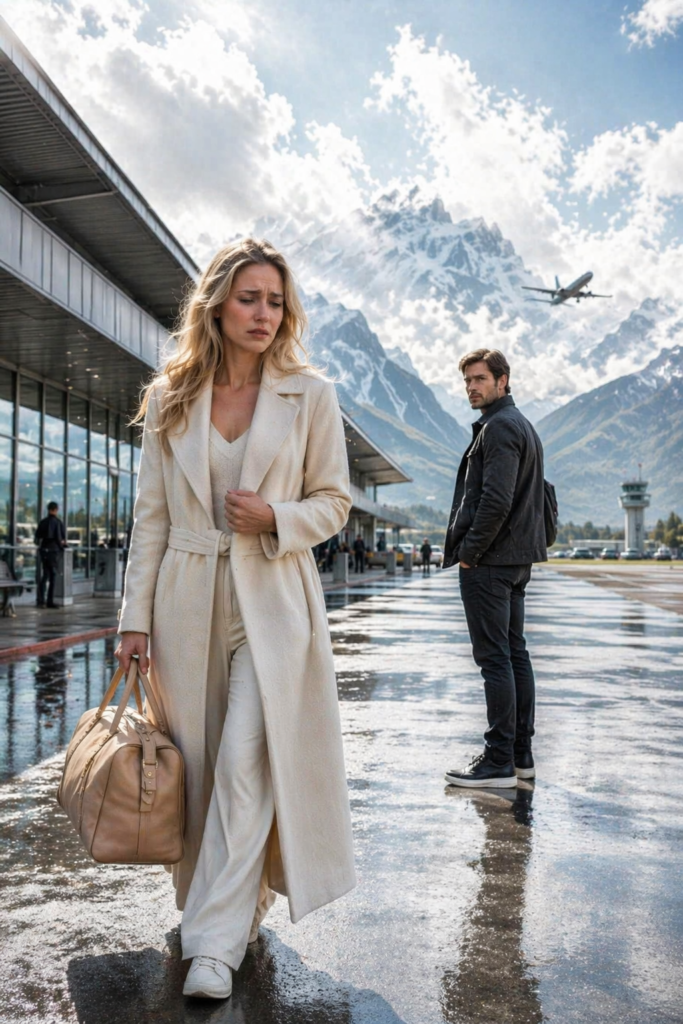
She walked toward the boarding gate with her face wet, but her back straight. Flight 628 was leaving for Oaxaca delayed due to bad weather. Renato had already sent her bags to his sister’s apartment.
Valeria sat by the window on the plane, hugging her bag to her chest.
The captain announced turbulence.
Then came a jolt.
Then another.
The lights flickered. A suitcase fell from the compartment. Someone shouted a prayer. A girl with braids cried in the aisle, searching for her mother.
Valeria caught a glimpse of an oxygen mask swaying in front of her.
And then everything turned to noise, metal, and darkness.
When she opened her eyes, she smelled wet earth, fuel, and blood.
The plane was broken between tall trees, fog, and mud. There were people trapped between seats. Others weren’t responding. The girl with the braids was underneath a fallen row, her leg pinned down.
—My mom… my mom was coming with me —she cried.
Valeria crawled toward her, even though every breath burned her ribs.
—Look at me, little one. Breathe with me.
—Are you a doctor?
—No —Valeria said, swallowing her pain—. But I know how to stay.
For 3 days, Valeria ceased to be Renato Salcedo’s humiliated wife.
She became the woman who distributed water with bottle caps, made tourniquets out of scarves, calmed a man who was screaming for his son, and wrote names on a napkin so that no one disappeared without an identity.
When helicopters were finally heard, Valeria staggered out among the wreckage, lifted a shiny sheet, and shouted until her voice broke.
A rescuer came down first.
—How many survivors?
Valeria, covered in mud and with the girl clinging to her waist, replied:
—28. There are 5 serious cases. 7 can’t walk. And this girl needs to find her mom before someone lies to her.
The rescuer looked at her with respect.
—Yes, ma’am.
They lowered her from the mountain at sunset.
And then Valeria saw a black truck next to the camp.
Renato was there.
Pale. Shaking. With the eyes of a man who had already imagined his funeral.
But what chilled her blood wasn’t seeing him.
It was understanding that he seemed guilty of something much worse than having abandoned her.
PART 2
Renato Salcedo knew that flight 628 had disappeared from an alert on his lawyer’s phone.
It was 3:47 AM.
He hadn’t slept. He hadn’t eaten. He hadn’t stopped walking around his office on Paseo de la Reforma, waiting for a single message: “Valeria arrived. She’s with her sister. No one followed her.”
But the news screen said otherwise.
“Flight 628 disappears in mountain area after severe storm.”
Renato stood frozen.
For the first time since he learned how to buy silences, he couldn’t control anything.
Not phones.
Not contacts.
Not police.
Not journalists.
He only thought of Valeria boarding that plane believing that he had discarded her like trash.
And he hated himself.
Renato wasn’t always the elegant businessman who appeared in magazines. As a young man, he helped his father in a hardware store in Ecatepec. When his construction company went bankrupt, Alonso Cárdenas appeared, a man in a gray suit, a clean smile, and too calm hands.
He offered investment.
50,000,000 pesos.
Public contracts.
Lands.
Permits.
Renato accepted because he had debts, employees, and a massive ego. When he wanted to back out, he understood that this money wasn’t help.
It was a chain.
Cárdenas used construction companies, small hotels, and social projects to launder money from a network that mixed entrepreneurs, officials, and white-collar criminals.
Renato lived trapped for 4 years.
He smiled in photos.
He signed whatever was put in front of him.
And inside, he sought a way out that wouldn’t leave him dead.
6 months before the accident, he went to the Attorney General’s Office and handed over everything he had. He didn’t do it for heroism. He did it because he found Valeria’s name in 3 false accounts set up to frame him if he spoke.
That was when he ran out of air.
Then came the threats.
A photo of Valeria leaving a salon in Roma.
A message with the address of the café where she had breakfast on Fridays.
A call from an unlisted number.
—Beautiful wife. It would be a shame if you ended up signing what you don’t want to sign.
Renato had 48 hours to get her out of the city.
He chose the most brutal lie because he believed that hatred would keep her safe.
He thought Oaxaca was safe.
He didn’t think of the storm.
When survivors were confirmed, Renato arrived at the rescue camp with wrinkled clothes and a gray face. He got out of the truck as if his bones were heavy.
First, he saw stretchers.
Then black bags.
Then Valeria.
She was next to a folding table, with a bandage on her forehead, her arm scraped, and a blanket over her shoulders. But she didn’t seem like a victim.
She seemed like a woman who had crossed hell and was still giving orders.
—Valeria —he said.
She didn’t turn immediately.
That second shattered him.
When she finally looked at him, Renato felt something sink in his chest.
—You’re alive —he murmured.
—For your misfortune, it seems so.
He wanted to move closer.
She stepped back.
It was a small step, but enough for everyone to understand that there was a wound bigger than the accident.
—I need to explain.
—Not here —she replied—. There are people looking for relatives. A girl named Abril doesn’t know if her mother is breathing. And I won’t use my little strength to listen to another one of your lies.
Renato lowered his gaze.
—I’ll be waiting.
—Don’t say that as if you’re still my home.
An hour later, Valeria agreed to get into his truck only because reporters were already surrounding her.
She sat pressed against the door.
—Speak fast.
Renato spoke.
He told her about Cárdenas. About the dirty money. About the accounts in his name. About the Attorney General’s Office. About the threats. About the 6 months he lived watching doors, phones, and cameras.
Valeria listened without crying.
That scared her more.
When he finished, she looked at her ring, dirty with mud and dried blood.
—You should have told me.
—If you reacted strangely, they would have noticed.
She turned toward him.
—I’m not an employee of your company, Renato.
—I know.
—No. You don’t know. Because deciding for me, lying to me, and breaking me to protect me is still control. And in this country, many women are fed up with being destroyed “for our own good.”
Renato had no way to defend himself.
—I just wanted you to stay alive.
—I almost died believing that my husband despised me. Does that also seem like protection to you?
He closed his eyes.
—Forgive me.
—How easy you say that when I was the one who fell from the sky.
Valeria got out of the truck and left him alone with his guilt.
For 2 weeks, she stayed in Oaxaca with her sister Natalia. She ate soup, slept poorly, went for medical check-ups, and avoided watching the videos where they called her “the heroine of flight 628.”
She also avoided reading the comments that said Renato had probably abandoned her for another.
Renato called once a day.
She never answered.
She only received 2 messages.
“I’m available to tell you everything.”
“I won’t pressure you.”
Valeria hated that he had finally understood something so basic.
Because if Renato learned not to push, she would have to decide if that changed anything.
On the 16th day, Valeria called Mariana Robles, Renato’s criminal lawyer.
—I want the whole truth —she said—. Not the pretty version for a scared wife.
The call lasted almost 4 hours.
When she hung up, Valeria sat in front of the window, looking at the cobblestone street.
The worst part wasn’t knowing that Renato was involved in a criminal network.
The worst part was knowing that he had known for 6 months.
6 months of breakfasting with her.
6 months of sleeping beside her.
6 months of kissing her forehead before leaving for meetings with men capable of making people disappear.
6 months of letting her organize charity dinners paid for with stained money.
That night marked her.
Renato answered before the first ring.
—I spoke with Mariana —Valeria said.
He fell silent.
—6 months, Renato.
—Yes.
—You didn’t protect me. You managed me. Like you manage risks, permits, and contracts.
His breathing changed.
—I have reasons. I have no excuses.
Valeria hurt that he didn’t argue.
It would have been easier to hate him if he remained arrogant.
—I’m going to Mexico City —she said.
—Are you sure?
—No. But I’m going. Not to come back with you. Not to forgive you. I’m going because I no longer accept being the only person in my own marriage who doesn’t know the truth.
2 days later, Valeria entered the Salcedo Tower wearing black pants, a beige coat, and the wound on her forehead still visible.
Employees stopped talking.
She kept walking.
In the meeting room were Renato, Mariana Robles, and a federal agent named Lucía Herrera. On the table were photographs, bank statements, inflated contracts, and copies of transfers.
—The situation accelerated —Lucía said.
—What situation?
Renato looked at her with a guilt so profound that Valeria understood.
Something worse was coming.
Lucía opened a folder.
—There’s an accountant named Inés Duarte. She worked for Alonso Cárdenas. She has enough files to take down the network, but she doesn’t trust official protection. She believes there’s a leak.
—And what do you want from me? —Valeria asked.
Mariana adjusted her glasses.
—Inés agreed to talk only to a woman. She saw what happened in the accident. She saw how you helped the survivors.
Valeria let out a bitter laugh.
—How convenient. They break my life and then discover I’m good for inspiring trust.
Renato lowered his gaze.
—You don’t have to do it.
—I decide that, remember?
The meeting was in a closed fonda near Toluca, one of those with plastic chairs, the smell of reheated coffee, and a Virgin of Guadalupe behind the counter.
Inés Duarte was at a table in the back. She wore a black sweatshirt, a cap, and deep dark circles. A blue backpack rested by her feet.
—You’re Valeria —she said.
—Yes.
—You look less angry on TV.
Valeria almost smiled.
—You look more tired in person.
Inés tightened her cup.
—I haven’t slept in 5 days, seriously.
Valeria sat across from her.
—I didn’t come for Renato.
Inés looked up.
—I came because I know what it feels like for a scared man to decide about your life and then label it nicely. If you have proof, hand it over on your terms. But come out alive.
Inés swallowed hard.
—There are people in the Attorney General’s Office who are sold out.
—I believe you.
—If I’m moved wrong, they’ll kill me.
—Then we’re not going to pretend everything is okay.
—Can you promise me nothing will happen to me?
Valeria shook her head slowly.
—No. But I can promise you I won’t lie to manage you more easily.
That broke Inés.
Her eyes filled with tears.
—I’m so tired of being scared.
Valeria extended her hand over the table, without touching her.
—I know.
Then a white truck entered the parking lot too fast.
Inés saw her reflection in the glass.
—They’re not yours.
Valeria didn’t turn. She saw 2 men getting out with dark jackets.
Her body remembered the fall.
The hit.
The screams.
The cold of the mountain.
But now she wasn’t going to stay still.
—To the bathroom —she ordered.
Inés grabbed the backpack and ran.
Valeria grabbed a coffee pot and spilled it on the floor by the entrance. The first man entered, slipped, and fell against a table.
The second man reached under his jacket.
Valeria threw the pot at his face.
It didn’t stop him for long.
But it stopped him long enough.
Federal agents rushed in, shouting orders.
From the back, a thud was heard.
Valeria ran.
Another man had Inés by the arm near the kitchen. The backpack was on the floor.
Renato appeared through the back door, with blood on his lip and his shirt torn.
He wanted to go against the man.
Valeria was quicker.
She grabbed the backpack and threw it out the window to a cook who was hiding outside.
—Save it! —she shouted.
The man turned toward her.
That half-second was enough for Renato to take him down.
The fight was short, clumsy, and violent. Agents piled on top. Inés crying against the wall. The cook holding the backpack as if carrying dynamite.
—Do you have it? —Inés asked.
Valeria pointed to the window.
—We have it.
The files arrived that night at the Attorney General’s Office.
In 48 hours, Alonso Cárdenas was arrested at a private airstrip near Querétaro with 2 passports, 4 cell phones, and enough cash to prove that even untouchables run when their facade crumbles.
The leak fell 3 days later.
Renato turned himself in the following Monday.
Valeria accompanied him to the courthouse steps because he asked her once and because she wanted to show that being present didn’t mean obeying.
Reporters swarmed her.
—Are you going to defend your husband?
—Did you know about the money?
—Do you forgive him?
Valeria stopped.
For years, she had smiled silently to protect the Salcedo name. She had been elegant, discreet, proper. The perfect wife of a powerful man.
Not anymore.
—My name is Valeria Montalvo —she said firmly—. I didn’t know my husband’s crimes. I didn’t choose them. I didn’t sign them. I helped deliver evidence because a woman was in danger and because the truth matters, even if it destroys the house you live in.
The noise fell.
—Renato tried to protect me from some things, and he broke me with others. Both truths exist. But to love isn’t to decide for someone. To love isn’t to lie and then expect applause for the sacrifice.
Renato lowered his head.
He pled guilty to financial crimes linked to Cárdenas’s network. His cooperation reduced his sentence, but it didn’t erase what he did.
Before they took him away, Valeria saw him in a small room in the courthouse.
—I signed the separation —she said.
Renato nodded slowly.
—I understand.
—I don’t know what will happen when you get out.
—I don’t owe you a future.
—No —she replied—. I don’t owe you that.
He looked at her with watery eyes.
—you were never the fragile part of my life. You were the strongest. I was too cowardly to tell you the truth.
Valeria looked at his hand.
The ring was no longer there.
—I kept it in a drawer —she said—. Not in the trash.
Renato let out a broken breath.
—That’s more than I deserve.
—It’s not forgiveness. It’s honesty. I still don’t know.
A guard knocked on the door.
Valeria moved closer and caressed his lip just once.
—Come back clean —she whispered—. Not for me. For you.
—I’ll try.
—No. Don’t try. Do it.
A year later, Valeria returned to the mountains where the plane fell.
Abril, the girl with the braids, took her hand in front of a stone memorial with engraved names. Her mom survived, although it took months for her to walk properly.
—My mom says I came back home for you —Abril said.
Valeria squeezed her fingers.
—You came back because you were brave.
The girl thought for a few seconds.
—Can both things be true?
Valeria looked at the mountain, the clear sky, and the path down which she once descended, carrying names she refused to forget.
—Yes —she said—. Almost everything important has more than one truth.
That night, upon returning to her apartment in Mexico City, she found a letter from Renato.
He wrote once a month from prison. She replied when she felt like it, which wasn’t always.
At first, they were apologies.
Then explanations.
Then memories.
That letter said:
“Valeria, today I said a truth I had conveniently hidden. No one congratulated me. No one applauded me. But I thought you should know. I once believed that loving was keeping you away from danger. Now I understand that loving is also stopping the danger from being created and calling it protection.”
Valeria read the letter twice.
Then she folded it and put it in the drawer next to the ring.
It wasn’t forgiveness.
Not yet.
But it wasn’t nothing either.
She opened the window. Outside, the city remained noisy, beautiful, and harsh, filled with men who confused silence with loyalty and control with love.
Valeria took a deep breath.
For the first time in a long while, she didn’t feel like a woman waiting to be chosen, saved, or discarded.
She felt like a woman who fell from the sky, walked through fire, descended from the mountain with the truth in her hands, and understood that surviving could also be justice.
And somewhere, behind bars, the man who sent her crying to the airport was learning too late that love without honesty was not sacrifice.
It was another pretty lie.