PART 1
Rafael Márquez arrived in Zapopan on a Friday night, dragging a suitcase full of toys, perfumes, new sneakers, and five years of exhaustion weighing heavily on his back.
He had labored in Saudi Arabia under a sun that scorched the skin. He built walls, carried rebar, slept in shared quarters, and ate the cheapest meals to send money back to Mexico every month.
His only dream was to return to the house he had built for his wife, Marisol, and their two children.
The house stood there, imposing, lit up like a politician's mansion. Golden gate, marble columns, freshly trimmed garden, new cameras, and a black truck parked in the driveway.
Rafael smiled at the sight.
“It was worth it,” he murmured.
But his smile died when he heard loud music from inside. Laughter, clinking glasses, party shouts.
He hadn’t announced his return. He wanted to surprise them.
He walked around to the side of the house, looking for the back entrance, and there, next to the trash cans, he saw something that shattered his soul.
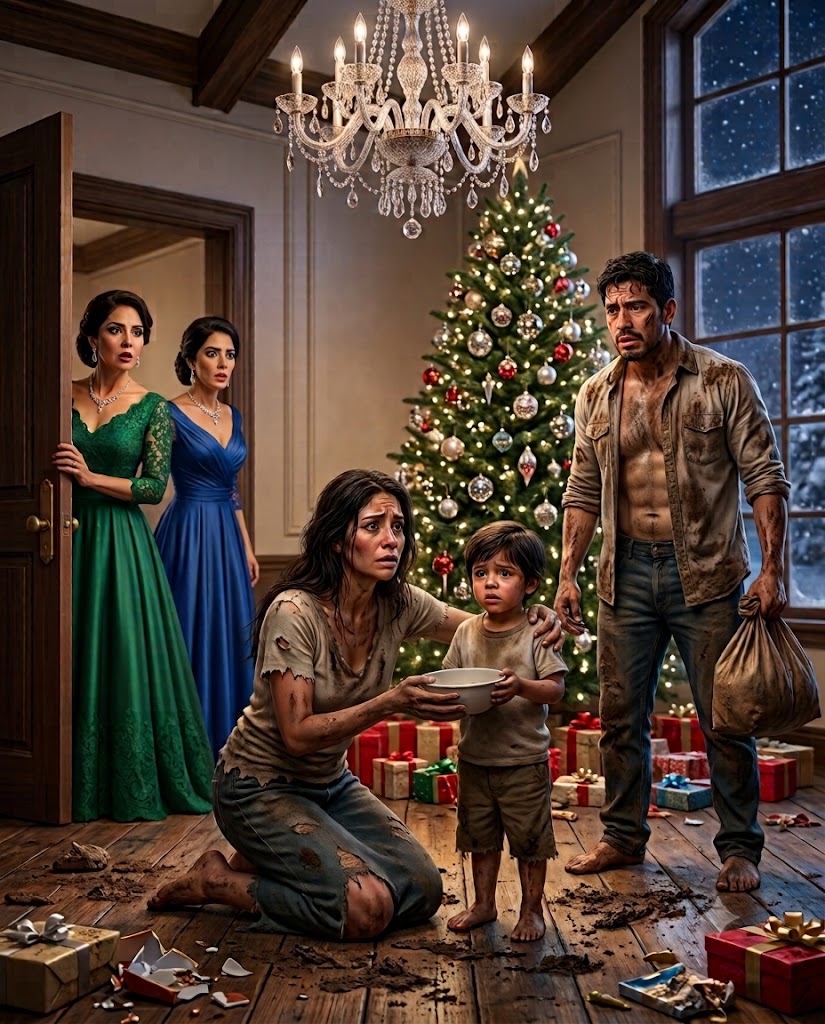
Marisol was sitting on an overturned bucket, gaunt, with her hair thrown up haphazardly. In front of her, their children were eating watery rice from plastic cups.
The little girl, Sofía, had a dress torn at the shoulder. The boy, Emiliano, wore an enormous, stained t-shirt, and his arms were so thin they looked like twigs.
Sofía looked up first.
“Dad?”
Rafael felt the world tilt beneath him.
The girl ran barefoot across the dirt. Emiliano followed, confused, as if he barely remembered his father’s face.
Rafael dropped the suitcase and fell to his knees to embrace them.
“My children… what happened to you?”
Marisol stood up slowly. Her lips were chapped, and her eyes sunken.
“Rafael… we didn’t know you were coming back.”
He looked at the plate. It wasn’t real food. It was boiled leaves with a little salt.
“Where is the money I sent?” he asked, his voice trembling.
Marisol looked down.
“Your mom said it was hers. That you sent it to her because she owned the house. She let us live back here in the service room. Then she took that from us too.”
Rafael couldn’t comprehend. For five years, he had been transferring money to his mother, Doña Elvira, because she cried saying Marisol was “too innocent” to handle accounts, payments, and laborers.
He had also sent money to his sister, Vanesa, for the kids’ schooling, clothing, medical consultations, groceries.
Inside, the music grew louder.
He heard Vanesa's voice, drunk and happy:
“Pour more tequila! My brother is still breaking his back in the desert!”
Rafael froze.
He moved closer to the kitchen window and looked inside.
Doña Elvira sat in the living room with gold bracelets up to her elbows. Vanesa danced with two men by a table full of expensive bottles, grilled meat, designer bags, and wads of cash.
The wedding photo of Rafael and Marisol was no longer on the wall.
In its place hung a huge portrait of Doña Elvira, dressed to the nines, as if she were the queen of that house.
Marisol grabbed his arm.
“Don’t go in like that. They’ll make you look crazy.”
Rafael looked at his children, dirty, hungry, trembling behind him.
He clenched his fists, took a deep breath, and picked up his suitcase.
“I’m not going in angry,” he said quietly.
Then he walked to the front door, rang the bell of his own house, and smiled as if he hadn’t just discovered hell.
PART 2
When the door opened, Vanesa appeared with a drink in hand, smeared makeup, and a red dress that looked more expensive than all of Marisol's clothes combined.
Seeing Rafael, she turned pale.
“Rafa?”
The music kept playing for a few seconds until someone turned it down. Doña Elvira rose from the couch as if she had seen a ghost.
“Son… what are you doing here?” she said, forcing a smile.
Rafael stepped in slowly, dragging the suitcase. He looked at the Italian furniture, the giant screen, the expensive paintings, the imported bottles.
All of it smelled of his sweat.
“I came back early,” he replied. “I wanted to surprise you all.”
Vanesa swallowed hard.
“Wow… you sure surprised us.”
Doña Elvira walked towards him, arms wide open.
“My boy, my hard worker, my pride. Come here, give me a hug.”
Rafael let her embrace him. He felt his mother’s expensive perfume and almost felt disgusted.
“And Marisol?” he asked.
The living room went silent.
Doña Elvira let out a theatrical sigh.
“Oh, son… I didn’t want to tell you over the phone to distract you over there. Your wife changed a lot. She became lazy, rude, ungrateful. We have kept her out of pity.”
Vanesa stepped closer, now more confident.
“Seriously, Rafa, that woman is playing the victim. You sent money, but it wasn’t enough because she spent it on nonsense. We had to save the house.”
Rafael nodded slowly.
“So the house is fine thanks to you?”
“Exactly,” Doña Elvira said. “If it weren’t for me, Marisol would have already left you out in the street.”
Rafael opened the suitcase. He pulled out gifts and placed them on the table: perfumes, watches, clothes, cell phones.
Vanesa smiled, thinking everything was fine.
“Now that’s how you come back like a king, little brother.”
Rafael smiled too.
“I brought something else.”
He pulled out a small black device from his pocket and set it next to a bottle.
“Recorder. In Arabia, you learn to protect yourself. Everything has been recorded since I arrived.”
The color drained from Doña Elvira’s face.
“What nonsense is that?”
Rafael walked to the back door and flung it wide open.
Marisol entered with Sofía and Emiliano.
The guests fell silent. No one could ignore the brutal difference: inside there was meat, alcohol, and luxury; before them stood three people who looked like they had survived the streets.
Sofía hid behind her mother.
Rafael spoke without shouting.
“Mom, explain to my children why they were eating boiled leaves while you toasted with my money.”
Doña Elvira raised her chin.
“You’re not going to humiliate me in my own house.”
Rafael let out a dry laugh.
“Your house?”
Vanesa jumped in quickly.
“Don’t start, Rafa. You were away. My mom managed everything. Besides, you signed papers before you left.”
Marisol looked at him, surprised.
“What papers?”
Rafael opened another folder he had in the suitcase.
“That’s what I came to check.”
In the last months in Saudi Arabia, something didn’t add up. Marisol hardly answered his calls. When she did, she always said she was fine, but it was with fear. Their children no longer appeared in video calls. His mother said they were asleep, sick, or in school.
Then Rafael called Don Ernesto, an old neighbor who had been an auxiliary notary.
Don Ernesto investigated in silence.
And what he found was worse than a betrayal.
“They signed a false power of attorney,” Rafael said. “They changed invoices, invented medical expenses, took out loans in my name, and tried to put this house as my mother’s property.”
Doña Elvira screamed:
“Lies!”
Rafael threw several documents on the table.
“Here are the transfers. Every month I sent money for Marisol and the kids. Here are the receipts for schools that were never paid. Here are the false medical consultations. And here is the complaint I filed before coming.”
Vanesa dropped her glass. The crystal shattered on the floor.
One of the men tried to leave, but just then they knocked on the gate.
It was two municipal police officers and Don Ernesto, accompanied by a lawyer.
Doña Elvira placed her hand on her chest.
“Rafael, I’m your mother.”
That phrase fell like poison.
Marisol tightened her grip on Emiliano’s hand. Sofía looked at her grandmother with fear, not with affection.
Rafael approached Doña Elvira.
“My mother would have taken care of my children. My mother wouldn’t have let my wife sleep next to the trash. My mother wouldn’t have toasted saying I was breaking my back in the desert.”
Doña Elvira started to cry, but her tears had lost their power.
“I did everything for this family.”
“No,” Rafael said. “You did everything for yourself.”
The lawyer asked to check a side room. There they found boxes with new children’s clothes still with tags, unopened school supplies, expired medications, and envelopes with cash.
But the hardest blow came afterward.
Don Ernesto handed over a blue folder.
“Rafael, we also found this at the civil registry.”
Rafael opened it and stood frozen.
Vanesa had enrolled her two children in a private school using Rafael’s last name as if he were the economic tutor. The tuition was paid with the money meant for Sofía and Emiliano.
The same sister who said “poor kids” on social media had stolen food from her nephews to give luxuries to her own.
Marisol covered her mouth to keep from crying.
“My children left school because they said there was no money…”
Sofía, in a tiny voice, let out:
“Grandma said Dad forgot about us.”
Rafael felt that phrase pierce his chest.
He knelt in front of his daughter.
“Never. Not for a day. Not for a single night.”
Emiliano hugged him around the neck.
“I thought you weren’t coming back.”
Rafael closed his eyes. He had endured heat, loneliness, insults from bosses, and sleepless nights dreaming of returning. But nothing hurt like knowing his children had suffered thinking he had abandoned them.
Doña Elvira tried to approach.
“Son, please, let’s fix this as a family. Blood is thicker.”
Marisol looked at her for the first time without lowering her head.
“Blood doesn’t fill an empty plate. Blood doesn’t heal a child crying from hunger.”
Vanesa lost control.
“Oh, come on! They weren’t dying! We just wanted to live well. Rafa earned in dollars; what’s with all the drama?”
The entire room froze.
Rafael turned to her.
“What’s with all the drama?”
He walked to the table, took a tray full of meat, and placed it in front of his children.
“They didn’t eat meat for months.”
Then he took one of Vanesa’s designer bags and pulled out several bills.
“With this, their vaccinations were covered.”
He took a gold necklace from around his mother’s neck.
“With this, Emiliano’s milk was bought.”
Doña Elvira cried harder.
“Don’t take everything from me.”
Rafael took a deep breath.
“You’ve already taken too much from us.”
The police asked Doña Elvira and Vanesa to accompany them. The guests began to record with their cell phones. A neighbor, from the door, murmured:
“What a shame. They boasted about a house that wasn’t theirs on Facebook.”
Vanesa, handcuffed, glared at Rafael with hatred.
“You’re going to regret this.”
He answered without raising his voice:
“No. I regret trusting you.”
Doña Elvira, before getting into the police car, tried one last blow.
“Your wife will leave you when the money runs out. I’m the only one who will always be your mother.”
Marisol stepped forward.
“A mother doesn’t destroy her grandchildren to feel like a queen.”
That night, Rafael didn’t sleep in the master bedroom. He also didn’t let Marisol and the kids touch the party food.
He ordered soup, tortillas, fruit, and chicken broth from a nearby eatery. He sat them in the kitchen and watched them eat slowly, afraid someone would take their plates away.
Sofía asked:
“Are we really going to stay inside now?”
Rafael broke.
He hugged her so tightly that the girl let out the cry she had held back for years.
“This house has always been yours.”
In the days that followed, the story exploded on social media. Videos of the party, audios of Vanesa mocking, forged documents, and photos of the room where Marisol and the kids lived circulated all over Jalisco.
Many defended Doña Elvira with the same phrase: “But she’s your mom.”
Others replied with what Rafael wrote in a single post:
“Family isn’t measured by blood but by what one does when they have power over someone defenseless.”
The house was legally recovered. The accounts were frozen. Vanesa had to answer for fraud. Doña Elvira faced charges for forgery and breach of trust.
But true justice didn’t happen in a courtroom.
It happened one afternoon when Rafael took Sofía and Emiliano to buy new shoes, school supplies, and clean clothes. Marisol walked beside him, still thin, still hurt, but holding her head high.
As they passed a store, Sofía saw a blue dress and asked if she could try it on.
Rafael didn’t look at the price.
“Of course, my girl.”
When Sofía emerged from the fitting room, she smiled for the first time, unafraid.
Marisol cried silently.
Rafael understood then that money could recover a house, pay lawyers, and fill a refrigerator. But the stolen years would never return.
That’s why he never withdrew the complaint.
Because forgiving doesn’t always mean opening the door again.
Sometimes, forgiving is letting go of hate… but allowing those who destroyed a family to pay for every empty plate, every lie, and every tear no one wanted to see.