PART 1
At 39, Sebastián Alcázar could buy almost anything in Mexico City.
Hotels on Reforma, towers in Santa Fe, land in Polanco, and even the silence of those who preferred not to face the businessman dubbed "the king of concrete" by the magazines.
The one thing he couldn't buy was time.
That January morning, his mother, Rebeca, asked him to cancel a video call with investors from Monterrey.
"Come walk with me in Chapultepec," she said. "A Sunday won't destroy your empire."
Sebastián agreed out of guilt, not desire.
They walked near the Lake Mayor among joggers, vendors selling coffee, and families pushing strollers against an unexpectedly harsh chill.
Rebeca held his arm, impeccable in her beige coat and silk scarf.
"Look at the people," she murmured. "They live. You just work, eat, and go back to work."
Sebastián shot her a dry smile.
Then he saw her.
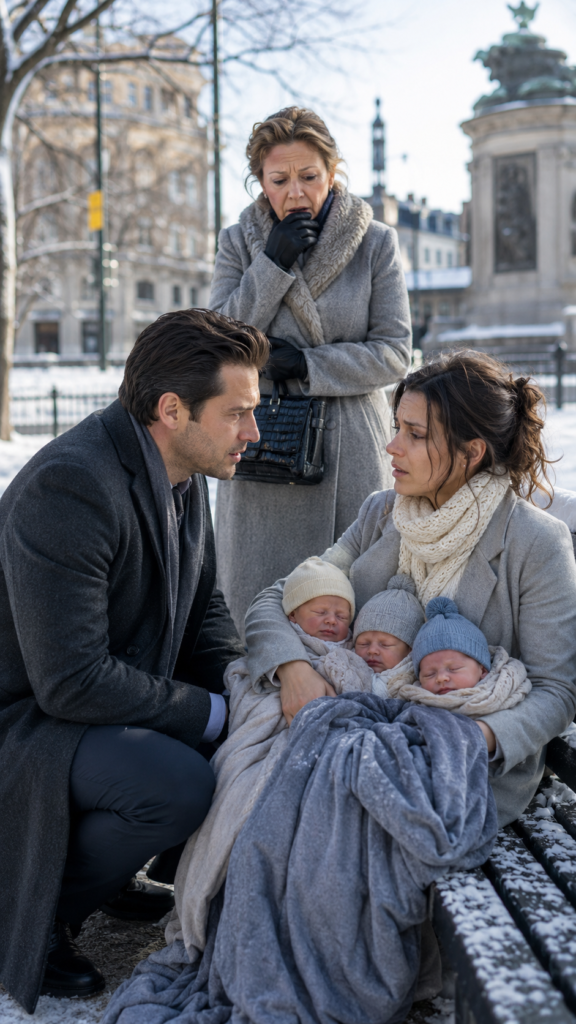
Under an ahuehuete, a woman slept curled up on a bench, covered with a coat too thin for the cold.
Her body shielded 3 small bundles wrapped in different blankets.
One pink, one blue, and one yellow.
Sebastián recognized the hand first.
Then the profile.
Then that little scar next to the left eyebrow.
Valeria Montes.
The woman who had shared a tiny apartment with him in the Doctores neighborhood when they could barely afford the rent.
The one who cooked chilaquiles with the last scraps in the pantry.
The one who designed, without charging a dime, the presentation that landed him his first big contract.
And the same woman he had abandoned 5 years ago, convinced that love was a luxury for less ambitious men.
Sebastián froze.
Rebeca did too.
But on his mother's face, there was no surprise.
There was terror.
One of the babies stirred, pulling a hand from the yellow blanket.
On the knuckle of the index finger was a small round indentation.
The same mark Sebastián had inherited from his father.
The same mark he saw every morning when he put on his watch.
"Mom..." he whispered.
Rebeca tightened her grip on his arm.
"Let's go, Sebastián."
He pulled away and moved toward the bench.
Valeria's eyes flew open.
Upon recognizing him, she clutched the babies desperately.
"Don’t come closer."
Her voice was weak, but the hatred remained intact.
Sebastián knelt before her, not caring about staining his designer pants.
"What happened to you? Whose kids are those?"
Valeria let out a bitter laugh.
"No way. You still have the gall to ask?"
Sebastián glanced at Rebeca.
She avoided his gaze.
"Mom, tell me the truth. Are they mine?"
Rebeca closed her eyes.
"Yes."
The word fell like a stone.
Sebastián stopped breathing.
"But that's not the worst part," she added.
Valeria pulled a folded envelope from a tattered diaper bag and handed it to him.
Inside was the letter with which, 5 years earlier, she had informed him of her pregnancy.
At the bottom was a handwritten instruction:
"Return to sender. Sebastián must not find out."
The signature was Rebeca's.
But behind the letter was a lab report dated just 8 days prior.
Valeria pointed to the result and said:
"Your kids aren’t here by chance. Someone has been trying to find them before you did for months."
PART 2
Sebastián looked up.
"Who?"
Valeria glared at Rebeca with fury.
"Ask your mother. She knows who wants to take my kids away."
Rebeca staggered.
Sebastián called a private ambulance. Valeria tried to stop him, but one of the babies started coughing with a dry sound.
"His name's Mateo," she said. "He’s had a fever since last night."
At the hospital, Mateo was stabilized. Sofía and Emiliano were kept for observation due to dehydration and cold.
Valeria refused to let Sebastián sign for them.
"A mark on the hand doesn’t make you a father. Being a father means staying."
He took the blow without defending himself.
Then he took Rebeca to a private room.
"Talk."
"I thought I was protecting you."
"From my children?"
5 years ago, when Valeria discovered her first pregnancy, Sebastián was negotiating the purchase of 12 hectares in Santa Fe.
The deal depended on the Luján family, owners of a powerful financial group.
They demanded something that never appeared in the contracts: that Sebastián marry Miranda Luján.
A social alliance.
A perfect cover.
A useful surname.
Rebeca knew her son wouldn’t agree if he knew about the pregnancy. She intercepted the letter, blocked Valeria's number, and paid a doctor to keep her away.
"She had complications," she stammered. "The baby was born premature and..."
Valeria appeared in the doorway.
"And they told me he died," she completed. "I was allowed to see him for less than 1 minute. Then they handed me a sealed urn."
Sebastián paled.
"Our child died?"
"No."
Valeria placed the genetic report she carried in the diaper bag on the table.
The lab had found a relation between Sebastián and a 4-year-old boy named Santiago Luján Alcázar.
Rebeca began to cry.
Valeria's first child had been given up for illegal adoption to Miranda, who pretended to be pregnant while living in the United States for several months.
Then she presented him as Sebastián's heir.
But the wedding was called off before it took place when Sebastián discovered Miranda was embezzling money from a foundation.
The Lujáns then hid Santiago to avoid scandal.
"Do I have a son living with that family?" Sebastián roared.
"Yes," Rebeca admitted. "And when they found out about the triplets, they feared a genetic test would reveal everything."
Valeria explained that she had rebuilt her life alone.
She worked as a freelance designer in Azcapotzalco and never sought Sebastián again because she believed he had rejected the letter.
Two years later, a retired nurse contacted her.
She had been present at the birth and could no longer stay silent.
She confessed that the baby was alive when they took him away.
Valeria investigated until she found Miranda's name.
Before gathering enough evidence, she became pregnant again with Sebastián's child.
"That’s impossible," he said.
"We met at your company’s anniversary, 17 months ago. You were drunk. You apologized and said you never received the letter."
Sebastián recalled rain on a Reforma terrace, an elevator, and a hotel room.
The next morning, Valeria had vanished.
"I thought about telling you about the pregnancy," she continued. "But someone broke into my apartment and left a photo of Santiago sleeping. On the back, it said: 'Stay silent or the boy disappears for real.'"
Sebastián looked at Rebeca.
"Was it you?"
"It was Octavio Luján," she replied.
Valeria fled after 2 men tried to put the triplets into a truck outside a clinic.
She changed homes 3 times, lost clients, and sold her computer.
The previous week she was evicted for two months' unpaid rent.
She had spent the last night in Chapultepec waiting for the nurse to deliver the genetic results.
"Why didn’t you go to the police?" Sebastián asked.
Valeria showed 2 archived complaints.
One of the agents even called Octavio in front of her.
"Money opens doors," he said. "It also closes them."
Sebastián felt shame.
For years, he had boasted that no one could stop him. Now he understood that his power had protected those who had torn Valeria apart.
He called his criminal attorney, his company's security team, and an investigative journalist.
"Back up cameras, accounts, calls, and medical records. No one touches Valeria or the kids."
Rebeca grabbed him.
"If you make this public, you’ll destroy our family."
"You destroyed it 5 years ago."
Hours later, Mateo was out of danger.
Sebastián entered when Valeria allowed him.
The baby was sleeping, connected to a monitor. When he felt a finger nearby, he grasped it with his tiny hand.
Sebastián cried silently.
Not just from tenderness.
But also from guilt.
His mother had committed something monstrous, but the lie grew in the space he left when he chose his ambition over Valeria.
The next morning, another twist emerged.
The account used to pay the doctor did not belong to Octavio.
It was from the Alcázar Foundation, run by Rebeca.
There were also recent transfers to the men who chased Valeria.
Sebastián confronted his mother.
"It was you. You tried to take the triplets away too."
Rebeca broke down.
She confessed that Octavio had blackmailed her for years. If Santiago appeared, both could go to prison.
When she learned of the new pregnancy, she paid to monitor Valeria and force her to hand over the babies.
One of the men decided to kidnap them for ransom.
"Everything spiraled out of control," Rebeca sobbed.
Valeria looked at her coldly.
"No. You made decisions. One after another."
That noon, Sebastián called a press conference.
In front of national cameras, he admitted that he had 4 children whose existence was hidden through threats, forged documents, and illegal adoption.
He didn’t try to appear innocent.
He acknowledged that he abandoned Valeria, that his obsession with growth made him easy to manipulate, and that his surname helped silence complaints.
Then he handed over his foundation's financial files to the prosecutor's office.
Rebeca was arrested when she left the hospital.
Octavio Luján was captured 2 days later at the Toluca airport while trying to board a private flight.
The doctor lost his license and faced charges.
Miranda claimed she was unaware of Santiago's origin, but her messages proved otherwise.
The DNA tests ordered by the judge later confirmed that Sebastián was the biological father of all 4 children.
The news set social media ablaze.
Thousands labeled Rebeca a monster. Others blamed Valeria for getting close to Sebastián that night in Reforma.
There were also those who defended Miranda, arguing that taking Santiago away was punishing the child for others' crimes.
Sebastián didn’t respond to those discussions.
At an extraordinary company meeting, several partners tried to convince him to deny everything until the process was over.
"Your surname is worth more than any confession," one said.
"That thinking was precisely what allowed this," he replied.
He resigned in front of everyone and ordered an external audit of every donation made by the foundation over 6 years.
The review uncovered payments to officials, clinics, and firms that had fabricated documents for at least 3 other irregular adoptions.
The case was no longer just the drama of a wealthy family.
There were more mothers searching for children who had been told they had died.
Recovering Santiago was the most painful.
The boy called Miranda "mom" and hid when Valeria approached.
The judge ordered therapy and a gradual transition.
Valeria accepted, even though each visit broke her heart.
"I don't want to tear him from the only life he knows," she said. "Too many adults have decided for him already."
Sebastián rented a house near the hospital, but Valeria refused to live with him.
She also rejected the penthouse and the bank account he offered.
She only accepted legal protection, medical care, and the return of rights over 2 architectural projects that Sebastián had presented years earlier as his own.
"I'm not going to sell you forgiveness."
"I'm not trying to buy it."
"You still don’t know how to do anything else."
For months, Sebastián learned what no board meeting had taught him.
He changed diapers, woke up at 3 a.m., and took the triplets to the pediatrician.
He waited outside therapy while Santiago began to recognize Valeria's voice without hiding.
He ceded the presidency of his company and sold 3 properties to create an independent legal support fund for mothers victimized by fraudulent adoptions.
Some said it was an image strategy.
Others claimed Valeria should forgive him because "at least he took responsibility."
She never allowed the public to decide for her.
One year later, Santiago ran towards his siblings in a garden in Coyoacán.
The 4 ended up covered in dirt, fighting over a ball.
Valeria sat across from Sebastián.
"Santiago asked if you'll ever live with us."
He swallowed hard.
"What did you tell him?"
"That being a family doesn’t always mean living under the same roof."
Sebastián nodded, pained.
"I also told him that people can change, but they have to prove it every day."
It wasn’t a reconciliation.
It was something harder: an opportunity without guarantees.
Rebeca was convicted and sent dozens of letters asking for forgiveness from prison.
Valeria didn’t respond to any.
Sebastián read only 1 and kept it alongside the letter his mother had intercepted.
One letter provoked silence.
The other could not erase it.
That morning in Chapultepec, Sebastián thought he had found his ex and 3 babies abandoned in the cold.
In reality, he found the ruins of everything his money could not protect.
And he understood that justice is not about lamenting what is lost, but accepting the price of what one allowed, even if forgiveness never comes.