PART 1
When Adrián Rivas returned to Mexico City after three years away, Mariana Salvatierra didn’t hear his voice first.
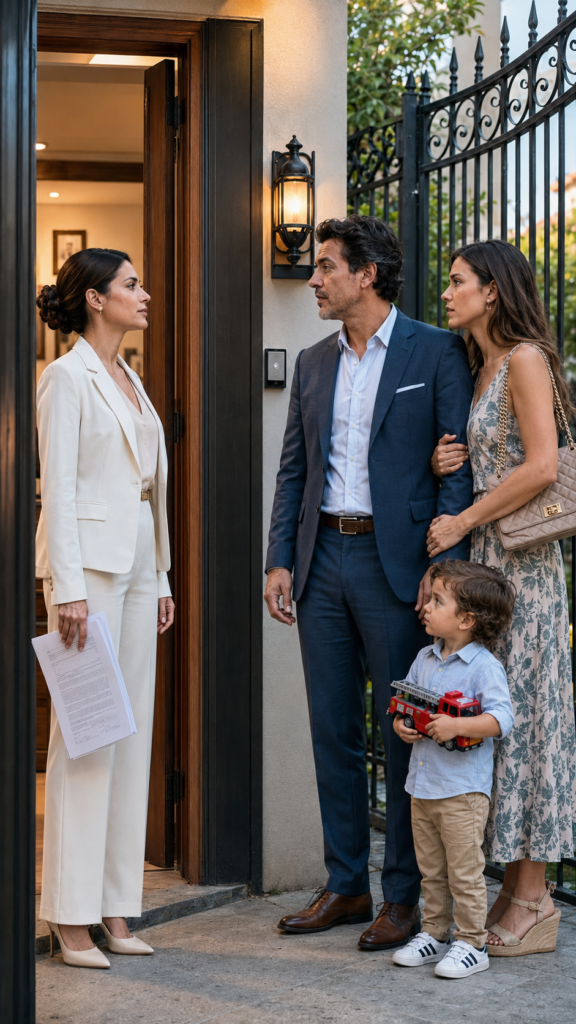
She heard the engine of a truck stop in front of the dark iron gate of the family house in Lomas de Chapultepec.
It was almost 8 PM.
The house smelled of freshly brewed coffee and old wood, a scent that Mariana associated with her father, with Sunday gatherings, and with a life she had tried to sustain alone while her husband claimed to be 'sacrificing himself for the business.'
She opened the door thinking it was Mauricio, the operations director, dropping off urgent documents.
But what she found left her frozen.
Adrián was there.
Older, yes, but with the same arrogance as always.
Beside him was a stylish, dark-haired woman in her early thirties, a small suitcase next to her legs and a nervous expression that didn’t match the confidence with which Adrián held her arm.
Between them was a two-year-old boy clutching a red fire truck.
The boy looked at Mariana with wide eyes.
Adrián lifted his chin.
—Mariana, we need to talk like adults. This is Emiliano. He’s my son. And she’s Paola.
The word 'son' fell in the foyer like a shattering glass.
Mariana didn’t scream.
She didn’t cry.
She didn’t ask how long.
She just stared at him.
Adrián, uncomfortable with that silence, dropped the phrase that ignited everything.
—I need you to be mature. Things have changed, and you’re going to have to accept it.
Mature.
He didn’t say 'sorry.'
He didn’t say 'I lied.'
He didn’t say 'I betrayed you.'
He said mature, as if she were an exaggerated woman throwing a tantrum over a schedule change.
For 15 years, Mariana had been his wife.
For 15 years, she had also been the true backbone of Salvatierra Energía Industrial, the company her father left her before he died.
On paper, she was the majority partner.
But Adrián got used to presenting himself in meetings as the owner, talking over her, signing, ordering, and bragging that he had built everything.
When he accepted contracts in Monterrey, Tamaulipas, and Oaxaca, he promised it would only be a few months.
—It’s temporary, Mariana. This project is going to elevate us to another level.
But a few months turned into one year.
Then two.
Then three.
His calls grew colder.
His visits, shorter.
His explanations, always the same.
—So much work.
—It’s almost stabilizing.
—Don’t be intense, seriously, you know how the job is.
While he hid behind work, Mariana paid salaries, calmed suppliers, reviewed accounts, and took care of Adrián’s sick mother when he claimed he couldn’t travel.
The truth didn’t come from a photograph or a scent on a shirt.
It came from the numbers.
Six months before, Mariana found strange payments.
Rent in San Pedro Garza García.
Private daycare.
Children’s pharmacies.
Pediatric consultations.
Furniture.
Car insurance.
Travel expenses disguised as technical allowances.
Adrián had financed a second life with money from his family’s company.
That’s why Mariana wasn’t surprised that night.
She walked toward the foyer, grabbed a black folder, and returned to the gate.
—You’re not coming in —she said.
Adrián let out a dry laugh.
—Don’t make a drama out of this.
She handed him the folder.
Inside were the divorce petition, the suspension of his bank accesses, the audit report, and the board resolution that stripped him of all signing power from that very night.
Paola paled.
Adrián read the first page.
And for the first time in 15 years, Mariana saw fear in his eyes.
Then she opened another envelope and said the phrase that froze his blood:
—And you haven’t seen the worst yet.
PART 2
Adrián gripped the folder as if he could destroy the evidence with just his fingers.
His face no longer bore the confidence of a man arriving at someone else’s house, believing it was still his.
Now he looked like a guy trapped in the middle of the street, with a confused mistress, a scared child, and a wife no longer willing to obey.
—What the hell is this? —he asked quietly.
Mariana didn’t move.
—This is what happens when a man confuses silence with permission.
Paola turned to Adrián.
—Audit? What audit?
He didn’t even look at her.
—Paola, don’t start.
But Mariana did look at her.
There was no hatred in her eyes.
There was something stronger: clarity.
—He paid for your apartment, your car, the child's daycare, your furniture, and several trips with money from Salvatierra Energía Industrial.
Paola opened her mouth, but no sound came out.
Emiliano hid behind her leg, clutching the red truck tightly.
That gesture squeezed Mariana’s chest.
The child wasn’t guilty.
He hadn’t lied.
He hadn’t stolen.
He was just standing on a sidewalk where adults had just turned his life into a public disgrace.
Adrián stepped toward the entrance.
—This is also my house.
Mariana let out a brief laugh.
It wasn’t mocking.
It was exhaustion.
—No. This house is in my name. The company is in my name. The majority shares are in my name. You just spoke so loudly for so many years that you forgot to read the documents.
Adrián’s jaw tightened.
Before, that gesture was enough to make Mariana lower her voice.
Before, she preferred peace.
Before, she confused patience with love.
But that woman was no longer there.
A curtain moved in the house across the street.
Adrián lowered his voice as he noticed the scene was beginning to have witnesses.
—Mariana, seriously, don’t do this here. Let us in and we’ll talk.
—You brought the spectacle to my doorstep —she replied—. I just prepared the ending.
At that moment, a black truck parked behind them.
Licenciada Rebeca Olvera, Mariana’s lawyer, stepped out with a leather folder under her arm.
Behind her were Mauricio and two private guards.
Adrián let out a bitter laugh.
—Did you bring bodyguards too?
—I brought witnesses —Mariana said—. So tomorrow you can’t make up stories that I assaulted you, that you didn’t understand, or that it was all just a couple’s fight.
Licenciada Rebeca approached calmly.
—Mr. Rivas, you are officially notified that you cannot withdraw documents, computers, contracts, files, or assets belonging to Salvatierra Energía Industrial. You also cannot contact banks or suppliers on behalf of the company without written authorization from the board.
Adrián looked at her with disdain.
—I ran that company.
—Wrong —Mariana said.
The word hung in the air.
Paola looked at her as if she were starting to understand that she had been living in a story fabricated for Adrián's ego.
—You told me you were separated —she whispered.
Adrián closed his eyes.
—Not here.
—You told me she knew about us.
—Paola, shut up.
The way he spoke made Mariana realize something all at once.
Paola wasn’t entirely innocent, but she wasn’t the queen Adrián had presented her as.
She was another woman caught in a lie tailored to his ego.
Paola stepped back.
—You also told me the company was yours.
Adrián didn’t respond.
That silence confessed everything.
Mariana looked at Mauricio.
—Get a car for her and the child. There’s a hotel on Reforma. They don’t have to stay in this scene.
Adrián looked at her indignantly.
—Are you going to help her now?
—I’m going to help the only one who didn’t choose to be here.
Paola took her suitcase with one hand and Emiliano with the other.
Before getting into the car, she looked at Mariana with shame.
—I didn’t know all this.
Mariana nodded.
—Now you do.
The car drove away.
The red lights faded into the distance.
And Adrián was left alone.
Without a mistress.
Without a child.
Without an audience to admire him.
Only with his rage and his folder.
—You’re going to regret this —he said.
Mariana looked at him like one looks at a closed door.
—No, Adrián. Tomorrow you’re going to start regretting it.
And so it was.
At 8:20 the next morning, Adrián arrived at the headquarters of Salvatierra Energía Industrial in Santa Fe.
He wore his navy suit, the expensive watch, and the same face of a man who believes a bad night can be fixed by shouting in a boardroom.
But the turnstile didn’t open.
The receptionist looked up.
—Your access is deactivated, Mr. Rivas.
—Call IT.
—IT deactivated it last night at the request of the board.
When he tried to pass anyway, two internal guards stepped in front of him.
They escorted him to the main room.
There was Mariana.
Black blazer, ivory blouse, hair pulled back, and her father’s watch on her wrist.
On the table were folders for each board member.
Account statements.
Invoices.
Emails.
Digital signatures.
Transfers.
Expense reports.
Everything Adrián thought no one would check.
The meeting was worse than a fight.
It was orderly.
No one shouted.
No one cried.
The documents spoke line by line.
Private rent marked as technical lodging.
Car insurance charged to logistics.
Furniture billed as regional equipment.
Daycare disguised as operational support.
Personal trips mixed with site visits.
And then, something graver.
Parallel payments to suppliers.
Hidden commissions.
An account linked to a Monterrey intermediary.
Adrián first denied it.
Then said they were necessary expenses.
Then talked about 'gray areas.'
Then accused Mariana of spite.
And finally, when he felt the ground slipping away, he said the same old thing.
—This happens when a woman lets her emotions enter the business.
The room went cold.
Don Ernesto, an old partner of Mariana’s father, took off his glasses.
—No, Mr. Rivas. This happens when a man believes that trust is a limitless card.
By noon, Adrián was suspended from all his functions.
By 3 PM, the banks confirmed the blockages.
By 6, his main clients already knew that no agreement signed by him would be valid.
His downfall wasn’t explosive.
It was administrative.
Cold.
Documented.
Impossible to manipulate.
For weeks, Adrián tried to regain control with gossip.
He said Mariana was outraged.
That the audit was revenge.
That it was all a marital issue.
That she could never run the company without him.
But while he talked, Mariana worked.
She reviewed contracts.
Protected salaries.
Renegotiated with suppliers.
Organized areas that had been functioning in fear for years.
Promoted two brilliant engineers that Adrián had ignored because, in his words, 'they lacked character.'
In four months, the company stopped bleeding money.
In one year, it had its best quarter since Mariana’s father died.
But the final blow came from where Adrián least expected.
Paola sought out Mariana.
They met in a café in Roma Norte on a rainy afternoon.
Paola arrived without makeup, with dark circles under her eyes and a USB drive in her hand.
—I found this on an old computer of Adrián’s —she said—. Messages, photos of contracts, deposits. I also discovered I wasn’t the only one. There was another woman in Mérida.
Mariana wasn’t surprised.
She just felt a dry sadness.
The USB contained evidence of an illegal agreement with a supplier from Nuevo León, undeclared transfers, and messages where Adrián mocked Mariana’s 'patience.'
Adrián’s defense crumbled.
The divorce progressed slowly because he fought over every peso, every property, and every calculation.
Men who have already lost power often believe that stalling is a way to win.
But Mariana no longer expected anything from him.
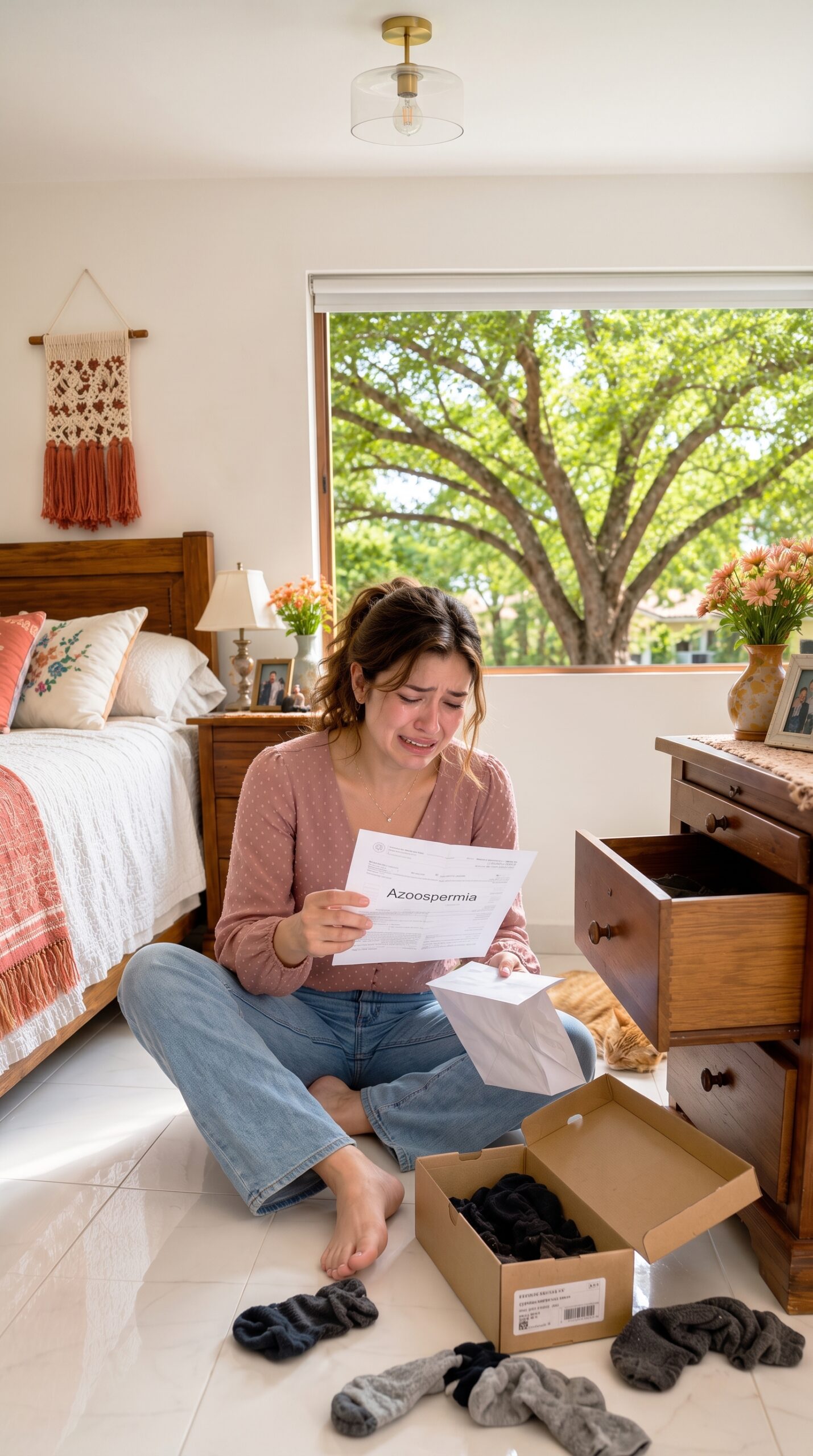
The day she found one of Adrián’s dumbbells behind the headboard of her bed, she cried for the first time.
Not because she missed him.
She cried for the woman she had been.
For all the times she had spoken softly to avoid upsetting him.
For all the times she thought enduring was loving.
For all the nights she went to bed alone, inventing excuses for a man who already had another life paid for with her money.
She cried until she was empty.
And the next day she returned to the office.
Not as a victim.
As the owner.
Over time, Salvatierra Energía Industrial grew.
Mariana opened a logistics unit in Querétaro.
Then she signed contracts in Oaxaca and Nuevo León.
Later she was invited to panels on renewable energy.
The same businessmen who used to ask Adrián everything began requesting meetings with her.
Some said:
—Your father would be proud.
Mariana smiled, though inside she thought they could have seen her before.
They just didn’t want to look.
Five years later, at a national energy congress in Cancún, Adrián saw her again.
The hotel was facing the sea.
The Salvatierra Energía Industrial logo appeared at the entrance of the auditorium.
Mariana was the keynote speaker.
Adrián was in the registration line, wearing a proper jacket but lacking luster.
He had more gray hair.
Less confidence.
When he saw her, he froze.
For him, the world stopped.
For her, it didn’t.
Mariana lowered her gaze from her tablet.
—Adrián.
—Mariana —he said—. I didn’t know you’d be here.
—I’m giving the 4 PM conference.
He looked at the poster.
Her name.
Her company.
Her authority.
Everything he had sworn she couldn’t sustain without him.
—You look good —he murmured.
—I’m fine.
Adrián swallowed hard.
—I was a fool. I thought you were going to break. I thought you were going to need me. Every year that passed and you grew more, I understood that you were never the weak one.
Mariana didn’t smile.
Nor did she hate him.
And that was what hurt him the most.
Hatred still binds.
Calm no longer does.
—Can we have coffee someday? —he asked—. Talk from another place. Start fresh.
Mariana adjusted her tablet under her arm.
—No.
—Is it because of what I did?
—No, Adrián. It’s because of the woman I became after surviving what you did.
He looked down.
An assistant from the event approached.
—Ms. Salvatierra, the press is waiting for you.
—I’m coming.
Mariana gave Adrián a brief, polite, definitive smile.
—Take care.
At 4 PM, she stepped onto the stage and spoke of ethics, leadership, industry, and difficult decisions.
The room listened to her in silence.
In the back, Adrián stood for several minutes.
Not because there were no chairs.
But because some men don’t know where to sit when the woman they tried to humiliate becomes impossible to ignore.
That night, Mariana looked at the sea from her hotel window.
She didn’t thank betrayal.
She didn’t romanticize the pain.
She didn’t say that Adrián made her strong.
That would be giving credit to the one who tried to destroy her.
He only started the fire.
Everything that rose afterward, she built.
And somewhere in Mexico, Adrián understood too late that the woman he tried to silence not only reclaimed her company.
She reclaimed her name.
She reclaimed her story.
And she reclaimed a life where no one ever told her to accept humiliation in silence.