PART 1
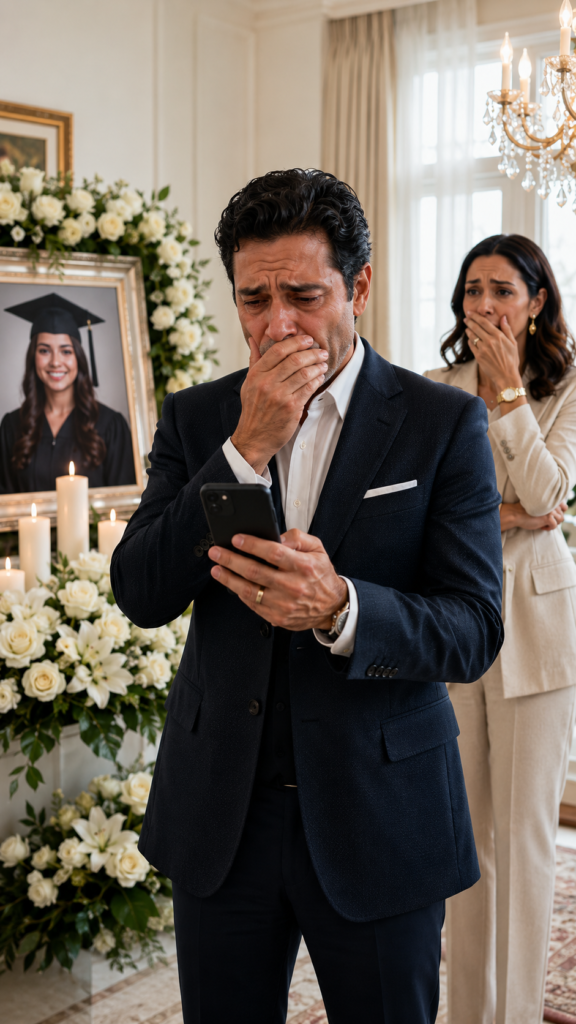
The mass for the second anniversary of Valeria Salcedo's death was about to end when Alejandro's cell phone vibrated on the wooden bench.
He didn’t plan to answer.
That number was only used by executives, lawyers, and people who knew he didn’t take calls on Sunday afternoons.
But when he looked at the screen, his blood ran cold.
The message came from Valeria's old number.
His daughter.
The same daughter who, according to all the paperwork, had died two years ago in an accident on the Mexico-Cuernavaca highway.
"Dad, I'm graduating tomorrow. If you ever really loved me, don't be late again."
Alejandro felt as if the temple was moving.
The priest continued talking about eternal rest, resignation, and faith, but he was no longer listening to anything.
Beside him, Beatriz, his second wife, noticed his face.
"What happened?" she whispered, leaning toward him.
Alejandro didn’t respond. He just showed her the cell phone.
Beatriz read the message and went pale in just one second. Then she pressed her lips together, as if she already had a response prepared.
"It’s a scam, Alejandro. What a low blow from whoever is doing this."
Rodrigo, Beatriz's son and the financial director of the family business, approached from the back row.
"Give it to me. I’ll track the number digitally."
Alejandro hid the phone against his chest.
"No one touches this."
Beatriz caressed his arm, but her fingers were trembling.
"My love, Valeria is dead. You signed the death certificate. You went to the funeral."
"I went to a closed-casket funeral," he said, his voice breaking. "I never saw her face."
A heavy silence fell between the three of them.
Rodrigo glanced at his mother out of the corner of his eye.
"The hospital confirmed the identity. Don’t let yourself be manipulated by a message, seriously."
Then the cell phone vibrated again.
It was a photo.
Blurry, taken from a distance, but enough for Alejandro to feel like his soul was leaving his body.
A young woman with her back turned, wearing a black gown, in front of a university building. On her left wrist, she wore a silver bracelet with a small moon.
The bracelet Alejandro had given Valeria when she turned 15.
The bracelet Beatriz claimed had burned in the accident.
"That bracelet can’t exist," he murmured.
Beatriz tried to snatch the cell phone from him.
Alejandro reacted suddenly.
"No!"
Several people turned to look within the church. The mass continued, but the Salcedo family was already broken inside.
When they left, Beatriz suggested going back to their house in Las Lomas. She said Alejandro was upset, that he needed to rest, that the press could find out.
But he wasn’t listening to her anymore.
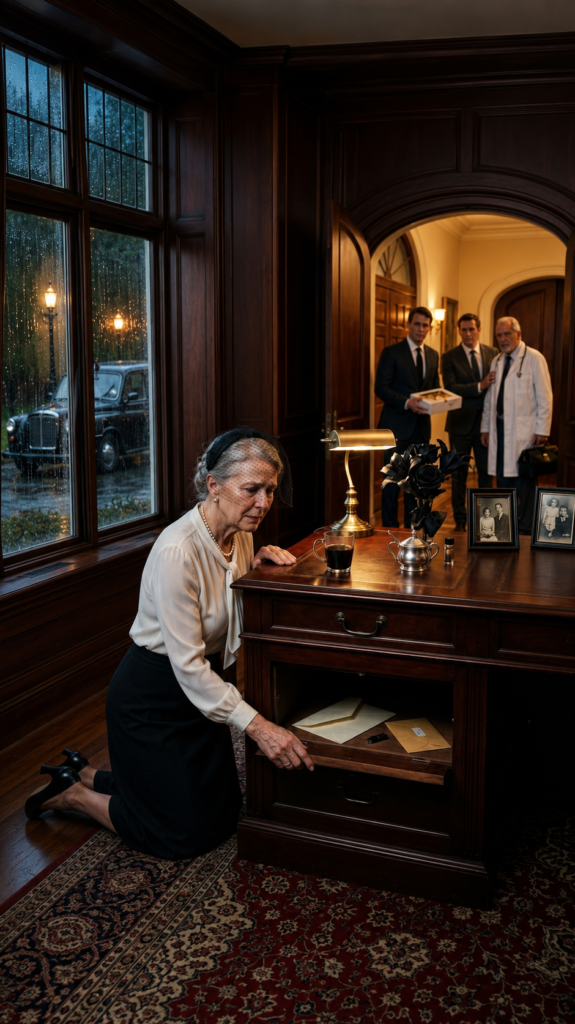
That night he entered Valeria's untouched room. Her books, sneakers, law notes, and photos with friends were still there.
In a notebook, he found a phrase repeated many times:
"Don’t be late."
Alejandro sat on the bed and cried quietly.
At midnight, he called Rafael Mendoza, an old lawyer who had worked for Elena, Alejandro's first wife and Valeria's mother.
Rafael arrived with a serious expression, reviewed the message, the photo, and the bracelet.
Then he asked:
"Did you see the body?"
Alejandro shook his head.
"Beatriz said it was better to remember her beautifully."
Rafael closed the folder.
"Then we don’t have a confirmed death. We have a story that someone wanted you to believe."
The next morning, Beatriz found the bed empty.
The closet was open.
Alejandro's passport was no longer there.
Rodrigo saw her come down the stairs without makeup, her face distorted.
"Mom… why are you so afraid?"
Beatriz squeezed the cell phone between her fingers.
"Because if Alejandro finds that girl, everything we built will fall apart."
And Rodrigo understood that his mother wasn’t talking about a scam.
She was talking about a truth buried alive.
PART 2
Alejandro arrived at Ciudad Universitaria before 6 PM.
The ceremony started at 7, but he couldn’t wait another minute.
He didn’t have bodyguards, expensive suits, or that look of a businessman used to having doors opened for him.
He carried fear.
Rafael walked beside him with a folder under his arm.
He had confirmed that a student named Lucía Rojas from the Faculty of Law was graduating that night.
She didn’t have a complete academic record.
She had no registered parents.
She had appeared at the university two semesters after Valeria's accident.
As if she had been born out of nowhere.
Alejandro saw her before the ceremony began.
She was next to other graduates, adjusting her gown. She had shorter hair, a thin scar near her eyebrow, and a more serious face.
But her eyes were the same.
Valeria's eyes.
"It’s her," Alejandro said, almost in a whisper.
Rafael didn’t respond immediately.
"If it's her, someone hid her very well."
In Las Lomas, Beatriz entered her bedroom and took an old cell phone from a hidden compartment.
She called Dr. Álvaro Siqueiros, the administrator of Hospital Santa Constanza.
"Alejandro is at the graduation," she said, without greeting.
There was silence on the other end.
"Beatriz, this should have stayed closed for two years."
"Closed doesn’t mean buried," she replied. "I want to know who opened the files."
Rodrigo listened from the hallway.
He didn’t understand everything, but he understood enough.
His mother spoke like someone protecting a crime.
In the auditorium, families applauded, cried, and recorded with their cell phones.
When they announced "Lucía Rojas," the young woman went up to the stage.
Alejandro stood up without realizing it.
She received the symbolic diploma and, upon turning, saw him.
She didn’t smile.
She didn’t run to him.
She didn’t say "dad."
She just looked at him like someone who arrived alive at the wrong funeral.
Then she continued walking.
Alejandro felt a shame he couldn’t contain in his chest.
"She’s alive," he whispered. "But she didn’t come with me."
Rafael spoke quietly.
"Maybe to her, you also died two years ago."
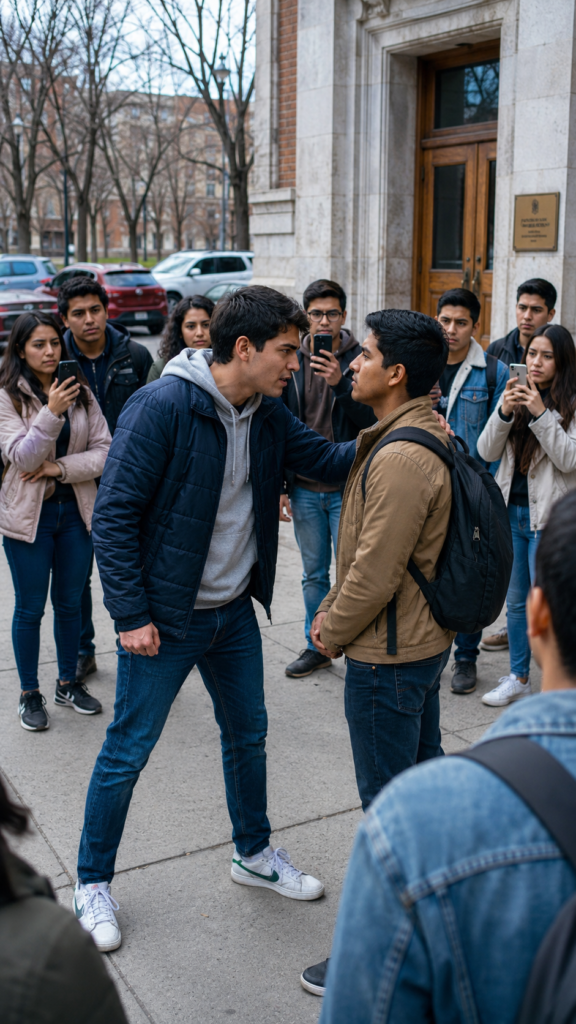
After the ceremony, Alejandro tried to approach.
"Valeria…"
The young woman paused for just half a second.
But she didn’t turn around.
An older professor placed a hand on her shoulder and guided her toward a side exit.
Rafael grabbed Alejandro by the arm.
"We’re being recorded."
In the back, a man in a gray suit was pointing a cell phone.
Minutes later, Beatriz received the video.
"I’ve got them," the man said.
"Don’t touch her," she ordered. "First, we need to make her look like an opportunist."
Rodrigo, sitting across from his mother, looked up.
"Who are you going to destroy?"
Beatriz turned pale.
"A woman who wants to intrude into a family that doesn’t belong to her."
Rodrigo showed an old transfer on his laptop.
It was from Grupo Salcedo to a medical consulting firm without a contract.
Date: two weeks after the accident.
Authorized by Beatriz.
"Was this also to protect the family?"
She didn’t answer.
It wasn’t necessary.
That night, Rafael arrived at the hotel where Alejandro was hiding from Beatriz’s 23 calls.
He brought preliminary documents.
"On the night of the accident, two women entered Hospital Santa Constanza," he said. "One was critical. The other had bruises, facial trauma, and partial memory loss, but was stable."
Alejandro gripped the table.
"Which one was Valeria?"
Rafael took time to respond.
"During the first 48 hours, the stable patient had no name. Then she appeared registered as Lucía Rojas."
"And the other?"
"The critical patient ended up registered as Valeria Salcedo."
Alejandro placed a hand on his chest.
"No…"
"The woman buried under your daughter’s name may not have been Valeria."
The blow was brutal.
Not only had they stolen a living daughter from him.
They had also buried a stranger under a lie.
At 6:43 AM, Rafael received a message from Lucía.
"Chapel of San Antonio, Coyoacán. At 8. He enters alone."
Alejandro arrived with cold hands.
He saw her in the third row, wearing a white blouse, dark pants, and the moon bracelet on her wrist.
"Valeria…"
She didn’t get up.
"Don’t use that name as if you hadn’t let them bury it."
He sat far away, not daring to touch her.
"I didn’t know."
She let out a sad laugh.
"You never knew anything. You didn’t know that Beatriz told me I was taking Rodrigo’s place. You didn’t know she tore up my acceptance letter to law. You didn’t know I called you three times the night of the accident."
Alejandro closed his eyes.
The night of the accident, Beatriz had entered his meeting crying.
She told him Valeria had died.
He believed.
He didn’t ask.
He didn’t demand to see the body.
He didn’t investigate.
The paperwork hurt him less than the guilt.
"I woke up not remembering well who I was," she continued. "A nurse told me to be quiet if I wanted to live. Then new documents appeared. They called me Lucía Rojas. They said I had no family."
"Who ordered that?"
Valeria looked at him for the first time directly.
"People with money. People who knew your last name could erase a life."
Outside, Rafael received Teresa, a former nurse from the hospital.
The woman arrived trembling with a yellow envelope.
"I didn’t kill anyone," she whispered. "But I stayed silent."
Inside the envelope were shifts, medical notes, and a nearly erased name:
Ana Paula Martínez, 23 years old.
The other young woman.
The one no one searched for on television.
The one buried as Valeria Salcedo because it was easier to make a poor person disappear than to touch a powerful family.
That same day, Beatriz called a press conference at a hotel in Polanco.
She arrived dressed in white, with rehearsed tears and a huge photo of Valeria behind her.
"A woman is trying to take advantage of my husband’s pain," she said before the cameras. "We will not allow anyone to tarnish the memory of our daughter."
Then the door opened.
Valeria entered.
Without an elegant dress.
Without jewelry.
Only with the moon bracelet and a firm look.
Rafael walked in beside her.
Alejandro followed.
The reporters stood up as if a bomb had exploded.
"Are you Lucía Rojas or Valeria Salcedo?" someone yelled.
She took a deep breath.
"For two years, I was forced to live as Lucía Rojas because powerful people found it convenient for Valeria Salcedo to be dead."
Beatriz slammed the table.
"This is a lie!"
Valeria raised her wrist.
"A lie was saying this bracelet burned. A lie was a closed casket. A lie was using my death to steal my name."
Rafael connected his computer.
The records appeared on the screen.
Admission of two women.
Administrative change of identity.
Discharge issued under the name of Lucía Rojas.
Death certificate issued as Valeria Salcedo.
Then came the transfers.
Fractioned payments.
False consultancies.
Internal messages from Beatriz where she referred to Valeria as "the original heir" and requested to "close any possibility of a claim."
The motive became clear.
Elena, Valeria’s mother, had left shares for her daughter upon turning 21.
If Valeria lived, Rodrigo wouldn’t inherit that portion.
If Valeria died, Beatriz gained space for her son.
Rodrigo entered the room with a destroyed face.
Beatriz paled.
"Don’t do this."
He left a USB drive on the table.
"All my life I believed I had to fight for a place. You taught me to hate someone who never took anything from me."
"I did it for you," Beatriz said.
Rodrigo shook his head, crying.
"No. You did it for yourself using my name."
Alejandro took the microphone.
He looked at Valeria as if asking for permission.
She didn’t smile, but she didn’t stop him either.
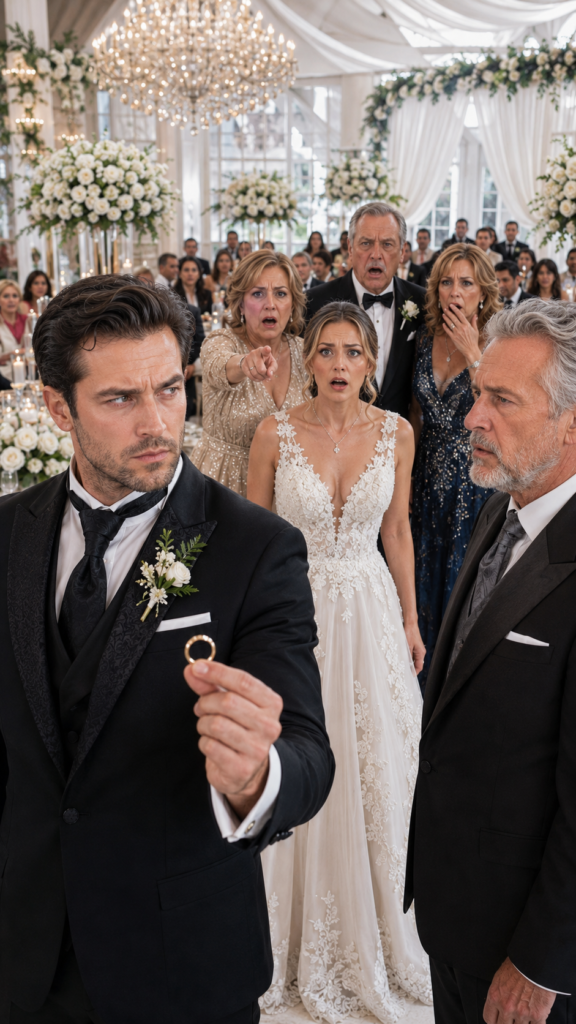
"I publicly recognize this woman as Valeria Salcedo Robles, my daughter. I also recognize that another woman, Ana Paula Martínez, was buried under her name. This family deserves answers for both."
The room turned chaotic.
Beatriz screamed that everyone was crazy.
The lawyers tried to stop the broadcast.
But it was too late.
All of Mexico was watching how a powerful woman lost her mask.
The following weeks were tough.
The hospital was investigated.
Dr. Siqueiros fell.
Beatriz faced charges for altering records, improper payments, and defamation.
Rodrigo submitted files that also compromised him, accepting that he preferred to obey rather than ask.
Valeria didn’t return to the mansion.
Alejandro asked her once.
"I can give you a safe house."
She crossed her arms.
"Do you still think caring is buying walls?"
He looked down.
"I don’t know how to do it any other way."
"Learn."
And Alejandro learned by waiting.
He waited when she didn’t respond.
He waited when she didn’t want to see him.
He waited when she cried for a robbed life that no money could return.
Time later, Ana Paula Martínez had a face, a story, and a family.
Her sister Juana arrived from Puebla with a wrinkled photo and two years of questions.
Valeria was there when they told her the truth.
Alejandro was there too, but he didn’t speak first.
He just listened.
That day he understood that his pain was news because he was rich.
Ana Paula's pain was silence because she was poor.
Valeria created a fund named after Ana Paula to help families without resources identify bodies, review files, and confront corrupt hospitals.
"Without photos of you handing out checks," she told Alejandro.
He almost smiled.
"You talk just like your mom."
Valeria didn’t respond.
But she didn’t leave.
Almost a year later, Valeria presented a research project at UNAM on identity and missing persons.
There weren’t big cameras.
Just professors, Rafael, Juana, and Alejandro, who arrived 20 minutes early with white flowers.
Before sitting in the front row, he looked at Valeria as if asking for permission.
She pointed to the empty chair.
Throughout the entire presentation, Alejandro didn’t look at his cell phone even once.
At the end, he applauded standing.
Without a spectacle.
Without speeches.
Just as a father finally learning to arrive.
In the hallway, Valeria approached.
"You arrived early."
Alejandro smiled sadly.
"I’m practicing."
She looked at the flowers.
"For me?"
"For you and for Ana Paula."
Valeria took a flower and gave another to Juana.
Then she walked toward the exit.
Alejandro stayed a step back, not demanding hugs, not asking for forgiveness as if that could erase two years.
Near the stairs, Valeria stopped.
"I still don’t know if I can forgive everything."
He responded:
"I still don’t deserve everything."
She took a deep breath.
She had tears but also strength.
"You can walk with me to the outside, Dad."
The word came out wounded, small, imperfect.
But it opened a door.
And Alejandro walked by her side, not arriving late, as the evening fell over Ciudad Universitaria and finally someone pronounced correctly the names of the living and also those of the dead.