PART 1
Natalia Cervantes had waited five long years to hear her name called in front of the packed auditorium.
That afternoon, when they announced her during the graduation ceremony at Panamerican University, her mom, Laura, cried as if they were giving her life back. Her friends screamed, her teachers hugged her, and even some classmates who had ignored her before came up to take pictures.
But Natalia couldn’t fully enjoy it.
Because next came the party.
And the party would be at the family home in San Ángel, that grand estate adorned with bougainvillea at the entrance, cantera stone floors, and employees moving like shadows. Her father’s house, Ricardo Cervantes.
A man who was elegant, successful, and respectable to everyone.
To Natalia, he was something else entirely.
Ricardo looked at her as if she had been born to be an inconvenience. He never forgave her for not being like Mariana, his younger daughter, the golden child, the perfect one, the one who graced social magazines, who knew how to sweet-talk businesspeople and say “yes, daddy” in a soft voice.
Mariana was 24, hadn’t finished a single degree, but Ricardo flaunted her as if she had discovered the cure for cancer.
Natalia, on the other hand, had graduated with honors.
And yet, that night, her father barely gave her a cold kiss on the forehead.
“Don’t make a scene today,” he whispered in her ear as the guests arrived. “It’s a decent party.”
Natalia swallowed hard.
Her mom pretended she hadn’t heard, as always.
The music began with a versatile group playing modern boleros. The tables were decorated with white flowers, candles, and champagne glasses. There were politicians, lawyers, Ricardo’s partners, and relatives Natalia hadn’t seen in years.
Everyone repeated the same thing:
“What a pride, Natalia.”
“Wow, licensed one.”
“Now go out and conquer the world.”
But Ricardo smiled more when someone complimented Mariana on her red dress than when they spoke of Natalia’s achievements.
Mariana arrived late, as usual.
She walked in with sky-high heels, perfect hair, flawless makeup, and a loud laugh that turned half the room. She exaggeratedly hugged Natalia, as if she loved her dearly.
“Oh, Nat, congratulations. You finally finished, huh? You were taking forever.”
Several people let out an awkward laugh.
Natalia smiled.
She was used to it.
What she didn’t expect happened twenty minutes later.
While she was talking with two friends near the drink table, Natalia saw her father on the other side of the room. He wasn’t conversing. He wasn’t toasting. He wasn’t proud.
He was watching her.
With a strange calmness.
Ricardo approached a silver tray where several glasses were ready. A young waiter stepped aside. Ricardo whispered something to him, and the boy lowered his gaze as if he were afraid.
Then Natalia saw the label.
A small white card tied to the stem of a glass:
“NATALIA.”
Her stomach twisted.
Ricardo reached into his jacket, pulled out a tiny envelope, and emptied a white powder into the glass marked with her name.
It wasn’t quick.
It wasn’t clumsy.
He did it as someone who had already thought through every move.
Then he took a coffee spoon, stirred it just enough, and left the glass right where it was.
Natalia felt the world tilt beneath her.
She didn’t scream.
She didn’t run.
She didn’t cry.
She just stood still, a fake smile plastered on her face, while her heart slammed against her ribs.
Ricardo walked away and positioned himself by the fireplace.
From there, he watched her.
Waiting.
Natalia walked toward the tray with trembling legs. She took the glass marked with her name. The liquid bubbled as if nothing was wrong.
Her father raised his glass from afar.
As if inviting her to obey.
And just then, Mariana appeared by her side, laughing, with her phone in hand.
“Come on, graduate, let’s toast. You finally got a little attention today.”
Natalia turned to her.
For one second, she thought about throwing the glass to the floor.
But she saw her father staring at her intently. She saw the waiter sweating. She saw her mother distracted, talking to an aunt. She saw all the guests pouring drinks, completely unaware.
And she understood something horrible:
If she didn’t make everyone look, Ricardo would get away with it.
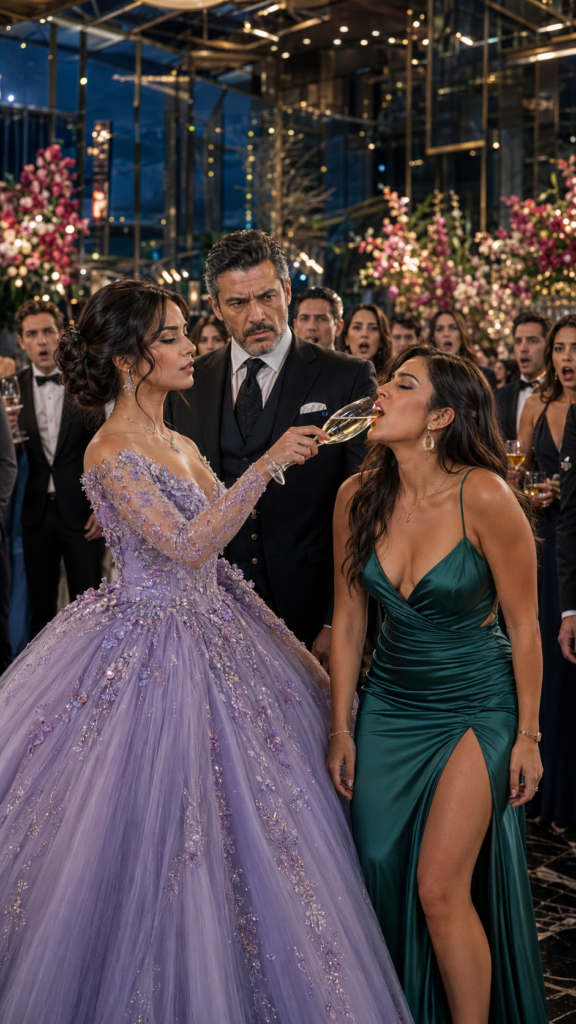
With a calmness she didn’t even recognize, Natalia handed the glass to Mariana.
“Here, you drink it,” she said, smiling. “You’ve always been dad’s favorite.”
Mariana let out a laugh.
“Oh, so intense, seriously.”
And before Natalia could stop her, Mariana lifted the glass and drank it all in one gulp.
Ricardo turned pale as a ghost.
PART 2
Silence arrived before fear.
Mariana lowered the empty glass and licked her lips, still amused. She didn’t understand why Natalia was looking at her as if she had just crossed a point of no return.
Ricardo took two steps toward them, but stopped when he noticed Natalia was already walking directly toward the small stage where the band was playing.
The young woman snatched the microphone from the singer’s hands, her hands trembling.
“NO ONE TAKE ANYTHING!” she shouted.
The music cut off abruptly.
Conversations died one by one.
An uncle left his glass halfway. A cousin let out a nervous giggle. Laura, Natalia’s mother, stood up from her chair with a white face.
“Natalia, what’s wrong?” Ricardo asked, forcing a smile. “You’re making a fool of yourself.”
But his voice sounded different.
It no longer held authority.
It sounded like panic.
Natalia pointed toward the drink table.
“My dad just put something in the glass that had my name on it.”
A murmur swept through the room.
Mariana’s eyes widened.
“What?”
“That glass,” Natalia said, pointing at her sister’s hand. “The one you just drank.”
Mariana’s face drained of color.
Ricardo tried to move toward the stage.
“Get down from there, girl. You’re crazy. You’ve always wanted attention.”
“I’m not getting down,” Natalia replied. “And this time, everyone is going to listen.”
Laura walked toward Ricardo.
“Tell me it’s not true.”
He didn’t even look at her.
He just searched for the young waiter with his eyes.
The boy shrank behind a column.
Natalia saw him and raised her voice.
“Javier, you saw something. Say it.”
The waiter first shook his head, terrified.
Ricardo glared at him.
“Watch what you’re making up, kid.”
But the young man’s fear broke when Mariana put a hand to her stomach and started breathing oddly.
“Mr. Ricardo asked me to set aside a glass,” Javier said, his voice breaking. “He told me it was special for Miss Natalia. He also told me not to let anyone else touch it.”
“LIAR!” Ricardo roared.
Mariana dropped the glass. The crystal shattered against the floor.
“I feel sick,” she whispered.
Laura rushed to her.
A doctor who was a family friend immediately came over and took her pulse. She asked for water, requested space, and ordered someone to call for emergency services.
The entire room erupted into chaos.
But Natalia didn’t let go of the microphone.
“I saw the envelope. I saw the powder. I saw how he stirred it.”
Ricardo laughed, but that laugh no longer convinced anyone.
“Look at that. My resentful daughter putting on a show because she can’t stand that her sister is loved.”
Then there was a loud bang at the front door.
It wasn’t a guest.
It was three agents from the Mexico City Prosecutor’s Office and a man in a dark suit who entered with a folder under his arm.
“Good evening,” the man said. “Inspector Salgado. We need everyone to remain on the property.”
Ricardo froze.
Natalia closed her eyes for a moment.
She hadn’t planned for this that night, but she had spent months preparing for something like it.
Because the powder in the glass wasn’t the first sign.
During her last semester, Natalia had found odd movements in the university account her grandfather left her before he died. Diverted scholarships. Canceled payments. Forged signatures.
Then she found emails where Ricardo spoke with a private doctor about “controlling his eldest daughter’s rebellious episodes.”
When Natalia confronted her father three weeks before, he only smiled.
“Without my last name, you are nobody.”
That same night, Natalia sought out the Prosecutor’s Office.
At first, they didn’t believe her. It was hard to accuse a well-known businessman, a friend of judges, a donor to campaigns, and a benefactor of hospitals.
But Natalia delivered audios.
Screenshots.
Account statements.
And a recording where Ricardo said, unaware he was being recorded:
“If Natalia speaks at graduation, the family ends. We need to sedate her, take her out, and put her in the clinic before she opens her mouth.”
Inspector Salgado walked towards Ricardo.
“Mr. Cervantes, we have a warrant to search the property and secure evidence related to fraud, document forgery, and possible attempted poisoning.”
“This is nonsense,” Ricardo spat. “I know the prosecutor.”
“Then you can call him from where it matters,” Salgado replied.
Mariana began to cry.
“Dad? What did I drink?”
Ricardo finally looked at her.
And that was when the first real blow of the night landed.
It wasn’t concern that appeared on his face.
It was anger.
“THAT WASN’T FOR YOU!” he shouted.
The room went cold.
Laura covered her mouth with her hand.
Mariana stopped crying for a second, as if that phrase had hurt her more than the poison.
“Wasn’t for me?” she repeated. “Then it was for Natalia?”
Ricardo realized too late what he had said.
“Mariana, you don’t understand…”
“No,” Natalia interrupted from the stage. “Now she understands perfectly.”
The doctor instructed that Mariana should not fall asleep. An ambulance arrived eight minutes later. The paramedics took her out on a stretcher, conscious but trembling. Before leaving, Mariana took Natalia’s hand.
For the first time in years, there was no arrogance in her eyes.
There was terror.
And a silent question:
What kind of father had raised them?
The agents secured the broken glass, the napkins, the tray, and Ricardo’s jacket. In his pocket, they found another identical envelope.
Javier, the waiter, declared that Ricardo had offered him 20,000 pesos not to touch the glass and not to talk to anyone.
But the real twist came when Salgado opened the folder.
“Mrs. Laura,” he said, “we need to show you something.”
Ricardo shouted no, but two agents held him back.
The folder contained documents from Natalia’s grandfather, Don Ernesto Cervantes.
That man, before dying, had left most of his shares and properties in Natalia’s name, not Ricardo’s.
Not because she was the eldest.
But because he knew what his son was capable of.
There was a notarized letter dated six years prior.
Laura read it with trembling hands.
“My granddaughter Natalia has a cool head and a pure heart. Ricardo will seek to break her because he cannot control her. If anything happens to me or if she is admitted without medical cause, review my documents. My son did not inherit control of the family. I only made him believe it to protect her until she turned 25.”
Natalia didn’t know that part.
No one did.
Ricardo had hidden the letter and manipulated accountants, lawyers, and family members for years to pretend that everything was still under his control.
The graduation party was not just a celebration.
It was the day Natalia turned 25.
Starting from that midnight, she could legally claim full administration of the estate her grandfather left her.
That’s why Ricardo wanted to sedate her and take her away from the house.
That’s why he wanted to lock her in a private clinic with a false diagnosis.
That’s why he had prepared the glass with her name on it.
Mariana, still on her way to the hospital, was not the target.
She was the mistake that exposed everything.
Laura collapsed into a chair.
“Ricardo… were you going to admit your daughter?”
He stopped pretending.
He adjusted his jacket as if he were still in a board meeting.
“I built this family. I decided who serves and who doesn’t.”
Natalia stepped down from the stage.
She walked until she stood directly in front of him.
“You didn’t build a family. You manufactured an altar for everyone to fear you.”
Ricardo let out a dry laugh.
“Without me, you wouldn’t last a month.”
“Without you,” Natalia said, “we will finally breathe.”
The agents took him away as some guests recorded with their cell phones. His image as an untouchable man crumbled amidst murmurs, flashes, and a phrase someone shouted from the back:
“What a lowlife.”
At the hospital, Mariana received timely treatment. The analysis confirmed a strong sedative mixed with another substance that could cause serious harm when combined with alcohol.
She survived.
But she woke up different.
When Natalia entered the room, she expected reproaches. She expected Mariana to blame her for giving her the glass.
But her sister only cried.
“I thought he loved me more.”
Natalia stood by the door.
“He loved you while you served him.”
Mariana clutched the sheets.
“My whole life I competed with you for the scraps of a monster.”
That phrase didn’t fix years of humiliation, but it opened a crack where something like truth seeped in.
Days later, Ricardo was linked to the process. False transfers, bought doctors, altered contracts, and a clinic in Cuernavaca prepared to receive Natalia that very night were uncovered.
The diagnosis was already written.
“Severe nervous crisis.”
Only the patient was missing.
Laura had to testify against her husband. She wasn’t heroic. She wasn’t perfect. She cried, hesitated, and apologized too late.
Natalia didn’t embrace her immediately.
Sometimes forgiveness doesn’t come with an apology. Sometimes it needs years of broken silence.
The house in San Ángel ceased to be the Cervantes surname’s stage and became judicial evidence.
The champagne table disappeared.
The glasses were stored as evidence.
And the official graduation photo, the one where Natalia appeared with gown, cap, and a weary smile, ended up framed in the office that Ricardo once occupied.
Months later, Natalia took legal control of the estate. She sold part of the vacant properties and created a foundation to help young victims of domestic violence and financial control.
She didn’t do it to appear good.
She did it because she knew that many beautiful houses hide very expensive prisons.
Mariana began therapy. She left social magazines, canceled false commitments, and, for the first time, sought a job without using her father’s last name as a key.
One afternoon, she visited Natalia in the office.
She carried a simple bag, her hair tied back, and her gaze low.
“I’m not here to ask for money,” she said. “I’m here to ask you not to hate me forever.”
Natalia watched her for a long time.
She remembered every mockery, every stolen birthday, every time Mariana sat next to Ricardo while he destroyed her with a smile.
But she also remembered the stretcher.
The trembling hand.
The phrase: “That wasn’t for you.”
“I don’t know if I can love you as a sister yet,” Natalia replied. “But I do know that neither of us deserved to be raised by him.”
Mariana cried in silence.
There was no movie-like hug.
There was no background music.
Just two women understanding, too late, that they had been enemies in a war designed by their own father.
The story went viral when one of the guests leaked the video. Half of Mexico weighed in.
Some said Natalia was cruel for giving the glass to Mariana.
Others said that if she hadn’t done it, Ricardo would have never fallen.
But those who had lived under the roof of someone like Ricardo understood something more uncomfortable:
Sometimes the truth doesn’t come out because someone screams.
It comes out because the monster chooses the wrong victim.
And that night, at the party where Natalia was supposed to toast her future, she ended up burying forever the most elegant lie of her family.