PART 1
—If you’re so embarrassed about being bald, you’d better not show up in the photos.
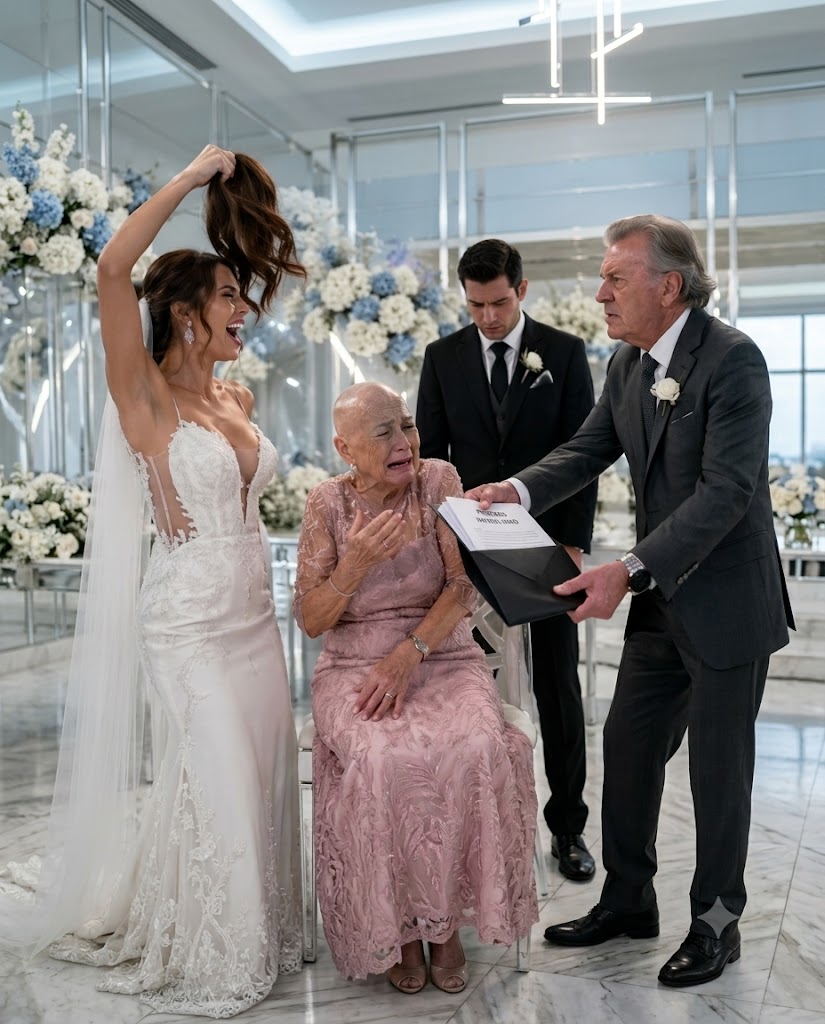
Renata said it with a smile, as if she had just cracked a fine joke in front of 280 guests. But no one laughed at first. The music faded away. The photographer lowered his camera. Even the waiters, trays of canapés in hand, froze in place.
Before the five-tier cake, Consuelo stood there, her head bare.
Renata, the bride, held in one hand the brown wig she had just yanked off.
Consuelo didn’t scream. She didn’t run. She didn’t cover herself right away. She just stared at the marble floor of the hall in San Ángel, caught in a silent shame that hurt more than any cry.
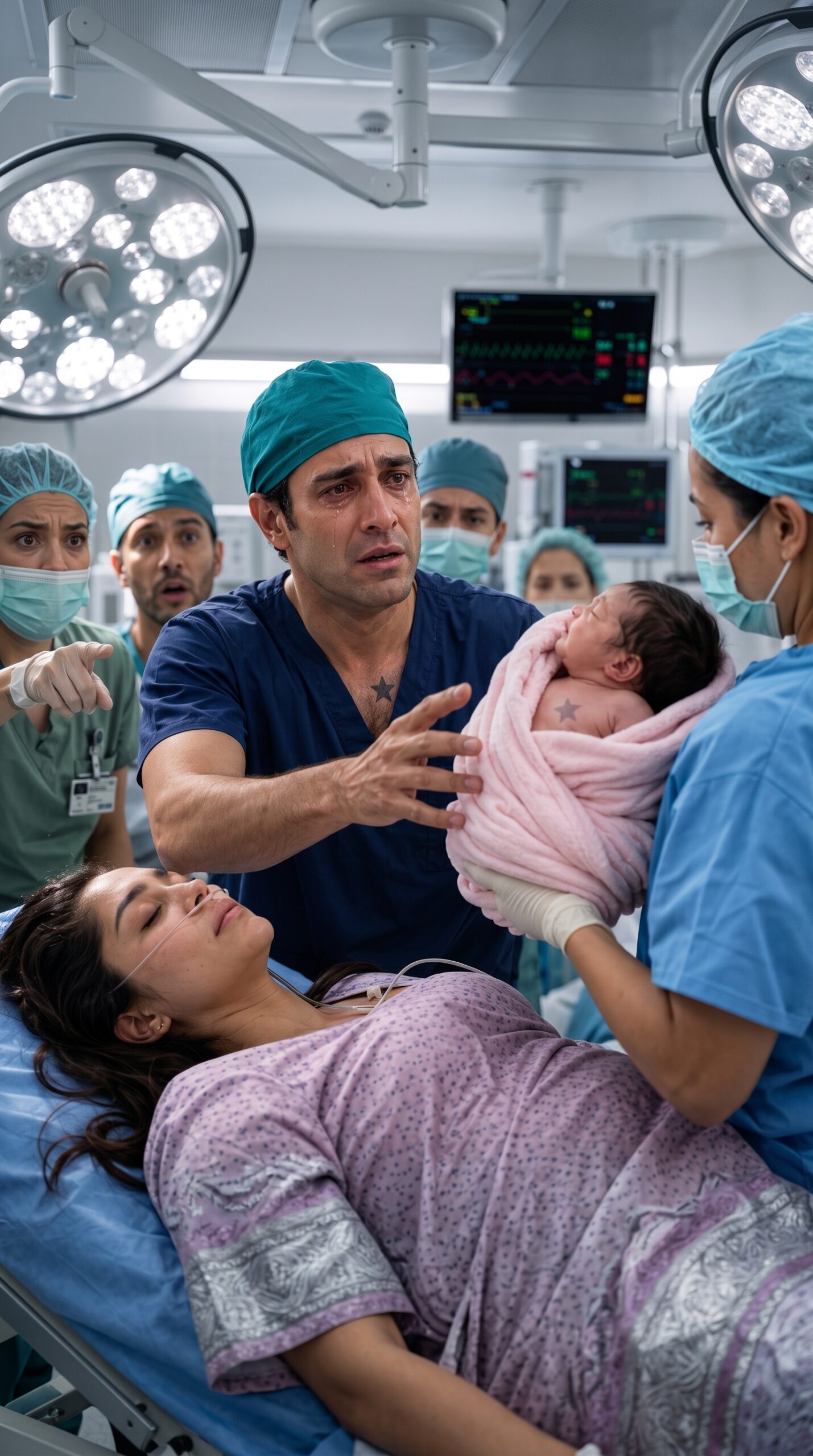
She had been battling cancer for eight months. Chemotherapy had robbed her of her hair, her strength, and many peaceful nights. But that night, at her only son’s wedding, someone decided to strip away her dignity too.
Don Julián Montiel, her husband, walked toward her with a hard expression. He took off his navy blue jacket and draped it over her shoulders. Then he picked up the wig from the floor.
Renata let out a chuckle.
—Oh, Don Julián, don’t exaggerate. We’re all family here. It was just to help the lady loosen up a bit. Seriously, how intense.
Santiago, the groom, stood beside her. Tall, elegant, dressed in an expensive suit, a champagne glass between his fingers. He glanced at his mother for barely a second and then looked down.
Julián confronted him.
—Aren’t you going to say anything?
Santiago swallowed hard.
—Dad, please. Don’t make a scene at my wedding.
Consuelo closed her eyes.
—Your wedding? —Julián asked, his voice low—. And what is your mother here?
Santiago clenched his jaw.
—Mom knows we love her. Renata didn’t mean any harm.
That phrase was worse than the mockery.
Because Consuelo cried then. Not loudly. Just one slow tear, rolling down her cheek while everyone watched as if humiliation were part of the feast.
Julián took the microphone from the master of ceremonies.
The sound of his breathing came through the speakers.
—Good evening, everyone.
Renata stopped smiling.
—Before you continue toasting to this beautiful union —Julián said—, I want to clarify a few things.
To the side of the stage, Licenciado Barragán, the Montiel family lawyer, appeared with a black folder in hand.
Santiago’s eyes widened.
—Dad, no...
—The apartment in Polanco where you and Renata planned to live after the honeymoon —Julián continued— is not in your name. It belongs to the family estate of your mother and me. Starting today, the usage contract is canceled.
Renata went pale.
—What?
—You have until Monday at 5:00 PM to clear your things.
A murmur swept through the hall.
Julián turned to another page.
—Also, there’s the loan of 20 million pesos I gave you to open your financial office, Santiago.
—It was family support —he mumbled.
—It was a signed loan.
Renata looked at her husband as if she had just discovered he wasn’t as wealthy as she had imagined.
Julián held up another document.
—And since we’re talking family, Don Tadeo, I also bought the overdue debt of your construction company in Querétaro. The machinery repossession starts Tuesday.
Renata's father stood up furiously.
—You can’t do this at my daughter’s wedding!
Julián stared at him without blinking.
—Your daughter couldn’t strip my wife of her dignity in front of everyone either.
The silence grew heavy, uncomfortable, unbearable.
Then Consuelo, still covered with her husband’s jacket, raised her face.
—Julián… the papers aren’t the worst part.
Everyone turned to her.
From the staff table, an older woman pressed a cellphone to her chest and said with a trembling voice:
—Doña Consuelo is right… I recorded what Renata planned before entering the hall.
PART 2
The woman was Lucha, the nanny who had worked for Renata’s family for 25 years. Her hair was pulled back, she wore a simple burgundy dress, and her hands trembled as if she were about to betray a household to save a truth.
Renata froze.
—Lucha, don’t you dare.
The old woman lowered her gaze but didn’t back down.
—I’ve stayed silent many times, girl. But today you went too far.
Don Tadeo slammed the table.
—That woman is fired!
Lucha let out a sad laugh.
—No, boss. I quit the moment I saw what they were going to do to Doña Consuelo.
Santiago looked at Renata.
—What is she talking about?
Renata tried to take his arm.
—It’s nothing, love. Your dad set all this up to destroy us. Don’t give him the satisfaction.
But Julián signaled the sound technician. On the screen where romantic photos of Santiago and Renata in Valle de Bravo had just been shown, a vertically recorded video appeared.
It showed the bride’s room.
Renata was sitting in front of the mirror, surrounded by bridesmaids, makeup artists, and champagne glasses. Veil on, she spoke with a venomous confidence.
—When the lady approaches the cake, I’ll rip off that horrible wig. It’ll be great so she learns not to steal my spotlight.
A bridesmaid burst into laughter.
—What if Santiago gets mad?
Renata painted her lips.
—Santiago doesn’t get mad at me. That guy does what I want. Besides, as long as his dad keeps giving him money, he stays quiet.
The entire hall seemed to run out of air.
Consuelo tightened her grip on Julián’s fingers.
In the video, Renata continued:
—The lady is already sick. She won’t last long. The important thing is that before it complicates, Santiago signs the trust.
Then Don Tadeo appeared in the recording.
—Don’t speak so loudly. First, we marry him. Then we convince him that his parents can no longer manage well due to her illness and the old man’s age.
Renata smiled.
—With the doctor you know, we can make an assessment, right?
—Of course —Tadeo replied—. If we manage to get Santiago to cede the management of the future inheritance, we’re in through the front door.
The video ended.
No one spoke.
Not the musicians. Not the guests. Not the gossipy cousins who had been recording with their phones.
Santiago was white as a sheet.
—Renata… tell me that’s edited.
She lifted her chin, but her voice came out broken.
—You don’t understand. Your family always saw me as an intruder. I was just protecting what was ours.
—What’s ours? —Santiago let out a hollow laugh—. Did you plan to declare my parents incompetent?
—Your mom is sick —Renata spat—. And your dad already thinks he’s a king. Someone had to think with a clear head.
Consuelo stepped toward her.
The entire room tensed.
—My body is sick, Renata —she said calmly—. But yours comes from the soul. And no hospital can cure that.
Renata lost control.
—Oh, please! Always playing the victim. Since I arrived, you saw me as beneath you. You know what? I was glad to take off that wig. At least for one minute, everyone saw what I saw: a worn-out lady, clinging to a place that no longer belongs to her.
Santiago closed his eyes as if he had just been slapped.
Julián lifted another page.
—Twelve days ago, Renata sent your father a modified prenup agreement. You didn’t sign it, Santiago, because she planned to present it to you during the honeymoon, once you were married and pressured.
Licenciado Barragán handed him a copy.
Santiago read with trembling hands.
—It says here that any future participation in family businesses could be managed by a trust… presided over by Renata.
—Keep reading —Julián said.
Santiago lowered his eyes.
His voice broke.
—It also states that in the case of physical or emotional incapacity of my parents, I could request external intervention to “protect the marital estate.”
Consuelo closed her eyes.
Sometimes a mother doesn’t need an explanation of betrayal. She feels it beforehand but hopes she’s wrong.
—Mom… —Santiago murmured.
She looked at him.
—Don’t call me mom right now.
That crushed him more than any scream.
Renata approached him.
—Santi, listen to me. This was all strategy. Your dad was never going to give you your place if we didn’t pressure him.
—My place was beside my mother when you humiliated her —he replied.
—Don’t be ridiculous! —Renata shouted—. If it weren’t for me, you’d still be the obedient boy asking for permission to breathe.
Julián signaled. Four guards discreetly entered from the sides.
Don Tadeo tried to advance.
—This is an assault! My daughter is the bride!
—And you’re the man who was just recorded discussing asset fraud —Licenciado Barragán replied—. I recommend you stop providing witnesses.
Tadeo froze.
Renata looked around for support. Her bridesmaids lowered their gazes. Her cousins pretended to check their messages. An aunt who had laughed at Consuelo just ten minutes ago now cried as if she had always been a good person.
—Now everyone is acting like saints? —Renata spat—. Everyone thought the same when they saw that lady without a wig. It’s just that I had the guts to say it.
Consuelo took a deep breath.
—No, Renata. You didn’t have guts. You had cruelty. And cruelty is not bravery, even if you dress it up as a bride.
Santiago took off his ring.
Renata looked at him, terrified.
—You’re not going to do this.
—I already did.
—Without my family, you’re nobody —she told him.
He looked at her as if finally waking from a long anesthesia.
—Without my family, I was someone. With you, I became a coward.
Renata slapped him.
The sound was sharp.
The guards moved forward, but Santiago didn’t respond. He only touched his cheek and lowered his hand slowly.
—Get her out —Julián ordered.
Renata struggled.
—You can’t kick me out of my own wedding!
—This wedding ended when you touched my wife —Julián said.
As the guards escorted her toward the exit, Renata’s dress got caught on a chair. The tulle ripped. She turned, furious, disheveled, without the perfect image she had maintained for months.
—Consuelo is going to die anyway! —she screamed from the doorway.
Santiago lifted his head.
—Shut up.
It wasn’t a loud shout. It was a late, broken command, but real.
The doors closed.
Then Don Tadeo exited, not pushed, but defeated. His wife followed him in tears, her gaze buried in the floor.
The hall was filled with white flowers, untouched glasses, expensive candles, and a humiliation that no one knew where to hide.
Julián took the microphone again.
—The reception ends here.
The guests began to stir, uncomfortable.
—But before you leave, listen to something.
Everyone stopped.
Julián scanned the tables one by one.
—Many saw how my wife was humiliated. Some laughed. Others hung their heads. Almost no one did anything. Maybe they thought it was a joke. Maybe they thought that, because it was an elegant wedding, cruelty smelled less foul.
Consuelo took his arm but did not stop him.
—My wife is not her wig. She is not her illness. She is not the handkerchief she wears nor the medical appointments stuck to the refrigerator. She is the woman who raised this family when I worked 14-hour days. She is the mother who sold her jewels to help Santiago open his first office. She is the one who spent two whole days preparing mole because Renata once said it reminded her of her grandmother.
Santiago began to cry.
—And if anyone thinks that a mother should endure slights to not inconvenience her children, let them leave thinking this: the love that demands silence in the face of humiliation is not love. It’s cowardice.
Julián dropped the microphone.
There were no applause.
And it was better that way.
Santiago walked toward Consuelo. He no longer looked like the perfect magazine groom. He looked like a lost child in an expensive suit.
—Mom, forgive me.
Consuelo looked at him for a long time.
—Don’t ask for forgiveness to feel better.
He lowered his head.
—I didn’t know about the plan.
—But you knew she despised me.
Santiago didn’t respond.
—You knew she called me “the sick one” when she thought I couldn’t hear.
He cried harder.
—Yes.
—You knew she asked me not to appear in family photos because she said I made the wedding look sad.
—Yes.
—You knew you left me alone on the day of my chemotherapy because you had a menu tasting with her.
Santiago covered his face.
—Yes.
Consuelo breathed heavily.
—Then you knew enough.
He fell to his knees.
—I was an idiot. I was a coward. I thought that after the wedding I could fix everything.
Consuelo shook her head slowly.
—Cruelty doesn’t fix itself once you’ve already rewarded it.
Julián signaled the guards.
Santiago raised his hands.
—Don’t take me out. Please. I just want to talk to her.
—You already spoke with your silence —Julián said.
Consuelo closed her eyes.
—Let him go.
Santiago stood up slowly.
—I don’t want the apartment. I don’t want the money. I don’t want anything. I just want not to lose you.
Consuelo looked at him with a pain that no one could capture.
—Opportunities aren’t asked for the same night you break someone. They’re built afterward, if there’s anything left to build. Today, I can’t even listen to you without it hurting to breathe.
Santiago nodded, devastated.
The guards escorted him to the exit. Before crossing the door, he turned.
—Mom...
Consuelo pressed the wig against her chest.
—Leave, Santiago.
And he went.
That night, Julián and Consuelo returned home without music, without cake, and without their son. Outside, Mexico City remained alive: taco stands closing, cars soaked by the rain, couples running under umbrellas.
In the living room, Consuelo took off her husband’s jacket. Then she removed the handkerchief as well.
Julián knelt before her.
—Am I embarrassing to you? —she asked.
He took her hands.
—You make me proud.
Then Consuelo cried with her whole body. She cried for the illness, for the shame, for the son who didn’t defend her, and for all the times she smiled to avoid troubling anyone.
The following days were an inferno.
Lucha’s video circulated widely.
Lucha quit Renata’s household and went to find Consuelo. She arrived with a small bag and red eyes.
—I’m sorry for taking so long —she said.
Consuelo hugged her.
—What matters is that you didn’t stay silent.
Santiago appeared 15 days later at the gate of the house. He didn’t ask to enter. He handed Julián the keys to the apartment, the cards, the watch given to him at 18, and a letter for his mother.
—I’m going to pay what I owe —he said—. I’ve already started therapy. I’m not asking for forgiveness. I’m starting to take responsibility.
Julián looked at him sternly.
—That doesn’t erase anything.
—I know.
From a window, Consuelo watched him behind the curtain. Santiago saw her, but she didn’t step out.
A year passed.
Consuelo’s treatment was tough, but something changed since that broken wedding. She stopped hiding. She stopped apologizing for being tired. One Sunday, she went out to the garden without a handkerchief, wearing big earrings and a simple white dress.
Santiago continued writing letters every month. Consuelo didn’t reply to the first ones. On the sixth, she cried. On the tenth, she wrote a single sentence:
“I’m alive. Start by respecting that.”
Months later, she agreed to meet him on a bench in Valle de Bravo. They talked for 40 minutes. There was no hug. There was no complete forgiveness. Just a half-open door.
Sometimes justice isn’t about destroying those who failed. Sometimes it’s about forcing them to see what they did without allowing them to enter as if nothing happened.
Renata disappeared from those circles. Some said she got what she deserved. Others that Julián was too cruel. Others defended Santiago because “children make mistakes.”
But Consuelo understood something she never forgot.
Family isn’t measured by blood, by surnames, or by elegant photos under white flowers.
Family is measured by who stands up when everyone else remains seated.
And that night, although a wedding was lost, Consuelo regained the only thing no one should have dared to touch:
her dignity.