PART 1
—To my sister Valeria… who today, finally, is going to get what she deserves.
The glass hung in Valeria Castañeda's hand.
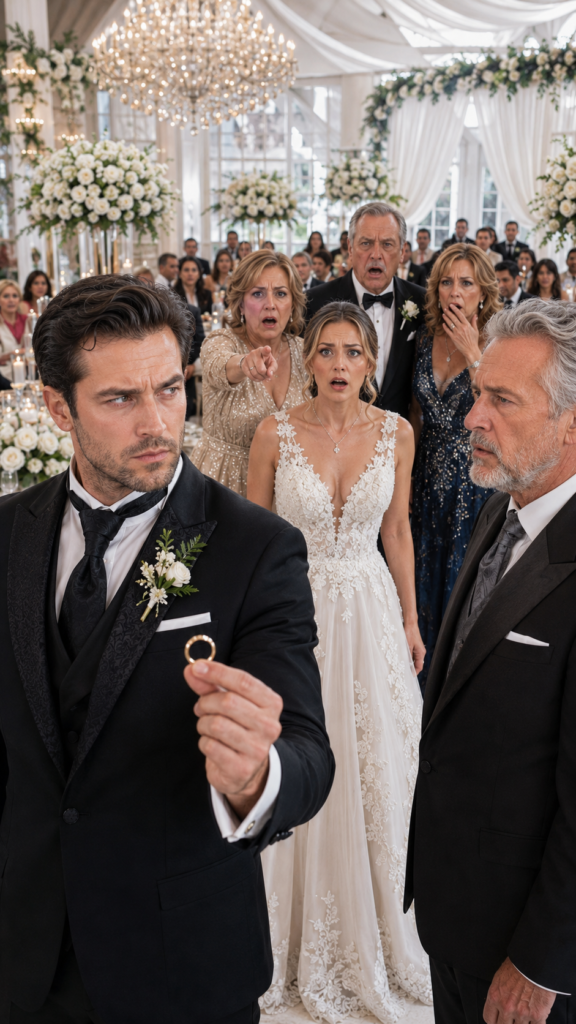
The hotel ballroom on Reforma was filled with warm lights, arrangements of white bougainvillea, golden candles, and almost 200 guests dressed as if that night were perfect. Outside, the mariachi waited for its turn. Inside, everyone smiled.
But Valeria no longer heard the music.
She only looked at her brother's hand.
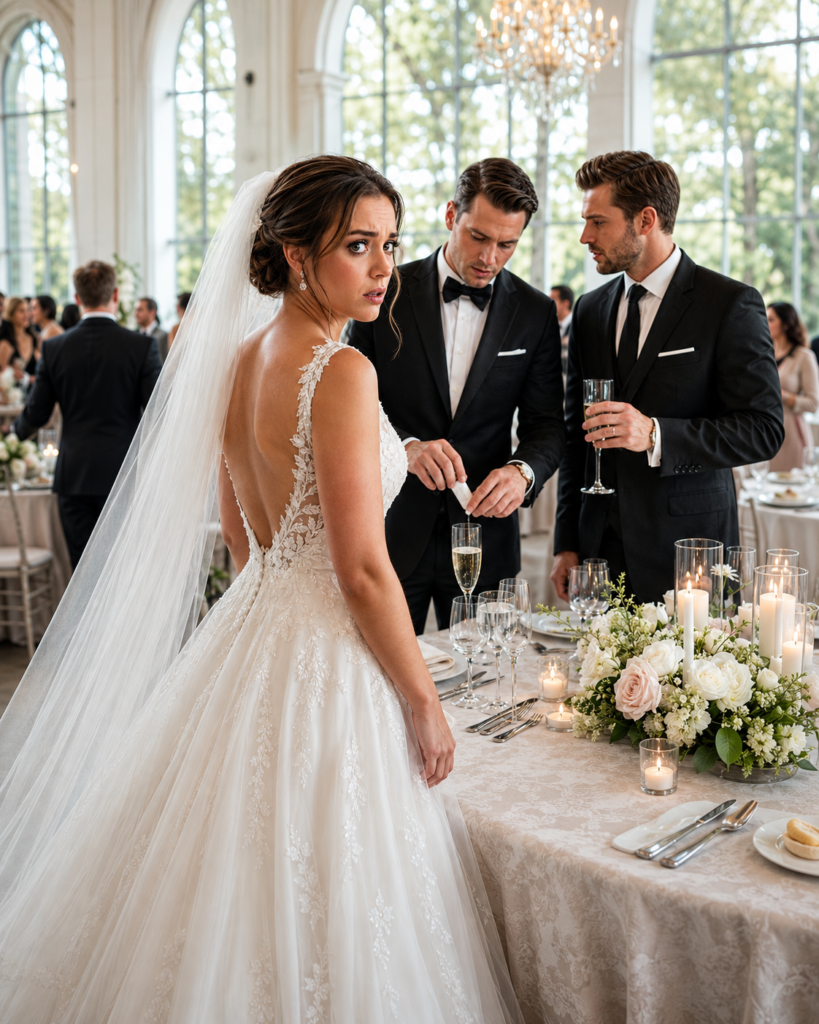
Damián Castañeda had approached the main table with that “it wasn’t me” smile he had used since childhood. While the photographer arranged the godparents, Damián covered Valeria's glass with the sleeve of his jacket and dropped a white powder into the sparkling wine.
Valeria saw it clearly.
She didn’t scream.
She didn’t flip the table.
She didn’t ruin her wedding in front of everyone.
She just felt the blood drain from her face.
For 32 years, her family had repeated to her that staying quiet was better than making a scene. Damián lied, stole, humiliated, and in the end, Valeria always ended up apologizing so her mother wouldn’t cry.
—Oh, daughter, you know how your brother is —doña Elvira always said.
Yes.
Valeria knew perfectly how Damián was.
That’s why she smiled.
Her husband, Santiago, whispered something in her ear, thinking she was nervous about the toast. Valeria feigned a laugh, left her glass on the table, took Damián's glass, and placed hers in his spot.
It was a small movement.
Clean.
Almost invisible.
Damián caught a glimpse of the glasses, but just at that moment a cousin pulled him for a photo. When he looked back, Valeria was already holding the clean glass.
He lifted the other one.
The contaminated glass.
—To Valeria —Damián said, raising his voice—. My perfect little sister, the family’s favorite victim. I hope tonight she learns that you don’t always win by crying.
Some guests laughed awkwardly.
Santiago stopped smiling.
Don Armando, Valeria's father, frowned, but not to defend her. He seemed more annoyed that she wasn’t looking down.
Valeria held the clean glass.
—Cheers —she said calmly.
Damián drank first.
Everything.
Even the last drop.
Then he leaned toward her and murmured, with his mouth smelling of expensive alcohol:
—Congratulations, little sister. My little gift is already on its way.
Valeria brought the glass to her lips, without drinking.
—How exciting —she replied.
30 minutes later, Damián's smile began to fade.
First, he loosened his tie. Then he leaned a hand on the dessert table. His wife, Renata, approached with an annoyed look.
—Damián, come on, have you already gotten wasted?
—I’m fine —he grunted.
But he wasn't fine.
His skin turned gray. Sweat ran down his forehead. He tried to walk toward his father, but tripped over a chair and knocked down a tray full of glasses.
The glass shattered on the floor.
The mariachi stopped playing.
Doña Elvira looked at Valeria as if she had caused everything just by existing.
Damián wanted to speak, but only a twisted sound came out. His legs trembled. His eyes searched for the main table, then the empty glass next to his plate.
Santiago took Valeria's hand.
—What’s happening?
Valeria looked at her brother staggering in front of everyone.
Then she said, with a calmness that chilled more than any scream:
—I think Damián's surprise arrived early.
Damián heard her.
His eyes opened wide with panic.
And for the first time in his life, Valeria saw fear on the face of the man who had always made her feel guilty.
Then Damián fell to his knees on the dance floor, in front of the whole family, and before collapsing, he uttered a phrase that left the entire ballroom breathless:
—You… shouldn’t have switched the glasses.
PART 2
The ballroom exploded in screams.
Renata knelt beside Damián and started crying so loudly, as if her tears were also an act.
—Help him! Please, someone do something!
Two guests ran to him. One was a doctor from Hospital ABC and the other was a nurse. They checked his pulse while the hotel manager called an ambulance.
Valeria remained standing, with her white dress falling to the floor and the bouquet hanging from her fingers.
Santiago stood in front of her.
—Vale, look at me. What do you know?
She swallowed hard.
For years she had said “nothing.”
Nothing when Damián sold some ancient coins from their grandfather and blamed her.
Nothing when he forged her signature on a loan.
Nothing when he convinced everyone that Valeria was “unstable” because she wouldn’t agree to give up her shares in the family business.
But that night, saying “nothing” could destroy her.
—He put something in my glass —she said.
Santiago didn’t shout.
He just turned cold.
—Did anyone record that?
Valeria looked toward the corner of the ballroom.
—The videographer was nearby.
Santiago raised his voice.
—Mateo! Don’t delete a single second.
Mateo, the videographer, slowly lowered the camera.
—I haven’t deleted anything.
Don Armando approached Valeria with a red face.
—What did you do to your brother?
Valeria let out a dry laugh.
There it was.
Damián was collapsing after threatening her, and yet she was the one being accused.
Santiago stepped forward.
—Don’t talk to my wife like that.
—This is a family matter —don Armando said.
—No —Santiago replied—. This is an attempt to drug a bride at her own wedding.
Silence fell like a stone.
Doña Elvira placed a hand on her chest.
—How dare you say such a thing?
Valeria pointed to the table.
—My glass was there. Damián put something in it. I moved it away from me. If he drank from that glass, it was because he thought I was still the same fool as always.
Renata stopped crying for 1 second.
Just 1.
But Valeria noticed it.
The ambulance arrived through the side entrance. The paramedics lifted Damián onto a stretcher. He was already conscious, though lost, with red eyes and a heavy tongue.
As they passed by Valeria, he turned his head.
—You ruined everything —he whispered.
Valeria leaned in a little.
—No. I just stopped hiding you.
Damián closed his eyes.
He didn’t seem remorseful.
He seemed exposed.
Minutes later, in a private office at the hotel, a Public Ministry agent, Lucía Rivas, reviewed Mateo's video. On the screen, Damián was seen approaching the main table, touching Valeria's shoulder with one hand while emptying a small bag over the glass with the other.
The image was clear.
Too clear.
—Mrs. Valeria —said the agent—, you switched the glasses after seeing him.
—I moved my glass away from me —she replied—. I didn’t know what it was. I only knew my brother had put something in there.
Lucía nodded.
—That matters.
Then the hotel’s head of security arrived with another recording. In it, Damián was seen entering the men's bathroom 12 minutes before the toast. Outside was Renata. She opened her purse, took out something small, and handed it to him.
Renata turned pale.
—They were anxiety pills —she stammered—. He was nervous. I didn’t know…
—How strange —Valeria said—. Because the nervous one ended up being him when he drank from my glass.
At 3:20 in the morning, the agent returned with the first medical report.
Damián was stable.
He had ingested a strong sedative mixed with alcohol.
Santiago asked the question everyone was avoiding:
—What did they want to put Valeria to sleep at her wedding for?
Valeria closed her eyes.
Because she already knew.
Money.
And not just money.
Control.
The story went back 2 years, when doña Leonor, Valeria's grandmother, died. She had been the only person in the family who treated her as someone capable, not as the girl who had to obey.
Before she died, doña Leonor left Valeria 45% of Constructora Castañeda, a company with land in Querétaro, Puebla, and the State of Mexico.
Damián received 20%.
Don Armando kept the rest.
At first, Valeria believed it was an inheritance.
Then she discovered it was a bomb.
The company had hidden debts, inflated contracts, payments to ghost suppliers, and an urgent agreement with Grupo Miravalle, a construction company that wanted to absorb the company at a ridiculous price.
Damián insisted on signing.
Don Armando said it was “for everyone’s good.”
But Valeria reviewed the documents with Santiago, who was a commercial lawyer. They found tricky clauses: after the restructuring, minority shareholders could be forced to sell at a discount.
In plain words, Valeria would lose almost everything her grandmother had left her.
Damián and his father, on the other hand, would receive immediate money to cover their mistakes.
Valeria refused to sign.
That’s where the war began.
Damián called her selfish.
Her father called her ungrateful.
Her mother told her that Santiago was filling her with ideas.
A week before the wedding, doña Elvira called her to a café in San Ángel.
—Daughter, postpone the wedding a few months —she pleaded—. You’re confused. Damián just wants to protect the family.
—No, Mom —Valeria replied—. Damián wants to protect his debts.
Doña Elvira slapped her in the parking lot.
Valeria covered the mark with makeup during the dress fitting.
She never told Santiago.
Until that morning.
In the police station, with her dress wrinkled and her makeup smudged, Valeria told everything. The forged signatures. The pressures. The calls. The threats disguised as advice.
Santiago listened to her with eyes full of sadness.
—You should have told me —he murmured.
—I was ashamed.
He took her hand.
—The shame wasn’t yours.
That phrase hurt her more than any blow.
Because it was true.
The next morning, agent Lucía returned with a folder.
—We found this in your brother's jacket.
On the table, she placed an authorization supposedly signed by Valeria.
The document stated that, due to “emotional exhaustion” and “nervous crisis,” Valeria temporarily ceded her right to vote to her father for 90 days regarding all decisions of Constructora Castañeda.
Valeria felt nauseous.
—They forged my signature.
—There was also a USB —Lucía added.
Santiago looked up.
—What did it contain?
—An edited video —the agent replied—. Fragments of Valeria crying at a funeral, arguing with Damián, and leaving a family meal in an agitated state. All staged to make her seem out of control.
Valeria understood the complete plan.
They didn’t want to kill her.
They wanted to sedate her, record her, display her as a “hysterical” bride, and use the forged document to strip her of her vote while she looked crazy in front of everyone.
It was Damián’s favorite type of violence.
The one that left no blood.
The one that made everyone doubt a woman when she finally dared to speak up.
On Monday at 9:00, Valeria entered the shareholders’ meeting of Constructora Castañeda.
She wasn’t wearing a wedding dress.
She wore a black suit, her hair tied up, and a folder under her arm.
Santiago accompanied her to the door, but didn’t speak for her.
He knew that this battle belonged to her.
The room was on the 18th floor of a building in Polanco. Valeria had been there as a child when Damián told her that women were not fit to run companies.
Back then, she believed him.
Not anymore.
Don Armando was sitting at the head.
—Valeria —he said—, this meeting should be postponed. After the scandal, you’re not in a position.
She placed the folder on the table.
—On the contrary. I’m clearer than ever.
One of the advisors turned on the recorder.
Valeria distributed copies: the merger analysis, the hidden clauses, the medical report, the fraud complaint, the toast video, and the recording where Renata handed over the sedative.
—I vote against the merger with Grupo Miravalle —she said—. And I request a forensic audit of the last 7 years.
Don Armando slammed the table.
—You don’t know what you’re doing!
Valeria looked him in the eye.
For years, her father had seemed enormous to her. A man capable of destroying her with a single phrase.
That morning, she saw him differently.
Not innocent.
Not weak.
Just smaller than the fear he had built himself.
—I do know —she replied—. I’m stopping my obedience.
The merger was rejected.
The audit was approved.
In less than 3 weeks, evidence appeared: diversions, ghost companies, invented contracts, illegal commissions, and Damián's personal debt to an executive at Grupo Miravalle.
Damián was arrested as he left the hospital.
Renata testified months later. She admitted to handing over the sedative, although she swore Damián told her it was just “to calm Valeria down” and to prevent her from “ruining the wedding by making a scene.”
She also confessed that don Armando knew about the forged document.
He denied it until the end.
Doña Elvira called Valeria only once.
—Daughter, this has gone too far.
Valeria closed her eyes.
Again the same thing.
Not “are you okay?”
Not “forgive me.”
Not “I failed you.”
Just the old order disguised as concern.
—It went too far when Damián put something in my glass —Valeria said.
—He’s your brother.
—And I was his sister.
Doña Elvira fell silent.
Valeria hung up before they asked her to sacrifice herself once more.
The trial lasted almost 1 year. There were hearings, expensive lawyers, hypocritical relatives who suddenly swore they had always believed her, and nights when Valeria woke up trembling, thinking she had exaggerated.
Santiago never said “get over it.”
He just turned on the lamp, gave her water, and repeated:
—You’re here. I’m here. We know what happened.
That started to be enough.
When Damián accepted a plea deal, he appeared before the judge in a dark suit and an empty gaze. The prosecution described the glass, the sedative, the forged document, the manipulated video, and the attempt to strip her of her vote.
Damián didn’t look at Valeria until the end.
When he finally did, she didn’t see remorse.
She saw disbelief.
He still didn’t understand how his “little sister” had escaped the victim role he had written for her all her life.
Valeria testified without crying.
—My brother didn’t act on impulse —she said—. He acted with the confidence that I would remain silent, that my family would blame me, and that my silence would be easier to believe than the truth. But he was wrong. I’m not here for revenge. I’m here because silence was the weapon they used against me the most.
Damián looked down first.
Months later, Valeria and Santiago had a small dinner at their home in Coyoacán.
There was no luxury ballroom.
There was no champagne.
There was no family pretending to love.
Just lights hung in the patio, wooden tables, true friends, Santiago’s parents, Mateo without a camera, and a soft song playing as the night fell.
Santiago extended his hand.
—Will you grant me this dance, Mrs. Castañeda?
Valeria smiled.
—I’m Castañeda of no one —she corrected—. I’m not going to let go of my last name. I’m just going to clean it.
He laughed and took her to the center of the patio.
They danced barefoot on the grass. No one interrupted her. No one blamed her. No one tried to turn her happiness into evidence against her.
At the end of the song, Santiago kissed her forehead.
—Do you regret anything?
Valeria looked at the lights, the night, and the life that still stood.
She thought of the glass.
Of Damián's hand.
Of the exact second she decided to save herself.
—Yes —she said—. I regret not having believed in myself sooner.
Santiago squeezed her hand.
—You believed in yourself just in time.
And it was true.
At her wedding, Damián put something in her glass because he believed Valeria was still the sister who swallowed everything he gave her.
He was wrong.
And 30 minutes later, everyone knew it.