PART 1
The smell of bleach, IV fluids, and sorrow had seeped into Doña Amparo Salcedo's bones.
At 76 years old, sitting on the edge of a bed at the General Hospital of Mexico City, she struggled to fit her left foot into an orthopedic shoe. It was hard work. After the stroke, her right hand trembled like a wet leaf.
Nurse Rosalba entered with the discharge papers pressed against her chest. She wasn't smiling. She wore that uncomfortable expression of someone who knows too much about a stranger's family.
—Doña Amparo… you can go home now —she said softly—. Would you like me to call any of your 5 children to come get you?
The room froze.
Amparo looked down at her old brown leather bag. For 40 days she had watched her children enter with flowers, husbands with soups, grandchildren with balloons, and even neighbors carrying blankets. No one brought her even a sweet roll.
Her 5 children were important people. Gerardo had an office in Santa Fe. Marcela flaunted her house in Interlomas. Iván appeared in business magazines. Paulina organized luxury events. Bruno, the youngest, traveled every month "for work."
They all drove brand-new trucks. They all wore expensive watches. They all claimed to love their mother.
But none of them answered.
At home in San Ángel was Don Jacinto, her husband. A man who once filled the house with songs of Pedro Infante, but for the past 3 years had been lost in the fog of Alzheimer’s. He no longer remembered Amparo's name, though sometimes he would kiss her hand as if his soul still recognized her.
Before she fainted in the kitchen, Amparo managed to scream at Doña Nati, the neighbor:
—My old man! Don’t leave him alone!
And then everything went black.
During the first 2 weeks, Amparo made excuses. Gerardo was in a hearing. Marcela couldn't drive. Iván had a meeting. Paulina didn’t know about the hospital. Bruno was out of the country.
But on day 40, a truth fell on her like a burial stone: her children weren’t busy. They were waiting.
Waiting for her not to return.
—Don’t call anyone, miss —Amparo said, her voice hoarse—. No one is coming.
The nurse pressed her lips together. She wanted to insist, but the elderly woman's gaze stopped her. It wasn’t a weak gaze. It was hard, dry, like an old griddle over fire.
—So… should I call an ambulance?
—A taxi —Amparo corrected—. And make it quick.
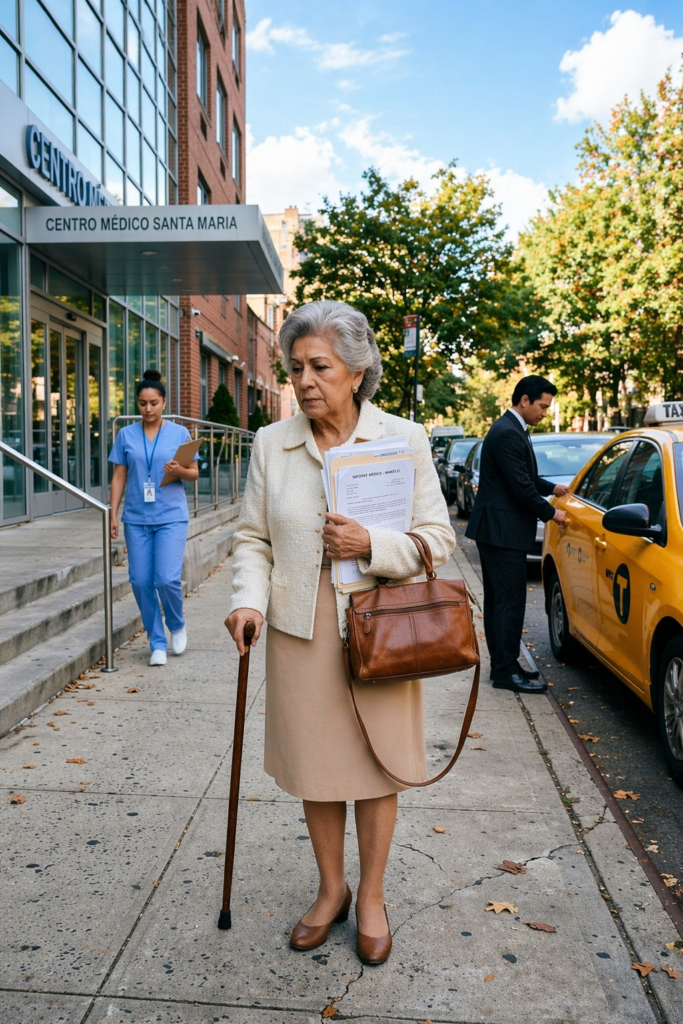
Half an hour later, Doña Amparo left the hospital leaning on a cane. The afternoon light hurt her eyes. Mexico City roared as always: trucks, vendors, honking horns, hurried people.
A pink and white taxi stopped in front of her.
—Careful, ma'am —said the driver, getting out to help her—. Shall I take you to your little house?
Amparo settled into the back seat. For a moment, she thought about returning to San Ángel, hugging Jacinto, and crying softly.
But that sacrificed mother had died in room 312.
She looked at the driver through the mirror.
—I’m not going home, young man. Take me to the notary on Palma Street.
The taxi driver blinked.
—At this hour?
Doña Amparo closed her bag over her legs.
—Yes. Today I’m going to bury my 5 children alive.
PART 2
The driver didn’t ask anything else.
Doña Amparo stared out the window with a calm that was frightening. They passed restaurants where she had paid for entire birthdays because her children always claimed to be “tight on money.” Tight, how could they not be? Gerardo had just bought an apartment in Miami. Marcela carried a designer handbag. Iván took photos on yachts. Paulina owed half a million on parties she called “investments.” Bruno had a new girlfriend and 2 additional cards that she paid without complaining.
Amparo remembered all the times she had gone without her full medications to help them.
“He’s my son,” she would say.
“She’s my daughter,” she repeated.
As if blood were an open check.
When the taxi arrived at the notary's office, the guard tried to stop her.
—Ma’am, we’re about to close.
She raised her chin.
—Tell Licenciado Montalvo that Amparo Salcedo de Arriaga has arrived. And tell him that if he doesn’t let me in, I’ll come back with a lawyer tomorrow.
The guard ran.
Licenciado Octavio Montalvo, the family’s trusted notary for over 30 years, stepped out pale upon seeing her.
—Amparito, for God’s sake… what happened to you?
—What happened is that I woke up, Octavio —she replied—. And I’m here to do what I should have done years ago.
They seated her in an office of dark wood. They offered her coffee. She asked for water and all the files of her assets.
—I want to revoke the powers my children have. All of them. Also the additional cards, the bank authorizations, access to the investment accounts, and any permission signed before today.
Octavio froze.
—Amparo, that could cause a very serious family problem.
She let out a dry laugh.
—Family problem? I spent 40 days in a public hospital. 960 hours. Not a single call. Not a single visit. Not a damn gelatin. The family problem has already started, Licenciado.
Octavio looked down.
—And the house in San Ángel?
—It’s for sale.
—But that house…
—It’s mine and Jacinto's. Not my children’s. The land in Valle de Bravo is also for sale. The shares of the pharmaceutical group, too. I want an irrevocable trust. The money will be for private medical care for Jacinto, a dignified residence for the two of us, and whatever's left of my life without asking for permission.
The notary swallowed hard.
—And when you’re gone?
Amparo leaned slightly forward.
—Everything left will be donated to a foundation for abandoned seniors. Not a single peso for my children.
Octavio said nothing for several seconds.
Then he opened the drawer, pulled out a thick folder, and began preparing the documents.
That night, Doña Amparo returned to her home in San Ángel. Doña Nati received her in tears.
—Oh, blessed Lupita, I thought you wouldn’t come back. Don Jacinto was calm, but he asks for you without knowing he asks for you.
Amparo walked slowly into the dining room. Jacinto was sitting by the window, looking at the jacarandas in the garden. Upon seeing her, he smiled like a child.
—What a pretty lady —he murmured.
Amparo felt her heart shatter, but she didn’t cry.
—Thank you, old man.
She went up to Jacinto's office. She was looking for some deeds but found something else. At the bottom of the drawer was a blue notebook, tied with a rubber band. She opened it.
It was her husband’s notes, written before Alzheimer’s stole his memory.
“Gerardo asked for 700,000 to save his office. He never paid.”
“Marcela asked for 350,000 for the children's school. She bought a truck.”
“Iván used my signature to guarantee a loan.”
“Paulina asked for Amparo's jewelry to pawn it. She returned nothing.”
“Bruno emptied the emergency account.”
At the end, there was a note in shaky handwriting:
“Amparo, forgive me for not being tougher. Our children learned to ask, not to love. When I can no longer protect you, protect yourself.”
Doña Amparo closed the notebook.
That night she didn’t sleep. Not out of pain. Out of strategy.
The next day, she changed locks, canceled cards, and hired a professional caregiver for Jacinto. Then she called her 5 children, one by one, in a sweet voice.
—Come over for lunch on Sunday. I’m making black mole and red rice. I want to see you.
All 5 accepted.
Of course, they accepted. They thought the old woman was obedient again.
On Sunday, at 2 PM, the house smelled of mole, hot tortillas, and fear.
Gerardo arrived first, expensive suit, cell phone glued to his ear.
—Mom, I’m so glad you’re better. I need you to sign an authorization tomorrow; it’s a quick thing.
He didn’t even ask how she was doing.
Marcela entered complaining.
—Mom, my card didn’t go through at Liverpool. How embarrassing, seriously. They made me look like a beggar.
Iván arrived with dark glasses and strong cologne.
—We need to talk about the land, mom. You can’t have money sitting around.
Paulina asked for wine before greeting anyone.
Bruno arrived late, wearing a very expensive shirt and an annoyed expression.
—Are we going to eat or what? I have a reservation in Polanco.
Doña Amparo watched them sitting at the table of her life. Those 5 elegant adults seemed like strangers using surnames she had birthed.
Jacinto was at the head of the table. He didn’t understand the tension, but he stirred his spoon as if it were another Sunday of past times.
They ate. They served double. They criticized the salt. They talked about money. They talked about properties. They discussed the inheritance as if Amparo were already underground.
Then Gerardo dropped the phrase.
—Mom, seriously, you’re getting old. After the stroke, we need to organize your things. The healthiest thing is that you sign over total management. For your own good.
Amparo placed the napkin on the table.
—For my good?
—Yes —Marcela said—. Don’t be stubborn. At your age, one gets confused.
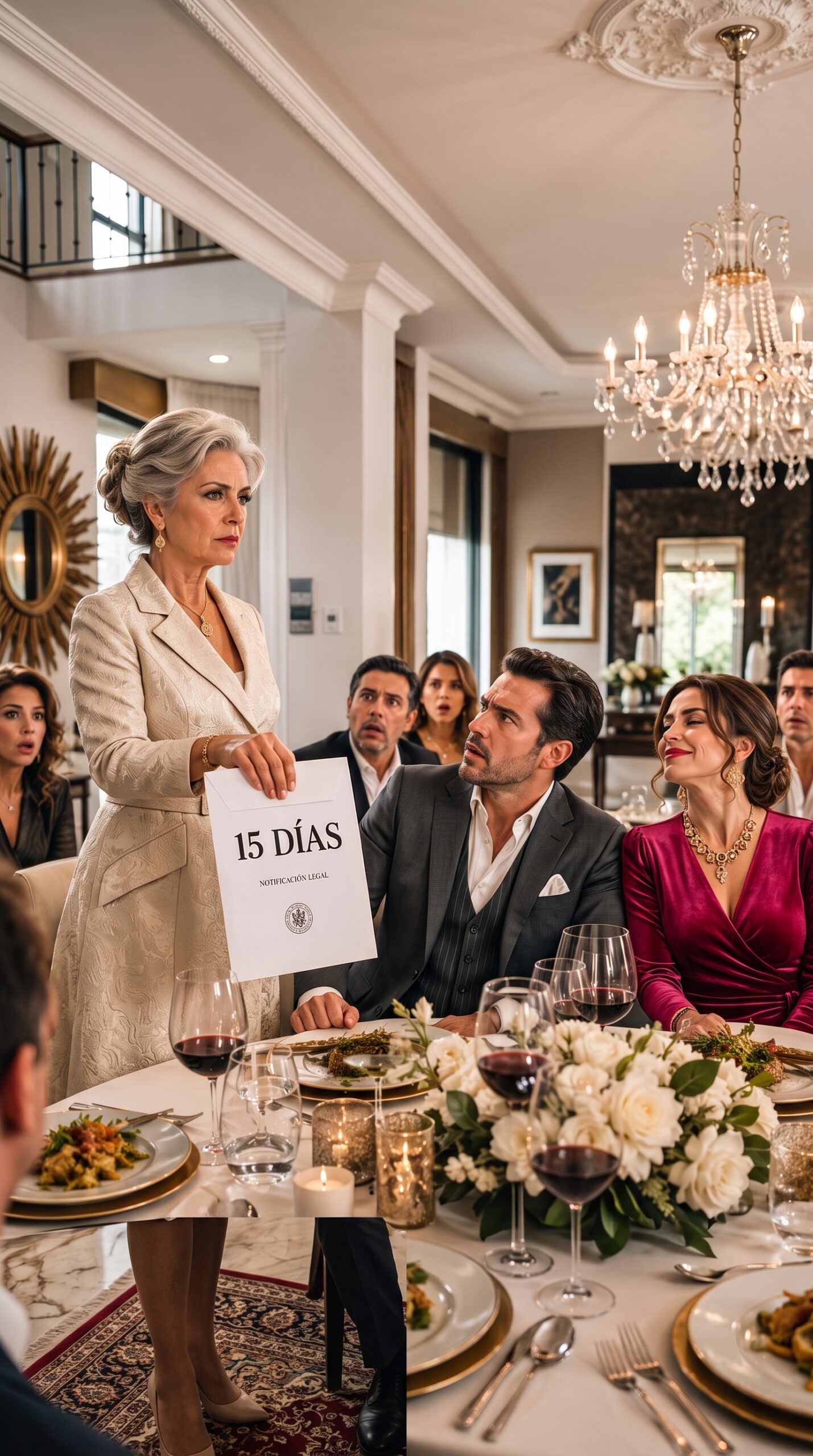
Doña Amparo stood up with difficulty. She went to the kitchen and returned without dessert. She brought 5 white envelopes and Jacinto’s blue notebook.
—Open that.
Gerardo was the first. His face changed color.
Marcela let out a scream.
Iván took off his glasses. Paulina started reading quickly. Bruno stood up.
The documents were clear: power revocation, card cancellations, initiated sale of the house, creation of an irrevocable trust, and eviction from the family properties they used for free.
—What did you do, crazy old woman? —shouted Bruno.
The silence was brutal.
Amparo raised her cane and hit the floor.
—Don’t you ever talk to me like that again, bastard.
Bruno froze.
—I spent 40 days alone in a hospital. None of you came. None called. None asked if your father was alive. But today all of you came because you smelled mole and inheritance.
Gerardo gritted his teeth.
—That’s illegal. That house belongs to us too.
—No, fifth-rate lawyer —Amparo said—. That house is your father’s and mine. And you already collected your part when we paid for your career, the office, the wedding, and the debts you hid from your wife.
She opened the notebook.
—Here it all is. The 700,000 from Gerardo. The 350,000 from Marcela. Iván’s dirty credit. Paulina’s jewelry. Bruno’s emptied accounts. You didn’t want an inheritance. You wanted carrion.
Marcela started to cry.
—Mom, you can’t do this to us. We are your children.
Amparo looked at her without anger but without tenderness.
—That’s why I endured so long. Because you were my children. But you forgot that I am a person too.
Iván threw his chair.
—I’ll see you in court.
—I’ll be waiting.
The meal ended amid shouts, threats, and untidy plates. Gerardo swore to destroy the trust. Paulina called her mother ungrateful. Bruno said they would put her in a public nursing home "so she could learn."
Doña Amparo didn’t respond.
She simply took Jacinto’s hand and waited for them to leave.
The real stab came 3 days later.
A clerk knocked on the door with a court notice. Gerardo, representing his siblings, had initiated a lawsuit to declare Doña Amparo incapable due to "mental deterioration following a cerebrovascular event."
They requested to manage her assets.
They requested to intern her.
They requested to separate her from Jacinto.
That night, Doña Amparo read each page without blinking. Doña Nati cried with rage in the kitchen.
—They are your children, Amparito. How can they?
Amparo closed the folder.
—Because they never had enough.
The preliminary hearing was in a private family court room. The 5 siblings arrived dressed like decent people. Gerardo brought a private psychiatrist, Dr. Sandoval, who hadn’t even examined Amparo but already had a signed report.
—My mother is confused —Gerardo said before the judge—. She acts with paranoia. She changed documents without understanding. My siblings and I just want to protect her.
Amparo was sitting across from him, wearing a navy blue dress, wooden cane, and Jacinto’s notebook on her lap.
The judge asked her:
—Doña Amparo, do you understand why you’re here?
She nodded.
—Of course. My children want to declare me crazy because alive I don’t suit them and dead I urge them.
There were murmurs.
Gerardo feigned pain.
—Do you see? That aggressiveness isn’t normal.
Then Amparo turned to her lawyer, Licenciado Montalvo.
—Now.
The door opened.
Dr. Hernán Arriaga, head of Neurology at the hospital where Amparo was hospitalized, entered. Behind him were 2 official experts and a social worker.
Gerardo lost his smile.
The doctor handed over a thick file.
—Your Honor, I evaluated Doña Amparo during her hospitalization and again 24 hours ago. Her cognitive capacity is preserved. She understands, decides, reasons, and signs with full awareness. There is no medical basis to declare her incapable.
Then he looked at Gerardo’s psychiatrist.
—And this private report has serious irregularities. It claims symptoms that were never observed and was issued without a clinical interview. I have already filed a complaint with the Medical College.
Dr. Sandoval began to sweat.
The social worker spoke afterward. Her voice was firm.
—For 40 days, no child visited the hospital. There is only a record of one neighbor asking about her. Furthermore, Don Jacinto was attended by third parties while the lady was hospitalized. There are signs of family abandonment.
The room fell silent.
The judge looked at Gerardo.
—Counselor, do you want to explain why you requested to manage the assets of a person who is medically lucid?
Gerardo opened his mouth, but nothing came out.
Amparo asked for permission to speak.
—I don’t want jail for my children. Not yet. I want it recorded that I do not wish for any economic contact with them. That I do not authorize internment. That I do not authorize visits without my consent. And that if they attempt to take my freedom again, then I will charge them for every breath.
The judge granted protective measures for both her property and personal safety. The attempt at interdiction collapsed like a wet house of cards.
When they left, Marcela ran after her mother.
—Mom, please. My children aren’t to blame.
Amparo stopped.
—Don’t use them as a shield. When I was in the hospital, your children didn’t know either because you didn’t want to be uncomfortable.
—We were busy...
—No, honey. You were waiting.
Marcela broke down, but Amparo kept walking.
2 weeks later, the house in San Ángel was sold. Gerardo lost clients when it was revealed that he attempted to incapacitate his own mother. Iván was sued for the fraudulent credit. Paulina had to sell fake jewelry because the real ones were never hers. Bruno vanished when his cards stopped working. Marcela, for the first time in years, looked for a job.
Doña Amparo and Don Jacinto moved to a private residence in Cuernavaca, surrounded by bougainvilleas, patient nurses, and warm afternoons.
Jacinto died 7 months later, asleep, with Amparo holding his hand. The last word he said was:
—Pretty.
She understood he was referring to her.
She didn’t invite her children to the funeral. Only Doña Nati, Dr. Arriaga, Licenciado Montalvo, and 3 nurses who had learned to love Jacinto attended.
At 77 years old, Doña Amparo got a passport, took painting classes, and bought a modern cell phone. One day, while packing a suitcase to travel to Mérida, she received a call from an unknown number.
—Grandma? —said a child’s voice—. I’m Renata. My mom says if you could deposit for my graduation.
Amparo closed her eyes. It was Marcela’s daughter.
—Put your mom on the phone, sweetheart.
There was silence and then Marcela’s tearful voice.
—Mom, we’re in bad shape. Gerardo isn’t talking to us, Iván owes money, Bruno left… You’re the only one who can help us.
Amparo took a deep breath.
—Don’t put your daughter to beg for you. If she needs a dress, sew it. If she needs a party, make her a simple meal. But don’t teach her to beg for love with bank transfers.
—So you’re going to abandon your grandchildren?
—No. I’m going to teach them something you never learned: that love is visited, cared for, and earned. It’s not billed.
She hung up.
Then she put the cell phone away, closed the suitcase, and looked at herself in the mirror. She was no longer the abandoned old woman in a public bed. She was a woman who had survived the worst betrayal: that of the children who confused a mother’s love with slavery.
And although many in Mexico debated whether Doña Amparo was cruel or just, she never doubted again.
Because that hospital didn’t kill her.
It woke her up.