PART 1
—Mariana… stay one night with me.
The tray with the tea trembled in Mariana Cruz's hands, and for a second she thought she'd misheard.
Don Ernesto Salvatierra hadn't asked her to change the sheets. He hadn't asked for the medicine, nor to close the heavy curtains of that enormous bedroom overlooking the Acapulco sea. He had simply looked at her from his bed, pale under the golden light of the lamp, and repeated in a broken voice:
—Just one night. Please.
Mariana swallowed.
For three years she had worked as a live-in maid at the Salvatierra mansion, a white stone house in Punta Diamante, with black gates, cameras on every corner, and employees who spoke in hushed tones. Everyone knew who Ernesto Salvatierra was: owner of construction companies, hotels, and transportation businesses. A man who had built half the coast and destroyed anyone who stood in his way.
His children feared him.
His lawyers obeyed him.
His employees avoided looking at him for too long.
But Mariana was never afraid of him.
Perhaps because she had seen him when no one else was watching. She had seen him lie awake looking at old photographs. She had seen him send birthday gifts to people who never called to say thank you. She had seen him reach for a silver music box on his nightstand and then pull it back, as if touching it hurt.
"Sir..." she said carefully. "I don't think this is right."
Don Ernesto closed his eyes, ashamed.
"Not like that, young lady. God forbid. I just want someone to stay awake with me. Someone to listen. Someone who isn't waiting for me to die to divide my things."
Mariana glanced at the closed door.
Downstairs, in the main room, Don Ernesto's three children had been arguing since the afternoon. Roberto demanded to review the will. Valeria wanted the jewelry inventoried. Santiago kept asking about accounts abroad.
None of them had gone upstairs to ask their father if he was cold.
Don Ernesto breathed heavily.
"The doctors say I might not make it to the weekend. And before I go, I need to tell you something."
Mariana placed the tray on the table.
"Why me?"
The old man looked at her with deep sadness.
"Because you look like her."
"To whom?"
Don Ernesto barely turned his head toward a photograph on the nightstand. A young woman in a blue dress held a baby near a garden filled with bougainvillea.
"To my daughter Lucía," he whispered. "The daughter no one in this house is allowed to mention."
Mariana felt a chill.
"I thought you only had three children."
"That's what all of Mexico thinks."
Outside, the rain pounded against the windows.
Don Ernesto spoke slowly, as if each word had been stuck in his throat for years.
"Lucía was good. Stubborn. Braver than all my children combined. She fell in love with a high school teacher from Puebla. I said he wasn't good enough for her. I told her that if she left this house with him, she should never come back."
His eyes filled with tears.
"And she believed me."
Mariana remained motionless.
"What happened to her?"
"She wrote to me when her husband died. She had a little girl. She needed help. I was too proud to answer."
The room seemed to grow cold.
A little girl.
A father absent from all the school forms.
A mother working double shifts at a laundromat in Nezahualcóyotl.
Mariana reached for the pendant hidden beneath her uniform: a small silver hummingbird her mother had left her before she died.
Don Ernesto saw it.
His face changed completely.
"Mariana…" he murmured. "What was your mother's name?"
She took a step back.
She didn't want to answer.
But she did.
"Lucía Cruz."
The old man covered his mouth with a trembling hand.
On the other side of the door, someone moved.
Someone had been listening.
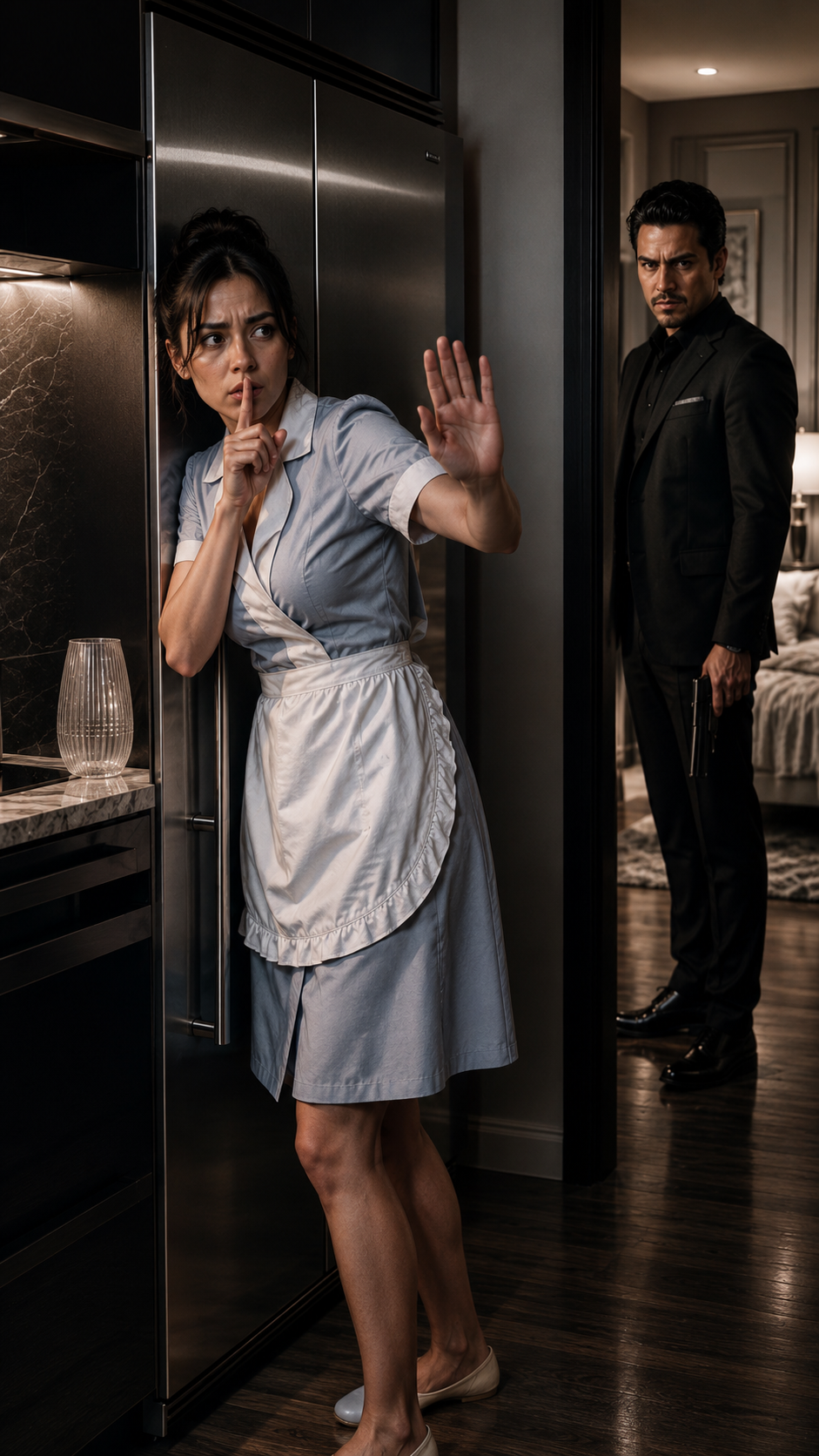
Then the door burst open.
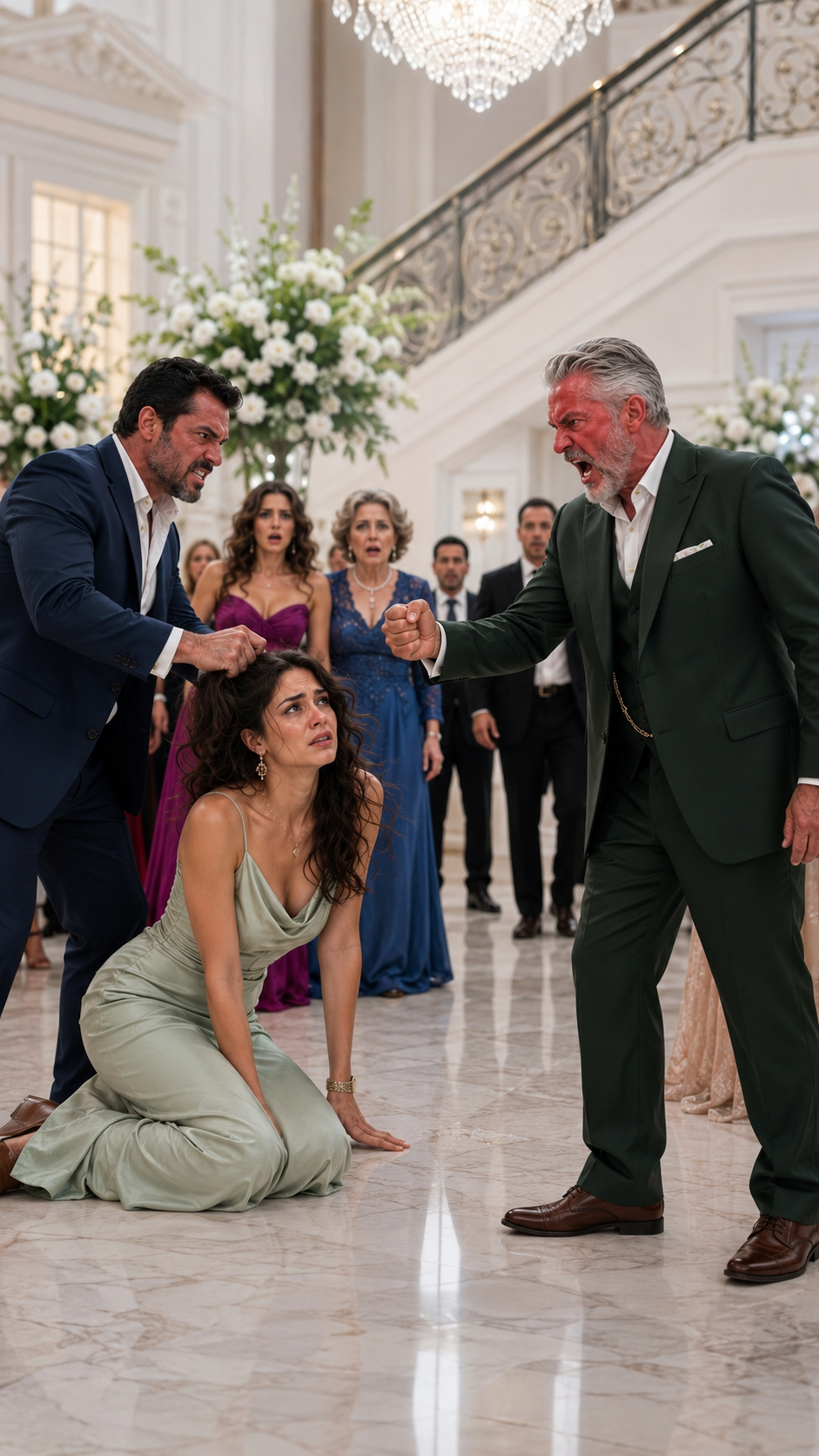
Roberto Salvatierra entered first, impeccable in his gray suit. Valeria followed behind, diamonds around her neck and anger in her eyes. Santiago appeared last, recording with his cell phone.
"What a touching scene," Roberto said coldly.
Valeria looked at Mariana's pendant.
Then she looked at her father.
"You can't be serious. A maid?"
Don Ernesto raised his voice with a force no one expected.
"Don't you ever call my granddaughter that again."
The word landed like thunder.
Granddaughter.
Mariana felt the floor disappear beneath her feet.
Santiago let out a nervous laugh.
"This is crazy. She must have planned it."
"I didn't plan anything," Mariana said.
Valeria pointed at her uniform.
"So now it turns out the girl who cleans the bathrooms is Lucía's daughter?"
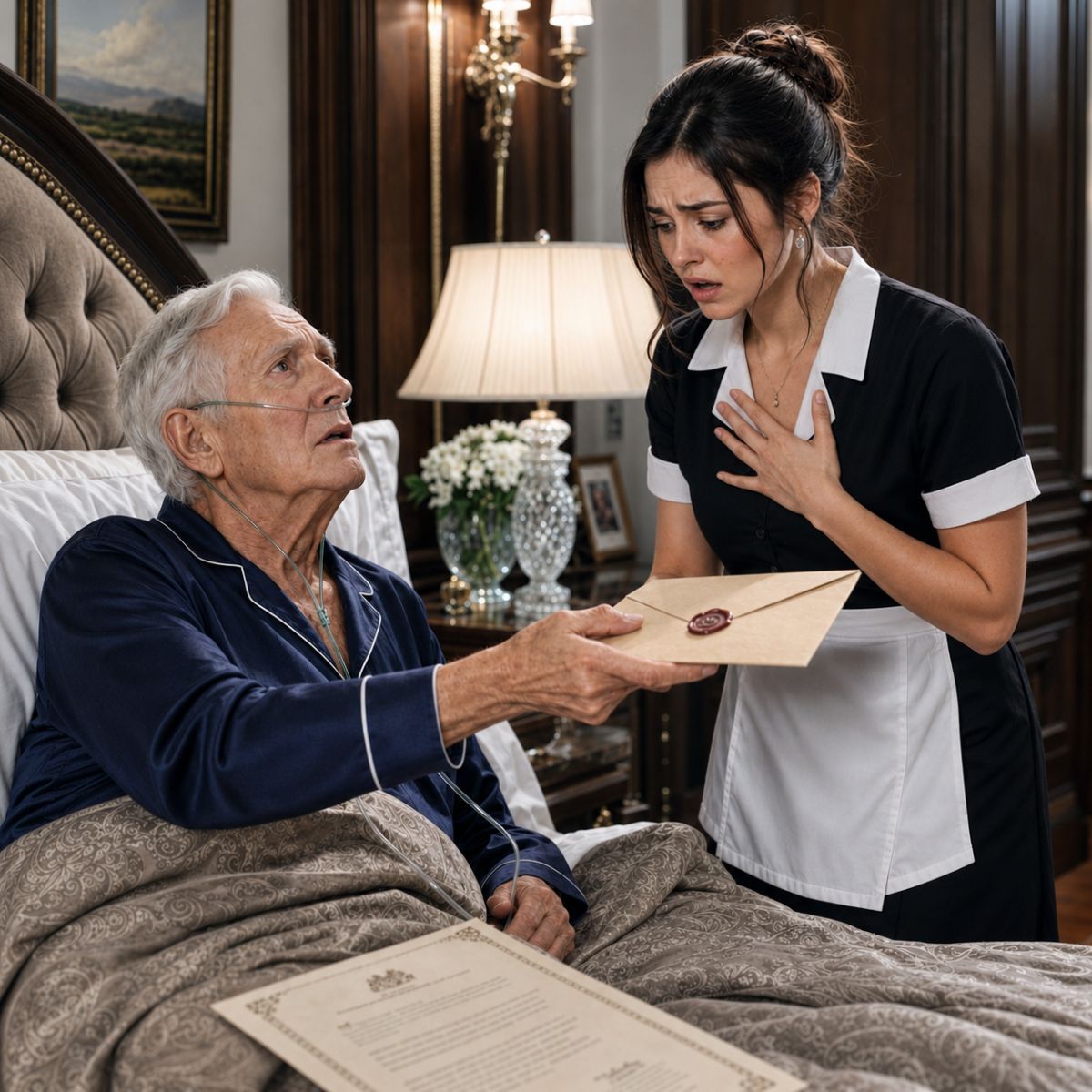
Don Ernesto opened a drawer with difficulty. Mariana helped him.
Inside was a yellowed envelope.
On the front, written in shaky handwriting, it read:
Dad, please read this.
Mariana recognized the handwriting.
It was her mother's.
Don Ernesto wept openly.
"I read it too late," he said. "But I kept everything."
Roberto stepped forward.
"Dad, you're confused."
"No," the old man replied. "For the first time in years, I'm seeing things clearly."
He looked at his children with sorrow.
"You went downstairs to fight over paintings, stocks, and houses. She came upstairs to bring me tea when my hands could no longer hold a cup."
Valeria clenched her jaw.
"You can't change the will now."
Don Ernesto smiled slightly.
"I changed it six months ago."
The silence was deafening.
Santiago lowered his cell phone.
Roberto lost his color.
Don Ernesto took the envelope and placed it in Mariana's hands.
"That's why I asked you to stay tonight. Not because of a scandal. Not out of shame. I wanted an honest witness before the truth destroyed this house."
And when Mariana clutched the letter to her chest, she understood that she hadn't been called here that night to serve.
She had been called here to reclaim a name that had been stolen from her.
PART 2
Roberto was the first to find his voice.
"This doesn't change anything."
His tone was calm, but that calmness was more frightening than a scream.
"Mariana, I understand this must be very emotional for you. But my father is medicated, ill, and vulnerable. If you hand over that envelope and leave this room, we can arrange something privately."
Mariana looked at him.
"Arrange something?"
Valeria smiled contemptuously.
"Don't play the victim. Women like you dream of opportunities like this."
—Women like me?
—Mujeres con historias tristes y cuentas vacías.
Mariana sintió arder la cara.
Mariana felt her face burn.
She remembered her mother washing other people's clothes until dawn. She remembered the landlords talking about them as if being poor were a sign of bad manners. She remembered entering through the service entrance of the Salvatierra mansion while the guests passed by without noticing her.
She had learned to keep quiet because the work was necessary.
But that letter was from her mother.
And a daughter doesn't stay silent when someone who can no longer defend themselves is insulted.
"My mother wasn't an opportunity," Mariana said. "And neither am I."
Don Ernesto looked at her with sad pride.
Santiago picked up his cell phone again.
"I'm going to call Dr. Rivas. He can confirm that my father is unwell."
Don Ernesto smiled weakly.
"Rivas is no longer my doctor."
Santiago froze.
"You paid him too well," the old man added.
Roberto clenched his fists.
Don Ernesto pointed to the silver music box on the nightstand.
"Mariana, behind the box."
She picked up the box. It had a hummingbird engraved on it, identical to the one on her pendant. Behind it, glued to the wood, was a small black device.
Valeria paled.
"What's that?"
"The truth," said Don Ernesto.
Mariana pressed the button.
First, there was static.
Then, Santiago's voice filled the room.
"The old man is taking too long to die."
Then Valeria spoke:
"If anything changes, we'll say the servants manipulated him."
Roberto replied:
"The girl is a problem. He trusts her too much."
Santiago laughed.
"Then we'll fire her."
"Not yet," Roberto answered. "Keep him comfortable." When the time comes, we'll give you a settlement and a confidentiality agreement.
The recording ended.
No one breathed.
Don Ernesto looked at his children as if he were seeing them for the first time.
"You could have had it all," he said softly. "But you never learned to want anything you couldn't buy."
Valeria turned to Mariana.
"Don't feel important."
"She's my granddaughter," Ernesto replied.
This time, the word didn't sound impossible.
It sounded like a door opening.
Mariana opened the envelope with trembling hands. The first line tore her apart.
Dad, I know you told me not to come back, that's why I'm not coming back.
She silently read a few lines. Her mother recounted that Daniel, her husband, had died. That she worked all night. That she carried three-month-old Mariana, wrapped in a blanket, while she ran the laundromat. She wasn't asking for money for herself, but for a chance for her daughter.
Mariana couldn't go on.
"Did you answer?" she asked.
Don Ernesto lowered his gaze.
"I wrote a cruel letter. Then I tore it up. I thought about calling the next day. Then the following week. Then at Christmas. Pride makes cowards feel busy."
Mariana closed her eyes.
Nothing.
That's what her mother had received.
Nothing.
No help, no rejection, no forgiveness. Just an empty mailbox that she had probably checked for months.
At that moment, there was a knock at the door.
A woman in a black coat and carrying a leather briefcase entered. Mariana recognized her: Attorney Ángela Duarte, Don Ernesto's personal lawyer.
"I came as soon as you called," she said.
Roberto exploded.
"Did you call your lawyer?"
"Before dinner," Ernesto replied.
Angela closed the door.
"For the record, the probate documents were signed six months ago, with witnesses, independent medical reports, and notarization."
Valeria paled.
"That's impossible."
"Uncomfortable, yes," Angela said. "Impossible, no."
Santiago muttered,
"We're going to contest it."
"You can try," the lawyer replied. "But Mr. Salvatierra anticipated this."
She pulled out several documents.
—Mariana Cruz is recognized as the biological granddaughter of Ernesto Salvatierra, through his daughter Lucía Salvatierra Cruz. The genetic confirmation was made using personal effects preserved by the family.
Mariana looked at the old man.
"Did you know?"
Don Ernesto nodded, embarrassed.
"I suspected something when I saw your pendant. I investigated you to protect you before I said anything."
"Protect me from whom?"
He looked at his children.
The answer hung in the air.
Angela handed Mariana another envelope.
"Mr. Salvatierra asked that you hear this in his presence. The inheritance comes with a decision."
"What decision?"
"You can receive the mansion and the personal belongings. But the main shares and the largest trust can go to you or become the Casa Lucía Cruz Foundation, for women with children who don't have a safe place to live."
Mariana felt a pang in her chest.
"The help my mother asked for."
Don Ernesto whispered:
"The answer I never gave her."
Valeria let out a bitter laugh.
"How noble. Giving away our fortune to strangers."
Mariana looked at her.
"Your sister wasn't a stranger."
Valeria opened her mouth, but said nothing.
Roberto approached the bed.
“Dad, think about it. You’re going to give the Salvatierra name to a woman who used to scrub your floors.”
Don Ernesto took Mariana’s hand.
“Yes. And she’s still cleaner than all of you.”
Roberto felt as if he’d been slapped.
Mariana looked at the papers, her mother’s letter, and the pendant on her chest.
She didn’t know about corporations. She didn’t know about millions. But she did know what it was like to wait for help behind a locked door.
And just as she was about to speak, Santiago lunged toward the desk to snatch the device.
Angela screamed.
Roberto blocked the exit.
Valeria locked the door.
And Mariana understood that the Salvatierra family was still willing to destroy the truth before losing everything.
PART 3
"Give me that recording," Roberto ordered.
Mariana stepped back, the device in her hand.
Santiago moved forward, but Don Ernesto, from his bed, raised his voice with a force that seemed to come from another time.
"If they touch it, every newspaper in Mexico will receive copies tomorrow."
Santiago stopped.
Valeria turned to him.
"Copies?"
Attorney Ángela Duarte adjusted her briefcase against her chest.
"Physical, digital, and notarized copies. There's also a signed statement from Mr. Salvatierra explaining why he feared for his granddaughter's safety."
Roberto slowly turned to his father.
"You're accusing us."
Don Ernesto looked at him sadly.
"You accused yourselves."
The silence that followed was heavier than the storm.
Mariana didn't feel victory. She felt rage, pain, immense confusion. She had gone upstairs that night thinking she was a caregiver called to keep an elderly man company. Now she stood before a family that hated her for existing.
And in her hands she held her mother's last written note.
"I want to read it all," she said.
No one answered.
She sat down beside the bed and opened the letter again.
Lucía spoke of hunger without naming it directly. Of nights when she pretended not to be tired so her daughter wouldn't learn the magnitude of fear too soon. Of a borrowed crib. Of medicine she couldn't afford. Of a little girl who smiled in her sleep as if the world still owed her nothing.
Mariana read to the end.
Dad, I don't want Mariana to grow up hating a family she doesn't know. If you can't forgive me, at least don't punish her for being born of my decision. She's your granddaughter. And even if you never hug her, I wanted you to know she exists.
The page trembled in Mariana's hands.
Don Ernesto wept silently.
"Your mother was better than me," he said.
"Yes," Mariana replied.
The honesty hurt, but it was necessary.
The old man nodded.
"I know."
Roberto murmured:
"This is emotional manipulation."
Mariana stood up.
"No. Manipulation was letting my mother die, believing she wasn't worth a phone call. Manipulation was pretending Lucía never existed. Manipulation was watching me serve you coffee for three years while you knew your father trusted me and were planning to bribe me to keep quiet."
Valeria lowered her gaze.
For the first time, her face didn't just show fury.
It showed a crack.
"I was 17 when Lucía left," she said softly. "Dad said she'd traded us for some poor devil. I believed him."
Don Ernesto closed his eyes.
"I taught you to despise her because I couldn't bear missing her."
Valeria pressed her lips together.
"She wrote to me once."
Mariana looked at her.
"Did you answer?"
Valeria couldn't meet his gaze.
"No."
Mariana felt something break again.
Her mother hadn't knocked on one door.
She had knocked on several.
And they had all remained closed.
"My mother waited for them," Mariana said. "All of them."
No one answered.
The early morning dragged on. Ángela made calls. Two security guards, loyal to the lawyer and not to the children, arrived in the hallway. The door opened again. Roberto could no longer rule the room as if he owned the air.
Don Ernesto asked them to open the curtains.
Mariana walked toward the windows. The rain had stopped. The sky was beginning to turn light gray over the sea.
When she returned to the bed, the old man handed her the music box.
“I gave it to Lucía when she turned 18,” he whispered. “She said the hummingbird seemed to want to escape.”
Mariana ran her fingers over the lid.
“My mother said that hummingbirds always find flowers, even if the path is long.”
Don Ernesto smiled sadly.
“She was always wiser than me.”
Angela approached.
“Sir, we need to confirm your last instruction.”
Don Ernesto looked at Mariana.
“The decision is yours.”
She thought of the marble floors. The priceless paintings. The empty swimming pool. The closed rooms. She also thought of her mother folding laundry, her hands chapped from soap. She thought of a young woman with a three-month-old baby writing a letter that went unanswered.
“The mansion will keep my mother’s name,” Mariana said. “I don’t want them to erase it again.”
Roberto sighed impatiently.
"And the company?"
"The company is going to fund the Casa Lucía Cruz Foundation."
"You don't know how to run anything," Santiago spat.
"No," Mariana admitted. "But I know how to ask honest people for help. That already puts me ahead of you."
Angela almost smiled.
Valeria covered her mouth, as if she wanted to cry but didn't know how.
Roberto shook his head.
"You're going to destroy the Salvatierra legacy."
Mariana looked him straight in the eye.
"No. I'm going to clean up what you called a legacy."
Don Ernesto took her hand.
"I don't expect forgiveness," he murmured.
Mariana sat down beside him.
"I don't know if I can give it to you."
"The truth is better than consolation."
She squeezed his cold fingers.
"But I can stay until dawn."
The old man's eyes welled up with tears.
"That's more than I deserve."
For the next hour, Don Ernesto spoke of Lucía.
He recounted how, as a child, she would run away to the Acapulco market because she preferred eating corn on the cob with chili to dining with businessmen. He said that she once sold an expensive necklace to pay for a gardener's dog's surgery. That she hated being called Miss Salvatierra and preferred to be called Lucía, nothing more.
Mariana laughed through her tears.
"Yes, it was her."
Then Mariana told him about the life he hadn't seen. She said that Lucía sang boleros while she did the laundry. That she burned tortillas on Sundays. That she kept a blue dress in a plastic bag and never dared to wear it.
Don Ernesto closed his eyes.
"I bought her that dress."
"She said it belonged to another life."
"It must have belonged to this one too."
The sun began to rise.
The room was filled with a soft light.
Don Ernesto's breathing grew slower and slower. His children were no longer near the bed. Roberto was talking to lawyers in the hallway. Santiago had disappeared. Valeria stood by the door, weeping silently for a sister she had punished for years.
The old man looked at Mariana.
"Do you think Lucía knew I loved her?"
The question hurt him more than anything.
Because loving in silence can feel too much like abandonment.
Mariana didn't want to lie.
"I think she hoped so."
A tear rolled down Don Ernesto's temple.
"Hope is more generous than I am."
"It's what she left me," Mariana said.
Minutes later, he whispered:
"Lucía..."
Mariana didn't correct him.
She just held his hand.
Don Ernesto Salvatierra died at 6:12 in the morning, not surrounded by impatient heirs or powerful business partners, but by the granddaughter he had almost lost forever.
The news broke that same day.
Mexican millionaire leaves fortune to unknown granddaughter and creates foundation for homeless mothers.
Reporters thronged the entrance to the mansion. Roberto declared the will suspicious. Santiago tried to sell interviews, but the recordings exposed him before he could concoct another lie. Valeria remained silent.
Three days later, Don Ernesto was buried in the family mausoleum.
But first, Mariana carried a small urn.
Lucía's ashes.
For years they had sat on a humble shelf, next to a candle and a faded photograph. Now they were placed beneath a white stone in the Salvatierra garden.
LUCÍA SALVATIERRA CRUZ
BELOVED DAUGHTER
BELOVED MOTHER
FINALLY HOME
Mariana stood before the gravestone for a long time.
Money couldn't mend the past.
But the truth, even if it came late, was better than silence.
A month later, she opened Lucía's room, which had been closed for almost 30 years. There was dust, white sheets draped over the furniture, and a blue ribbon tied to the headboard. In the closet, she found letters. Dozens of them.
One read:
For Mariana, when she grows up and asks where we come from.
She read it sitting on the floor.
My daughter, you come from a family with a beautiful house and a terrible habit: loving too late. If the Salvatierra name ever finds you, don't let money make you cruel. Don't let a closed door impress you. Open them. Open as many as you can.
That letter became the first painting of the Casa Lucía Cruz Foundation.
Six months later, the mansion opened its east wing to the first women.
The ballroom became a daycare.
The library became a legal aid office.
The main dining room, where only prominent families once sat, was filled with young mothers, children with used backpacks, social workers, and volunteers who knew how to listen.
The first night, a 22-year-old woman arrived with a sleeping baby and a grocery bag with all her clothes.
She stared at the marble.
"I don't belong here," she whispered.
Mariana remembered her first day entering through the service entrance.
She took the bag from her hand.
"Yes, you belong," she said. "That's precisely the point."
Two years passed.
Roberto lost the lawsuits. Santiago lost credibility. Valeria showed up one afternoon with boxes full of Lucía's things.
"I should have brought them sooner," she said.
"Yes," Mariana replied.
Valeria nodded.
"I know."
It wasn't forgiveness.
It was a beginning.
And sometimes a beginning is the only honest thing a broken family can offer.
On the second anniversary of Don Ernesto's death, Mariana stood facing the sea, the music box in her hands. The foundation had already helped 87 women and 112 children.
She opened the lid.
The melody played softly.
Behind her, children laughed in the garden. A mother filled out an application to finish high school. Doña Chayo, the cook, came out with a tray of sweet bread, scolding everyone to eat before they fainted.
The house no longer seemed like a museum of mistakes.
It seemed like an answer.
That night, Mariana wrote a letter to her mother.
Mom, you were right. Where we come from doesn't define who we are. But sometimes, when the truth returns home, the place we come from can become what we heal. He loved you late, poorly, and silently. But in the end, he tried to use that love to open a door.
The next day, she left it under Lucia's white stone.
When she returned to the entrance, a boy from the foundation ran toward her with a paper hummingbird.
"Look, Miss Mariana! It flies!"
He tossed it into the air.
The hummingbird rose for a second and fell to the grass.
The boy clapped anyway.
Mariana picked it up and gave it back to him.
"Try again."
The boy smiled.
And he did.
Then Mariana understood why Don Ernesto had asked her to stay with him that night.
He didn't just want company.
He wanted a witness.
Someone to hear the truth before money buried it.
Someone to take his repentance to a better place than a grave.
People later said that Mariana was lucky.
That she went from being an employee to owning a mansion.
That she inherited a fortune.
But that was never the real story.
The real story was a mother who wrote a letter.
A daughter who kept a silver hummingbird.
An old man who almost waited too long to ask for forgiveness.
And a house that, at last, learned to welcome those whom no one else wanted to let in.
Because sometimes a cup of tea seems like a small gesture.
But Mariana brought tea to a lonely man.
And he gave her back his mother's name.