PART 1
—This mole tastes like cheap diner food… just like you.
Marcela Alcántara didn't even lower her voice. She took another spoonful, made a disgusted face, and spat the sauce right on doña Elvira Salgado’s face.
The mole trickled down her cheek, her neck, and onto the white blouse she had ironed before leaving her home in Coyoacán.
A thick silence hung in the kitchen.
Only the pots simmered, and a jazz playlist that Marcela had chosen to make dinner feel 'like it was for important people' filled the air.
Rodrigo, doña Elvira’s son, stood by the marble bar with a glass of wine.
He witnessed it all.
But instead of defending his mother, he wrapped his arms around his wife’s waist.
—Enough, love. Don’t get upset. Your parents are about to arrive.
Doña Elvira felt something break inside her.
Not from the spit.
But because the son she had raised alone since he was fourteen had just consoled the woman who humiliated her.
The dinner was crucial.
Marcela’s parents, Octavio Alcántara and Susana Ledesma, were traveling from San Pedro Garza García to sign an investment of 180 million pesos in Desarrollos Altavista, the company Rodrigo boasted as his own.
For weeks, Marcela had been insisting that night would determine 'the future of the family.'
What her parents didn’t know was that Rodrigo didn’t own the construction company.
Nor did he own the residence in Bosques de las Lomas.
Or the offices, the land, or the main accounts.
Everything belonged to the Salgado Trust, created by doña Elvira after selling the three restaurants she built with her late husband, Tomás, starting with an inexpensive kitchen in the Obrera neighborhood.
Rodrigo was the CEO because his mother had given him a chance.
Marcela presented him as a self-made entrepreneur and doña Elvira as 'the lady who helps us with the food.'
For two years, she had forbidden her to sit with guests, hid family photos, and mocked her working-class accent.
Rodrigo would always say:
—Don’t make a scene, Mom. Marcela is tough, but that’s just her nature.
That afternoon, doña Elvira had cooked for seven hours: stuffed pork loin, poblano cream, almond mole, beet salad, and rompope flan.
Marcela had only given orders.
—Don’t mention you used to sell cheap meals.
—Use the French plates.
—And when my parents get here, stay in the kitchen.
Then came the insult.
Followed by the spit.
Doña Elvira slowly wiped her face with a napkin.
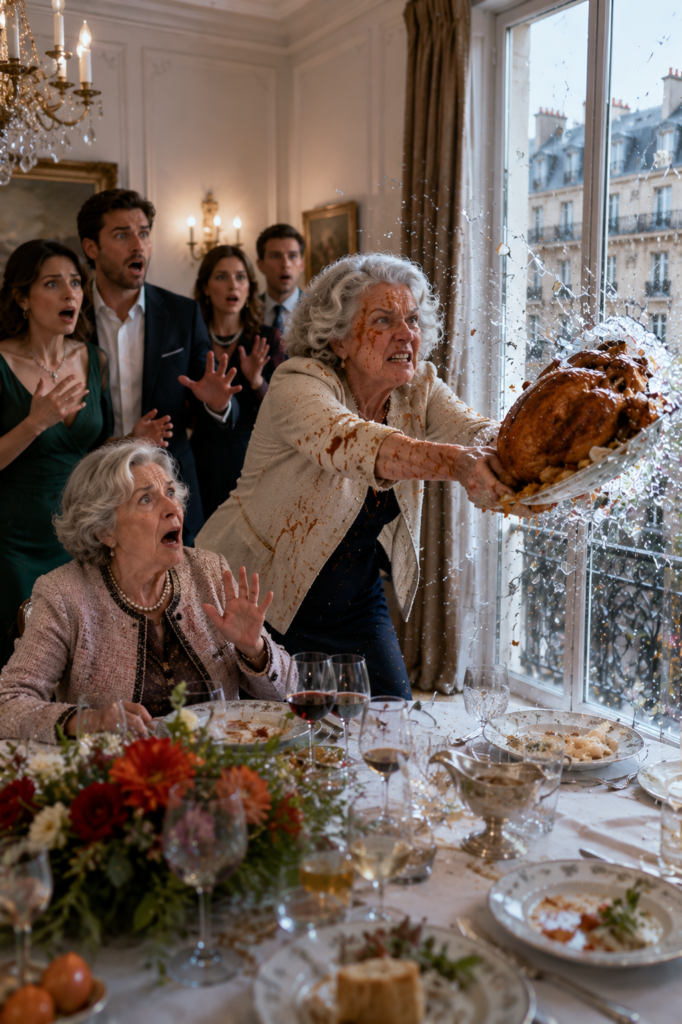
She looked at the enormous golden pork loin on the tray.
She lifted it with both hands.
Rodrigo paled.
—Mom, don’t you dare make a scene.
She walked to the dining room and threw the tray against the window.
The glass shattered with a crash that made Marcela scream.
At that very moment, the doorbell rang.
Doña Elvira, still covered in mole, looked at her son with a calm that sent chills down his spine.
—Perfect. They’ve arrived. Now they’ll know who cooked this dinner… and who paid for absolutely everything in this house.
PART 2
Octavio Alcántara entered in a dark suit. Susana followed, carrying French wine.
The two froze at the sight of the broken window, the tray crushed among the shards, and doña Elvira with her stained face.
Marcela ran towards them.
—Mom, Dad! This woman lost her mind. I told her the food wasn’t up to par, and she went crazy.
Doña Elvira looked at Rodrigo, hoping he would tell the truth.
He lowered his gaze.
That gesture extinguished what little hope she had left for her son.
Susana approached with concern.
—Ma’am, do you need a doctor?
Marcela grabbed her arm.
—Don’t coddle her. She always plays the victim. Rodrigo and I have supported her out of pity.
—Supported me? —doña Elvira asked.
Octavio frowned.
—Rodrigo, tell me what's going on for once.
—What’s happening is that this woman doesn’t understand her place. She thinks that because she had some restaurants, she can comment on our home and our business.
Our home.
Doña Elvira let out a brief laugh.
She took her phone from her apron pocket and placed it on the table.
—Yesterday Marcela asked me to check the cameras because one of them “was malfunctioning.” Lucky for her, they all worked perfectly.
The confidence vanished from Marcela’s face.
—Elvira, don’t put on a show.
Susana blinked.
—Elvira? You told us her name was Elsa and that she was your trusted cook.
Doña Elvira played the video.
On the screen, Marcela was seen tasting the mole, mocking, and spitting it right in her face.
Rodrigo was also seen approaching his wife, not his mother.
The audio came through clear:
—This mole tastes like cheap diner food… just like you.
Susana covered her mouth.
Octavio looked at his daughter with a harshness that made her step back.
—Did you spit on her?
—It was an impulse. She provoked me since she arrived.
—It didn’t start today —doña Elvira said—. She’s been trying to make me feel like an intruder in properties I bought for two years.
Rodrigo lifted his head.
—Mom, please don’t mix things up.
—You mixed them when you used my money to fake a life that doesn’t belong to you.
Doña Elvira pulled out a blue folder and placed it in front of Octavio.
—Before investing 180 million, you have the right to know who controls Desarrollos Altavista.
Octavio reviewed the deeds, and his expression changed.
—It says here that 82% belongs to the Salgado Trust.
—That’s right.
—Rodrigo assured me he had total control.
Rodrigo moistened his lips.
—It’s a family business. My mom retains shares for tax reasons, but I run it.
—You ran it —doña Elvira corrected—. I provided the capital, signed the loans, purchased the land, and accounted for every debt.
Marcela crossed her arms.
—How convenient to pull out papers right now.
—More convenient was using a shell company to drain the accounts.
Rodrigo’s face drained of color.
Marcela clenched her jaw.
Doña Elvira extended several account statements.
—Six months ago, transfers appeared to Consultoría Regiomontana del Norte. In total, 24 million pesos.
Octavio took a sheet.
—That firm appears as the operator of the project they offered me.
—It has no employees, offices, or projects —doña Elvira explained—. It’s registered under Daniela Ledesma, Marcela’s cousin.
Susana turned to her daughter. Marcela let out a nervous laugh.
—It’s legal. Many entrepreneurs do that.
—Those “transactions” paid for three trips to Europe, 11 luxury handbags, a sports car, and the down payment on an apartment in Polanco —doña Elvira responded.
Rodrigo stood up.
—Mom, we can settle this privately.
—You called me excessive in private. In private, you let your wife treat me like a servant. Today, we speak in front of everyone.
The doorbell rang again. Doña Elvira opened the door.
Licenciada Verónica Téllez, her accountant, two auditors, and two agents from the Investigative Police entered.
Marcela raised her voice.
—You can’t come in! This is my house!
The lawyer showed a warrant.
—The property belongs to the Salgado Trust. Additionally, there is a court order to secure equipment, documents, and devices linked to a complaint of fraud, forgery, and breach of trust.
Rodrigo collapsed into a chair. Susana began to cry, and Octavio looked at his son-in-law as if he were a stranger.
The lawyer handed an envelope to Rodrigo.
—You are suspended from your position while the forensic audit is conducted.
Rodrigo looked at his mother.
—I’m your only son.
—And I was your mother every day. Even when you allowed them to erase me from my own story.
The accountant connected a computer to the dining room screen.
Emails, invoices, and messages recovered from the server appeared.
The first was from Marcela:
“We need to wrap up my dad’s deal before the old lady checks the trust. With the 180 million, we can pressure her to sign her exit.”
Octavio slammed the table.
—You wanted to use my money to take the company from her?
No one replied.
The next message was from Rodrigo:
“My mom trusts me. Just don’t mistreat her too much before the signing because she can get stubborn.”
Doña Elvira closed her eyes.
She didn’t need another proof, but that phrase confirmed something worse than theft.
Her son wasn’t a victim of Marcela. He was an accomplice and only feared that her cruelty would ruin the business.
—I did it for Rodrigo! —she shouted—. That woman has him as an employee and then pretends to be a saint because she cooked mole.
Doña Elvira stared at her directly.
—I gave her a salary of 280,000 pesos a month, a house, conditional shares, and access to contacts that took me 35 years to build. She wasn’t an employee. She was a privileged child who confused trust with ownership.
The screen displayed a contract for a private loan of 70 million pesos.
As collateral appeared the corporate building in Santa Fe.
The authorization bore doña Elvira’s signature.
She had never signed that document.
Licenciada Verónica pointed at the file.
—The expertise determined that they took the signature from an old deed and inserted it digitally.
One of the agents asked for the cell phones. Marcela tried to hide hers but had to hand it over.
Octavio stood up.
—The investment is canceled. I will also file a complaint if you used my name to back false operations.
Marcela glared at him with hatred.
—I’m your daughter!
—Precisely why I’m ashamed to see you turned into this.
Rodrigo began to cry. He didn’t ask for forgiveness; he pleaded for them to think of his reputation and let him “fix the numbers.”
Doña Elvira realized he wasn’t remorseful. He was just afraid.
Dinner was never served.
The mole cooled, and the pork loin, lying among the shards, ended up photographed as evidence of the scene they had planned to use against doña Elvira.
Because that was the final secret.
During the audit, an email sent four days prior to a private doctor appeared.
Marcela wanted to obtain a report declaring doña Elvira incapable of managing her assets due to “impulsive behavior and emotional deterioration.”
The plan was to provoke her during dinner, only record her reaction, and present the video of the shattered window as proof of instability.
Then they would request control of the trust in Rodrigo’s name.
But the cameras captured the insults and the spit, and doña Elvira had backed up all the videos on an external server.
In the following weeks, the investigation confirmed 12 irregular transfers.
Marcela had created two shell companies with her cousin. Rodrigo authorized payments, altered reports, and pressured the accountant to erase traces.
When the accountant refused, they threatened to accuse him of theft. A forged agreement was also found where doña Elvira relinquished the trust “of her own volition.”
Rodrigo agreed to cooperate with the Prosecutor's Office, returned part of the money, and acknowledged his involvement.
Marcela maintained that it was all a revenge from her mother-in-law “for not belonging to her level.”
In the trial, she repeated that doña Elvira was an ignorant, resentful, and emotionally unstable woman.
Then the Prosecutor's Office played the complete video.
It showed 38 minutes of orders, mockery, humiliation, and Rodrigo's passivity.
The hall fell silent.
This no longer felt like a family dispute.
It felt like what it truly was: patrimonial and psychological violence disguised as elegance.
Marcela received a five-year sentence for fraud, forgery, and attempted dispossession against an elderly person.
Rodrigo received a lesser sentence for cooperating and repairing part of the damage, but he lost his position, his conditional shares, and the right to manage any asset of the trust.
His marriage ended before the sentence.
Susana wrote to doña Elvira, asking for forgiveness for believing they were helping “a humble cook.”
Octavio offered to pay for the window.
Doña Elvira refused.
—I broke that glass myself. I will also replace it. I need to remember that waking up has consequences, but staying asleep costs more.
Months later, she sold a share of Desarrollos Altavista and left the management to professionals.
With part of the money, she founded Casa Elvira, an organization that provided free legal advice to elderly victims of their own families.
Rodrigo sent her a letter every Sunday.
Some talked about guilt; others blamed Marcela. Doña Elvira read them but didn’t respond.
She didn’t hate him.
However, she had learned that forgiveness doesn’t compel you to return the keys to someone who tried to throw you out of your own house.
A year later, she organized another dinner in the same dining room.
She invited 12 women from Casa Elvira.
Some had lost their savings; others had been locked away by their children. All had heard: “you’re too old now” or “family has to endure.”
They cooked together.
They prepared mole, pork loin, and rompope flan.
The new window reflected the garden lights.
One woman tasted the sauce and smiled.
—Doña Elvira, it’s amazing. Seriously, you should sell it.
They all laughed.
Doña Elvira raised her glass.
No one treated her like a servant anymore.
No one hid her photographs.
And in front of that table full of women who had regained their voices, she understood something that still unsettles many families:
A mother can deeply love a son and still close the door on him.
Because limitless love doesn’t always save a family.
Sometimes it only protects the abuser.