PART 1
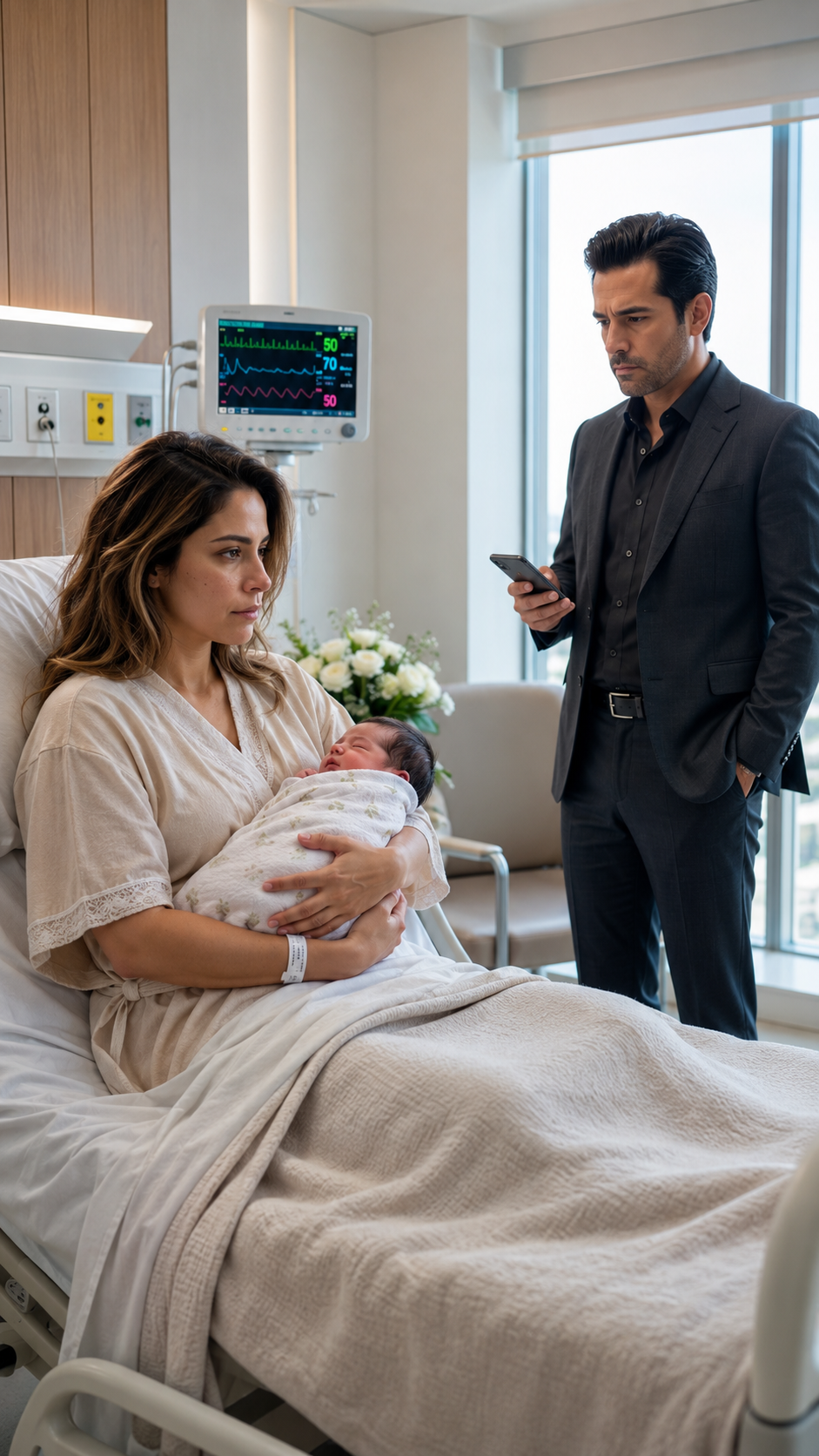
At 8:32 in the morning, in a private room of a hospital in Santa Fe, Valeria Montes held her newborn daughter for the first time.
The baby slept on her chest, swaddled in a white blanket, with her tiny mouth open and her fists clenched as if clinging to life.
Valeria was pale, exhausted, her hair plastered to her forehead after 13 hours of labor. Still, she smiled.
—Gabriel —she whispered—, come. Hold her.
Gabriel Ledesma didn’t move.
He stood by the window, immaculate, in a blue shirt, an expensive watch, and a distant gaze fixed on the city’s buildings. He seemed more concerned about a meeting than the child who had just been born.
Valeria thought he was just nervous.
Until he approached the bed and spoke softly, like someone confessing something while trying not to dirty his hands.
—I already have a child with another woman —he said coldly—. And I won’t give my last name to this girl.
Valeria didn’t scream.
She didn’t cry.
She just looked at her daughter, so defenseless, so unaware of the cruelty in that room, and understood that the man she had loved had just died to her.
—What did you say? —she barely asked.
Gabriel sighed, annoyed.
—Paola had a boy three months ago. My family already knows. He’s a boy, Valeria. You know how these things are.
Valeria felt the pain of childbirth hadn’t ended. It had only shifted locations.
—Your daughter has just been born.
—Don’t make it a drama.
That phrase was worse than the betrayal.
It wasn’t just a lover. It wasn’t just a hidden child. It was utter contempt for a baby who hadn’t even opened her eyes to know him.
Gabriel looked at the crib as if it were in the way.
—My dad won’t accept another scandal. The best thing is to handle this discreetly.
Valeria smiled.
A smile so calm it made Gabriel uncomfortable.
—Then remember this moment well —she said—. Because it’s the last one where you still think you can decide for us.
Gabriel let out a dry laugh.
—You’re tired. We’ll talk tomorrow.
But the next day, when he returned to the hospital with his mother and a family lawyer, the room was empty.
The bed was made.
The crib was gone.
Valeria was gone too.
On the bedside table was only a folded card with one handwritten phrase:
“Now, Gabriel… let’s see how much your last name is worth when everyone knows how you used it.”
And no one in the Ledesma family could imagine what that woman had just begun.
PART 2
Valeria left the hospital before dawn, her sister Mariana carrying the diaper bag and a nurse helping her walk slowly to the service elevator.
The baby was named Abril.
That name Valeria had chosen alone, while Gabriel pretended to be excited during the ultrasounds and answered Paola’s messages in the bathroom.
For months, Valeria had suspected. The midnight calls, the sudden trips to Guadalajara, the work dinners that ended in boutique hotels, the strange silences when she asked too much.
But she never imagined the humiliation would come just two hours after giving birth.
Gabriel Ledesma was the commercial director of Grupo Ledesma, a powerful construction company from Monterrey with projects in Cancun, Querétaro, and Mexico City. His family boasted values, Sunday Mass, and a clean last name.
Don Ernesto Ledesma, the patriarch, repeatedly said in interviews that “the family was the foundation of any business.”
Pure façade.
Valeria knew better than anyone.
Before marrying Gabriel, she wasn’t an innocent girl looking for a rich husband. She was a forensic accountant. She had worked auditing frauds, inflated contracts, and family trusts where the numbers lied less than the people.
That’s why, when Gabriel underestimated her, he made the worst mistake of his life.
Valeria didn’t rush to social media.
She didn’t go live crying.
She didn’t send furious messages.
She went to Puebla, to her aunt Rosa’s house, a widowed woman who sold home-cooked meals and who, as soon as she saw Valeria with the baby in her arms, asked nothing.
She just opened the door and said:
—Come in, dear. No one here will treat you like trash.
For ten days, Gabriel called 27 times.
Valeria didn’t answer.
Doña Teresa, her mother-in-law, sent long audio messages saying that women “should think of the children before pride.”
Valeria saved them all.
Paola also tried to reach her.
At first, Valeria didn’t want to see her. She hated her without knowing her, because it was easier to hate the other woman than to accept that both had been manipulated by the same man.
But Paola insisted with one message that chilled her blood:
“Gabriel told me you knew about me and that you accepted as long as your daughter wouldn’t inherit anything.”
Valeria agreed to meet her at a small café near the Zócalo in Puebla.
Paola arrived with dark circles under her eyes, no makeup, carrying a three-month-old baby named Mateo. She didn’t look like a triumphant lover. She looked like a broken woman.
—He told me he was going to divorce you before my son was born —Paola said, her voice trembling—. He told me you only stayed with him for money.
Valeria tightened Abril against her chest.
—He told me you were an obsessed employee.
Paola lowered her gaze.
—What a lowlife.
They both fell silent.
They weren’t enemies.
They were two mothers sitting face to face, understanding that their children had been used as pawns in a war of last names, inheritance, and machismo disguised as tradition.
Then Paola pulled out a folder.
—I have messages, transfers, emails. Gabriel asked me to sign an agreement so that Mateo wouldn’t claim anything from the company, but promised to keep us a secret until his father accepted the “male heir.”
Valeria felt anger, but not surprise.
—Do you have a copy?
Paola nodded.
—Everything.
What Gabriel didn’t know was that Valeria had something too.
Months before, while reviewing papers at home, she found documents of an old partnership linked to her maternal grandfather. The grandfather had invested in industrial land that, years later, was absorbed by Grupo Ledesma.
No one in the Ledesma family remembered that.
But the participation was still active: 9% of a key subsidiary and the right to request an internal audit if a director put the company’s reputation at risk.
Gabriel hadn’t rejected just any woman.
He had rejected the only person who could open a door that his family had tried to keep closed for years.
At 9:00 on a Monday, the board of Grupo Ledesma received a formal request for an executive review signed by Valeria Montes.
Reasons: hidden relationship with direct subordinate, possible misuse of corporate resources, private paternity agreements, concealment of information from banks, and discriminatory conduct against a minor born within the marriage.
The scandal didn’t go public at first.
But within the company, it exploded like a bomb.
Don Ernesto called Gabriel into his office.
—Is it true? —he asked.
Gabriel tried to smile.
—Dad, it’s a personal matter.
—No, dude —responded his younger brother, Rodrigo, who was present—. Personal is forgetting an anniversary. This is legal dynamite.
Gabriel turned around, furious.
—Don’t get involved.
But it was too late.
Valeria arrived at the board meeting with Abril in a baby carrier. Paola arrived five minutes later with Mateo. The two women walked together.
The silence was brutal.
Doña Teresa sat next to her husband, turning pale.
Gabriel looked at Valeria as if he couldn’t believe she had dared.
—This wasn’t necessary —he murmured.
Valeria stared at him without blinking.
—It also wasn’t necessary to abandon your daughter two hours after she was born.
Paola laid down on the table screenshots of messages, hotel receipts, emails, and a private contract that Gabriel had wanted her to sign.
Valeria handed over audios of Doña Teresa pressuring her to accept “a decent arrangement” and messages where Gabriel said that Abril “shouldn’t complicate the family line.”
Don Ernesto read that phrase three times.
On the third, he looked up.
—Is this how you spoke about your daughter?
Gabriel swallowed hard.
—I was under pressure.
—No —Valeria said—. You were just being you.
Then came the twist that no one expected.
Rodrigo, Gabriel’s younger brother, pulled out another document.
—There’s something more.
Gabriel turned pale.
Rodrigo explained that for years Gabriel had used project accounts in Cancun to pay for apartments, trips, and personal expenses. Not just with Paola. Also with other hidden relationships.
The audit Valeria requested had uncovered something much larger than infidelity.
There was fraud.
Don Ernesto remained motionless.
Doña Teresa began to cry, but no one knew if she was crying for her grandchildren or for the last name.
Gabriel lost control.
—This is all your fault! —he shouted at Valeria—. If you had agreed to talk like an adult…
Valeria stood up slowly.
The baby Abril stirred in her arms.
—You would have been an adult if you had held her when she was born —she said—. You would have been an adult if you had told the truth before destroying two homes. You would have been an adult if you didn’t confuse being a father with producing heirs.
No one spoke.
Not even Gabriel.
The suspension was immediate. First temporary. Then permanent.
The company opened an internal investigation. The banks demanded explanations. The partners demanded distance. Gabriel, the perfect heir, was reduced to a problem everyone wanted off the table.
Valeria didn’t ask for revenge.
She asked for full custody, legal recognition of Abril, fair support, property protection, and a written apology where Gabriel acknowledged that he had denied his daughter for reasons of gender and family pressure.
Gabriel’s lawyer laughed when he read that last condition.
—He’ll never sign that.
Valeria closed the folder.
—Then I’ll see you in court.
She signed three weeks later.
Paola also obtained protection for Mateo. Not a hidden handout, but an educational fund and formal support. She quit the company and opened a small administration office for women wanting to leave abusive relationships without starting from scratch.
Valeria returned to work from home while Abril slept in 40-minute naps. Sometimes she cried from exhaustion. Sometimes she found herself staring at the wall, wondering how she could have loved a man so empty.
But every time Abril opened her eyes, everything made sense again.
At six months, Don Ernesto asked to meet his granddaughter.
Valeria agreed only in a public place, with Mariana present.
The man arrived without escort, without ostentatious watch, and without that boss tone he always used.
When he saw Abril, his face broke.
—She looks like my mother —he said.
Valeria didn’t respond.
Don Ernesto lowered his head.
—I raised Gabriel believing that a last name was defended with power. I never taught him that it was defended with decency.
—My daughter doesn’t need to carry your burdens —Valeria said.
—I know.
—And she won’t have to earn her place. She already has it.
Don Ernesto nodded.
—That’s why I came to ask for permission, not rights.
Valeria allowed supervised visits. Not for Gabriel. Not for the Ledesma family. She did it for Abril, so one day she would know that her story didn’t start with rejection, but with a mother who refused to let anyone make her less.
Gabriel appeared a year later.
He called at dawn.
—Valeria, I want to see my daughter.
She was in the kitchen, preparing a bottle. Abril was sleeping in the living room, hugging a fabric bunny.
—Don’t call her your daughter when the first time you saw her you decided she wasn’t worth your last name.
—I’ve changed.
—No, Gabriel. You lost power. It’s not the same.
He fell silent.
—I made a mistake.
Valeria closed her eyes.
—A mistake is sending a wrong address. What you did was a decision made while looking at a newborn.
She hung up.
She didn’t feel joy.
Just peace.
Today Abril is three years old. She runs around the yard of the house in Puebla, laughs with Mateo when Paola visits, and calls Don Ernesto “serious grandpa” because he always arrives with a stern face and ends up sitting on the floor playing with blocks.
Valeria no longer wonders why Gabriel didn’t choose her.
She understood that some people don’t know how to love unless they can control.
And that there are families that talk a lot about honor but only know shame when someone holds a mirror up to them.
Sometimes, at night, Valeria watches Abril sleep and remembers that hospital room.
Gabriel by the window.
The cruel phrase.
The crib.
The blood.
The silence.
And the smile she gave him when he thought he had just broken her.
But he didn’t break her.
He awakened her.
Because a mother can leave the hospital with her body stitched, her heart shattered, and a baby in her arms… and still have more strength than an entire family used to buying silence.
Gabriel lost his company, his prestige, and the respect of those who obeyed him.
But his true loss happened long before.
He lost it two hours after Abril was born when he looked at her as if she were less for being a girl.
Valeria, on the other hand, looked at her as if she were everything.
And that’s why, although many still debate whether it was justice or revenge, she knows the truth:
She never wanted to destroy Gabriel.
She just stopped protecting him from the consequences of being who he was.