PART 1
At 2:18 PM, Doña Mercedes Alvarado received the call that shattered her life into pieces. She was leaving the cardiologist’s office in Morelia when she heard her neighbor screaming on the other end of the line.
—Meche, get here now! They’re tearing down your trees with machines!
Mercedes, 72, froze on the sidewalk. The medical prescription slipped from her hands, and the world began to buzz like she had bees inside her chest.
Rancho La Esperanza lay on the outskirts of Uruapan, Michoacán. It was not just a simple plot of land. For 46 years, Mercedes and her husband, Don Ignacio, had tended to 40 hectares of heirloom apple trees, ancient avocados, and rich black soil that smelled of rain as October approached.
Ignacio had been an agronomist. He used to say that trees also had memories, that a lost variety was like burning a letter written by one’s grandparents. Before dying from a heart attack, he left notebooks, maps, photographs, contracts, and records of every graft he had painstakingly made with his hands.
The heart of the ranch was in the southern hill: 12 hectares of ancient apple trees. Rare varieties thrived there like the Negra de Zacatlán, the Rayada de la Sierra, and the Menudita de Sidra.
But Ignacio’s pride was the Roja Alvarado, an apple with a deep red skin, sweet and tart, resistant to the cold and sought after by artisanal cider houses in Mexico and the United States.
Mercedes was no helpless old lady. Her hands were marked by pruning shears, her back straight, and her gaze silenced anyone who dared challenge her. Every afternoon, she would pass by the oak by the creek, where Ignacio’s ashes rested, and softly say:
—We’re still here, old man.
But progress, as they called it in the Town Hall, had already begun to encircle her.
Grupo Lomas Doradas, a developer from Morelia, had bought 300 hectares around her to build a luxury housing complex with an artificial lake, a country club, and “ecological” trails for wealthy people wanting to live among trees after tearing them down.
All they needed was one thing: Mercedes’s land.
First came elegant letters. Then friendly calls. After that, an offer for 48 million pesos.
Mercedes tore the envelope in front of the messenger.
The following week, Patricio Roldán, the acquisitions director, arrived in a shiny black truck. Expensive shoes, a fake smile, and no dirt on his soles.
—Doña Mercedes, you’ve worked enough. Sell and go relax by the sea.
She looked at him from the porch, black coffee in hand.
—My husband is under that oak. Every tree passed through his hands. This is not merchandise.
Patricio clenched his jaw.
—Taxes are going to rise. Growth doesn’t stop. Sooner or later, you’ll have to yield.
—Take your threat away before my dogs mistake you for trash.
From then on, the harassment began. Trucks stirring up dust, anonymous complaints, green mesh covering the view, a drainage canal that flooded the northern pasture.
Mercedes photographed everything. Noted dates. Hired a surveyor. And kept pruning.
That year, the Roja Alvarado was heavier than ever. A cider house from Valle de Bravo signed a pre-contract to purchase the entire harvest. Patricio learned and understood that Mercedes was not going to break.
Then he made the dirtiest calculation of his life.
If a crew “messed up” the line and wiped out the orchard, the company would pay a cheap fine. By the time the widow sued, the land would already be cleared.
That Tuesday, Mercedes left at 8 AM for the doctor. Twenty minutes later, three yellow excavators, two bulldozers, and several trucks entered through the neighboring construction site.
The contractor Abel Neri stopped when he saw the markers.
—The line doesn’t match, boss. This is already the lady’s property.
Patricio’s voice sounded dry over the radio:
—Follow the plan. Tear it all down. I want that hill bald by tomorrow.
The machines advanced.
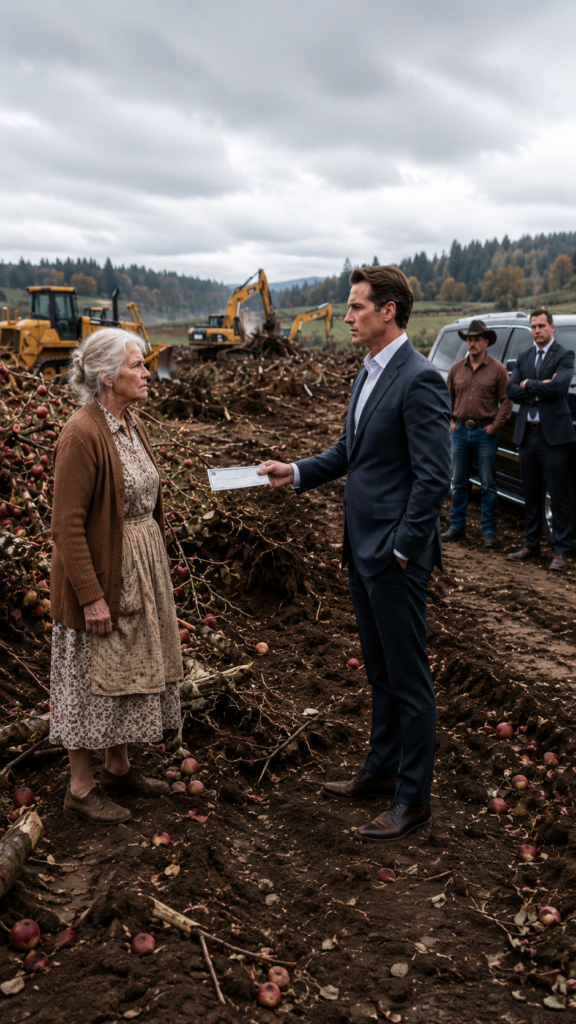
The first apple tree fell with a crack that sounded like a broken bone. The apples burst under the treads, staining the black earth red.
For four hours, they uprooted roots, broke metal tags, crushed rare branches, and mixed fruit, mud, and diesel.
When Mercedes arrived, she fell to her knees.
Where there had once been shade, now there was an open wound.
Then Patricio’s black truck appeared. He stepped out slowly, a check in hand.
—It was a terrible mapping error, Doña Mercedes. We want to resolve this today. 150,000 pesos for the wood and the new grass.
Mercedes lifted her dust-covered face.
She saw a metal tag buried in the mud, with the genetic bank code Ignacio had recorded.
Her crying dried up instantly.
—Do you think this was firewood?
Patricio let out an uncomfortable laugh.
—They were old trees. I understand the sentiment, but be reasonable.
Mercedes stood up, dirt in her hands and fire in her eyes.
—You didn’t cut down trees, Mr. Roldán. You just destroyed a living bank of registered agricultural genetics.
Patricio stopped smiling.
And the widow said the phrase that would ruin his life:
—You’ll wish you had never learned my last name.
PART 2
That night, Mercedes couldn’t sleep. The house was silent, but to her, everything creaked: branches falling, roots torn out, apples bursting as if someone were stepping on a lifetime’s work.
At 4 AM, she got up, walked to Ignacio’s study, and removed three loose floorboards. Beneath was the safe he had installed years ago when strange buyers started arriving to inquire about the Roja Alvarado.
Inside, there were no jewels or wads of cash.
There were grafting notebooks, root maps, photographs of blooms, contracts with nurseries, university records, agricultural conservation certificates, and a folder with the official seal of a national network of phytogenetic resources.
Mercedes ran her fingers over Ignacio’s handwriting.
—Now it’s time to fight, old man —she whispered.
At dawn, she drove to Morelia and sought out Clara Mendoza, an agrarian lawyer with gray hair, known for winning cases against mills, mining companies, and land barons who believed they owned entire towns.
Clara received her without hurry. But when she opened the file, her expression changed.
She read one contract, then another. Reviewed the old photographs. Examined the codes on the metal tags, the living bank plans, and the pre-contract from the cider house in Valle de Bravo.
—Doña Mercedes —she finally said—, did they admit they entered by mistake?
—Patricio offered me 150,000 pesos to keep quiet.
Clara closed the folder.
—Then we’re not asking for apologies. We’re demanding full restitution.
In the following days, experts, agronomists, appraisers, surveyors, and even two university researchers who had worked with Ignacio arrived.
Dr. Santiago Uriarte, a specialist in fruit conservation, walked among the remains with misty eyes. He lifted broken roots, recovered bent tags, took soil samples, and examined each of the notebooks one by one.
His report was brutal.
The Roja Alvarado could not be replaced by buying saplings at a nursery. Each mature specimen represented decades of selection, production, and genetic value. They had destroyed 110 mature trees of that variety alone.
Adding lost harvests, future contracts, soil restoration, damaged irrigation, property invasion, and loss of registered plant material, the initial damage exceeded 96 million pesos.
But Clara went further.
She didn’t just sue for trees. She sued for willful destruction of agricultural heritage, invasion of private property, projected economic damage, and impairment of protected genetic material.
When the notification reached the offices of Lomas Doradas, Patricio opened it with annoyance. He thought it would be a minor dispute with a stubborn widow.
Then he saw the figure.
288 million pesos.
The color drained from his face.
—She’s crazy —he said in front of the board—. They were just apple trees, for God’s sake.
The company’s lawyer swallowed hard.
—No, Patricio. According to these documents, they weren’t just ordinary apple trees. And if they prove you ordered the entry, this could sink us.
The company tried to pressure her. They sent emissaries to offer Mercedes 5 million, then 12 million, then 25 million to “avoid the scandal.”
She rejected everything.
—If you wanted to negotiate, you shouldn’t have sent machines into my home.
The case began to circulate on Facebook. Photos of the destroyed hill were shared all over Michoacán. Farmers, students, cider makers, and neighbors who had previously remained silent began to tell how Lomas Doradas had pressured other farmers.
Doña Elvira uploaded a video that clearly showed the machinery crossing the broken mesh.
The town ignited.
In the tortilla shop, they said Mercedes was stubborn. In the market, they said Patricio was a scoundrel. In the cafes of Morelia, businessmen murmured that a widow was putting a multimillion-dollar project in jeopardy.
The trial began six months later.
The courtroom was packed. There were journalists, farmers, agronomy students, cider workers, and even former employees of Lomas Doradas.
Mercedes arrived in a simple gray suit. Inside her bag, she carried a dry branch from the Roja Alvarado, the last one she had gathered the day of the destruction.
Patricio arrived in a blue suit, dark circles under his eyes, and a smile that no longer convinced anyone.
The defense tried to sell the story of an error. They said the plan was confusing, that the contractor misread it, that the company deeply regretted what had happened.
Clara listened to it all without interruption.
Then she called Abel Neri to the stand.
The contractor entered pale. For months, the company had pointed to him as the sole culprit, but when he saw they wanted to leave him alone with the whole mess, he decided to speak.
—Mr. Neri —Clara asked—, did you misread the line?
Abel looked at Patricio.
—No.
A murmur ran through the room.
—Explain.
Abel took a deep breath.
—I told Mr. Roldán that the markers didn’t match the plan. I told him that this orchard belonged to Mrs. Mercedes. He replied over the radio to follow the modified plan.
Clara raised a sheet.
—Do you have proof?
—Yes. Messages. Audios. And an extra deposit they made to me that same day to finish quickly.
Patricio clenched his fists.
Then came the blow that no one expected.
Clara presented the original plan of Lomas Doradas, obtained by a former employee of the developer. In that plan, Mercedes’s orchard appeared perfectly delineated, marked in red with an internal note: “Protected zone, potential legal conflict.”
She then showed the modified plan that Abel received that morning.
The line had been moved 68 meters into the ranch.
The room fell silent.
But there was more.
In an audio, Patricio’s voice said:
—The old lady will cry for two weeks and then sell. Tear it all down. The lawyers will sort out the rest.
Mercedes closed her eyes. Not out of fear. Out of rage.
The truth was no longer a suspicion. It was a confession.
The defense crumbled. Investors began to blame each other. A municipal official admitted that the drainage canal and the anonymous complaints had been part of a strategy to wear Mercedes down.
The trial ceased to be a dispute over land.
It became an exhibition of abuse, classism, and greed.
When the judge delivered the verdict, Mercedes did not smile. She simply gripped the dry branch inside her bag.
Grupo Lomas Doradas was found responsible for invasion, willful destruction, and aggravated property damage. They had to pay 288 million pesos, cover legal costs, finance ecological restoration, and permanently suspend phase 3 of the housing project.
Patricio was fired, sued by his own board, and banned from several business chambers. The municipal official resigned before he could be formally summoned.
Within 30 days, the banks demanded payments. Investors pulled out money. The half-built houses were left abandoned with torn tarps, rusted rebar, and signs of “natural living” covered in dust.
Mercedes gained a fortune.
But she didn’t buy an apartment in Cancún or move to live by the sea.
She did something that left the town speechless.
She bought, at a bargain price, the 300 hectares surrounding La Esperanza.
Where Lomas Doradas wanted to put private streets, Mercedes ordered the asphalt removed. Where they were going to build a golf club, she planted trees. Where they promised an artificial lake, she restored the natural flow of the creek.
With the help of the university, she rescued live fragments of roots she had protected in a greenhouse. Not everything could be saved. Some varieties were lost forever, and that truth hurt her as if Ignacio were dying again each morning.
But the land also knows how to resist.
Mercedes founded the Ignacio Alvarado Trust for the Conservation of Heirloom Apples and planted 10,000 new trees.
For three years, she worked quietly. The students returned. The bees returned. The farmers who wanted to learn to graft old varieties returned.
And one spring, the hill that Patricio had left bald was covered in white and pink flowers.
That Sunday, Mercedes walked to the oak by the creek. She was 75 years old and carried a basket with the first young apples from the new orchard. They were small, imperfect, red with golden spots.
She placed one on the ground where Ignacio’s ashes rested.
—They ripped away half our heart, old man —she whispered—. But they couldn’t tear out our roots.
The wind rustled the new branches, as if someone were responding.
Later, she opened the sanctuary to the public one Sunday a month. Families from Uruapan, Pátzcuaro, Morelia, and nearby towns came. The children learned to graft. The farmers took cuttings. The cider houses returned to buy fruit with a label that read: “Harvest from La Esperanza.”
One afternoon, a girl asked her:
—Doña Meche, why didn’t you sell when they offered you so much money?
Mercedes looked at the blossoming hill.
—Because some things aren’t for sale, dear.
—Like the land?
Mercedes smiled.
—Like dignity.
Patricio wanted to erase an orchard to build empty houses.
Mercedes turned the ruins into the most important agricultural sanctuary in the region.
And every spring, when the flowers cover the hills of La Esperanza, the town remembers the lesson that one widow left written with roots:
Never confuse a patient woman with a defeated one.





