PART 1
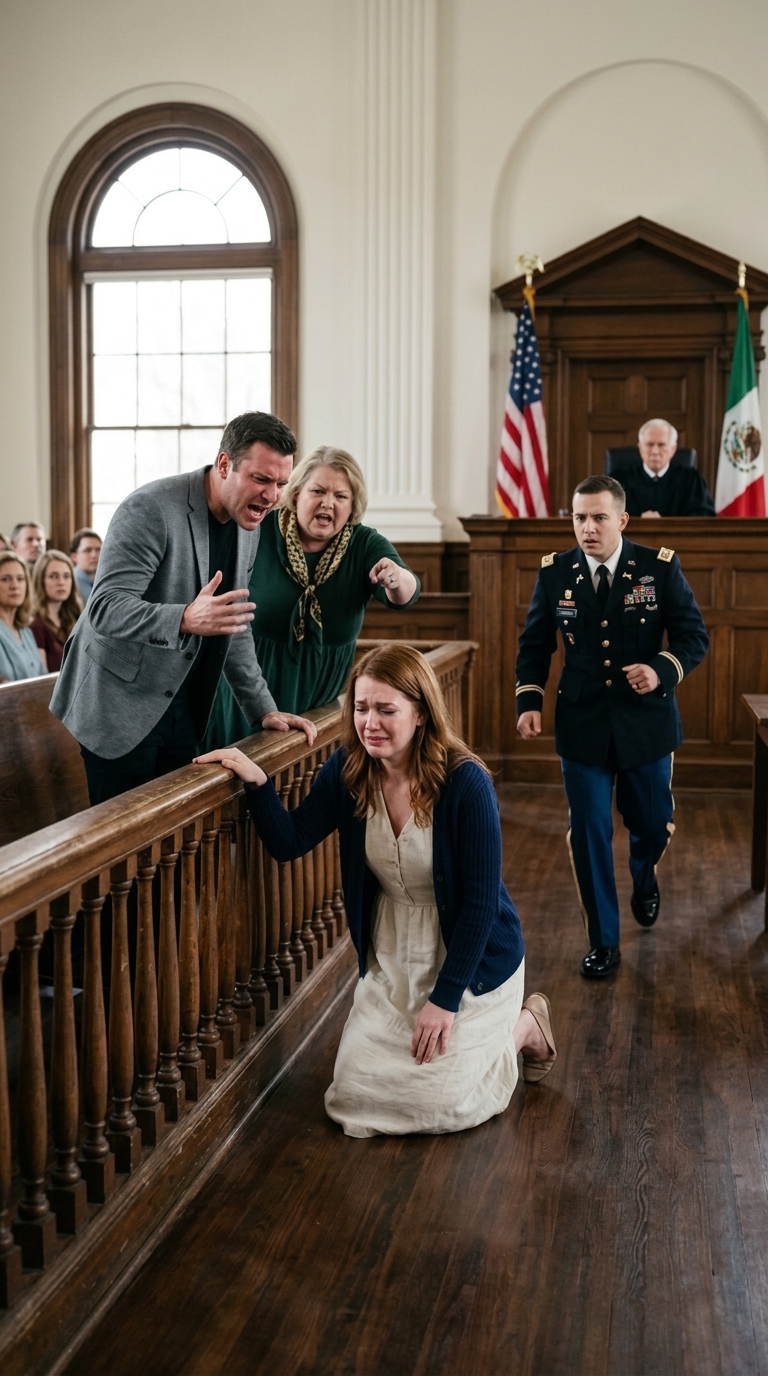
In Room 4 of the Family Court in Guadalajara, Mariana Robles could barely stand.
One hand gripped the wooden railing beside the judge's bench, her lips dry and her gaze fixed on Judge Alma Cárdenas, who wearily sifted through papers.
From the front row, Doña Teresa, her mother-in-law, raised a finger as if pointing at a criminal.
—She’s pretending, Your Honor.
The silence fell heavy.
Next to her lawyer, Daniel Montes, Mariana’s husband, wore a crooked smile. It was not a nervous smile. It was one of triumph.
—She always does this when things don’t go her way —he said, adjusting his jacket—. She gets dizzy, cries, plays the victim. Honestly, we all know her by now.
Mariana wanted to respond, but the words wouldn’t come.
They had been in the custody hearing for Valentina, their 7-year-old daughter, for two hours. Daniel was seeking custody from Monday to Friday, claiming Mariana was unstable, weak, and manipulative.
Her lawyer had presented medical records, emergency visit admissions, and fainting reports as if they were evidence that Mariana was unfit as a mother.
—The child needs a stable home —he had said—, not a mother who collapses every time there’s pressure.
Mariana had arrived alone.
Her lawyer had quit 15 days prior, after Daniel drained the account where Mariana kept the money to pay her. He also cut off her private insurance and canceled the card she used to buy her medications.
Still, Mariana went.
Because Valentina cried every Sunday night when she had to go with her dad.
Because the little girl had said three times: “Mom, I don’t want to sleep there. Grandma says you’re crazy.”
But no one seemed to hear that.
The judge looked up.
—Mrs. Robles, can you continue?
Mariana swallowed hard. The bright ceiling light burned her eyes. The hum of the air conditioning sounded like a swarm. The floor began to shift beneath her shoes.
—Your Honor… I need a minute.
Daniel let out a chuckle.
—There it is. Just like I said.
Doña Teresa shook her head in disdain.
—Just a show.
The judge clenched her jaw.
—This hearing has had too many interruptions already.
Then Mariana's legs stopped responding.
The railing slipped from her grasp. Her shoulder hit the floor with a sickening thud. Her head lay to the side, facing the benches where several people stood up, alarmed.
Daniel didn’t rush to her.
He merely stood, annoyed.
—Don’t mind her. She always does this.
From the back of the room, a tall man in olive green uniform rushed forward. He knelt beside Mariana and took her pulse.
On his badge, it read: Colonel Dr. Ignacio Saldaña.
He lifted one eyelid, checked her breathing, and his expression changed instantly.
—Call an ambulance.
Doña Teresa scoffed.
—Doctor, you don’t know her.
The military man looked at her with a coldness that chilled the room.
—I don’t need to know her to know this woman is at risk.
No one moved quickly enough.
Then the colonel slammed his palm against the floor.
—Get emergency services here now!
The judge rose from her chair.
And Daniel, for the first time that morning, stopped smiling…
PART 2
The court clerk dashed into the hallway, phone in hand.
Judge Alma Cárdenas ordered the hearing suspended and instructed that no one leave the room. Her voice, which minutes before had sounded impatient, now carried a different edge.
Colonel Ignacio Saldaña remained beside Mariana.
—Ma’am, if you can hear me, squeeze my hand.
Mariana barely moved her fingers.
The military man noted her pale skin, the cold sweat on her forehead, the slight tremor of her lips.
—Are you taking any medication? —he asked.
Mariana tried to speak.
She could only manage one word.
—Folder…
Her trembling hand pointed to the brown bag that had fallen next to the bench.
Daniel stepped forward.
—That bag is hers, but it’s nothing important. Just stuff she carries to make herself interesting.
The colonel looked up.
—You stay where you are.
The room fell silent.
A court clerk retrieved the bag with the judge's permission. Inside were tissues, a bottle of water, a photo of Valentina in her school uniform, and a yellow folder crumpled at the corners.
The judge asked to see it.
Daniel tensed.
—Your Honor, that wasn’t admitted as evidence.
—It wasn't admitted that the lady collapsed in my courtroom either —the judge replied—. Hand her the folder.
Daniel's lawyer tried to protest, but the judge silenced him with a glare.
The ambulance arrived nine minutes later.
Paramedics checked Mariana's blood pressure. One of them frowned.
—It’s very low. We need to transport her.
The colonel stood up.
—She shows signs of severe decompensation. And based on the pupillary response, this doesn’t appear to be anxiety or a simple fainting spell.
The word anxiety made Mariana barely open her eyes.
For months, Daniel had repeated the same thing.
Anxiety.
Drama.
Manipulation.
Every visit to the emergency room ended with him speaking first with the doctors, insisting she was overreacting, that she had emotional issues, that she invented symptoms to punish him.
And Mariana, weak, confused, terrified of losing her daughter, ended up silent.
The judge opened the yellow folder.
Inside were copies of medical records, printed messages, and a USB drive taped inside.
On the first page was a report from the Regional Military Hospital.
The judge read silently.
Then she looked up.
—Mr. Montes, it says here that your wife was treated three months ago for mild medication intoxication and severe dehydration.
Daniel paled.
—That was a misunderstanding.
The colonel approached.
—May I review that document?
The judge nodded.
Ignacio took the page, and his expression hardened.
—I signed this report.
The entire room seemed to hold its breath.
Daniel opened his mouth but said nothing.
The colonel continued.
—The lady arrived at the emergency room accompanied by a minor. The girl said her mother had fallen in the kitchen after drinking a tea her husband had given her.
Doña Teresa stood up.
—That’s a lie! That girl is just repeating what her mother puts in her head.
The judge slammed the gavel on the table.
—Sit down.
Doña Teresa sat down, red with anger.
The colonel didn’t lower his voice.
—That day, tests were ordered. The result showed sedatives in the blood at a concentration not corresponding to the medications prescribed to the patient.
Daniel's lawyer swallowed hard.
—Doctor, with all due respect, that doesn’t prove my client…
—I’m not finished —the colonel interrupted.
The judge examined another sheet.
It was a request for voluntary discharge.
It bore Daniel’s signature.
In the margin, a note written by a resident said: “Patient is not in a condition to decide. Husband insists on discharging her. Refuses further studies.”
Mariana, on the stretcher, shed a tear.
She couldn’t sit up, but she could hear.
Everything Daniel had buried was coming out in front of the very judge who almost took her daughter away.
The USB drive was handed to the court staff. The judge ordered only the file marked with date and time to be played, as it was mentioned in the folder as a “backup recording.”
The small screen in the room lit up.
Valentina appeared.
She was sitting at the kitchen table, in her pink pajamas with messy hair. The image trembled as if the phone were hidden behind a cup.
Doña Teresa’s voice echoed.
—If your mom gets sick again, you tell the judge she falls by herself. Understand?
Valentina cried softly.
—But my mom doesn’t fall by herself.
Then Daniel entered the frame.
He held a cup in his hand.
—Valentina, stop crying. Your mom needs to rest, and you need a normal family. If you keep defending her tantrums, you’ll end up without a dad.
The little girl covered her face.
—I want to be with my mom.
Daniel slammed the table.
—Your mom can’t take care of you. And after this hearing, her little shows are over.
The recording ended.
No one spoke for several seconds.
Not even Daniel's lawyer.
Judge Alma Cárdenas slowly removed her glasses.
—Mr. Montes, were you aware of this recording?
Daniel tried to regain his composure.
—It’s edited. Mariana is capable of anything. She’s an ill woman.
Then the colonel said something that completely changed the atmosphere of the room.
—Yes, she is ill. But not in the way you want to make it seem.
The judge looked at him.
—Explain yourself, doctor.
—The lady presents symptoms consistent with untreated adrenal insufficiency, worsened by stress, lack of medication, and possible exposure to sedatives. With treatment, she can live and care for her daughter. Without treatment, a crisis could kill her.
Mariana closed her eyes.
For a year, she had felt her body shutting down without explanation. She woke up with nausea, tremors, dark spots on her skin, brutal fatigue. Daniel said it was laziness.
When she insisted on seeing a doctor, he responded:
—Again? Seriously, you’re pathetic.
But the truth wasn’t that Mariana was fleeing from her responsibilities.
The truth was that Daniel had used her illness to build a prison.
He took away her money.
He hid results.
He told the family she was crazy.
He told Valentina her mom was worthless.
And then he brought all of that to court as if it were proof of paternal love.
A paramedic asked for permission to transport Mariana.
The judge approached the stretcher. Her face was no longer stern but profoundly serious.
—Mrs. Robles, you will be taken to the hospital. This hearing is suspended, but not closed.
Mariana barely nodded.
The judge looked at Daniel.
—For now, the minor will not be placed in Mr. Montes’s custody.
Daniel exploded.
—You can’t do that! I’m her father!
—You are also the adult who has just been indicated in a possible medical, economic, and emotional manipulation —the judge replied—. And this room has just seen enough evidence to activate protective measures.
Doña Teresa stood up again.
—My son is a decent man! She provoked him!
The judge pointed her gavel at her.
—One more word, and I’ll order you removed.
Daniel looked around for allies.
He found none.
The same man who had mocked Mariana just minutes earlier was now sweating as if the room had run out of air.
The ambulance took Mariana to the Civil Hospital.
Valentina arrived 40 minutes later with a social worker. The little girl came hugging a blue backpack and had puffy eyes from crying.
When she saw her mom in the bed, she ran to her.
—Mommy, are they not going to force me to go with Dad anymore?
Mariana, still weak, lifted a hand and caressed her hair.
She didn’t promise something that didn’t depend on her.
She only said:
—This time they listened to us, my love.
In the following days, the story took a turn.
The court requested the complete emergency records. The Military Hospital confirmed that Mariana had been treated twice for severe crises and that in both instances, Daniel had asked to close the case before completing the studies.
There was also a prescription Mariana had never seen.
It was in Daniel’s name.
Sedatives.
Purchased at a pharmacy in Zapopan.
The date matched one of the nights when Mariana collapsed while Valentina was calling a neighbor in tears.
The neighbor testified that Daniel arrived before the ambulance and shouted at the girl:
—If you say anything, your mom is going to the asylum.
That was the final blow.
The judge ordered provisional custody for Mariana, with support from her sister Laura, who traveled from Morelia to stay with her. Daniel received supervised visits, temporary suspension of medical decisions regarding the minor, and an investigation for domestic violence, economic abuse, and possible improper medication provision.
Doña Teresa attempted to show up at Valentina’s school.
The principal already had notice from the court.
They didn’t let her in.
The woman shouted at the entrance, in front of other moms:
—That girl belongs to my son!
One mom replied:
—No, ma’am. Children are not anyone’s property.
The phrase became neighborhood gossip, then a Facebook post, then a debate topic in moms' groups.
Some said Mariana should have spoken up sooner.
Others responded that no one speaks easily when their money, health, and credibility are stripped away.
But those who knew Valentina understood something harsher.
Sometimes children don’t cry because they’re spoiled.
Sometimes they cry because they are the only witnesses to a truth that adults refuse to see.
Three months later, Mariana returned to court.
She walked slowly, with treatment, a lightweight cane, and a new folder. She wasn’t perfect, but she was on her feet.
Daniel was there too.
No smile.
No mother in the front row.
No more of that untouchable man air he carried the first time.
The judge reviewed the new reports: treatment completed, medical stability, therapy for Valentina, psychological evaluation of the girl, and a social work report.
Valentina had said something simple during the interview:
—I’m afraid my mom will get sick. I’m afraid to talk with my dad.
The judge took less than a minute to read that sentence aloud.
Then she issued the ruling.
Mariana would retain primary custody. Daniel would have supervised visits and had to cover alimony, medical treatment, and therapy. Furthermore, the file would be sent to the Public Ministry for the possible crimes detected.
Daniel lowered his head.
Mariana didn’t smile.
It wasn’t a pretty victory.
It was a victory made of invisible bruises, sleepless nights, and a little girl who had to secretly record to make someone believe her mom.
As they left the court, Valentina hugged her tightly.
—Is it over now?
Mariana looked at the building, took a deep breath, and replied:
—Not everything. But the right thing has begun.
And while Daniel lingered behind, surrounded by lawyers and silence, a question hung in the air among those who witnessed the case:
How many women have been called dramatic, crazy, or exaggerated when they were really just surviving someone who knew perfectly how to destroy them without leaving marks?





