PART 1
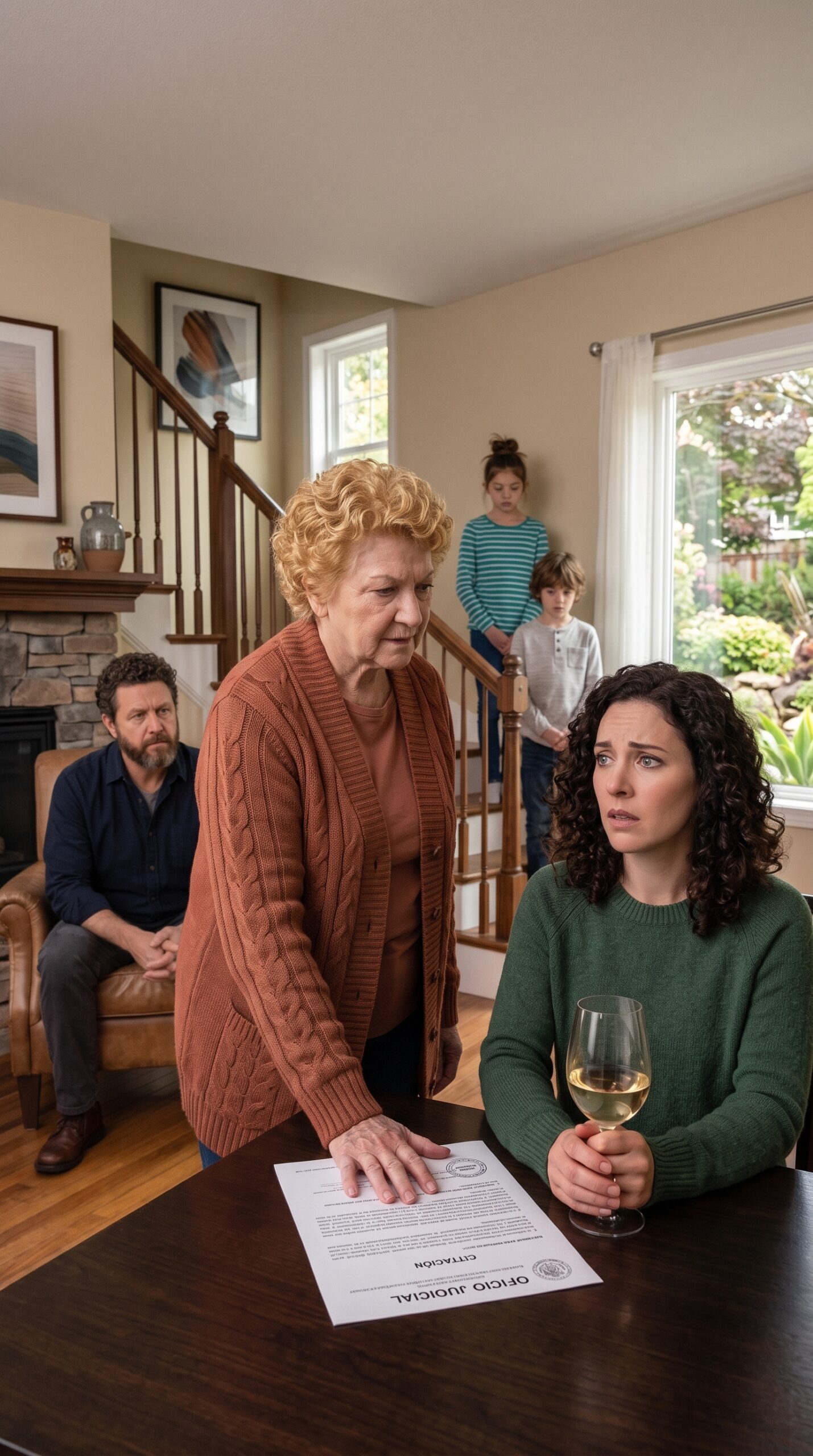
When Pamela lifted her wine glass in the middle of dinner and smiled with that cruel, fleeting satisfaction that only those who believe they’ve already won possess, Doña Mercedes didn’t lower her gaze.
— Thank you for living here all these years without paying a dime, dear mother-in-law. But we’ve bought our own house now. Finally, you can go live alone.
The silence descended upon the dining room like a shattered plate.
Her son, Rodrigo, kept slicing the meat as if the knife could save him from hearing. The children, Emiliano, 10, and Valeria, 7, remained frozen, wide-eyed, sensing that something ugly had just broken, even though no one had shouted yet.
Doña Mercedes didn’t cry.
She didn’t even feel the urge.
She felt something else. Something old, firm, buried beneath twelve years of small humiliations. A force she had learned to sleep while swallowing comments, disdain, and fake smiles for the sake of her grandchildren.
She adjusted the napkin on her lap, lifted her face, and smiled slowly.
A calm smile.
Almost kind.
That disoriented Pamela.
She expected tears. She expected the old woman to beg for forgiveness for existing, to plead for one more week, a tiny corner, a little compassion. But Doña Mercedes merely looked at her with calmness.
— That’s great, Pamela. I’m glad you finally want to live separately. Because I also have some news.
The glass trembled in Pamela's hand.
Rodrigo stopped slicing the meat. Emiliano looked at his grandmother with those restless eyes he had inherited from his grandfather Samuel. Valeria hugged her cup with both hands.
— What news? — Pamela asked, already without a smile.
Doña Mercedes took a deep breath.
She had waited too long to tell the truth. But sometimes the truth doesn’t arrive when one wants it, but when it must drop like a stone onto the table.
— A piece of news that matters more to you than anyone else.
Pamela clenched her jaw.
Minutes earlier, while Doña Mercedes finished the red rice in the kitchen, she had heard her daughter-in-law talking on the phone in the hallway. Pamela thought the extractor and the pot would muffle her voice.
She was wrong.
— We’re finally going to get rid of her — Pamela had said —. Honestly, I can’t stand her anymore. She feels entitled to everything. Tomorrow we see the lawyer. Rodrigo will sign, and if necessary, I’ll make sure the old woman signs too without understanding what she’s signing.
Without understanding.
That’s how she said it.
As if Doña Mercedes were a useless shadow, a silly old lady who was a nuisance in someone else's home.
Pamela didn’t know who she was.
She didn’t know what she had sacrificed.
She didn’t know what promise she had made beside the hospital bed where Samuel, her husband, left her the last warning of his life.
Doña Mercedes placed her hands on the table.
— Your years here haven’t been free, Pamela. But neither have mine. And this house… this house is not yours.
Rodrigo jolted his head up.
— What are you talking about, Mom?
She looked at him with tired tenderness. Her son looked like a defeated man, someone carrying a burden he didn’t even fully understand.
— I’m saying this house was never in your name. Not in your dad's. And certainly not in your wife’s. This house has been registered solely in my name for the past twelve years.
Pamela froze.
But the worst part wasn’t that the house wasn’t hers.
The worst was that Doña Mercedes had heard, word for word, the plan Pamela intended to execute the next day.
PART 2
— That’s a lie — Pamela whispered, although her voice no longer came out sharp, but broken —. You can’t prove anything.
Doña Mercedes didn’t raise her voice.
— Tomorrow you’ll see it with your own eyes. The deed, Samuel’s will, and every receipt of payment are kept safe.
Rodrigo turned pale.
— Dad did that without telling me?
Mercedes looked at him with pain.
— Your dad did that to protect this house. To protect the children. And, although it took me a long time to accept it, I believe he also did it because he saw something coming that I didn’t want to see.
Pamela stood up so quickly that the chair scraped against the floor.
— After everything I’ve done for this family, you want to leave me looking like a thief!
— No, Pamela — Mercedes said, now without softness —. You labeled yourself that when you thought you could trick me into signing papers.
Emiliano lowered his gaze. Valeria began to cry silently. Rodrigo wanted to say something, but couldn’t.
That night, the house in Coyoacán felt colder than ever.
Mercedes locked herself in her room and took out a dark wooden box from the closet. Samuel had given it to her two weeks before he died, when cancer was already gnawing at his body but not his mind.
— Only open it if you feel this family is in danger — he had told her —. Or if someone tries to take away what we built.
For twelve years, she hadn’t opened it.
Not when Rodrigo asked her to move in with him because “it was the most practical.”
Not when Pamela began correcting her in front of the children, saying that the grandmother confused things.
Not when she took away the keys to the gate “for security.”
Not when she started serving her food separately, cold, as if she were an uncomfortable guest.
Mercedes endured for her grandchildren. Because Emiliano would run to his room after school to share his problems with her. Because Valeria couldn’t sleep if her grandmother didn’t sing to her softly.
But that night, for the first time, she opened the box.
Inside were the original deed, the notarized will, property tax receipts, maintenance payments, and a letter written in Samuel’s firm handwriting.
Mercedes read slowly.
Samuel explained that he had transferred full ownership to his wife because he discovered strange movements in Rodrigo’s accounts months before he died. He also wrote that he didn’t trust Pamela, although he could never prove anything.
But there was something more.
An envelope with a yellow memory stick attached to the letter.
Mercedes took it with trembling hands.
The next morning, she prepared coffee and left a thick folder on the table. Rodrigo came down with dark circles under his eyes, without a tie, as if he had aged ten years overnight.
— Everything you need to know is there, son.
Rodrigo didn’t open it in front of her. He took it and left.
Pamela ran after him.
— Don’t be stupid, Rodrigo! Don’t check anything without my lawyer! Your mom is manipulating you.
He didn’t respond.
At noon, a man in a cheap gray suit arrived at the house. He carried a black briefcase and a snake-like smile.
— I’m looking for Mrs. Mercedes Ibarra — he said.
Pamela stepped out first, fixing her hair.
— She’s resting. I’m her daughter-in-law. You can deal with me.
Mercedes appeared behind her.
— I’m not resting. And if you’re here for signatures, you’ve come to the wrong place.
The man swallowed hard.
— Attorney Arturo Meza. I’m here to review some documents related to a family sale.
— Sale? — Mercedes asked.
Pamela turned pale.
The attorney tried to smile.
— Mrs. Pamela informed us that there was an agreement to sell this property and distribute the money among the direct heirs.
Mercedes didn’t blink.
— How curious. Because I’m the only owner. And I haven’t authorized any sale.
At that moment, Rodrigo entered through the door.
He was accompanied by a notary and an attorney with gray hair that Mercedes recognized instantly: Don Esteban Luján, a friend of Samuel’s since youth.
Pamela stepped back as if she’d seen a ghost.
— What’s he doing here?
Rodrigo placed the folder on the table.
— I went to verify everything. Mom is telling the truth.
Pamela laughed nervously.
— Of course, you went with your dad’s friend. So convenient, how arranged.
Don Esteban opened his briefcase.
— No, ma’am. What’s convenient is that Mr. Samuel left certified copies in three different notaries. He also left instructions in case someone attempted to pressure Doña Mercedes.
Attorney Meza tried to leave.
— I think this is a misunderstanding.
— Sit down — Rodrigo said, for the first time with a firm voice —. You’re going to listen, too.
Mercedes looked at her son. In his eyes, there was no longer sleep, but shame.
The notary reviewed the documents in front of everyone. She confirmed the deed. Confirmed the will. Confirmed that the house was the exclusive property of Mercedes Ibarra.
Pamela began to cry, but her tears had no pain. They were filled with rage.
— I just wanted to secure my children’s future!
Mercedes let out a sad laugh.
— Don’t use the children to mask your ambition.
Then Rodrigo took out the memory stick.
Pamela’s eyes widened.
— What is that?
— What my dad left stored — he replied.
They connected the memory to the living room TV. A video appeared, recorded in Samuel’s office, a few months before he died.
The man looked thin, with dark circles, but his voice remained strong.
“Mercedes, if you’re watching this, I’m sorry for not telling you everything sooner. I discovered that Pamela was pressuring Rodrigo to sign loans using family documents. I also found messages where she talked about selling the house when I died. I didn’t have time to confront her as I should have. That’s why I left everything in your name.”
Pamela covered her mouth.
Rodrigo clenched his fists.
The video continued.
“Rodrigo, son, if you’re watching this, open your eyes. Your mother is not a burden. Your mother is the reason you still have a roof, history, and a clean name. Take care of her. Because if you allow someone to humiliate her, it won’t be Pamela who betrays us. It will be you.”
Rodrigo broke down.
He sat on the couch and began to cry like a child, face in his hands.
— Mom… forgive me.
Mercedes didn’t rush to hug him. Not yet. There were apologies that needed to cross shame first.
Pamela screamed that the video was old, that Samuel was sick, that it was all manipulation. But Don Esteban pulled out another folder.
— There’s more.
Inside were copies of emails, printed messages, and transfer receipts. Pamela had been sending money for three years to an account in her brother’s name, using Rodrigo’s savings. She had also paid deposits for a house in Querétaro that was not in the couple’s name.
It was only in Pamela’s name.
Rodrigo slowly lifted his gaze.
— The house that “we bought together” is only in your name?
Pamela didn’t answer.
That silence was worse than any confession.
Emiliano, who had been listening from the stairs, came down with a red face.
— Were we going to leave Grandma here all alone?
Pamela tried to approach.
— My love, you don’t understand.
The boy stepped back.
— Yes, I understand. You said you hated her.
Valeria came down behind him, hugging her doll.
— I don’t want to live in a house where Grandma isn’t.
Pamela crumbled into a chair. But no one rushed to lift her up.
Rodrigo asked Attorney Meza to leave. Don Esteban warned that they could report an attempt of fraud and abuse against an elderly adult. The notary recommended changing locks, updating powers of attorney, and formally recording what had occurred.
Pamela stood up furiously.
— You can’t kick me out! I’m the mother of those children!
Mercedes took a deep breath.
— No one is taking your children from you. But you are leaving my house. Today.
Rodrigo looked at his wife with a hardness he had never had before.
— I also need you to go. The kids are staying with me tonight. Tomorrow we’ll talk to a family lawyer.
Pamela hurled insults, threats, and tears. She said that everyone would regret it. She said Mercedes was a venomous old woman. She said Rodrigo wouldn’t survive without her.
But no one believed her anymore.
That afternoon, Pamela left with two suitcases and her phone pressed to her ear. The gate closed behind her with a sharp snap.
The house fell into silence.
Not a silence shattered like that of dinner.
A different one.
One where, at last, the truth could fit.
Rodrigo approached his mother in the kitchen. She was washing cups, as if the world hadn’t just turned upside down.
— Mom — he said —, I was a coward.
Mercedes turned off the water.
— Yes.
Rodrigo bowed his head.
— I let her disrespect you in your own house.
— Yes.
— And I don’t know how to fix it.
Mercedes looked at him for a long time.
— It doesn’t get fixed with an apology, son. It gets fixed with years of not allowing it again.
He cried silently.
Then Valeria rushed in and hugged her grandmother’s waist. Emiliano stood at the door, serious, as if he had grown too much in twenty-four hours.
— Grandma — the girl asked —, are you leaving too?
Mercedes crouched down with effort and took her face.
— No, my life. This is my house.
Valeria smiled through tears.
— Then we’re all okay.
Mercedes glanced at Rodrigo.
No, they weren’t okay yet.
There were wounds that didn’t close just because the bad person left. There were children who needed to learn to defend their mother before it was too late. There were grandchildren who deserved to see that love shouldn’t endure humiliations to call itself family.
Months later, Pamela tried to fight for the house in court. She lost.
She also lost access to the money she had moved without authorization. Her brother had to return part of the transfers, and Rodrigo started a divorce process that revealed more lies than he wanted to imagine.
Mercedes didn’t celebrate.
Justice doesn’t always taste like victory. Sometimes it tastes like cold coffee and an empty chair at the table.
But one Sunday afternoon, while Emiliano did homework in the dining room and Valeria stuck drawings to the refrigerator, Rodrigo entered with a pot of bougainvilleas.
— For the patio, Mom — he said —. Dad liked them.
Mercedes received it without saying much.
When planting it, they found an old plaque under the soil. Samuel had had it placed years ago, but it had been covered by time.
It read:
“This house is not held up by bricks. It’s held up by those who love without asking for permission.”
Mercedes ran her fingers over the letters.
Rodrigo cried again.
And this time, she did hug him.
Because a mother can forgive, but that doesn’t mean she forgets. And a family that allows a grandmother to be humiliated doesn’t break when she defends herself.
It breaks long before, when everyone keeps silent.





