PART 1
Don Eusebio arrived at the wedding after a six-hour journey, his suit wrinkled, his shoes dusty, and a small wooden box clutched tightly against his chest.
His grandson Rodrigo's wedding was being held in an elegant estate in Tequisquiapan, Querétaro. There were hanging lights, linen-covered tables, expensive wine, white flowers, and waiters moving as if even breathing cost money.
Camila, his youngest granddaughter, was the only one who ran to greet him.
—Grandpa, why didn’t you tell me you were coming alone? —she asked, hugging him.
The old man smiled wearily.
—Because I knew that if I did, someone would tell me not to come.
And he wasn’t wrong.
A few meters away, Patricia, Camila's mother, pressed her lips together as she saw him getting out of the taxi.
—Oh, this can’t be happening —she murmured—. I told you, Ernesto, that man is going to ruin the family photo.
Ernesto, the father, said nothing. He only pretended to adjust his watch.
Rodrigo, the groom, caught sight of him from afar and quickly turned his gaze away. His fiancée, Ximena, daughter of a businessman from Monterrey, didn’t even know who that old man with the cane was.
Camila felt the blow to her chest.
Don Eusebio wasn’t just any guest. He was the man who had raised Rodrigo when Ernesto left for three years to work in the United States. He was the one who sold cows to pay for his high school. He was the one who took Camila to the hospital when her own mother said it was “just a tantrum.”
But that afternoon, he was treated like a nuisance.
A wedding coordinator checked the list and pointed to the back of the patio.
—The gentleman sits over there.
Camila followed the direction of his hand and froze.
Her grandfather's chair was behind some planters, next to the service entrance, close to two trash cans and a cooler where the waiters left empty bottles.
—There must be a mistake —Camila said.
The coordinator lowered his voice.
—It was Mrs. Patricia’s instruction.
Don Eusebio heard. He didn’t protest. He simply walked slowly towards the chair, as if each step weighed more than the last.
Camila confronted her mother.
—Why did you sit Grandpa there?
Patricia smiled shamelessly.
—Because he smells like the ranch, dear. And this wedding isn’t a church bazaar.
—He’s Rodrigo’s grandfather.
—He’s a stubborn old man who doesn’t understand when he’s no longer welcome.
Camila felt her eyes burning.
—Don’t talk about him like that.
Patricia leaned close to her ear.
—Don’t make a scene. Today your brother is marrying into an important family. We’re not going to lose our status because of an old man who looks like he walked out of a bus station.
Camila looked at her grandfather.
He had his gaze lowered, hands crossed over his cane, and the wooden box resting on his lap.
Then the master of ceremonies asked everyone to raise their glasses before the ceremony began.
Camila couldn’t hold it in any longer.
She walked over to one of the speakers, grabbed a wireless microphone resting on a table, and spoke with her voice trembling.
—Excuse me, I just want to ask something. Why is the man who traveled six hours to see his grandson marry sitting next to the trash, while people who aren’t even family occupy the main table?
The patio fell silent.
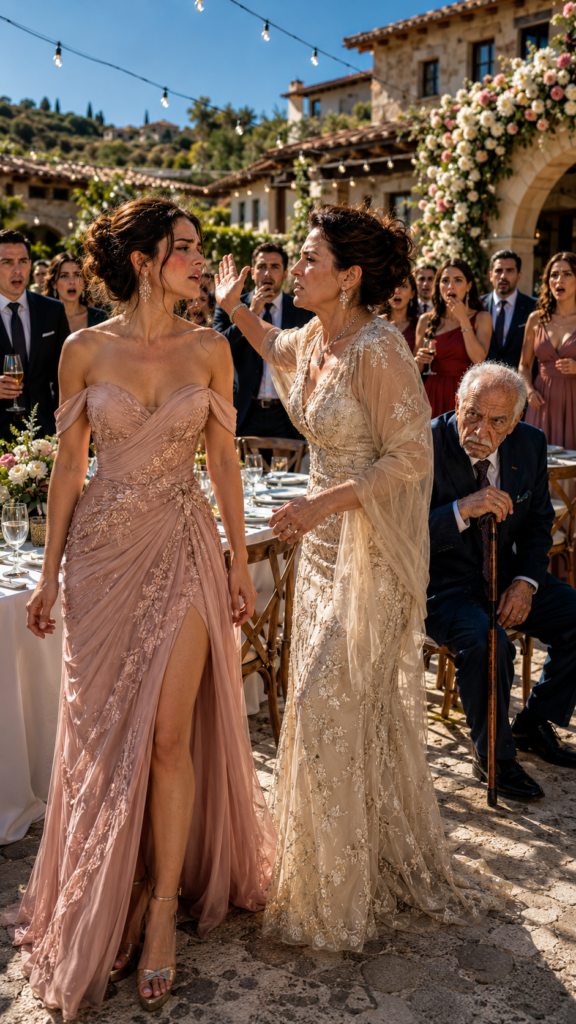
Patricia marched towards her furiously.
—Shut up, you ridiculous girl!
And in front of everyone, she slapped her so hard that the microphone fell to the floor, still on.
—You’ve never known how to behave —Patricia spat—. That’s why no one wants you here.
Camila froze, her cheek red.
Rodrigo didn’t defend her. Ernesto lowered his gaze. Ximena covered her mouth.
Patricia pointed to two guards.
—Get her out of here before she ruins the wedding.
The guards grabbed her by the arms.
But just as they were pushing her toward the gate, the microphone on the ground picked up another phrase from Patricia, clear, brutal, impossible to deny.
—And that old man better not come near the main table, because if he opens his mouth, we’ll lose everything we stole.
PART 2
No one moved.
The echo of that phrase hung in the air between the tables, above the glasses, the flowers, and the elegant guests who no longer knew whether to look at the bride, the groom, or the woman who had just confessed alone.
Patricia turned pale.
The master of ceremonies rushed to pick up the microphone, but it was too late. Everyone had heard.
Camila, still held by the guards, slowly turned to her grandfather.
Don Eusebio didn’t seem surprised.
That was what scared her the most.
The old man stood up with difficulty. He straightened his old suit, took the wooden box, and walked toward the center of the patio.
—Let her go —he said.
The guards hesitated.
—Let her go —he repeated, in a low voice, but so firm that even Rodrigo lowered his glass.
Camila was free.
Patricia tried to laugh it off, as if it were all a misunderstanding.
—Oh, Dad, don’t start with your dramas. You’re confused. You know how things slip your mind lately.
Don Eusebio looked at her with a sadness that hurt.
—Confused was when I thought my family had shame.
A murmur spread across the patio.
Rodrigo stepped forward.
—Grandpa, please. It’s my wedding.
—No, boy —Don Eusebio replied—. Today was supposed to be your wedding. But you all decided to turn it into a trial.
Patricia clenched her teeth.
—Ernesto, do something.
Ernesto didn’t move.
Then, from the entrance of the estate, three black SUVs appeared. They parked by the stone arch and two lawyers, a notary, and a woman in a gray suit with a large folder got out.
Camila didn’t understand anything.
Don Eusebio gestured to her.
—Come here, dear. They’re not going to throw you out of your own house anymore.
The phrase fell like a stone.
Rodrigo let out a nervous laugh.
—Your own house? What are you talking about?
The notary opened the folder and walked to the main table.
—Hacienda San Jacinto has been legally registered in the name of Camila Rivas Mendoza for the past four years.
Ximena slowly removed her veil from her face.
—Rodrigo… what does that mean?
Rodrigo didn’t answer.
Patricia did.
—That’s false! This estate belongs to the family.
Don Eusebio raised the wooden box.
—It belonged to my Carmen. And before she died, she made me promise that I would never leave it in the hands of people who confused inheritance with spoils.
He opened the box.
Inside was an old key, a handkerchief embroidered with the letter C, and an old photo of a smiling woman standing in front of the first grape rows.
—Your grandmother Carmen planted this land when no one would give a peso for it —Don Eusebio said, looking at Camila—. You were the only one who came to help me after school. You watered the roses. You listened to her stories. You never asked how much this was worth. You asked how to take care of it.
Camila felt her knees buckle.
For years, they made her believe her grandfather had forgotten her. That he didn’t call because he was sick. That he didn’t answer letters because he didn’t want trouble. That the estate was Rodrigo’s business because “he was a man” and would know how to handle finances.
It was all a lie.
The lawyer in the gray suit spoke up.
—Four years ago, Don Eusebio signed a legal assignment in favor of Camila. After that, an attempt was made to present a false medical report to declare him mentally incapable and annul the transaction.
Ximena’s mother’s eyes widened.
—Did they forge documents?
Patricia lost her composure.
—We did it to protect the estate!
—No —Don Eusebio replied—. You did it to sell it.
Another heavy silence fell over the wedding.
The notary pulled out several sheets.
—There are also proofs of negotiations with a hotel group from Cancún to turn part of the estate into a tourist complex. The sale required hiding the real ownership and sidelining Camila from any decision-making.
Rodrigo turned red.
—I worked here all these years. I found investors. I modernized this place.
Camila looked at him, her cheek still marked.
—Is modernizing erasing Grandma Carmen’s name from the labels?
Rodrigo clenched his jaw.
She continued, now without fear.
—Is modernizing firing Don Toño because he knew too much? Is it changing the locks so Grandpa couldn’t enter the storage room? Is it telling the staff I was a freeloader coming to ask for money?
Some employees, standing near the kitchen, lowered their gazes. Not out of guilt. Out of the shame of having stayed silent.
Ximena turned to Rodrigo.
—Tell me you didn’t know the estate belonged to your sister.
Rodrigo swallowed hard.
—It’s not that simple.
She took off the ring.
—For me, it is.
She placed it on the main table with a small but definitive sound.
Patricia rushed toward her.
—Ximena, please. Don’t destroy a family alliance over ranch gossip.
Ximena’s father stood up.
—Madam, my daughter is not an alliance. And my family doesn’t do business with thieves.
The guests began to murmur louder. Some filmed with their phones. Others were already packing their bags. The perfect wedding was unraveling among untouched glasses and expensive centerpieces.
But the worst was yet to come.
Don Eusebio looked at the sound technician.
—Play the file.
The man hesitated.
—Sir…
—Play it.
On the screen where a romantic video of Rodrigo and Ximena was supposed to play, a nighttime recording of the storage room appeared.
The date marked three months earlier.
Rodrigo was seen entering with a black cap. Behind him was Ernesto, his own father, carrying a canister.
Camila felt a chill run down her spine.
In the video, Rodrigo opened one of the reserve wine tanks, the last batch Carmen had supervised before her death. Ernesto looked toward the door and then said something that the audio captured perfectly:
—Pour it quickly. If the batch is lost, we’ll collect the insurance and justify the sale.
Patricia covered her face with her hands.
Rodrigo shouted:
—That’s edited!
But no one believed him.
The recording continued.
Ernesto emptied the liquid. Rodrigo closed the tank. Then Patricia appeared in the doorway of the storage room, elegant even to commit a betrayal.
—Make it look like a staff oversight —she said—. And if the old man asks, tell him Camila authorized the production review.
Camila felt as if the air had stopped.
They didn’t just want to steal the estate.
They wanted to use her name to destroy her grandmother’s last work.
Don Eusebio closed his eyes.
When he opened them again, he no longer looked like a tired old man. He looked like an old tree that had been tried to be burned but still stood.
—The evidence is already with the prosecutor’s office —the lawyer said—. There is a lawsuit for fraud, forgery, property damage, and sabotage. There’s also a request to freeze the accounts related to the estate.
Patricia looked at Camila with hatred.
—Are you happy? You just destroyed us.
Camila took a deep breath.
For the first time, she didn’t seek permission to speak.
—No, Mom. You destroyed yourselves when you thought a humble grandfather was easy to trample.
Ernesto took a step toward her.
—Camila, daughter, understand…
She raised her hand.
—Don’t call me daughter right now. A daughter doesn’t hide in pictures. A daughter isn’t thrown out of a wedding for defending her grandfather. A daughter isn’t used as a scapegoat to cover up a fraud.
Ernesto lowered his gaze.
—I just wanted to avoid problems.
—No, Dad. You wanted to avoid taking a stand.
The phrase hurt more than a scream.
Rodrigo, already without a bride, without a party, and without a mask, threw the glass to the ground.
—You won’t be able to handle this. You don’t know business. You’ve always been the sensitive one, the crybaby, the one who hid with Grandpa in the fields.
Camila looked at him with a newfound calm.
—Maybe I don’t know how to sell my soul for money. I’ll give you that.
Some guests murmured. Others smiled slightly, as if they knew they had just heard a truth that wouldn’t be forgotten.
Patricia tried to approach Camila, but Don Eusebio struck the floor with his cane.
—One more step and you’ll be escorted out.
The woman stopped.
It was the first time Camila saw her mother obey.
The wedding ended without a ceremony, without dancing, and without cake. Ximena left with her parents. Rodrigo slipped out a side door. Patricia and Ernesto were surrounded by lawyers. The guests abandoned the estate with the same speed they had previously boasted of being there.
When the patio was almost empty, Camila walked to the plastic chair where they had seated her grandfather.
He was still next to the trash cans.
He looked at her for a while and then lifted it to the main table.
Don Eusebio watched from afar.
—What are you doing, dear?
Camila placed the chair in the spot where Rodrigo had been before.
—Putting things where they should have been from the beginning.
The old man smiled, but his eyes filled with tears.
That night they didn’t sleep. Camila and Don Eusebio walked around the estate while the workers cleaned up the remnants of the party. There were stepped-on flowers, napkins on the ground, and half-filled glasses, as if luxury could also provoke secondhand embarrassment.
In the storage room, Don Toño, the old manager who had been fired months earlier, appeared with a folder.
—Doña Carmen asked me to keep this —he said—. She told me to give it to Camila when she stopped asking for permission to return.
Camila opened the folder with trembling hands.
There was a letter written by her grandmother.
“Camila: if you’re reading this, maybe you’ve understood by now that there are families that love while you obey and attack when you stop bowing your head. This land doesn’t need the most ambitious. It needs someone who looks at it with respect. Your grandfather and I always knew it was you.”
Camila cried in silence.
She didn’t cry like a rejected child. She cried like a woman who finally understood that she was never crazy, never out of place, and never less.
The following weeks were hard.
Rodrigo was investigated. Patricia lost access to all the estate’s accounts. Ernesto tried to call 17 times, but Camila didn’t answer. Not because she hated him, but because she no longer wanted apologies born of fear.
The estate changed.
Old workers returned. The label with Carmen’s name was restored. The sale to the hotel group was canceled. Camila opened a community table on Sundays for employees, neighbors, and visitors, where no one was seated next to the trash because of their clothes, accent, or shoes.
A month later, Don Eusebio arrived at the patio with his cane and his clean hat.
The workers stood up without anyone asking them to.
Camila seated him at the main table.
He raised a glass of wine rescued from the batch they hadn’t contaminated.
—I toast for Carmen —he said—. And for Camila, who didn’t inherit a estate to feel superior to anyone, but to remind everyone that dignity is also cultivated.
Everyone applauded.
In the back, by the gate, Patricia appeared.
She came without jewelry, without a false smile, without that air of an untouchable lady. Ernesto was behind her. Rodrigo didn’t come.
Patricia approached slowly.
—Camila —she said—. I’m not going to ask you to forget. I have no right. I just came to tell you that your grandmother was right. You do know how to take care of what we only wanted to possess.
Camila listened without moving.
For years she had waited for those words. But when they came, she no longer needed them to breathe.
—Thank you for saying that —she replied—. But I’m still not ready to open the door for you.
Patricia lowered her head.
—I understand.
And for the first time, she didn’t argue.
When she left, Camila didn’t feel victory. She felt peace.
Later, she placed a plaque under the oldest mesquite tree of the estate.
It read:
“For Carmen and Eusebio. For those who were treated as a nuisance yet continued to sow love.”
Camila touched the plaque and looked at the lights glowing in the patio.
The plastic chair was still at the main table.
Not as mockery.
As memory.
Because that day the family lost a wedding, a business, and a carefully crafted lie.
But Don Eusebio regained his name.
Camila regained her place.
And everyone understood something that in Mexico many prefer to remain silent about: sometimes the humblest at the party is the one who holds the whole house together, and sometimes the real trash isn’t by the kitchen, but sitting at the main table.





