PART 1
Four days before the wedding, Don Ernesto Villaseñor stepped into a tailor shop in the Historic Center of Mexico City to try on the suit he would wear to give his only daughter away at the altar.
He left with cold hands, a heart shattered into pieces, and a horrible certainty: the man Sofía loved didn’t want to marry her.
He wanted to bury her.
Don Ernesto was 68 and had spent half his life as a civil engineer. He could detect a crack in a wall before the concrete gave way. But in his own home, he hadn’t seen the most dangerous crack: Alejandro Moncada, his daughter’s perfect fiancé.
Alejandro was elegant, polite, one of those men who greeted everyone formally and paid the bill before the waiter arrived. He claimed to come from a family of businessmen from Monterrey, drove a German SUV, and talked about investments as if money were overflowing.
Sofía, 31, owned a small art restoration studio in Coyoacán. Since her mother passed six years ago, she and Ernesto had become inseparable. So when Sofía told him that Alejandro made her feel safe, Ernesto swallowed his doubts.
A father sometimes stays silent so as not to seem controlling.
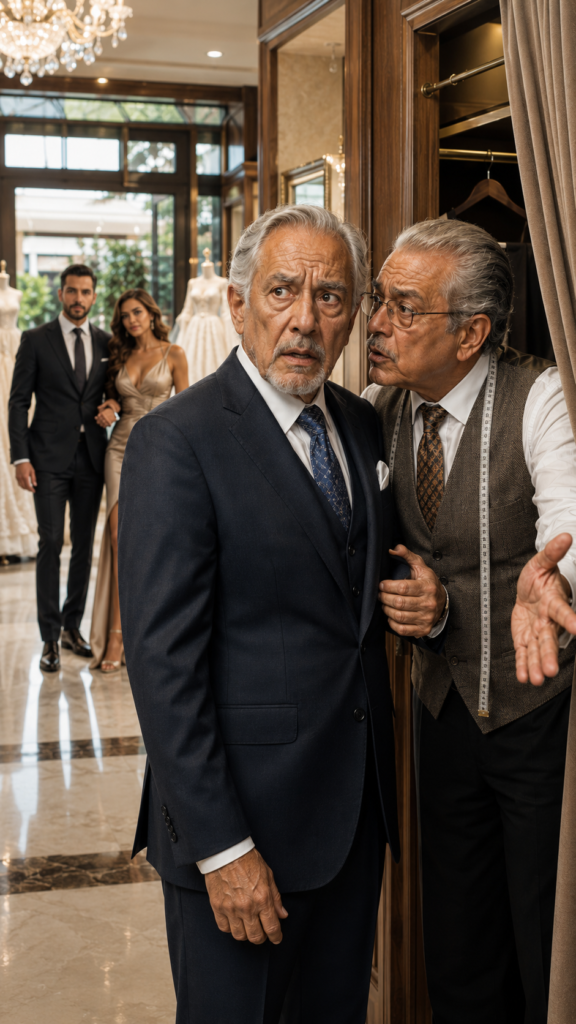
That Tuesday, he entered Don Julián Arriaga’s tailor shop, an old friend who had made suits for him for 25 years. But as soon as the bell on the door jingled, Julián paled.
“Ernesto, hide in the fitting room,” he whispered.
“What are you saying, Julián?”
The tailor closed the main door, partially lowered the curtain, and pushed him to the back, behind a wooden wall.
“Don’t make a sound. For God’s sake, don’t come out.”
Ernesto wanted to protest, but at that moment the bell jingled again.
In walked Alejandro and Claudia, the supposed older sister who had come “from Monterrey” to help with the wedding. They sat right across from the fitting room.
“The old man is going to sign at the rehearsal dinner,” Alejandro said, in a cold voice Ernesto had never heard before. “He thinks it’s a trust to protect Sofía.”
Claudia let out a giggle.
“And the medical letter?”
“It’s among the papers. Nobody reads that stuff, especially not a sentimental old man.”
Ernesto stopped breathing.
“When Sofía collapses in the Nevado de Toluca,” Alejandro continued, “I’ll be the devastated husband. You cry with me. The insurance of 150 million pesos will be released. And the old man’s properties will fall under the trust’s control.”
Claudia asked, “And what if she doesn’t die quickly?”
Alejandro replied without hesitation, “That’s what the drops I’m putting in her tea are for.”
Ernesto felt the floor drop out from beneath him.
He wasn’t overhearing a suspicion.
He was listening to a sentence.
And when Alejandro said the honeymoon was no longer a trip, but “the perfect ending,” Ernesto understood that the worst wasn’t what he had just discovered, but what was about to happen.
PART 2
When Alejandro and Claudia left the tailor shop, Don Julián opened the fitting room with trembling hands. Ernesto was pale, his eyes fixed on nothing, as if he had aged ten years in ten minutes.
“Forgive me, brother,” Julián murmured. “I heard them last week, but I thought I misunderstood. They came back today for a black suit Alejandro had altered.”
“A black suit?”
Julián looked down.
“He said he wanted it ready for ‘an elegant funeral.’”
Ernesto said nothing. He just took his phone and walked out onto Tacuba Street with the unfinished suit. Outside, the city continued as if nothing was wrong: corn vendors, tourists taking pictures, honking horns, sellers shouting deals.
But to him, everything felt distant.
His first impulse was to run to Sofía’s apartment, hug her, and get her out of there. And that’s what he did. It was his first mistake.
Sofía lived in Del Valle, in a bright apartment filled with paintings, plants, and boxes with wedding memorabilia. When she opened the door, she was holding several drafts of invitations.
“Dad, what a surprise. Alejandro is here.”
Alejandro appeared from the kitchen, impeccable, smiling as if he were the son-in-law of the year.
“Don Ernesto, we were just talking about you.”
Ernesto didn’t sit down.
“I know what you’re planning,” he said, looking at Alejandro. “The trust, the medical letter, the insurance, the trip to the Nevado. I also know about the drops.”
Sofía froze.
“What?”
Alejandro sighed with rehearsed patience.
“Sweetheart, your dad is just nervous about the wedding. It’s normal.”
“Don’t talk to me like that,” Ernesto said. “I heard you.”
Alejandro pulled a folder from the dining table. It had copies, law firm logos, banking terms, and papers that looked too official to be fake.
“Don Ernesto, the trust was your own tax lawyer’s idea,” he said. “The insurance is part of an estate strategy. And the medical letter is just a precaution. Honestly, this is starting to sound like a very serious accusation.”
Sofía looked at her father, pained.
“Dad, ever since Mom died, you’ve been afraid of being alone. But you can’t ruin my life because you can’t let me go.”
Those words hurt more than any blow.
Ernesto wanted to explain, but Sofía was already crying. Alejandro hugged her with false tenderness, and over her shoulder, he gave Ernesto a minimal smile.
A dirty smile.
A victorious smile.
Ernesto then understood that if he shouted, he would lose. If he attacked, Sofía would defend the monster. He had to do what he had always done with damaged buildings: inspect structure by structure until he found the flaw that no one could deny.
The next day, he called his daughter.
He apologized.
He told her that perhaps the pain from her mother had made him distrustful. Sofía hesitated, but she loved him. She agreed to have breakfast with him and Alejandro at a restaurant in Polanco to “make amends.”
Ernesto arrived calm. He greeted Alejandro. He kissed Sofía on the forehead. He ordered coffee de olla, even though they served it as if it were liquid gold in that expensive place.
And he observed.
Alejandro bragged about a family estate in San Pedro Garza García, but couldn’t name a single nearby street. He said he studied in Madrid but mispronounced the university’s name. He talked about Spanish wines but ordered a “reposado blanco” tequila.
First crack.
Then Ernesto noticed that Claudia, sitting next to Alejandro, had a clear mark on her finger where a ring would normally go. When she raised her glass, she brushed Alejandro’s wrist with too much intimacy.
No sister touches her brother like that.
Second crack.
Then he saw Sofía. His daughter, once full of energy, was slow. She blinked a lot. She struggled to hold the cup. Alejandro answered for her even when no one asked him.
“She’s exhausted from the preparations,” he said.
Ernesto smiled.
But inside, something was breaking.
That same afternoon, he sought Natalia Ríos, a former financial investigation agent he had helped years earlier when his building was damaged by an earthquake. Natalia didn’t ask much. She just listened to the story, reviewed a photo of Alejandro, and said:
“That guy doesn’t smell like a businessman. He smells like an old file.”
In 36 hours, Natalia found the first bombshell.
Alejandro Moncada didn’t exist.
His real name was Adrián Treviño Lugo. He had been arrested nine years earlier for defrauding a widow in Guadalajara but was released due to lack of evidence. Claudia wasn’t his sister either. She was his legal wife for the past seven years.
The second bombshell was worse.
In Veracruz, a woman named Renata died during a boat trip shortly after marrying a man who used another name. The widower collected a million-dollar insurance payout and vanished.
In a blurry photo from the news, Ernesto recognized the same jawline, the same gaze, and the same smile as Alejandro.
He was no longer a con artist.
He was a predator.
Natalia managed to legally review the movements of the company Alejandro claimed to own. There were no offices, no employees, no clients. Just shell accounts, small deposits, and a recent transfer from a private pharmacy in Satélite.
With that lead, Ernesto spoke to a family friend doctor. He asked her, without alarming Sofía, to convince her to undergo tests “because of the wedding stress.”
Sofía accepted, annoyed.
The results arrived that night.
Her blood showed traces of a mild sedative, administered constantly, enough to weaken her and make her seem anxious or ill. At altitude, mixed with cold and physical exertion, it could trigger a serious crisis.
Ernesto locked himself in the bathroom and cried silently.
Then he washed his face.
Because the hardest part was still ahead.
Saving her without her feeling humiliated in front of everyone.
Natalia suggested going directly to the Prosecutor's Office. Ernesto’s lawyer, Licenciado Barragán, crafted the strategy. It wasn’t enough to accuse. They needed a confession, a forged signature, proof of identity, and the link to Claudia.
The opportunity would be the rehearsal dinner.
Alejandro expected Ernesto to sign the trust and the medical letter there. Barragán prepared a folder identical to the one Alejandro wanted, but with a trap clause: by signing as “Alejandro Moncada,” any document would be tied to a nonexistent identity and open the door to arrest him for forgery, attempted fraud, and attempted homicide.
The Prosecutor's Office agreed to send undercover agents. They would enter as waiters, valet parking, and sound technicians.
But everything depended on one thing.
Alejandro had to sign.
On the night of the rehearsal dinner, the club hall in Las Lomas was filled with white flowers, candles, and soft music. The guests talked about the wedding as if it were the event of the year. Sofía wore a simple ivory dress. She looked beautiful but tired.
Ernesto wanted to take her hand and tell her the whole truth.
But he waited.
During the toast, he raised his glass. His voice broke as he mentioned his deceased wife.
“Elena always said that a house is not built to confine anyone, but to protect those you love,” he said. “Today I only wish for Sofía to live in a place where she never has to ask for permission to be happy.”
Sofía looked at him with tear-filled eyes.
Alejandro applauded first, exaggerated, theatrical.
“What beautiful words, Don Ernesto.”
Then Barragán placed the documents on the main table.
“Only the signature of Mr. Moncada is missing.”
Alejandro smiled. Claudia tightened her grip on her glass.
Ernesto felt his heart almost leap out of his chest.
Alejandro took the pen.
He signed.
For two seconds, nothing happened.
Then the lights in the hall changed. The music stopped. The waiters set down their trays. The sound technician removed his fake earpiece and pulled out a badge.
“Adrián Treviño Lugo,” said an agent, “you are under arrest for identity forgery, fraud, criminal association, and attempted homicide.”
The hall erupted into chaos.
Claudia tried to exit through the side door, but two agents intercepted her.
Sofía stood up, confused.
“Adrián? What’s happening?”
Alejandro attempted to approach her.
“Sweetheart, this is your dad’s setup.”
The screen in the hall lit up.
The marriage certificate of Adrián and Claudia appeared. Then the police record. Next, the toxicology report of Sofía. Finally, a photograph of Renata, the woman who died in Veracruz.
Sofía covered her mouth.
At first, she didn’t cry.
She just looked at Alejandro as if the face she loved was peeling away before her eyes.
“Tell me it’s a lie,” she whispered.
Alejandro opened his mouth, but he didn’t have time.
Claudia screamed from the entrance:
“Shut up, Adrián! The girl wasn’t even going to suffer!”
That scream split the hall in two.
It was the confession no one expected.
Sofía recoiled as if she had been pushed. Ernesto ran toward her but didn’t touch her until she flung herself into his arms.
“Dad…” she murmured. “Forgive me.”
Ernesto hugged her tightly.
“No, my girl. You did nothing wrong. You fell in love. The bad one was the one who used that to destroy you.”
Adrián tried to speak again.
“Sofía, I did love you.”
She lifted her gaze, pale but firm.
“Don’t ever call me love again.”
That was the true end of the wedding.
Not when they handcuffed him.
Not when Claudia was dragged out screaming.
But when Sofía stopped defending the man who was slowly killing her.
Adrián was taken out of the club amid cellphone cameras, whispers, and horrified faces. The next day, the case exploded on social media. Some relatives criticized Ernesto for “making a spectacle.” Others said he had saved his daughter as only a desperate father could.
Sofía spent three weeks in medical treatment. She cried a lot. She blamed herself for not seeing the signs. She got angry with her father, then with herself, then with the world.
Ernesto was there every day, without pushing her, bringing her coffee, sweet bread, and the brushes she used to restore old paintings.
One afternoon, Sofía asked him, “How did I not realize?”
Ernesto took a deep breath.
“Because intelligent monsters don’t arrive with claws, daughter. They arrive with flowers, promises, and a pretty smile.”
Months later, Sofía reopened her studio in Coyoacán. Her first exhibition was called “Cracks.” On the main wall, she hung a huge painting: a white house with a fissure in the middle, held up by two hands, one young and one old.
Below, she wrote:
“My dad didn’t ruin my wedding. He saved my life.”
That night, among friends, neighbors, and journalists, Sofía walked toward Ernesto. She no longer wore a wedding dress. She wore a light suit, her hair down, and a different look: stronger, more awake, more her own.
“Mom would be proud of you,” she said.
Ernesto shook his head, trying not to cry.
“She’d be proud of both of us.”
Because sometimes a family doesn’t break by canceling a wedding.
Sometimes it’s saved just when someone dares to stop it.
And although many still debate whether Ernesto should have exposed everything in front of the guests or done it in silence, Sofía always responds the same:
“True love doesn’t always arrive at the altar. Sometimes it arrives just in time to stop you from being buried.”





