PART 1
When it was announced that Dr. Valeria Mendoza would receive the merit medal at the Palacio de Medicina of UNAM, her biological parents appeared as if they had never abandoned her.
Ramiro Ortega arrived in a new suit, shiny shoes, and a rehearsed smile for everyone to see.
Beside him, Patricia held a huge bouquet of white roses, greeting strangers as if she were the proudest mother in Mexico.
No one there knew that, 15 years ago, that same woman had left Valeria alone in a hospital bed, at 13 years old, shaved from chemotherapy and trembling with fear.
The ceremony was packed.
Families with cameras, grandparents crying, children holding balloons, students embracing in their white coats.
And in the VIP section, right in the second row, Ramiro and Patricia occupied two seats they had demanded over the phone for an entire week.
“We’re her parents,” Ramiro had told the coordinators. “We deserve to be in the front. Our daughter is the best of her generation.”
He said it with such confidence that the secretary almost believed him.
Almost.
Behind the stage, Valeria watched them through a crack in the curtains.
She didn't cry.
She didn't tremble.
She just squeezed an old blue folder filled with documents, yellowed pages, certified copies, and a photo that hadn’t been seen in years.
Next to her was Elena Mendoza, the nurse who had cared for her when everyone else had given up.
Elena's hair was already flecked with gray, her hands weary from countless shifts at the hospital, and her eyes glistened with pride.
“Are you sure, honey?” she asked softly.
Valeria looked toward the VIP section.
Ramiro laughed with an important doctor. Patricia adjusted the bouquet to look nice in the photos.
“Yes, Mom,” Valeria responded. “Today they’re not going to steal my story.”
Before she was called Valeria Mendoza, she was Valeria Ortega.
At 13, she lived in Toluca, in a lovely house with an electric gate, a spotless living room, and an older sister named Renata, the perfect child of the family.
Renata had English lessons, a quinceañera dress picked out, school trips paid for, and a room decorated like a magazine.
Valeria, on the other hand, was the quiet daughter.
The one who didn’t ask for much.
The one who settled for used books, hand-me-down sneakers, and phrases like “not right now, Valeria, there are more important expenses.”
The day she was diagnosed with leukemia, Ramiro didn’t ask if she would survive.
He asked how much it would cost.
Patricia sat still, staring at the floor.
The oncologist explained treatments, probabilities, timelines, risks, and available support.
Valeria listened from the bed, wearing an oversized gown and cold feet.
She thought her parents would come close to hug her.
But Ramiro pulled out a calculator from his phone.
“Doctor, speak clearly,” he said. “How much is this going to cost us?”
The doctor fell silent for a few seconds.
“We’re talking about a long process. But there are programs, foundations, options…”
“Options that cost money too,” Ramiro interrupted. “And we have another daughter.”
Valeria felt something break inside her.
Patricia finally spoke.
“Renata already has her future planned. We can’t mortgage the house for something that might not work.”
The doctor looked at them as if he didn’t understand.
“You’re talking about a 13-year-old girl.”
Ramiro crossed his arms.
“We’re talking about reality.”
Three days later, they signed documents.
They renounced their temporary custody, said they couldn’t take care of her, and left with a bag of clothes they didn’t even leave complete.
There was no hug.
No kiss on the forehead.
No promise to return.
Valeria just watched as Patricia closed the door and saw Ramiro say in the hallway:
“Let’s go. If we stay, she’ll manipulate us.”
That night, Valeria vomited from the treatment and cried silently so as not to disturb the nurses.
Then Elena Mendoza appeared.
Elena wasn’t family.
She had no obligation.
But she sat next to the bed, wiped Valeria’s forehead, and said:
“My girl, you are not an expense. You are a life.”
As the months went by, Elena became everything.
She brought her broths, got her books, celebrated her 14th birthday with a small chocolate cake, and promised that no one would ever make her feel disposable again.
When Valeria’s parents never returned, Elena started the legal process.
She worked double shifts.
Sold her car.
Took out loans.
And finally adopted that skinny girl who no longer expected anything from anyone.
Valeria took her surname with pride.
Mendoza.
The last name of the woman who stayed.
Years passed.
The illness receded.
The girl survived.
Then she studied with a discipline that was frightening.
High school with a scholarship.
Medicine at UNAM.
Endless shifts.
Late nights, OXXO coffee, practices, exams, tears in hospital bathrooms, and a silent promise every time she saw a child with cancer:
“No patient should feel abandoned.”
At 28, Valeria graduated as the best of her generation and was chosen to deliver the main speech.
The news went viral on university networks.
“Young cancer survivor to be recognized as future pediatric oncologist.”
Two days later, Ramiro and Patricia called.
They didn’t call to apologize.
They didn’t ask how she had been.
They didn’t mention the 15 birthdays they had ignored.
They only demanded VIP seats.
Valeria authorized everything.
But she also asked for 5 extra minutes at the microphone.
And when the master of ceremonies announced her name, Ramiro stood up first, applauding like an exemplary father.
Patricia lifted the bouquet.
Cameras focused on her smile.
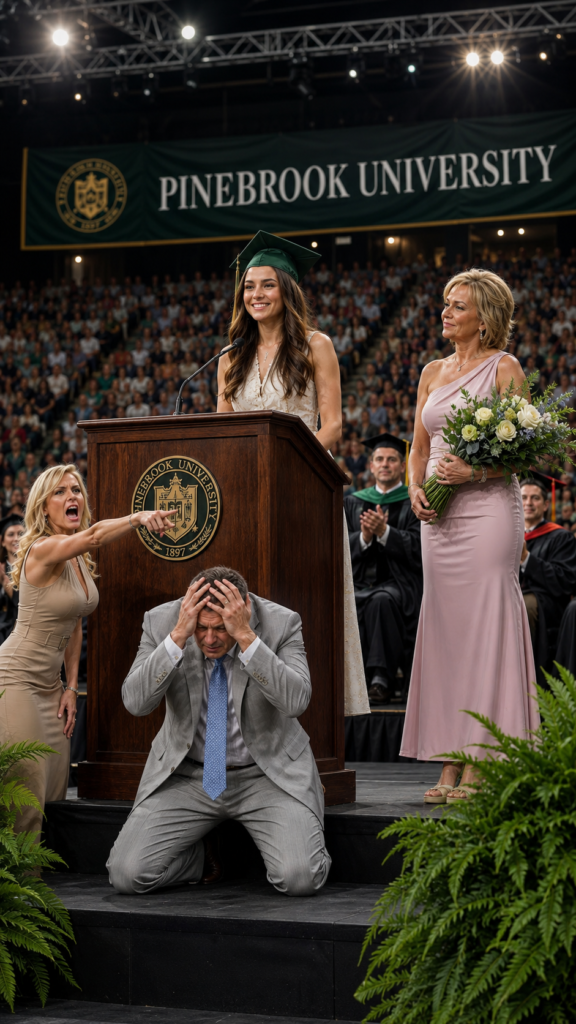
Then Valeria stepped onto the stage, opened the blue folder, and said before the entire audience:
“Before I thank for my medal, I need to present the people who tried to erase my life.”
PART 2
The auditorium fell completely silent.
Applause died abruptly.
Ramiro slowly lowered his hands.
Patricia stopped smiling, but kept the bouquet pressed against her chest, as if she could still pretend everything was under control.
Valeria took a deep breath in front of the microphone.
Her voice wasn’t shaky.
It was calm, dangerous, the kind that doesn’t need to shout to tear off anyone’s mask.
“Fifteen years ago,” she said, “a 13-year-old girl was diagnosed with leukemia. That girl was scared, sick, and needed her family.”
A picture appeared on the screen behind her.
Young Valeria, in a hospital bed, wearing a mask, wide eyes, and her head covered with a knitted hat.
Several people in the audience let out a sigh.
Elena, sitting in the front row, covered her mouth with one hand.
Ramiro turned red.
“That girl was Valeria Ortega,” she continued. “But today she graduates as Valeria Mendoza, because blood is not always family, and because a modestly paid nurse did what two parents with a house, a car, and businesses didn’t want to do.”
Patricia stood up from her seat.
“This is disrespectful!” she shouted.
Some turned to look at her.
Ramiro pulled her by the arm.
“Sit down, Patricia.”
But Valeria didn’t stop.
She opened the blue folder and pulled out a certified copy.
“This document was signed by Ramiro Ortega and Patricia Salgado when they renounced my custody. Here they declared that they couldn’t take care of my treatments because they represented an excessive economic burden.”
The scanned phrase appeared on the screen.
“Excessive economic burden.”
Murmurs spread throughout the venue like wildfire.
A woman said:
“What a disgrace.”
A student murmured:
“Really, how disgusting.”
Ramiro stood up, furious.
“That’s out of context!”
Valeria barely turned her head toward him.
“You will have a chance to speak to the media outside, Mr. Ortega. Not here.”
The use of “Mr. Ortega” landed like a slap.
Not “Dad.”
Never again.
Patricia started to cry, but they weren’t tears of pain.
They were tears of public shame.
“Valeria, honey, please… don’t do this.”
Elena closed her eyes upon hearing that word.
Daughter.
After 15 years of silence, Patricia used it just when there were cameras.
Valeria returned to the microphone.
“I also want to clarify something. They didn’t come today because they missed me. They didn’t come because they regretted it. They came because my name appeared in university newspapers and because it suited them to say they raised a successful doctor.”
Ramiro clenched his fists.
“Lies!”
Then Valeria pulled out another paper.
“Four days ago, I received this message from my biological sister, Renata Ortega.”
A conversation appeared on the screen.
Renata: “My parents want to go to your graduation. They urgently need to make a good impression because my dad’s partner will be there. Don’t cause drama, okay? A lot of time has passed.”
Another message.
Renata: “Besides, my son is sick. You’re an oncologist; you can help us. We’re family even if it burns you.”
The auditorium erupted in murmurs.
There was the twist that Ramiro and Patricia wanted to hide.
Not only were they looking for a picture.
They were looking for access.
Renata, the daughter for whom they had sacrificed everything, had a 6-year-old son with a suspected blood cancer diagnosis.
And suddenly, the abandoned daughter served them.
Suddenly, Valeria was no longer too expensive.
Suddenly, she was useful.
Patricia covered her face with her hands.
Ramiro looked around, desperate, calculating the damage.
“Valeria,” he said with a strained voice, “there’s a sick child. Your nephew. You can’t be so cruel.”
The auditorium became tenser.
Because there was the moral trap.
The same family that abandoned a sick girl was now asking her for compassion for another sick child.
Valeria swallowed hard.
For the first time, her gaze broke a little.
“No child deserves to pay for the cowardice of adults,” she said. “That child will receive medical guidance. I’ve already contacted a foundation and two specialists. If he needs care, he will be helped through the correct channels.”
Patricia lifted her face, confused.
Ramiro blinked.
Valeria held the microphone tighter.
“But that doesn’t mean you have the right to call me daughter when it suits you. It doesn’t mean you can sit here, smile for the cameras, and rewrite a story where you were the heroes.”
Silence returned.
Heavier.
Deeper.
“I’m not here to take revenge on a child,” she continued. “I’m here to prevent two adults from using their illness as a ticket into my life.”
Elena began to cry.
Not from sadness.
From relief.
Because for years she had seen Valeria wake from nightmares asking why it hadn’t been worth it.
And now, in front of everyone, that girl was answering herself:
Yes, it was worth it.
It had always been worth it.
Valeria took the last sheet from the folder.
“There’s also something I never said publicly. My treatment was not impossible to pay. The hospital offered support. Several foundations accepted to cover part of the process. But my biological parents rejected the interviews because they involved showing statements and justifying expenses.”
Ramiro turned pale.
Valeria looked directly at him.
“That same year, they paid for a quinceañera party of over 300,000 pesos for Renata.”
The screen showed photos obtained from old social media.
Renata in a huge dress.
Mariachi band.
Elegant hall.
Candy table.
Ramiro dancing with a smile.
Patricia toasting.
The date was there.
Three months after abandoning Valeria.
The audience reacted with open indignation.
Someone shouted:
“What a disgrace!”
Another said:
“That’s not how you treat even a stranger.”
Patricia shook her head, crying harder.
“It wasn’t like that… we suffered a lot.”
Valeria looked at her without hatred.
That was what hurt the most.
There was no uncontrolled resentment.
There was a firm peace, earned through blows.
“No, Mrs. Salgado. The one who suffered was me. You went off picking centerpieces while I learned to vomit without crying.”
Patricia collapsed into her seat.
Ramiro tried to leave, but two reporters had already stood up near the door.
The ceremony had become something larger than a graduation.
It was a public trial without a judge, but with a truth that was impossible to hide.
The rector approached the side microphone, worried.
Valeria raised her hand respectfully.
“I’m almost done.”
Then she looked at Elena.
Her voice changed completely.
It became soft.
“I want to dedicate this medal to Nurse Elena Mendoza. The woman who worked 16-hour shifts, who sold her car, who learned legal paperwork without knowing about laws, and who taught me that a mother is not the one who boasts your triumph, but the one who stays when there’s nothing to boast about.”
The entire auditorium stood up.
First the students.
Then the teachers.
Then the families.
The applause was so loud that Elena couldn’t remain seated.
Valeria stepped down from the stage, walked up to her, and hung the medal around her neck.
Elena tried to take it off.
“No, my love, it’s yours.”
Valeria shook her head.
“No. It’s ours.”
The entire palace applauded.
Patricia watched the scene with a shattered face.
Ramiro no longer seemed angry.
He seemed old.
Small.
Defeated by a truth that no expensive suit could cover.
When the ceremony ended, Ramiro and Patricia waited in a side hallway.
People passed by, looking at them with contempt or filming them with their cell phones.
Renata arrived, furious, pushing through the attendees.
“What did you do?” she demanded of Valeria. “Do you have any idea how you left us?”
Valeria looked at her.
Renata was still beautiful, impeccable, with an expensive bag and perfect nails.
But her eyes were filled with fear.
“I wasn’t the one who left you like this,” Valeria replied. “I just stopped covering for you.”
Renata lowered her voice.
“My son is sick.”
Valeria nodded.
“I know. And for him, I’ve already moved contacts. Tomorrow a social worker will reach out to you. I’m not going to close the door on a child.”
Renata seemed to soften.
But Valeria added:
“But you four are not going to enter my house, my family, or my life. Medical help does not buy forgiveness.”
Ramiro stepped toward her.
“I am your father.”
Elena stood up behind Valeria.
She said nothing.
It wasn’t necessary.
Valeria looked at Ramiro with a devastating calm.
“A father doesn’t calculate whether his daughter is worth it.”
Ramiro opened his mouth, but found no words.
Patricia, with the now wilted bouquet in her hands, whispered:
“Will you never forgive us?”
Valeria took a few seconds to respond.
Not because she doubted.
But because that question deserved the whole truth.
“Maybe one day it will stop hurting,” she said. “But forgiving doesn’t mean allowing you to sit in the front row again.”
That night, the video of the speech went viral.
Thousands of people debated in the comments.
Some said Valeria was too harsh.
Others said she had been too elegant for what they did to her.
Mothers, doctors, nurses, and cancer survivors shared their stories with rage and tears.
But Valeria didn’t read all of it.
She turned off her phone and had tacos with Elena at a stand near Coyoacán, still with her gown folded over a chair.
Elena wiped a salsa stain from her cheek, just like when she was a girl.
Valeria laughed for the first time all day.
“Are you okay?” Elena asked.
Valeria looked at the medal on the table, then at her mother’s weary hands.
“Yes,” she replied. “Today I understood something.”
Elena waited.
“They left me in a hospital thinking they were leaving me without a future. But in reality, they left me in the only place where someone knew how to love me.”
Elena cried silently.
Valeria took her hand.
And while the city continued to talk about betrayal, blood, money, and forgiveness, they walked together under the night lights.
Because sometimes, the family that breaks you demands a VIP place when you’ve already healed.
But the family that saves you never asks for a seat.
They just stay.





