PART 1
—If you think you’re burying my son without me seeing his face first, you’ll have to go through me.
Doña Amalia’s voice sliced through the silence of the funeral home in Guadalajara. She arrived with her shawl askew, sandals caked in dust, and bloodshot eyes from a sleepless night. She was 67, having traveled all night from Tepatitlán on a cramped bus.
No one was expecting her.
In front of her stood the closed coffin of Mauricio, her only son. There were enormous wreaths, extravagant arrangements, and white candles that looked like they had been bought to impress rather than to honor. To one side stood Renata, her daughter-in-law, immaculate in a black dress, makeup flawless, exuding a chilling serenity.
—Mrs. Amalia, please don’t make a scene — Renata said, clenching her jaw. — Mauricio requested that no one see him like this.
Doña Amalia shot her a look filled with old rage, the kind that arises when a mother feels someone is trying to take away even her last goodbye.
—My son would call me just to ask how much garlic was in the soup. Don’t come telling me what he wanted.
The attendees lowered their gazes. There were partners from Mauricio’s company, awkward employees, a lawyer sweating bullets, and two men who couldn’t stop checking their phones. Everyone knew something. Or at least everyone seemed to fear that something would go wrong.
Doña Amalia knew one thing: no one had told her.
She found out from a neighbor, with a terse message that arrived mid-morning:
“Mrs. Amalia, I’m sorry about Mauricio. I didn’t know today was the burial.”
Reading it, the coffee cup fell from her hands. She called Mauricio 12 times. Nothing. She called Renata. Nothing. She reached out to acquaintances until one, with a trembling voice, told her the funeral would be quick, with a closed coffin and burial before noon.
Mauricio wasn’t just any son. He was the boy she raised alone, selling tamales, washing other people’s clothes, and walking blocks just to save bus fare. His father abandoned her while she was pregnant, but she swore that boy would never feel like he had no one.
That’s why the distance of recent months hurt so deeply.
Since Mauricio married Renata, everything changed. First, he stopped visiting Tepatitlán. Then he stopped calling on Sundays. After that, he answered her calls curtly, as if someone were listening in. Doña Amalia managed to warn him once:
—That woman doesn’t look at you like a husband, son. She sees you as a business.
Mauricio got upset. He told her to mind her own business, that Renata supported him, that his tech company needed a strong woman by his side.
But one fight couldn’t erase 38 years of love.
Renata stood in front of the coffin.
—You were no longer part of his life.
Doña Amalia felt the words slap her face.
—He might have distanced himself, but he was still my son.
Renata raised her voice for the first time.
—Don’t touch him!
That scream was a mistake.
Doña Amalia pushed Renata with a strength no one expected from such a tired woman. Two employees tried to stop her, but she broke free like a wounded beast. She placed her trembling hands on the coffin lid.
—I’m sorry, son — she whispered —. Your mother’s late, but she’s here.
The lid opened.
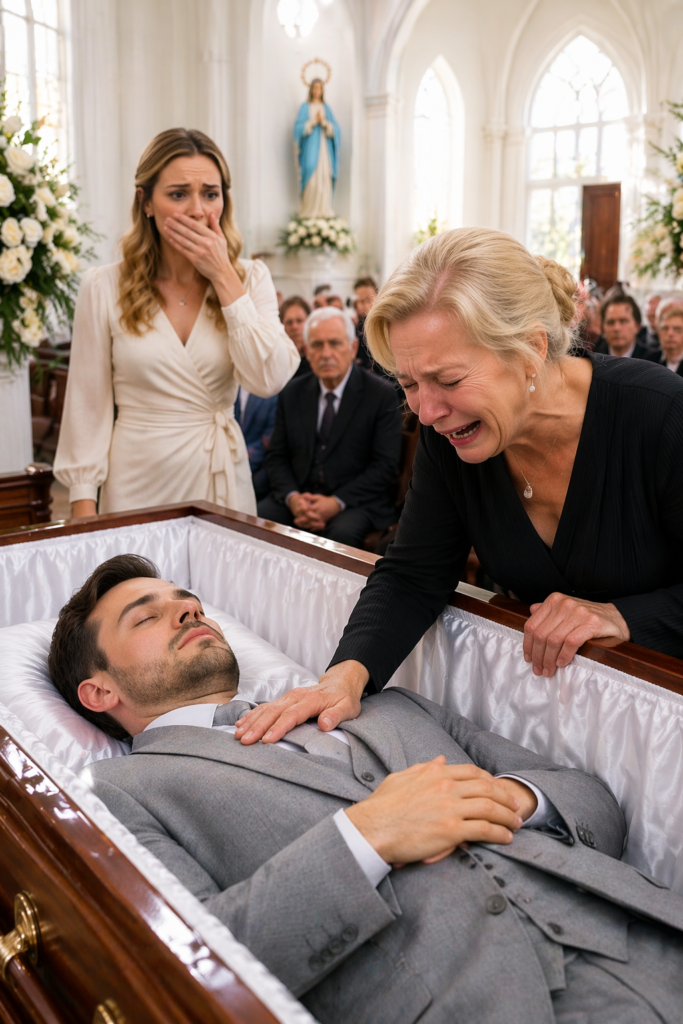
Mauricio lay there, pale, his lips purple, his face still. Doña Amalia let out a groan that made a stranger weep. She leaned down to kiss his forehead.
Then she saw it.
A slight movement of his eyelid.
Almost nothing.
Then, Mauricio’s chest barely rose, as if a spark refused to extinguish.
Doña Amalia froze.
—He’s alive — she whispered.
No one responded.
She turned to everyone with a distorted face.
—My son is alive! He’s breathing!
Renata recoiled, white as a sheet.
—That can’t be…
And as those words escaped her mouth, everyone understood they weren’t facing a medical error; they were confronting an unimaginable betrayal.
PART 2
—Call an ambulance, damn it! — Doña Amalia shouted, embracing Mauricio inside the coffin. — What are you waiting for? For him to actually die?
Javier, an old friend of Mauricio’s, was the first to react. He dialed 911 with trembling hands. Renata stood glued to the wall, no tears, no screams, her eyes locked on the open coffin as if she had witnessed someone she herself had ordered erased coming back to life.
—You knew — Doña Amalia said, not letting go of her son’s cold hand. — You knew he wasn’t dead.
—Don’t say nonsense — Renata replied. — I followed medical instructions.
—Whose doctor?
Renata remained silent.
The paramedics arrived within minutes. They examined Mauricio, gave him oxygen, and confirmed the impossible: he had a pulse. Very weak, almost gone, but it was there. One of them looked seriously at his colleagues.
—This isn’t normal. It looks like deep sedation.
Doña Amalia climbed into the ambulance without asking for permission. She took Mauricio’s hand and spoke in his ear as she had when he was a child and fever burned his forehead.
—I’m here, son. Don’t leave me. You still owe me a dinner, and you’re not going to leave me talking to myself, do you hear me?
At the Civil Hospital of Guadalajara, the doctors fought to stabilize him. Doña Amalia paced the waiting room with a rosary between her fingers. Javier stayed by her side, his face sunken with guilt.
—He sent me a message — he finally confessed. — Three days ago. He told me that if anything happened to him, I should seek you out.
Doña Amalia turned slowly.
—And why didn’t you find me?
Javier lowered his head.
—I thought he was exaggerating. He said he discovered strange movements in the company, forged signatures, transfers. He also said Renata was watching him.
Doña Amalia’s legs trembled.
Shortly after, Commander Ernesto Salazar, an investigator from the prosecutor’s office and a friend of Mauricio since college, arrived. He listened to everything without interrupting. Then he spoke with a harshness that chilled the room.
—No one ends up breathing inside a coffin by accident. This is already attempted homicide.
The evidence began to fall like stones.
The death certificate bore a forged signature. The doctor who supposedly examined Mauricio denied ever seeing him. The funeral home admitted that Renata paid in cash for an urgent service, with a closed coffin and immediate burial. Moreover, 48 hours before the alleged death, someone modified legal powers for Renata to gain absolute control of the company if Mauricio passed away.
Doña Amalia closed her eyes.
—She didn’t want a husband. She wanted an inheritance.
Then Javier delivered the complete message from Mauricio:
“I found million-dollar transfers to shell companies. Renata forged my signature. If something happens to me, don’t let her manage anything. Let my mom know. Even if she’s angry with me, she’ll believe me.”
Doña Amalia covered her mouth to keep from screaming.
Renata was arrested that same afternoon. At first, she denied everything. She said Mauricio was depressed, that a private doctor confirmed the death, that she was only respecting his wishes. But when the commander laid out videos, documents, audios, and transfers on the table, her mask cracked.
—He was going to destroy everything — she said with rage. — He didn’t understand what it took to build a big company. He always wanted to do the right thing, overpay, protect employees, consult his mother as if she were a saint.
—What did you give him? — Salazar asked.
Renata pressed her lips together.
—A compound. He just needed to seem dead for a few hours. After the burial, everything would be signed.
—They were going to bury him alive.
She looked at the floor, not out of guilt, but out of anger.
—I never thought that old woman would dare to open the coffin.
When Doña Amalia heard the confession, she didn’t celebrate. She sat still, hands on her knees, as if her soul weighed her down.
That night, a doctor emerged from intensive care.
—Mrs. Amalia… your son has woken up.
She entered almost without breathing. Mauricio was full of wires, his face ashen, a dark mark on his neck. But his eyes were open. They were the same eyes of the child she had carried when everyone told her that raising him alone was a curse.
—Mom — he whispered.
Doña Amalia crumpled beside the bed.
—I’m here, son. I’m not moving from here.
Mauricio cried. Not as a businessman or a successful man. He wept like that child who hid behind her skirt when the sky thundered.
—I’m sorry. I took you out of my life.
—A fight doesn’t erase blood — she said. — Nor does pride kill a mother’s love.
Mauricio confessed what remained. He had discovered Renata had been siphoning money for months. When he confronted her, she pretended to be remorseful, made him tea, and everything went dark. At times, he heard voices. He felt cold. He couldn’t move. Then he heard the lid of the coffin, the flowers, the silence.
—I wanted to scream — he said, tears streaming down his face. — But my body wouldn’t respond. Then I heard your voice.
Doña Amalia caressed his forehead.
—My soul knew you were still there.
The trial was swift and brutal. The corrupt doctor confessed. Renata’s lawyer submitted emails where she urged to speed up the burial. The funeral home presented videos showing her demanding no one open the coffin “out of respect for the deceased.”
The news exploded across Mexico.
“Mother opens coffin and saves her son from being buried alive.”
But Doña Amalia didn’t care about the cameras. She only wanted Mauricio to stop waking up screaming that he couldn’t breathe.
In the final hearing, Renata appeared handcuffed, dressed in gray, her gaze icy. She didn’t apologize. She said only:
—I built that company too. I deserved more.
The judge looked at her sternly.
—Thinking you deserve something doesn’t give you the right to bury a man alive.
She was sentenced to 15 years in prison for attempted homicide, fraud, forgery, and organized crime. Her assets were seized to compensate the damages.
When it was her turn to speak, Doña Amalia didn’t shout. She sat straight and looked at everyone.
—That woman thought I was an ignorant old lady. She thought that some expensive flowers and a closed coffin could silence me. But a mother recognizes her child even in the darkness. It was enough for me to see him breathe once.
The room fell silent.
Months later, Mauricio returned to Tepatitlán with his mother. They walked through the market where she sold tamales and visited the little room where he grew up. The pencil marks still etched on the wall showed how she measured his height.
Mauricio ran his fingers over those marks.
—I wanted to go so far that I thought looking back made me less.
—Leaving wasn’t wrong, son — she said. — What was wrong was forgetting who held you up when you had nothing.
He hugged her tightly.
Then he rebuilt his company, fired corrupt employees, and created a scholarship program for poor young people wanting to study technology. He called it Roots. At the inauguration, he asked Doña Amalia to cut the ribbon.
—This is yours too, Mom.
She shook her head, embarrassed.
—I just did what any mother would do.
Mauricio took her hand.
—No. You did what no one else dared to do.
The story didn’t go viral just because a mother opened a coffin and found her son alive. It went viral because many understood something uncomfortable: sometimes we underestimate the voice that loves us most until life forces us to listen from the edge of death.
Renata lost her freedom for turning love into a business.
Mauricio lost his pride but regained his roots.
And Doña Amalia proved that a mother can arrive late, exhausted, broken, and dust-covered.
But if she feels her son still breathing, not even death dares to contradict her.





