PART 1
In the prettiest house in the Narvarte neighborhood, Iker’s screams no longer surprised anyone.
For six nights, he had been waking everyone up, slamming his casted arm against the bed frame, his face flushed with fever and his eyes wide open, as if he were seeing something that others couldn’t.
—Get it off me! —he shrieked—. They’re moving! They’re stinging me from the inside!
He was nine years old and had been confined with a cast on his right arm for three weeks after falling on the schoolyard during a soccer game.
At first, his dad, Andrés, thought it was fear.
Then he thought it was a tantrum.
And later, thanks to Sofía, his new wife, he started to believe that his son was using the cast to destroy his marriage.
—Not this again —Sofía said from the doorway, dressed in her pristine white robe and her hair neatly tied back—. Andrés, this isn’t pain anymore. It’s manipulation.
Iker glared at her with hatred, but also with panic.
—You know! You know what happened!
Sofía let out a sad little laugh, the kind that made anyone look guilty except for her.
—See? Now he’s accusing me. Poor thing, but he needs help. You can’t keep allowing this.
Andrés entered the bedroom, exhausted, with a loose tie and shattered patience. Since Mariana, Iker’s mother, had died, he had tried to keep the household together: private school, therapy, work, meals, meetings, birthdays, everything.
When Sofía appeared, sweet and calm, he thought peace would finally come.
But that night, his son screamed as if he were being burned alive.
—Enough, Iker —Andrés said, gripping him by the shoulders—. You’re going to hurt yourself worse.
—Dad, seriously, it burns! Something’s crawling inside!
—There’s nothing in there.
—Yes, there is!
Doña Chole, the nanny who had been with the family for sixteen years, stood at the entrance with a cup of tea that had grown cold in her hands.
She had raised Iker since he was a baby. She had seen him cry over vaccinations, nightmares, the death of his mother. She knew his cries.
And this was not a cry of a spoiled child.
It was the cry of someone trapped.
—Mr. Andrés —she murmured—, the boy is boiling.
Sofía interrupted immediately.
—Chole, please. Don’t add more drama. You spoil him too much.
The nanny approached and changed the soaked pillow. Then she felt it.
A strange smell.
Sweet. Sour. Like rotten fruit mixed with an old wound.
Iker tried to stick a popsicle stick along the edge of the cast and scratched until he drew blood.
—My boy, no —Chole said, taking it from him.
—Nana, help me. She did something to me.
Andrés closed his eyes in rage.
—Don’t say that again.
Sofía clutched her chest.
—This has crossed a line, Andrés. Tomorrow, you call the clinic. We can’t live held hostage by his attacks.
Iker shook his head, trembling.
—I’m not crazy...
Chole adjusted the blanket and then saw something moving on the fabric.
A red ant walked directly toward the cast, climbed up the stained bandage, and vanished into a dark crack beside the inflamed skin.
Chole’s mouth went dry.
—Sir… an ant just got into the cast.
Andrés looked at her, fed up.
—Then clean it better. I’m sure he left candy everywhere.
—The boy has hardly eaten since the day before yesterday.
Sofía smiled faintly from the hallway.
Another ant crawled out from under the cast and disappeared among the blankets before Andrés could catch sight of it.
That night, while Iker pleaded that he not be locked away, Doña Chole understood something that froze her blood.
The boy wasn’t imagining monsters.
The monster lived inside that house.
PART 2
The next morning, Andrés came down with his phone glued to his ear and a blue folder under his arm.
He had barely slept for two hours. His face looked like that of a man defeated before the day even began.
—Yes, doctor, I understand —he said—. I’m bringing him today. Emotional assessment, yes. Urgent.
Iker listened from the stairs.
He descended slowly, hugging his cast against his chest. His lips were chapped, and his skin pale, as if the fever had drained the life out of him.
—Dad, please —he whispered—. Don’t take me to that place.
Andrés hung up and tried to sound firm.
—It’s for your good, son.
—I’M NOT CRAZY!
Sofía appeared behind Andrés and adjusted his collar.
—Honey, don’t engage in his game. The more you explain, the more he gets hooked. You’ve seen how he’s breaking us apart.
Doña Chole slammed a pitcher of water on the table so hard that the glass jumped.
—Before putting him in a clinic, take him to the emergency room.
Sofía turned with false patience.
—Chole, you’re not a doctor.
—I’m not a doctor, but I know when a child is sick. Smell his arm. Look into his eyes. That cast is wrong.
Andrés hesitated.
And Sofía noticed it right away.
—What if they take him to the hospital and see that the cast is damaged? —she said in a low voice—. They’ll think you neglected him. They’ll call child services. They could take Iker away from you, Andrés. Is that what you want?
The word “child services” fell over the living room like a bucket of cold water.
Andrés froze.
Fear did the job Sofía needed.
Iker approached Chole and squeezed her hand with his swollen fingers.
—Nana —he murmured—, bring me the big knife.
Chole felt her heart breaking.
—For what, my love?
—Cut off my arm. I don’t want it anymore. I swear I can hold on.
The nanny had to hold onto the railing.
A child who once cried for not wanting cough syrup now preferred to lose an arm than stay trapped in that hell.
—Don’t say that, sweetheart.
—Then believe me —Iker begged—. She put something in me.
Chole raised her gaze.
Sofía was not scared.
She was watching.
That afternoon, while Andrés filled out forms for the clinic, Chole went upstairs under the pretext of changing the sheets.
The bedroom smelled worse.
It wasn’t just sweat. It was something fermented, sticky, sick. The odor came from the cast as if a rotten fruit were hiding beneath.
Iker was no longer screaming.
That terrified her more.
He lay there with half-open eyes, breathing shallowly. His forehead burned. The skin around the cast looked red, moist, with little black dots moving among the gauze.
—Nana… —he babbled—. Are they gone?
—Who, my child?
—The ones who walk.
Chole swallowed hard and didn’t cry because there was no time.
She went down to the service yard and began to rummage through the garbage. She wasn’t looking for food. She was searching for an explanation.
At the bottom of a black bag, she found hardened napkins, an almost empty bottle of agave honey, and a jar of corn syrup for baking.
Everything was hidden beneath scraps of food.
Chole remembered that Iker hadn’t eaten anything sweet in days.
She tucked a sticky napkin into her apron pocket.
Then she heard Sofía’s voice behind her.
—Are you also checking my trash now?
Chole straightened up calmly.
—I’m cleaning.
Sofía approached. Her expensive perfume barely masked her rage.
—Look, Chole, you’re already old enough. It would be a shame for you to lose your job over making up stories. That boy isn’t yours.
The nanny held her gaze.
—He doesn’t need to be mine for me to care.
Sofía’s smile vanished.
—Don’t get involved where you’re not needed.
Chole walked away without responding.
But from that moment, she knew she couldn’t wait to convince Andrés.
At midnight, the rain hit the windows again. The house was silent, save for the clock in the living room and Sofía’s soft footsteps as she packed a suitcase.
The clinic would pick Iker up at 8 in the morning.
—You’ll see that in a few days he’ll return calmer —Sofía told Andrés, folding one of the boy’s pajamas—. This will help us all.
Andrés didn’t answer.
Something in his chest was starting to feel wrong, but guilt, exhaustion, and fear wouldn’t let him think.
At 2:23, Doña Chole heard a dry thud.
Then another.
She ran to Iker’s room and found him convulsing on the bed.
The cast was pounding against his chest. His eyes were rolled back. His mouth let out a tiny whimper, like a wounded animal.
—Holy Virgin! —the nanny shouted.
Andrés rushed out of his room.
—What’s happening?
But Chole was no longer going to ask for permission.
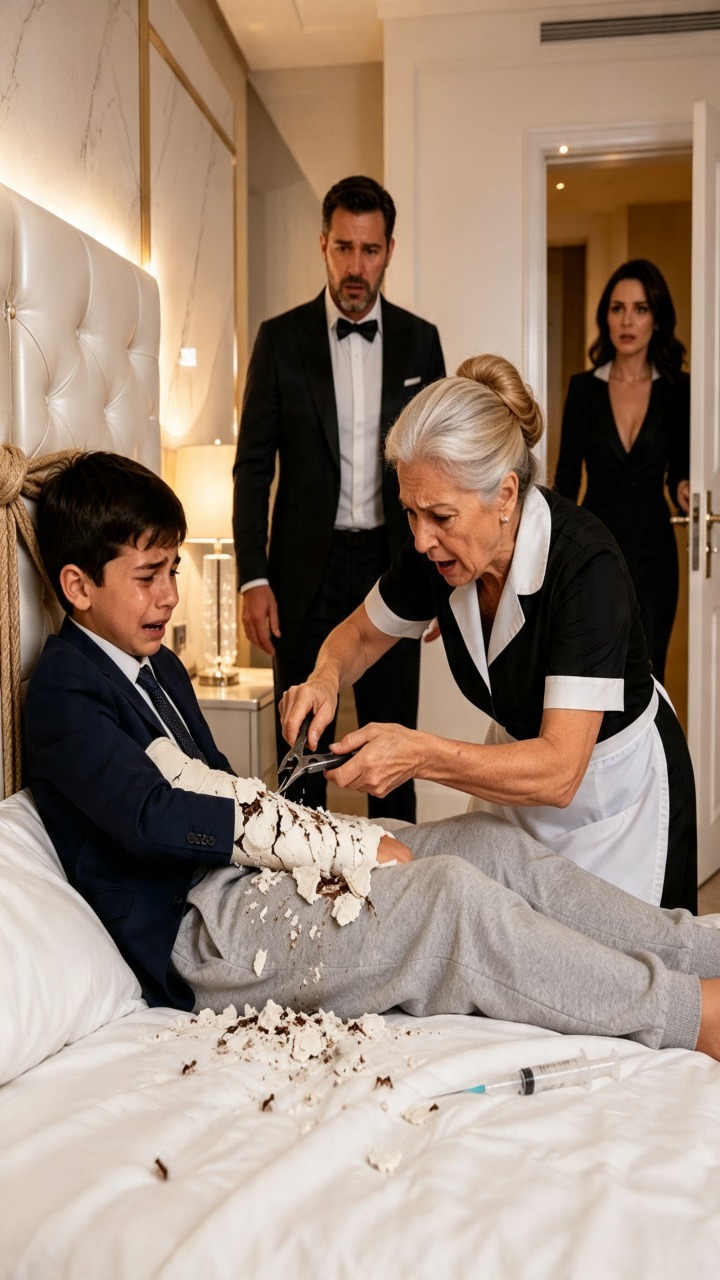
She ran down to the garage, opened the toolbox, and grabbed a pair of heavy, rusty cutting pliers.
She raced back upstairs, entered the bedroom, and locked the door.
On the other side, Andrés banged on the door.
—Chole! Open up!
Sofía screamed:
—She’s crazy! She’s going to destroy his arm!
Chole knelt beside Iker and brushed the sweat-drenched hair from his forehead.
—Hold on, my boy. Your nanny is going to get you out of there.
She placed the pliers at the edge of the cast.
She squeezed with all the strength she had left.
Crack.
The first piece split open.
A brutal smell burst forth, so sweet and rotten that even Andrés stopped banging for a second.
Chole squeezed again.
Crack.
The line opened all the way to his elbow.
Iker moaned with purple lips.
—Do you see them, Nana?
Chole looked inside and felt her legs buckle.
—Yes, my darling. Yes, I see them.
And even though it was a horrific scene, those words brought peace to Iker.
Finally, someone believed him.
Chole slipped her fingers through the opening and pulled. The cast split like old skin and fell to the floor.
Underneath, there was not just an infection.
There was living cruelty.
Iker’s arm was swollen, red, covered in wet wounds. There were dark patches, open skin, dried blood, and a shiny substance stuck to the gauze.
Red ants scurried between the folds.
There were also white larvae stuck to the sweet remnants.
Chole screamed, not in disgust but in rage.
At that instant, Andrés managed to open the door.
He stormed in, furious, ready to snatch the pliers from her, but he froze.
First, the smell hit him.
Then he saw the broken cast.
Next, he saw the ants escaping across the carpet.
And finally, he saw his son’s arm.
His whole world came crashing down.
—No… —he murmured.
Chole threw a piece of cast at his feet.
—Look closely, Mr. Andrés. Your son wasn’t inventing. He wasn’t crazy. They were eating him alive while you told him he was being dramatic.
Andrés covered his mouth.
He remembered every scream. Every threat. Every time he told him not to make a scene. Every time he believed Sofía because it was easier than accepting his own son’s terror.
He doubled over and vomited beside the door.
Iker, half-conscious, let out a thin voice.
—Dad… it was true.
Andrés fell to his knees.
—I’m sorry, son. I’m so sorry.
Chole wouldn’t let him sink.
—Call 911! And bring warm water. Now.
Andrés obeyed like a scolded child.
He lifted Iker with trembling hands and took him to the bathroom. As the warm water washed his arm, every insect that fell down the drain felt like a sentence.
—I’m sorry, my boy —Andrés kept repeating—. Dad should have listened to you.
Chole called emergency services.
While she spoke, she saw Sofía standing in the doorway.
The woman was pale, but she wasn’t looking at Iker.
She was staring at the nightstand.
Chole followed that gaze.
She opened the drawer and found bandages, gauze, pills, small scissors, and at the bottom, a thick pastry syringe, the kind used to fill cakes.
The tip was sticky.
It had crystallized golden remnants.
Chole picked it up with a towel.
—Mr. Andrés.
He stepped out of the bathroom with Iker wrapped in a white towel.
Upon seeing the syringe, he stopped breathing.
—What is that?
Sofía stepped back.
—I don’t know. It must be from the kitchen.
—It was in the boy’s medicine drawer —Chole said.
Andrés walked toward her slowly.
—What did you do to him?
Sofía tried to hold onto her mask.
—Nothing. They’re making a show. Iker must have put candy in there. You know how he is.
Iker opened his eyes slightly.
—She came in when you went to Querétaro —he murmured—. She told me that if I spoke, you would send me away. She grabbed my arm. I felt cold. Then sticky. Then the ants came.
Andrés felt the blood drain from his face.
The trip to Querétaro.
Two weeks before.
A work meeting.
Chole had gone to the doctor.
Sofía had been left alone with Iker.
Everything fit together with monstrous precision.
—You put honey inside the cast —Andrés said, almost voiceless.
Sofía clenched her jaw.
—It wasn’t that serious.
Chole stepped forward.
—It wasn’t that serious?
Sofía exploded.
—Since I married you, it’s all been Iker! Iker and his school, Iker and his grief, Iker and the photo of his mom, Iker and his therapies! I’m your wife too, Andrés. I wanted a family too.
The silence was louder than the rain.
Andrés raised his hand but stopped.
He wasn’t going to become another monster in front of his son.
He grabbed the phone.
—I need an ambulance and a police car —he said—. My son was assaulted inside my house.
Sofía tried to snatch the cellphone from him, but Chole stepped in front.
—Don’t you dare.
—You’re nobody —Sofía spat.
Chole stood tall.
—I’m the woman who believed the boy.
The sirens arrived eleven minutes later.
The paramedics rushed upstairs and, upon seeing Iker’s arm, their expressions changed. They administered IV fluids, checked his fever, and covered the area with sterile gauze.
Andrés wanted to board the ambulance.
Iker reached out his healthy hand toward Chole.
—Let my nanny come.
It hurt Andrés, but he nodded.
—Of course, son. She’ll come with you. I’ll follow behind.
On the sidewalk, two police officers spoke with Sofía. She was crying, saying it was all a misunderstanding, that the nanny hated her and that Iker had always been problematic.
But Andrés handed over the syringe, the sticky napkin, the jars, and the pieces of cast.
—I also want a restraining order —he said—. And I’m going to give a full statement.
Sofía glared at him.
—Without me, you can’t handle that boy.
Andrés looked at her in the rain.
For the first time, he didn’t see the elegant woman he thought he loved.
He saw someone capable of smiling while a child rotted beneath a cast.
—Without you, I almost lost him —he replied.
At the pediatric hospital, the doctors confirmed the nightmare.
Iker had a severe infection beneath the cast. The sweet mixture had kept it moist, attracted insects, and opened more wounds.
—If you had waited 24 more hours —the doctor said—, we would be talking about bone infection, amputation, or septic shock.
Andrés sat in the hallway and buried his face.
He didn’t ask for comfort.
He didn’t deserve it.
Chole stood in front of the operating room, hands clasped, praying softly.
The cleaning lasted more than two hours.
When the doctor came out, Andrés nearly fell over as he stood up.
—Is my son okay?
—He’s stable. His arm is saved. He’ll need antibiotics, dressings, and therapy, but we got to him in time.
Chole closed her eyes.
—Thank God.
When Iker woke up, the first thing he saw was his nanny.
Then he saw his dad, sitting in a corner, destroyed by guilt.
—Is she gone? —he asked.
Chole stroked his hair.
—Yes, my boy. She’s gone.
Andrés approached slowly.
—Iker… I don’t know if you’ll ever be able to forgive me. But I’m going to spend my entire life listening to you. I failed you.
The boy stared at him for a long time.
He didn’t say “I forgive you.”
Not yet.
He only asked:
—Will she never come back?
—Never —Andrés said—. I swear it.
Iker closed his eyes.
—Then stay.
Andrés sat beside him and took his healthy hand. He cried without playing the victim, without talking about his exhaustion, without justifying his blindness.
For the first time, he understood that being a father wasn’t about paying for an expensive school, living in a good neighborhood, or having a spotless house.
Being a father was believing a child when he said, “It hurts,” even if that truth destroyed the perfect family.
Sofía was arrested days later. The investigation gathered purchases, messages, remnants of syrup in the syringe, testimonies from Chole, and the medical report.
In the building, everyone talked.
Some judged Andrés for not listening. Others said Chole was an angel. Many wondered how many children had told the truth while adults called them dramatic.
Weeks later, Iker returned home.
The bedroom was completely cleaned. Andrés threw out the bed, the carpet, the sheets, and everything that smelled like that night.
But he couldn’t throw out the guilt.
That he would have to carry.
Iker arrived with his arm bandaged, without a cast, full of marks that would take a long time to heal. He walked slowly but alive.
Chole was waiting for him with chicken broth, lemon gelatin, and a soft blanket.
When he saw her, he smiled for the first time in weeks.
—Nana, can I sit with you?
—As long as you want, my darling.
Iker snuggled up next to her.
Andrés watched them from the doorway.
It would have hurt him before that his son sought Chole first.
Now he understood.
Trust isn’t demanded.
It’s earned.
And he had lost it when it mattered most.
That night, the house was silent.
But it was no longer a silence of fear.
It was a clean silence, with open doors, fresh water beside the bed, and calm breaths.
Days later, Andrés asked Chole to stop calling him “sir.”
—You saved my son —he told her—. This house is yours too. Not as an invisible employee. As family.
Chole looked at Iker, who was playing with toy cars, carefully using the hand he almost lost.
—I don’t need to own anything —she replied—. I just need that when a child says he hurts, someone believes him.
Andrés lowered his gaze.
—I’m going to remember that every day.
Iker raised his eyes.
—Me too.
The marks on his arm didn’t disappear completely.
But each one told a truth stronger than any lie.
Sometimes the monster doesn’t live in a child’s imagination.
Sometimes it lives in the comfort of adults who prefer not to look.
And that’s why, when a little one says, “Something is happening to me,” don’t silence them, don’t ridicule them, don’t send them into silence.
Because perhaps their life depends on a single brave person who dares to break the cast of appearances.





