PART 1
Lucía finished her shift at the La Madriguera restaurant with her wrist swollen beneath her sleeve and a fake smile plastered on her face.
It was almost 1 AM in the Juárez neighborhood, and the rain in Mexico City hammered against the awnings as if trying to tear them down.
No one in the kitchen dared to look her in the eye.
They had all seen what happened at table 7.
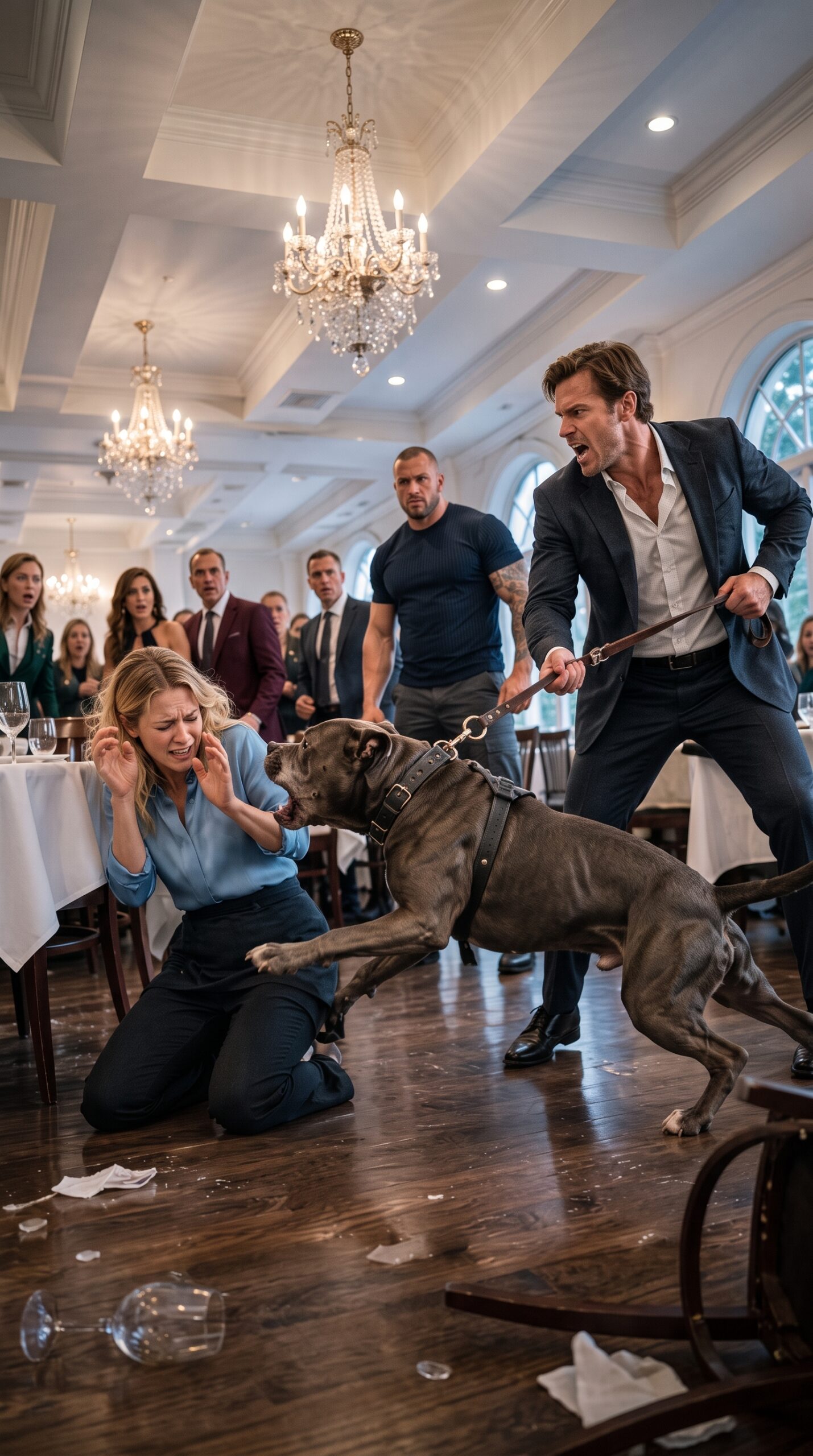
Damián Cárdenas, the man many called "The Saint" even though he was anything but saintly, had arrived with his black pitbull, a massive animal named Tizón.
The dog had a wide head, a chest riddled with scars, and honey-colored eyes that seemed to understand more than was wise.
A drunk customer had yanked Lucía's wrist when she asked him not to bother another waitress.
Before the manager could react, Damián snapped his fingers.
—Tizón.
Everyone thought the dog would lunge at Lucía.
But Tizón walked toward her, stepped between her and the drunk man, and let out a growl so low that the entire restaurant fell silent.
The drunk released her wrist.
Damián said nothing, but his eyes bore into Lucía as if she had just broken a law no one else knew about.
As she exited through the back door, Tomás, the dishwasher, caught up with her, a dead cigarette between his fingers.
—Watch out for that guy —he said—. The Cárdenas don’t notice anyone by accident.
Lucía hugged herself.
—I didn’t ask for anything.
—Nobody asks for anything from those people. They decide.
Lucía arrived at her tenement in Doctores with wet sneakers and fear lodged deep in her bones.
Her mom, Teresa, was sleeping upright in an old armchair because dialysis left her breathless if she lay down.
Lucía tucked a blanket around her and glanced at the medical bills on the table.
She owed 42,000 pesos before Friday.
At dawn, she made three decisions.
She would go back to the restaurant.
She would serve table 7.
And she wouldn’t let fear render her incapable of recognizing pain in another living being, even if that being had fangs.
The next night, Damián arrived right at 8.
Tizón entered alongside him but didn’t sit at his side.
He walked straight toward Lucía and rested his head against her leg.
—He did that all day —Damián said.
—What thing?
—Wait for you.
Lucía swallowed.
—Dogs don’t wait for just anyone.
—Exactly.
Damián slid an envelope across the table.
—Your mother’s clinic has already received payment for six months.
Lucía felt the ground shift beneath her.
—You had no right.
—I had a way.
—It’s not the same.
Damián looked at her as if no one had responded to him like that in years.
—I want to know why my dog chose you.
Lucía glanced at Tizón, his scars, his way of breathing as if always ready to take a hit.
—Because someone hurt him deeply —she whispered—. And the wounded recognize the wounded.
In that instant, Tizón stiffened.
The front door swung open.
An older man, elegantly dressed, wearing a gray hat and a grandfatherly smile, entered the restaurant.
Damián paled slightly.
And the dog began to tremble with rage.
PART 2
The man was named Ramiro Valcárcel, though half the city still referred to him as Don Ramiro.
He didn’t seem like a monster.
He had perfectly combed white hair, shining shoes, and a fine scarf that smelled of old money.
But when he walked into La Madriguera, the waiters lowered their voices, the bodyguards touched their radios, and even the musicians stopped tuning.
Damián didn’t stand.
Tizón did.
The dog’s growl rose from his chest like a buried alarm.
Don Ramiro smiled.
—Look at that. The little animal still remembers me.
Lucía felt cold.
Damián placed a hand on the table.
—You’re not welcome here.
—I made this place what it is —Ramiro replied—. And I made you what you are.
Lucía looked at Damián.
His face didn’t change, but something in his eyes shut down.
Don Ramiro turned to her.
—So you’re the little waitress.
—I have a name.
—Everyone has a name before they become a problem.
Tizón positioned himself in front of Lucía.
Ramiro noticed and his smile twisted.
—How curious. He used to bite when I commanded him.
Damián stood up.
The whole restaurant seemed to shrink.
—What do you want?
—To see if the rumors are true. That The Saint is softening because of a woman who serves coffee and a defective dog.
Lucía held the tray tightly.
—Not defective. Tired.
Ramiro looked at her with disdain.
—How sweet. The little girl thinks affection fixes what violence made useful.
Damián took a step.
—Careful.
Ramiro let out a calm laugh.
—Relax, son. I just came to remind you of something. In this world, what you love becomes a chain. And chains are broken by burning them.
Then he left a black card on the table and walked out.
No one breathed until the door closed.
Lucía approached Damián.
—Who is he really?
Damián looked at Tizón.
—The man who found me when I was 16.
He shared little but enough.
His father had been murdered behind a workshop in Iztapalapa for refusing to hand over transport routes.
His mother faded away with alcohol and sadness.
Damián ended up fighting in the streets until Ramiro picked him up, fed him, clothed him, provided contacts, and instilled a sick idea: that mercy was a debt always paid in blood.
—He taught me to survive —Damián said.
—No —Lucía replied—. He taught you to be alone.
He looked at her as if those words had hurt more than a bullet.
During the following week, La Madriguera felt like a bomb beneath a family table.
Men who once greeted Damián now watched him too closely.
A shipment didn’t arrive.
A dinner with three partners was canceled.
Tomás checked the alley twice before taking out the trash.
Damián stationed two men outside Lucía’s tenement.
She was furious.
She also let them stay.
Teresa, her mother, watched from the window.
—Is that man who paid for the clinic dangerous?
Lucía didn’t lie.
—Yes.
—And is he dangerous with you?
Lucía thought about the envelope, about Damián’s eyes, about Tizón lowering his head like a reprimanded child.
—I don’t know.
Teresa sighed.
—Honey, a dangerous man can be tender for five minutes. That doesn’t make him safe.
That phrase stuck with her all day.
That night, she found Damián in the office on the second floor, staring at Reforma through the wet glass.
Tizón was sleeping by the door, but with one eye open.
—Leave early —Damián ordered.
—Try again.
He turned, annoyed.
—You don’t understand what’s happening.
—Then explain it to me.
—I’m trying to keep you alive.
—By giving me orders?
—By getting you off the board before someone uses you.
Lucía clenched her jaw.
—I’m not a pawn.
—No —he said, his voice cracking slightly—. You’re the only thing in this city I don’t know how to lose.
Silence fell heavy.
Damián seemed to hate himself for saying it.
Lucía took a step.
—You can be afraid.
—I can’t.
—Yes, you can. What you can’t do is let fear decide for you.
He let out a bitter laugh.
—You talk like you’re training a dog.
—Maybe both of us need to repeat the lesson.
Damián stared at her for a long moment.
Then he slowly raised a hand, giving her a chance to step away.
She didn’t step away.
His fingers brushed her cheek with a clumsiness that pained.
—I’ve done things you would hate —he said.
—I don’t need you to be innocent.
—Then what?
—Be honest.
Damián took a deep breath.
—I want you close. And that scares me.
Lucía almost smiled.
—Look at that. You finally said something healthy.
Then Tizón growled.
Not at them.
At the door.
Tomás entered pale, cellphone in hand.
—Boss… you need to see this.
Downstairs, the bar screens flashed urgent news: fire at a warehouse in the Central de Abasto.
Three dead.
The reporters didn’t know that warehouse belonged to Damián.
Everyone in the restaurant did.
A message arrived on his cell from an unknown number.
"Soft things burn first."
Lucía read it over his shoulder.
Ramiro.
Damián went empty.
—Take her home —he ordered.
—No —Lucía said.
—This isn’t up for discussion.
—Exactly. I’m not leaving so he can turn you back into the boy he trained.
Damián glared at her.
—He killed three of mine.
—And he wants you to respond the way he expects.
—Don’t ask me for mercy tonight.
—I’m not asking for mercy. I’m asking for strategy.
That stopped him.
Lucía lowered her voice.
—If you go in alone and furious, you win twice. He either kills you or proves he still owns you.
The entire restaurant listened.
Damián slowly put away his phone.
—Call Omar —he said to Tomás—. I want to know where Ramiro is. No one moves without my order.
For a moment, Lucía thought the worst was over.
She was wrong.
The next day, she went out to buy saline solution for Teresa.
The store was two blocks away.
The bodyguards were parked out front.
A white van stopped next to the curb.
A cloth covered her mouth.
The world went dark.
When Lucía woke up, her wrists were bound to a metal chair and her mouth dry from chemicals.
She was in an abandoned slaughterhouse in Azcapotzalco.
Rusty hooks hung from the ceiling.
Rain poured through broken windows.
Don Ramiro was slicing an apple with a knife.
—Most wake up crying —he said.
Lucía swallowed.
—Most don’t work double shifts in a restaurant.
Ramiro smiled.
—I see why he likes you.
—I didn’t get kidnapped for chit-chat.
—No. I brought you here to remind Damián what happens when a man allows himself to want something.
Lucía scanned her surroundings.
She saw six armed men.
A side door.
A flickering bulb.
And on a table, an old leather strap.
Tizón would recognize it.
She understood too.
—You did that to the dog.
Ramiro didn’t deny it.
—He was a wild animal. I just made him useful.
—You tortured him.
—I prepared him. Just like Damián.
Lucía felt nauseous.
Then she saw an open folder on a box.
There were old photos, reports, and an ID card.
The name hit her like a stone.
Arturo Mendoza.
Her father.
Ramiro noticed her gaze and let out a low laugh.
—Ah, yes. Your dad. The busybody who tried to report the dog fights.
Lucía stopped breathing.
Her father hadn’t left because he was a coward.
He hadn’t abandoned Teresa.
He had been disappeared for trying to save animals like Tizón.
—You killed him —she whispered.
—I had a problem resolved.
Pain surged in her chest, but she didn’t cry.
Ramiro stepped closer.
—Damián will come alone. Furious. He’ll see your face, see this strap, see my knife. And then he’ll become what I made him.
Lucía lifted her gaze.
—You didn’t make him.
Ramiro frowned.
—Excuse me?
—You found a wounded boy and used him. That’s not creation. It’s taking advantage of a wound.
Ramiro slapped her.
The blow burned her cheek.
One of his men looked at the floor.
Lucía barely smiled.
—You needed to hit me to feel strong.
Ramiro tightened his grip on the knife.
Before he could respond, a thunderous noise shook the entrance.
The metal door crashed inward.
Smoke.
Screams.
Footsteps.
Damián appeared through the haze, but he wasn’t alone.
Omar came in from the side with four men.
Tomás led two more from the back.
And Tizón ran straight toward Lucía, low, firm, not lunging to bite anyone.
Damián had listened.
He didn’t arrive in a rage.
He arrived with a plan.
Gunshots exploded against the walls.
Tizón pressed against Lucía’s legs, shielding her with his body.
—Stay still, my boy —she whispered.
The dog obeyed.
Ramiro watched.
There, he lost his smile.
As his men began to fall unarmed, Ramiro grabbed Lucía from behind and pressed the knife to her throat.
—Drop the weapon! —he shouted.
Damián stood just a few steps away, eyes fixed on the blade.
Tizón growled.
Lucía breathed slowly.
She looked at the dog.
—Look at me.
Tizón fixed his eyes on her.
—Left.
The dog moved.
He didn’t attack.
He ran to the left, distracting the man aiming from a column.
Omar took him down immediately.
Lucía stomped with all her strength on Ramiro’s foot.
He loosened his grip.
Damián fired once.
The bullet struck the knife and knocked it from Ramiro’s hand.
Lucía fell to the ground.
Tizón charged at Ramiro’s chest without biting, just pushing him against a column.
Damián reached Lucía and cut her bonds.
His hands trembled once.
Just once.
—Are you hurt?
—My cheek. My wrists. And my soul, a bit.
He saw the mark from the slap.
Something dark crossed his face.
Lucía grabbed his sleeve.
—No.
—Lucía…
—No.
Ramiro, lying on the floor, laughed with blood in his mouth.
—Listen to her. Let the waitress put a leash on you.
Damián raised the weapon.
Lucía stepped between them.
Everyone froze.
—Move —Damián said quietly.
—No.
—He kidnapped the woman I love.
—And failed.
—He killed three men.
—And left evidence.
—He disappeared my father —she said, her voice breaking—. And mine too.
Damián went cold.
Lucía pointed to the folder.
—My dad didn’t abandon us. He reported your dog fights. Ramiro had him silenced.
For the first time, Damián looked at Ramiro not as a mentor but as an old lie.
Ramiro tried to speak.
He couldn’t.
—If you kill him —Lucía said—, you make him a legend. If you let him live without power, without people, without fear around him, you make him what he always was: a cowardly old man.
Damián slowly lowered the weapon.
Ramiro paled.
That frightened him more than death.
—You’re going to live —Damián said—. You’ll see how all those who swore loyalty to you deny your calls. You’ll leave my city with enough money not to die and without enough power to matter.
—That’s not mercy —Ramiro spat.
Lucía looked at him with tears in her eyes.
—No. It’s consequence.
Omar took Ramiro away.
No one defended him.
No one called him Don.
Three months later, La Madriguera still opened at 5.
Table 7 was still Damián’s.
But now Lucía sat there some nights.
Not as decoration.
Not as the boss’s girlfriend.
As the woman who had stopped a war with a phrase and a dog.
Teresa improved with a treatment chosen by her, not imposed.
Tomás received a raise.
The waiters stopped bowing their heads before abusive customers.
Tizón remained intimidating, of course.
But the children of some employees could now scratch behind his ears without him confusing a pet with a threat.
One morning, Damián took Lucía to a plot on the outskirts of Tepoztlán.
There was an old house, jacaranda trees, and a freshly painted sign.
“Refugio Arturo Mendoza.”
Lucía covered her mouth.
—You didn’t buy me a gift, did you?
Damián raised both hands.
—No. It’s in a trust. Your mom reviewed everything. You decide whether to manage it, change it, or tell me to go to hell.
Lucía cried.
Tizón sniffed the earth and wagged his tail.
—It’s for dogs like him —Damián said—. And to remember that your dad didn’t disappear for nothing.
Lucía looked at the man she had once confused control with care.
—And you?
Damián took time to respond.
—I’m still learning.
She took his hand.
—Then learn this: no one becomes good overnight. But one can choose not to resemble the one who broke them.
Damián lowered his head.
Tizón sat between them, full of scars but calm.
Years later, people would misremember the story.
They would say a boss unleashed his pitbull on a waitress and she tamed it.
They would say a woman changed a monster with love.
But the truth was stronger.
An injured dog recognized an injured woman.
A dangerous man understood that protecting wasn’t possessing.
And in a city where many obeyed out of fear, three broken souls built something much harder to destroy.
Trust.





