PART 1
The girl had dirty hands, worn-out sneakers, and a black bag larger than herself dragging along the floor of the Civil Hospital of Guadalajara.
Her name was Natalia, she was 7 years old, almost 8, and that morning she was searching for plastic bottles behind the emergency area while her mother, Clara, cleaned bathrooms in shifts to pay for overdue rent.
No one looked at her.
Or rather, everyone looked at her as one looks at something that gets in the way.
Until she spotted the man in the gray suit.
He was surrounded by four bodyguards, his face hard, his gaze cold, and a small scar on his eyebrow. People moved aside without anyone asking.
It was Leandro Rivas, owner of half the city, never appearing on any paperwork.
Some called him businessman.
Others, in hushed tones, called him The Wolf of Jalisco.
Leandro had come to the hospital for a heart check-up. For months, Dr. Héctor Valverde, a family friend for 20 years, had changed his medication because, according to him, he had a delicate arrhythmia.
Natalia watched him leave the doctor's office with a white bottle in hand.
And she froze.
The night before, hiding behind the trash cans, she had overheard the same doctor talking on the phone in the parking lot.
—Let him take it for three days, and he won’t wake up right again. It will look like heart failure, just like with Don Aurelio.
Natalia didn’t know who Don Aurelio was.
But she knew how to recognize evil.
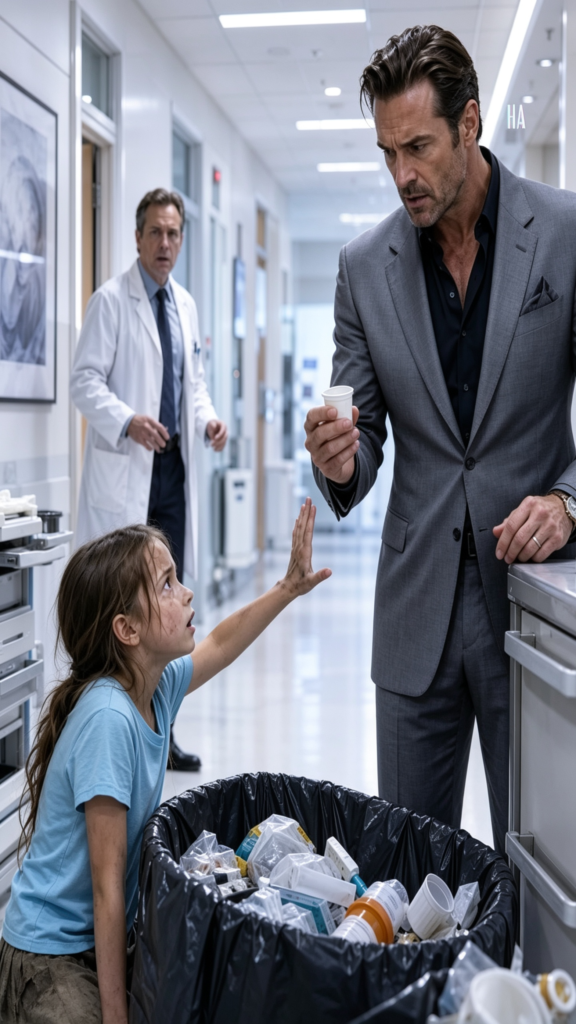
When Leandro opened the bottle to take the first pill with water, the girl ran and slapped his hand.
The pills fell to the floor.
One of the bodyguards yanked her arm.
—What’s wrong with you, kid?
Clara came running, pale.
—I'm sorry, sir! She's my daughter! She doesn’t know what she’s doing!
Natalia, trembling, pointed at the bottle.
—Don’t take that. The doctor said it would kill you.
The hallway fell silent.
Leandro didn’t shout.
He didn’t move.
He only lowered his gaze to the girl, then to the scattered pills next to his Italian shoes.
—What’s your name?
—Natalia.
—How old are you?
—7. Almost 8.
Leandro raised a hand for them to release the girl.
—And why are you helping me if you don’t even know me?
Natalia swallowed hard.
—Because my mom says that if you see someone about to die and you do nothing, you carry a bit of the blame too.
Clara closed her eyes, as if bracing for a blow.
But Leandro didn’t hit anyone.
He tucked a pill into a napkin, called his private doctor, and ordered all exits of the hospital to be closed.
That same afternoon, Dr. Camila Nájera checked the medication in a lab in Zapopan.
At 8:36 p.m., she called Leandro with a broken voice.
—It wasn’t your medicine. It was a compound to stop your heart slowly. If he took it, he’d be buried in 3 to 5 days.
Leandro looked at Natalia eating chips with Clara in the kitchen of his fortified home.
And then he remembered his father’s last words.
—Son... Héctor... don’t trust Héctor...
PART 2
For 8 years, Leandro had believed that his father, Aurelio Rivas, died of a sudden heart attack.
They held his wake with mariachis in Tlaquepaque.
He was buried among politicians, businessmen, and armed men crying as if they were real family.
Dr. Héctor Valverde signed the death certificate.
He also hugged Leandro at the cemetery and told him:
—Your dad left in peace, son. Don’t carry guilt.
Leandro carried guilt.
Because in Aurelio’s last hour, his father had tried to warn him of something. But he was weak, sweaty, with purple lips. Leandro thought he was delirious from the pain.
Now he understood.
His father hadn’t been delirious.
He had been murdered.
And the man who did it still walked into his house, drank coffee at his dining table, and called him “nephew” in front of everyone.
That night, Leandro didn’t order Héctor killed.
That was what scared his own men the most.
Salvador “Chava” Medina, his right-hand man, awaited a direct order.
—Boss, we can take him right now. In an hour he’ll sing like a canary.
Leandro was on the balcony, staring at the dark garden of his house in Puerta de Hierro.
—No.
Chava frowned.
—No?
—Héctor is a door. I want to know who’s on the other side.
At dawn, the Rivas house became a fortress.
No outsiders were allowed.
They changed codes, cameras, and routes.
Clara and Natalia were installed in the east wing, in a room that had been closed since Leandro’s ex-wife lost a pregnancy and left without looking back.
Natalia opened the door and gasped.
There was a white canopied bed, a small desk, and a window overlooking purple bougainvilleas.
—Mom... it looks like a princess’s room.
Clara couldn’t answer.
She sat on the bed and cried silently.
She wasn’t crying for luxury.
She cried because that night her daughter wouldn’t sleep on cardboard, nor with fear of being thrown out of another rented room.
Natalia adapted weirdly fast.
She learned the names of the gardeners.
She named a huge guard dog “Taco,” which everyone feared.
She drew Leandro with black crayon and wrote underneath: “Serious man who didn’t die.”
Leandro kept the drawing in the drawer where he used to keep a gun.
Clara, on the other hand, didn’t know how to be idle.
By the second day, she was in the kitchen preparing chilaquiles.
By the third, she mended a jacket for Chava.
By the fourth, even the house cook asked her for her red rice recipe.
Chava continued to be distrustful.
But when he accepted a coffee from her hands without checking it, everyone understood that this woman and her girl were no longer guests.
They were something more dangerous.
They were important.
The investigation advanced with a coldness that didn’t seem human.
Camila reviewed Aurelio’s files.
She found strange changes in prescriptions, doses moved without reason, Héctor’s signature on every adjustment.
Then more names appeared.
A deputy from Colima.
A transportation businessman.
A widow owning warehouses in Manzanillo.
A lawyer who was going to testify against a trafficking ring.
They all died from “heart failure” after being treated by Héctor Valverde.
Then came the information that flipped everything.
A ghost company in Panama was paying the doctor.
The real owner was Damián Beltrán, an old enemy of Aurelio Rivas.
Beltrán controlled illegal routes at the border and wanted to use trucks from Jalisco to move women and minors northward.
Aurelio refused.
Not because he was a saint.
He wasn’t.
But he had a line he never crossed.
—Not with kids—he had said in a meeting 8 years ago—. Whoever uses my routes for that, won’t see the sun again.
Three months later, Aurelio was dead.
Leandro felt something break inside him.
He had inherited a war thinking his father left him an empire.
In reality, he left him a warning.
To catch Beltrán, Leandro did something no one expected.
He died.
At 11:18 on a Friday, a black truck exploded in the parking lot of a hotel in Andares.
The news reported that The Wolf of Jalisco had died burned to a crisp.
At the scene, there was an unrecognizable body, fake documents, and enough remains to convince half the country.
Héctor Valverde watched the news from his office.
His hands trembled.
He closed the door and dialed a number.
—Damián... I didn’t do it. He didn’t take the pills.
On the other end, there was silence.
Then a dry voice responded:
—Then someone spoke.
—I don’t know who.
—Find out. And if it was the trash girl, bring her to me.
Héctor didn’t know that Leandro was listening to the call from a secure warehouse in Tlajomulco.
He also didn’t know that Natalia, the girl he despised as if she were invisible, had just become Mexico’s most dangerous witness.
The attack came 9 days later.
Clara was in the garden teaching Natalia how to water a pot of basil. Taco ran around them with a chewed-up ball.
Suddenly, the north gate exploded.
Six men in black vests entered.
The first shots shattered the windows.
Clara didn’t scream.
She grabbed Natalia and ran.
—Mom!
—Don’t look back, my love. Run.
The butler, Don Goyo, appeared in the kitchen and opened a panel behind the pantry.
—Down, quickly!
Clara pushed Natalia down first, then shoved Taco, and finally entered herself. The steel door closed just as the bullets hit the wood.
The underground room was small, cold, with water, cans, a red phone, and a camera showing pieces of the garden.
Natalia trembled in her mother’s arms.
—Is Mr. Leandro coming?
Clara hugged her tightly.
—Yes.
—Even if he’s dead?
Clara didn’t know what to say.
Above, the house was hell.
Twenty kilometers away, Leandro received the alert and for the first time in years felt true fear.
Not for himself.
For a 7-year-old girl still sleeping with a one-eyed doll.
—Drive—he ordered.
When he arrived, Chava had already contained the attackers.
One tried to flee through the back.
Leandro caught him by the bougainvilleas.
The man turned pale upon seeing him alive.
—Who sent you?
—No one.
Leandro crouched in front of him.
—There’s a girl under my kitchen thinking maybe I won’t return. Don’t make me repeat it.
The man spat blood.
—Beltrán. He wanted the kid alive. If not, dead.
That phrase sealed everyone’s fate.
That same night, Héctor Valverde was arrested as he left his private hospital.
He wasn’t beaten.
He wasn’t disappeared.
They sat him in a clean room, with a bottle of water, a camera, and Leandro in front of him.
—Start with my father—Leandro said.
Héctor looked like he had aged 20 years in 20 minutes.
—I owed money—he whispered—. A lot. Damián offered to wipe my debt if I switched medications for certain patients.
—How many before Aurelio?
—Three.
Leandro didn’t blink.
—And my father?
Héctor cried.
—Your dad was going to report the routes. Damián said if Aurelio spoke, everything would fall apart. They paid me 5,000,000.
—Did my dad suffer?
Héctor looked down.
That silence was worse than any answer.
The confession lasted 52 minutes.
He gave names of laboratories, accounts, accomplices, fake certificates, and 14 deaths disguised as illness.
But the twist came at the end.
Héctor pulled out a USB drive hidden in his briefcase lining.
—There’s something else. Your father recorded a meeting before he died. He gave it to me to keep, in case something happened to him. I never destroyed it.
Leandro connected the drive.
On the screen appeared Aurelio Rivas, thinner, sitting in front of the camera.
—If you’re watching this, son, it’s because I didn’t get to tell you the truth.
Leandro stopped breathing.
Aurelio looked directly at him, as if he were alive.
—Damián Beltrán didn’t just want me out. He also wanted to buy you. He knew that if I died, you would be filled with rage. He wanted you to become just like him.
Leandro clenched his fists.
—Don’t give him that pleasure. Don’t tarnish the name with kids. Don’t use fear to fill the gap I left. If one day someone innocent saves you, listen to him. God speaks in strange ways, son. Sometimes He speaks from the places we look the least.
Leandro closed his eyes.
Natalia.
The girl from the trash.
The voice his father had foreshadowed without knowing.
With that confession, Leandro did the unthinkable.
He handed everything over to a federal prosecutor named Renata Salcedo, a woman who had spent years trying to take down Beltrán but had never managed to get a clean piece of evidence.
They met at a roadside diner near Tepatitlán.
Renata listened to the audio and watched the videos without saying a word.
In the end, she looked at Leandro.
—This could put Beltrán away for life.
—That’s what I want.
—And what do you want in return?
Leandro left a folder on the table.
—I’ll close my dirty businesses. Casinos, collections, routes. Everything. I’ll move to legal logistics, hotels, and construction. But I need to do it without Jalisco turning into a slaughterhouse.
Renata let out a bitter laugh.
—Did the Wolf find conscience?
Leandro thought of Natalia asking if he would return.
—No. I found family.
The operations began before dawn.
Damián Beltrán was captured in a vacation house in Chapala, hidden behind an Italian marble wine cellar.
Héctor Valverde formally surrendered and agreed to cooperate.
The news exploded across Mexico.
The doctor of the rich had killed patients for hire.
The most feared enemy of Jalisco had been taken down by the warning of a poor girl.
During the trial, the victims' families filled the courtroom.
Widows.
Children.
Mothers.
People who for years believed their loved ones died of illness when in reality they had been erased as obstacles.
Leandro testified without raising his voice.
—My father wasn’t a saint. I’m not either. But he had a line. Damián Beltrán killed him for not crossing it.
He looked at the judge.
—I thought I inherited his power. But I inherited his debt to the truth. And that truth didn’t come from a lawyer, nor from a policeman, nor from a partner. It came from a hungry girl, standing behind a hospital, with more courage than all of us.
Damián received multiple life sentences.
So did Héctor.
When they left the courthouse, reporters shouted.
—Mr. Rivas! What will happen now?
Leandro looked at Clara, who was holding Natalia’s hand.
Then he replied:
—Now we will build something that doesn’t need fear to exist.
One year later, the house in Puerta de Hierro no longer looked like a hideout.
The garden had white tables, flowers, soft music, and children running among the bougainvilleas.
There were no politicians.
There were no false friends.
Only Chava, Don Goyo, Dr. Camila, some trusted employees, and several families helped by the new Aurelio and Natalia Foundation.
The foundation funded education, therapy, food, and temporary housing for children who had lost their parents due to violence or abandonment.
Clara was the director.
She continued being a teacher, only now her classroom was bigger.
Natalia went to school with a clean uniform, a new backpack, and the same old sneakers kept in a box because she said they reminded her of where she came from.
That day she wore a pink dress and was angry because Taco had a bow around his neck.
—He looks ridiculous, but he’s family—she said very seriously.
Leandro couldn’t help but laugh.
He no longer laughed like before, fearing it would hurt.
He laughed fully.
Clara walked towards him in a simple ivory dress.
It wasn’t a magazine wedding.
It was a promise before people who knew all too well how much it cost to survive.
When Leandro placed the ring on her finger, he whispered:
—You saved me.
Clara shook her head with tears.
—Natalia saved you.
—You taught her how to do it.
Months later, on a night of gentle rain, Clara took Leandro's hand in the kitchen.
—I have to tell you something.
He looked at her worried.
She placed a hand on her belly.
Leandro froze.
Then he fell to his knees and rested his forehead against her, crying without shame.
Natalia appeared at the door in dinosaur pajamas.
—Why are you crying?
Leandro waved her over.
—Because you’re going to be a big sister.
Natalia's eyes widened.
Then she hugged both of them and screamed so loud that Taco began to bark.
That night, after tucking her in, Leandro went out to the patio.
He looked at the dark sky of Guadalajara and thought of Aurelio.
Violence wasn’t erased with a wedding.
The past couldn’t be cleaned with a foundation.
But a girl had stopped a pill.
She had uncovered a murder.
She had broken a chain of death that had been hidden for 8 years behind white coats and powerful surnames.
And she had done something even harder.
She found the living heart inside the man everyone called a wolf.
From the door, Natalia called him half-asleep.
—Leandro?
He turned.
—What are you doing awake, little one?
—I came to see if you returned.
Leandro walked toward her and carefully lifted her.
—I will always return.
Natalia rested her head on his shoulder.
And for the first time in a long while, the house didn’t sound like a fortress.
It sounded like home.





