PART 1
—Don’t take off, sir! That car won’t make it to the toll booth alive!
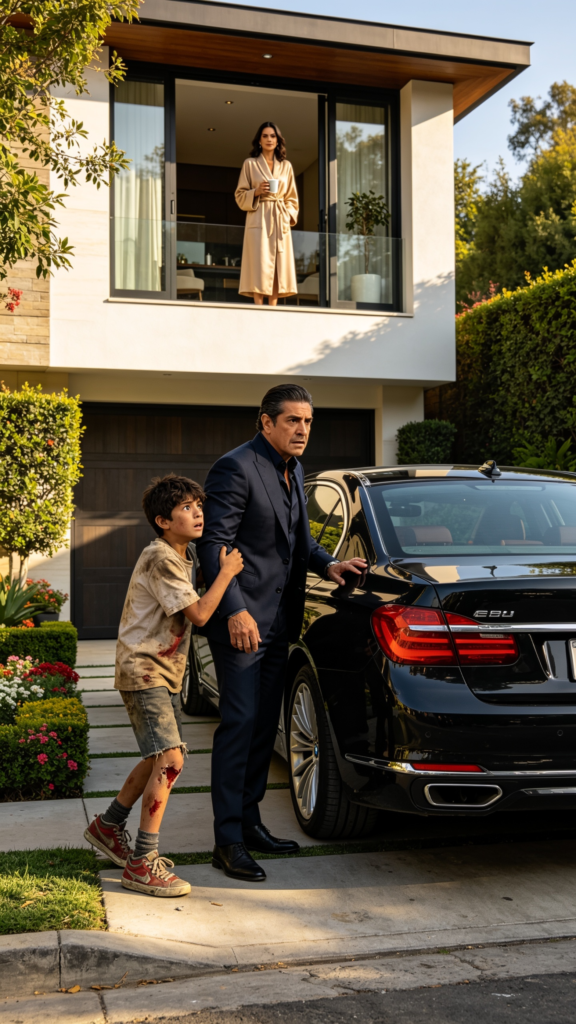
Julián Robles froze, his hand hovering over the door of his black BMW. In front of him stood a skinny boy, his face caked with dirt, knees scraped, and sneakers so torn they were barely holding on.
He couldn’t be more than 11 years old.
But he wasn’t crying from hunger or common fear. He was crying like someone who had just seen death lurking beneath a chest.
—Get out of the way, kid —Julián said, his voice trembling—. I’m running late.
—Your wife ordered the brakes cut! —the boy blurted, clutching Julián’s jacket—. She said that on the curve in La Marquesa, it would all look like an accident.
Julián felt ice seep into his bones.
This morning was no ordinary morning. At 44 years old, the owner of a financial software company in Santa Fe, he was about to sign a contract with a group of Japanese investors. This was the deal that could elevate his company to new heights.
He had a driver. He had bodyguards. He had three SUVs at his disposal.
But he wanted to drive alone.
He claimed it helped him think.
From the entrance of his home in Bosques de las Lomas, he lifted his gaze to the window of the second floor.
There was Mariela, his wife.
Perfectly coiffed, wearing a beige robe, coffee cup in hand. She didn’t rush down. She didn’t ask who the boy was. She didn’t show a hint of concern.
She just watched.
As if she were waiting for Julián to start the engine.
—What’s your name? —he asked, lowering his voice.
—Toño.
—Tell me everything. No embellishments.
The boy swallowed hard.
—My mom cleans houses in the private area behind. I snuck through the vacant lot to look for a ball. Last night, I heard your wife talking on the phone in the garden. She said: “César, it can’t fail. If Julián signs tomorrow, everything falls apart. Let the car go down the slope and make it look like brake failure.”
Julián felt a buzzing in his ears.
César.
César Barrera had been his security chief until six months ago. Julián had fired him when he discovered he was billing for false services, leaking routes, and selling information about the house.
Mariela had defended him back then.
Too much for someone who claimed not to know him well.
—And then what did you hear? —Julián pressed.
—That if anyone had seen me, they should look for me. He said, “that kid is snooping around, I don’t want any loose ends.”
Julián glanced up again.
Mariela was still there.
Just a slight smile.
Not a wife’s smile.
It was the smile of someone waiting to collect.
Julián opened the BMW door and sat down. Toño pounded on the glass desperately.
—No, sir! Seriously, don’t start it!
Julián inserted the key. The dashboard lit up. The engine purred softly.
In the rearview mirror, he saw Mariela lean toward the glass, attentive, cold, motionless.
Then he understood something that shattered his heart.
His wife wasn’t saying goodbye.
She was waiting for her plan to roll out of the garage.
He turned off the engine.
Mariela almost immediately descended, her steps elegant, her voice sweet, which for the first time sounded false to Julián.
—Everything okay, love? You’re running late.
—I felt something strange with the pedal —he replied—. I’d better take the old truck from the service garage.
Mariela’s smile hardened.
—In that clunker? You’ll arrive sweaty and late. Come on.
—Better late than dead.
She said nothing.
Not even pretending to be surprised.
Julián grabbed Toño by the shoulder and pulled him into a side storage room.
—Stay here. Don’t come out even if you hear shouting.
—Are they going to do something to me?
Julián looked at him with dry sadness.
—As long as I’m breathing, no.
He left through the back door in an old truck that Mariela loathed because “it was embarrassing.” Five minutes later, he pulled out a hidden cellphone from beneath the seat and called Don Octavio Salcedo, the family lawyer who had been with them since his father opened the first office in a local area in Doctores.
—My wife tried to kill me —Julián said.
There was a long silence.
—Come to my ranch in Lerma. Don’t tell anyone.
—Why?
—Because Mariela doesn’t just want you dead, Julián. She wants to erase a truth you don’t even know exists.
Julián gripped the steering wheel, his hands trembling.
And for the first time, he understood that the boy with the torn sneakers hadn’t come to save him from a meeting; he had come to open the door to hell.
PART 2
Don Octavio’s ranch didn’t look like a ranch. Outside, it had an old wall, cacti, and a rusty gate. Inside, there were cameras, radios, trained dogs, and two former police officers who neither smiled nor asked unnecessary questions.
Julián arrived with his shirt stuck to his body and his jaw clenched.
Don Octavio awaited him in a library that smelled of old wood. On the desk lay a red folder, several sealed envelopes, and a USB drive.
—Your father left instructions —the lawyer said—. He asked me to open this only if your life was in danger from someone in your inner circle.
Julián let out a bitter laugh.
—Did my dad know I could marry a murderer?
—Your father knew that money attracts people with hunger. But he also knew that there are hungers that aren’t about food.
He opened the folder.
There it was, Mariela’s full name.
Mariela Durán Sosa.
But beneath it appeared another: Mariela Rivas Ortega.
—That’s her real last name —Don Octavio explained—. She changed it nine years ago, before she met you.
Julián frowned.
—Why would she do that?
Don Octavio turned the page.
—Because her family was involved in a fraud that nearly destroyed your father’s company 23 years ago. The Rivas diverted funds, forged contracts, and left over 200 workers without severance. Your father paid everything to keep people off the street, but he kept evidence.
Julián felt the ground shift beneath him.
—And did Mariela know?
—Of course she knew. Her father died blaming the Robles for sinking them. She grew up hearing that your family robbed them of their lives.
Julián slumped into a chair.
He recalled Mariela’s questions about safes. Her jokes about “the old papers no one reads.” Her insistence that he not sign certain protective agreements. Her anger every time Don Octavio appeared at family gatherings.
—Today’s signature… —he murmured.
—Today’s signature would have protected your company, your shares, and your family legacy. If you died first, she could present herself as a widow, fight for control, and destroy the evidence against the Rivas. But if you signed, she’d be out.
Julián closed his eyes.
The most brutal thing wasn’t the money.
It was remembering that just that morning, Mariela adjusted his tie, kissed his cheek, and said, “Everything is going to be perfect, love.”
Perfect.
For her, perfect meant watching him fall off a cliff.
Suddenly, Julián stood up.
—Toño is in my house. I left him hidden.
Don Octavio paled.
—Then that kid is the most dangerous witness for her.
There was no time for doubt.
Don Octavio made two calls. One to a trusted commander. Another to a mechanical expert who had already worked sabotage cases. Meanwhile, Julián sent a false message from a mirror app to the cellphone he had left in his study.
“I’m with Octavio. I have the evidence. Mariela is done.”
The trap was simple.
If Mariela was innocent, she would call worried.
If she was guilty, she would rush to destroy whatever remained.
At 6:40 PM, Julián returned to his house through the service entrance, wearing a cap, dark jacket, and a truck without logos. The mansion appeared quiet, but it was a rare tranquility, like a theater before the curtain rises.
A private patrol was outside.
The cook was crying in the laundry room.
A neighbor was recording from the sidewalk.
And Mariela was in the living room, dressed in black, her eyes glistening just when someone looked at her.
Julián crept up to the study silently. He pulled out an old tablet, invoices, hard drives, and a folder that Mariela had never managed to open.
Then he heard footsteps.
He hid behind a heavy curtain.
Mariela entered with César.
She no longer had the face of a worried widow. She had the face of a cornered animal.
—I told you to check the body —she spat—. An accident note without a name doesn’t help me, César.
—The BMW didn’t leave —he replied—. Someone tipped them off.
—It was the kid. I told you that brat had been listening.
A knot formed in Julián’s throat.
César frantically opened drawers.
—Where’s the paper?
—It has to be here or with old Octavio —Mariela said—. Without that file, I can’t claim anything. And if Julián signs, my family is buried forever.
César found Julián’s phone on the desk. He read the false message.
Mariela smiled.
A horrible, twisted, ugly smile.
—Then let’s go for the old man. After that, we’ll find that kid.
Julián had to clench his fists to stop himself from rushing out.
But he needed them to sink themselves.
As they left, he called Don Octavio.
—They’re on their way.
—We’re ready for them —the lawyer replied.
Before leaving, Julián dashed to the side storage room.
Toño was still there, sitting on a toolbox, hugging his knees. His eyes were red, but he hadn’t made a sound.
—Let’s go, champ —Julián said.
—Are they going to kill me?
—No. Not today.
He took him out through the back and helped him into the truck. Throughout the journey, the boy didn’t ask anything. He only stared at his torn sneakers, as if embarrassed to have saved someone dressed like that.
At Don Octavio’s ranch, the night fell heavily.
Mariela arrived in a black SUV with César. She stepped out without perfect makeup, without a sweet voice, without the fine woman mask she wore at Polanco dinners.
—Open up, Don Octavio —she shouted from the gate—. Don’t make this circus any bigger.
From a speaker, the lawyer’s voice echoed.
—Everything is being recorded, Mariela.
She let out a dry laugh.
—Record whatever you want. That document doesn’t belong to you.
Julián appeared from the shadows, with Toño shielded behind two men.
Mariela saw him and lost color.
—You…
—Yes —he said—. The dead man you were waiting for.
César tried to back away, but the former police officers blocked his path.
—Don’t move, buddy —one warned—. That’s enough.
Mariela didn’t look at César. She looked at Julián with an ancient hatred, as if she were not seeing her husband, but all the ghosts of her family.
—You don’t understand anything —she said—. The Robles destroyed mine.
Don Octavio stepped out holding the red folder.
—Your family robbed workers, forged contracts, and then played the victims. Julián’s father paid for what you left behind.
—My dad died sick from that shame! —Mariela screamed—. My mom sold even her earrings. And you? You continued with trucks, bodyguards, and clean surnames.
Julián looked at her with eyes full of pain.
—So you married me to get revenge.
She didn’t respond.
That silence was worse than a confession.
César, seeing himself surrounded, cracked first.
—She planned everything —he said, raising his hands—. I only did the brake job. She gave me the route, the time, the money, and the exact point of the curve.
Mariela turned furiously.
—Shut up, idiot!
—No, ma’am —César said—. You also said that if the kid spoke, he had to be taken out.
Toño hid behind Julián.
That movement broke something inside him.
Julián had imagined betrayals. A lover. A secret account. A marriage of convenience.
But not this.
Not that his wife could hear the voice of a poor child and decide he was also a nuisance.
The patrols arrived four minutes later.
In the SUV, they found tools, gloves, envelopes filled with cash, a disposable phone, photos of the BMW, and a map of the Mexico-Toluca highway with a curve marked in red.
The investigation confirmed the worst: the brake line had been tampered with. It wasn’t a malfunction. It wasn’t an accident. It was attempted murder.
When they put the cuffs on Mariela, she didn’t cry.
She just lifted her chin.
—You were easy to deceive, Julián.
He took a deep breath.
—And you were too cowardly to understand that no family wound justifies killing someone.
They took her away.
César testified to reduce his sentence. He delivered audios, transfers, and messages where Mariela asked that “the blow leave no doubts.” In one of those chats, he wrote a phrase that went viral when it hit the press:
“If the kid saw something, first silence the kid.”
All of Mexico erupted in comments.
Some said Mariela was the product of an old injustice. Others said that resentment doesn’t give you the right to become a murderer. Many debated whether Julián had been naïve, whether money blinds, or whether families inherit hatred as if it were a house.
But Julián stopped reading.
The next morning, he went with Toño and his mother, Teresa, to a tin room behind a taco stand in Naucalpan. She thought they had come to confront her about something. She hugged her son as if they were going to take him away.
—Ma’am —Julián said, his voice broken—. Your son saved my life.
Teresa began to cry silently.
She didn’t ask for money. She didn’t ask for favors. She simply said:
—I told him not to get into trouble, but this kid has a stubborn heart.
Julián knelt in front of Toño.
—Why did you run to tell me?
The boy shrugged.
—Because if I listened and didn’t say anything, that would be like helping them, right?
Julián could not respond.
He secured Teresa a safe house, a formal job at an industrial laundry in his company, and school for Toño. But he did it without cameras, without interviews, without turning the boy into a trophy.
Months later, Julián signed the contract that Mariela had tried to prevent. The company grew, yes, but he no longer celebrated the same way. He changed statutes, created a fund for child witnesses of violence, and families trapped in economic blackmail.
It was officially called the Robles Foundation.
Privately, everyone in the office called it the Toño Fund.
The trial took nearly a year. Mariela tried to present herself as a victim of an inherited debt, but the recordings, the investigation, and the threat against the child ended her act.
She was convicted.
Not for being the daughter of a broken family.
But for choosing to break another life.
Julián never drove that BMW again. He left it stored in a warehouse, not out of fear of the car, but out of respect for the memory of that morning.
Sometimes he would pass by it and remember the hand on the key, the engine running, Mariela at the window, and a child pounding on the glass with open sneakers.
Then he understood that death doesn’t always arrive with the face of an enemy.
Sometimes it sleeps in your bed, fixes your tie, and says, “I hope it goes well for you.”
And he also understood something stronger: salvation doesn’t always come from expensive lawyers, armed bodyguards, or powerful surnames.
Sometimes it comes running from a vacant lot, with dirt-covered knees, fear in its eyes, and the courage to shout the truth right before you drive off toward your own death.