PART 1
When Mariana accepted Daniel Arriaga's marriage proposal, she believed she was stepping into a family shattered by tragedy, not into a home built on a sick lie.
Daniel lived in a quiet neighborhood of Querétaro, in a spacious house with bougainvilleas at the entrance, a well-kept garden, and large windows that let in the afternoon light.
He had two daughters: Lucía, four years old, and Renata, six.
From their first date, Daniel spoke of them with a tenderness that seemed impossible to feign.
He called them "my girls," his voice cracking just a bit.
He also told her that his wife, Laura, had died three years earlier in an accident on the road to San Miguel de Allende.
He didn’t give many details.
Only that it had been quick, that he had to learn overnight how to braid hair, pack lunches, take them to kindergarten, administer syrup in the middle of the night, and sleep between two girls who woke up crying for their mother.
Mariana didn’t ask more.
She thought there were pains that deserved to be respected in silence.
Over time, Lucía began to run to her when she saw her arrive.
Renata was more serious. She would watch her from a distance, as if measuring whether she could trust.
Mariana learned which soup one liked, which story calmed the other, and how to distinguish when a tantrum was due to tiredness and when it was fear.
She never wanted to replace Laura.
Honestly, it never even crossed her mind.
She just wanted to be a good presence in a house that seemed to have suffered too much.
After a year, Daniel proposed without a big celebration or drama.
He told her the girls loved her.
That he loved her.
That it was time for the four of them to stop living half-lives.
Mariana believed him.
The wedding was small, in a hacienda near Tequisquiapan, with white flowers, soft music, and a table where everyone spoke carefully, as if mentioning Laura could break something.
Renata carried the petals.
Lucía fell asleep before the cake, her cheek pressed against Mariana’s dress.
Daniel cried during their vows.
Mariana thought he was crying for the woman he had lost.
Later, she would understand that some tears don’t cleanse guilt.
Sometimes they cover it.
They moved in two days later.
The house seemed normal.
There were drawings stuck to the refrigerator, backpacks by the door, plastic cups, dolls on the couch, and a list with vaccination schedules.
But from the very first day, Mariana noticed the basement door.
It was at the end of a short hallway, between the guest bathroom and an old bookshelf.
It was a dark door, heavier than the others.
The lock shone too much.
There was no dust around it.
That was the first thing that struck her as odd.
Daniel said he kept tools, broken furniture, and old boxes down there.
That he locked it so the girls wouldn’t go down and hurt themselves.
The answer sounded logical.
Too logical.
Mariana wanted to believe him because she had just married him.
She wanted to believe him because mistrusting a widower felt cruel.
But the house didn’t help.
Sometimes, while passing through the hallway, she felt a damp, sour smell, like clothes locked away for too long.
Sometimes Daniel would come up with a black bag and go back down without it.
Sometimes he would say he was checking the heater and lock himself in for several minutes.
And each time the girls heard his keys, they stopped talking.
One Tuesday morning, Daniel left early for work.
Renata and Lucía had a slight fever, so Mariana left them in the living room with blankets, chamomile tea, and cartoons.
Lucía hid under the table.
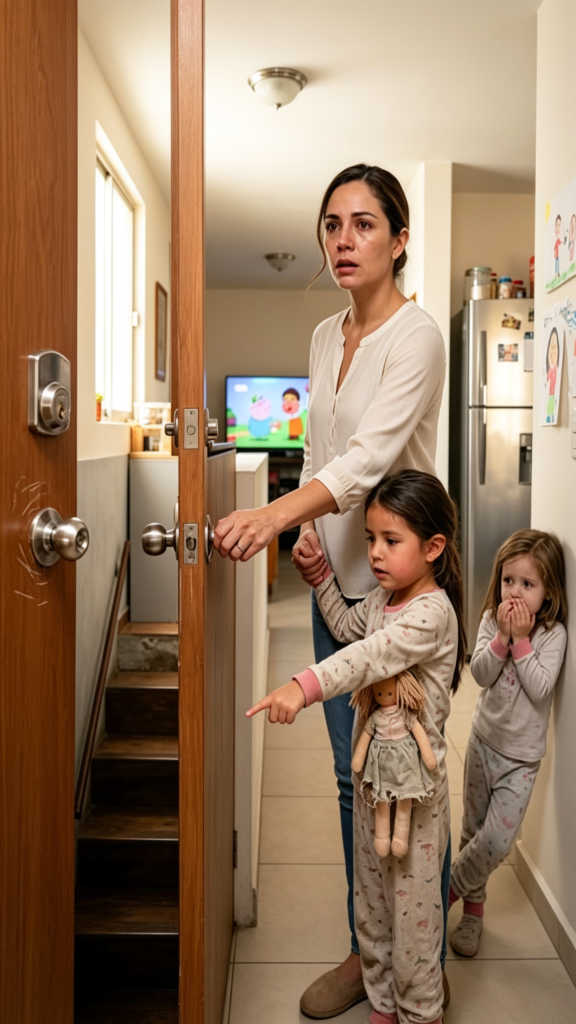
Renata appeared next to Mariana, clutching an old doll.
Her face was red from the fever, but her eyes were too wide awake.
She took Mariana’s hand and whispered:
—Do you want to meet my mom?
Mariana felt something freeze in her chest.
She knelt down slowly.
—My love… your mom passed away. Your dad told me about the accident.
Renata frowned, as if Mariana were the one who didn’t understand.
—No —she said softly—. My mom lives downstairs.
Under the table, Lucía stopped moving.
The silence of the two girls was worse than any scream.
Renata pulled Mariana down the hallway.
Lucía followed them, her face pale.
They reached the basement door.
Renata pointed at the lock.
—If you open it, you’ll see her.
Mariana looked at the metal.
There were scratches around the keyhole.
Small marks on the wood, at the height of the girls, as if tiny fingers had pushed many times without being able to enter.
It didn’t have a key.
Daniel always carried that keychain.
Mariana went to the bathroom, took out a hairpin, and returned.
She didn’t know if she was acting out of courage or terror.
She only knew that Renata didn’t seem to be playing.
She seemed to be asking for help without knowing how.
She slipped the hairpin into the lock.
Her hands trembled.
The click was small.
But it shattered Mariana’s life.
She pushed the door.
The smell came out first.
Dampness.
Confinement.
Something sour.
Something human.
On the first steps, there was dust, but not abandoned dust.
There were footprints.
Drag marks.
And on the landing, a metal tray with a blue cup and a piece of hard bread.
Lucía began to cry soundlessly.
Renata whispered:
—Mom gets mad if we take too long.
Mariana stepped down one stair.
Then another.
At the end of the basement, behind an old curtain, a breath was heard.
The curtain moved.
And a woman stepped out of the shadows.
She was alive.
Too thin, pale, with long tangled hair, wrapped in a gray blanket.
She first looked at the open door.
Then at the girls.
Then at Mariana.
And with a broken voice, she asked:
—Did Daniel arrive yet?
PART 2
Mariana felt her legs fail her.
The woman didn’t seem like a ghost.
She wasn’t an old photo or a sick memory.
She was a living person, breathing down there, in the basement of the house where Daniel had just brought his new wife.
Renata let go of Mariana’s hand and wanted to run down.
—Mommy!
The woman raised her arms, but she stopped halfway through the gesture, as if even hugging her daughters required permission.
That was what finally broke Mariana.
Because she didn’t see madness.
She saw learned fear.
She saw a woman who had been trained not to move too much, not to speak too much, not to ask too much.
Mariana immediately took the girls upstairs.
Not because she wanted to separate them from their mother.
But because she didn’t know when Daniel might return.
She closed the door without locking it.
She took Renata and Lucía to the living room, asked them to stay close, and took out her cell phone.
She called 911.
She didn’t scream.
She didn’t cry.
She spoke slowly, as if each word had to hold the house up so it wouldn’t fall on all of them.
She gave the address.
Explained that there was a woman locked in the basement.
That the girls knew.
That the husband could return at any moment.
The operator asked her to keep the line open.
Told her not to confront Daniel.
But Daniel arrived before the patrol.
He walked in with his keys, like any other day.
He wore a blue shirt, a briefcase in one hand, and had the face of a calm man.
Until he saw the basement door open.
His expression changed.
He didn’t scream.
That was the scariest part.
He just looked at Mariana.
Then at Renata.
Then back at the door.
—What did you do? —he asked.
Mariana positioned the girls behind her.
—Don’t come any closer, Daniel.
He breathed heavily, as if he wanted to control the scene before it slipped from his grasp.
—You don’t understand.
—I understood enough.
Daniel walked toward the hallway.
Renata stood in front of Lucía.
A six-year-old girl trying to protect her little sister from her own father.
That gesture knocked the air out of Mariana.
Daniel started speaking quickly.
He said Laura wasn’t well.
That after the accident she had changed.
That she screamed, that she confused things, that she could hurt the girls.
That he was just protecting the family.
People who lie for years always call "complicated" what is unforgivable.
But it wasn’t complicated.
It was a door locked from the outside.
It was a woman fed on leftovers.
It was two girls forced to grow up on a lie beneath their feet.
When the sirens sounded, Daniel broke.
He didn’t cry upon seeing his daughters trembling.
He didn’t cry upon learning that Laura was alive.
He cried when he understood that others were going to see him.
The police entered first.
Then the paramedics.
Daniel tried to say it was all a misunderstanding, that his wife was delusional, that he had medical documents.
But Laura spoke.
At first, she could barely hold herself up.
She stepped out of the basement slowly, holding onto the railing, blinking as if the light hurt her.
Renata ran to her.
Lucía stayed glued to Mariana, confused, trembling.
Laura hugged Renata with a silent desperation.
Then she looked at Lucía.
—Did you eat, my little girl?
That was her first question.
She didn’t ask what day it was.
She didn’t ask about Daniel.
She didn’t ask if the house was still hers.
She asked if her daughter had eaten.
It became clear who the mother was and who had manufactured the monster.
In the hospital, the truth began to emerge piece by piece.
Laura hadn’t died in any accident.
There had indeed been a crash three years earlier, but she survived.
She was left weak, suffering from anxiety attacks and memory lapses for a few months.
Daniel took advantage of that.
First, he isolated her "to care for her."
Then he stopped allowing visits.
After that, he told everyone she had gone to stay with an aunt to recover.
And when Laura’s family began to ask too many questions, he falsified messages from her phone saying she wanted to be alone.
He fabricated the story of the fatal accident later, when no one was watching her.
But the most shocking twist came when a social worker reviewed the items found in the basement.
In a plastic box were notebooks.
Laura had written dates, names, noises, schedules.
She had counted the days with tally marks on the wall.
She had also noted something that made even the police officer fall silent.
Daniel hadn't locked her away just out of fear or control.
He locked her away for money.
Laura had inherited a house in Jurica, two commercial premises, and an investment account that her father left her before he died.
Everything was in her name.
Daniel needed her signature to sell.
Since Laura refused to transfer the assets, he began to declare her "unstable."
He wanted a well-known doctor to sign a false diagnosis to become her legal guardian.
But Laura recorded a conversation with an old phone that Renata, without fully understanding, had secretly taken one night.
In the recording, Daniel said:
—You sign, Laura, or your daughters will grow up believing you’re dead. You choose.
That phrase destroyed any defense.
Daniel was arrested for unlawful confinement, domestic violence, forgery of documents, and threats.
His lawyer tried to argue that Mariana had misinterpreted everything.
But the door, the trays, the notebooks, the marks, the audio recordings, and Renata’s testimony spoke louder than any expensive suit.
Renata recounted that her dad sometimes asked her to leave water by the stairs.
He told her that mommy was sick.
That if she said anything, they would take her to the asylum.
Lucía, smaller, only repeated:
—Daddy said not to go down.
Mariana heard that and felt a ridiculous guilt.
She had lived barely days in that house.
But still, it hurt to not have opened the door sooner.
Laura, from the hospital bed, took her hand.
—You did open it —she said in a weak voice—. No one had ever done that.
Mariana’s marriage ended before a week had passed.
She didn’t need to think about it.
She took off the ring at the precinct and left it on the table in front of Daniel when he asked to speak with her.
He tried to cry.
He tried to say he loved her.
That everything had spiraled out of control.
That the girls needed stability.
Mariana looked at him without blinking.
—Your daughters don’t need stability, Daniel. They need to stop being afraid of you.
Daniel lowered his head.
For the first time, he found no ready lie.
Months later, Laura legally regained her properties and custody of her daughters.
It wasn’t easy.
Renata would wake up screaming some nights.
Lucía asked if basements existed in all houses.
Mariana didn’t disappear.
Even though she was no longer Daniel’s wife, she continued to visit them with Laura’s permission.
Not as a mother.
Not as a savior.
Just as the woman who once believed a lie but decided to listen to a girl.
Daniel’s house was secured.
The basement remained empty.
No trays.
No locks.
No hidden breaths.
But the story became a topic of discussion throughout Querétaro.
Some said Mariana had been brave.
Others wondered how no one had noticed anything for three years.
And many, with that cruelty so easily found on the internet, said Laura should have screamed louder.
As if a woman locked up with her threatened daughters could save herself just by wanting to.
The truth was more uncomfortable.
Daniel didn’t hide Laura in a cave far from the world.
He hid her beneath a beautiful house, in a good neighborhood, with a watered garden and girls groomed for school.
He hid her behind the image of a widowed father, responsible and suffering.
He hid her because he knew people more easily believe in a crying man than in a woman who survives.
And in the end, it wasn’t a powerful adult who toppled the lie.
It was Renata.
A six-year-old girl with a fever, a doll in her arms, and the courage to take Mariana by the hand.
Because sometimes the truth doesn’t come screaming.
Sometimes it whispers:
"Do you want to meet my mom?"
And it only needs someone to finally dare to open the door.





