PART 1
The rain fell so hard on the Del Valle neighborhood in Mexico City that it seemed to want to wash away even the traces of pain.
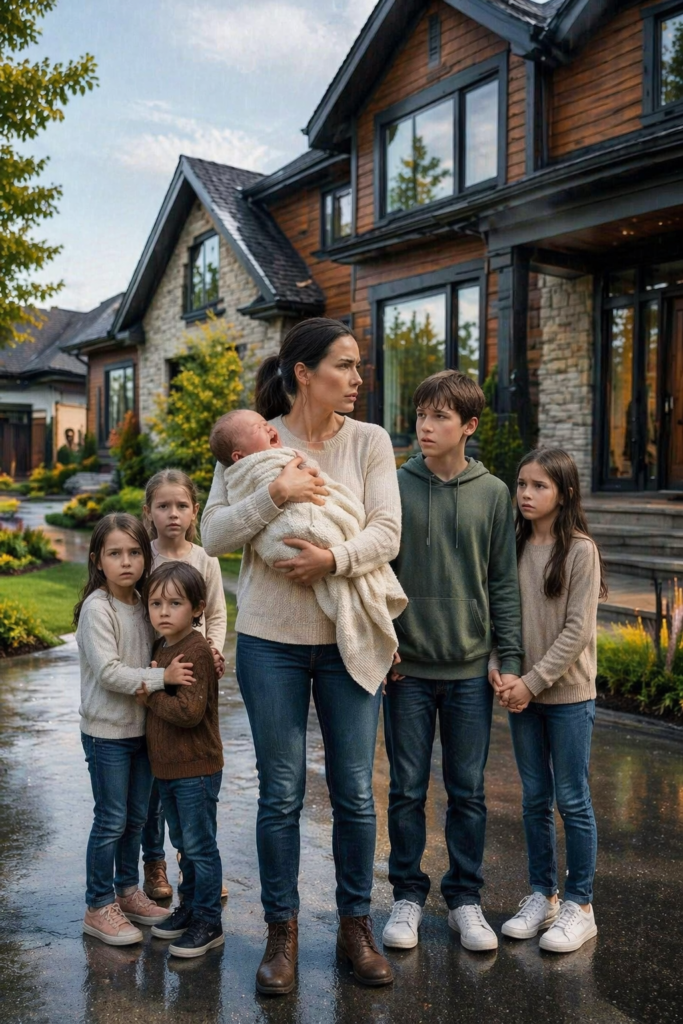
Mónica held little Lucía, her nine-month-old baby, tightly against her chest while her other five children stood behind her, soaked, clutching backpacks and black bags with the few clothes they had been allowed to take.
At the door of the house, Don Ramiro Castañeda looked at her as if she were an intruder.
Not as the widow of his son. Not as the mother of his grandchildren. As a nuisance he could finally cast aside.
"Grab your six brats and get out," he said, pointing to the street with his cane. "This house belongs to the Castañeda blood."
Mónica didn’t cry.
Her eyes were red, her hair stuck to her face, and her hands trembled from exhaustion, but she didn’t cry. Not in front of her children. Not in front of those people who had treated her for twelve years as if marrying Julián had been a favor they granted her.
"Blood?" she asked, her voice low. "I gave your son six children."
Doña Graciela, her mother-in-law, let out a dry laugh from the foyer.
"Six mouths, you mean. Six burdens. Julián did enough just to keep them fed."
Diego, the oldest at thirteen, stepped forward.
"Grandpa, my dad said this was our house too."
The strike was so quick that Mónica barely caught the movement.
Don Ramiro's palm slapped Diego’s cheek with a horrible, dry sound that made the children freeze.
Mónica dropped the suitcase to the ground and stood in front of her son.
"Don’t you dare touch him again."
Don Ramiro smiled, full of contempt.
"Or what? Are you going to sue me, little girl? You have nothing. No husband, no money, no name."
Doña Graciela descended the stairs wearing the pearl necklace. It was the same necklace Julián had given Mónica on their tenth anniversary, but now it shone around the neck of the woman who was throwing her out.
"Julián is dead," she said coldly. "And with him, your protection ended."
Mónica looked at the house.
There she had given midnight feedings. There she had sewn school uniforms. There she had cared for Julián when cancer no longer allowed him to climb the stairs by himself.
And now they were throwing her out as if she had never existed.
Don Ramiro tossed two suitcases into the puddle.
"Here are your things. Be grateful I didn’t throw them in the trash."
The twins began to cry. Sofía, seven years old, hugged her younger brother and murmured that she was cold.
Mónica took a deep breath.
"Kids, we’re leaving."
Doña Graciela raised her phone and started recording.
"So you don’t say we kicked you out for no reason. People need to know what you’re like."
Mónica looked at her for barely a second.
Then she hugged her baby tighter and said something that made Don Ramiro's smile vanish.
"Then maybe you should check the name on the deed."
Silence fell over the room like thunder.
PART 2
Don Ramiro squinted.
"What did you say?"
Mónica didn’t respond immediately. She bent down, picked up Mateo’s backpack, wiped Diego’s red cheek with her sleeve, and adjusted the blanket over the baby’s head.
"I said you should check the deed before talking about blood."
Doña Graciela let out a nervous laugh.
"Oh, please. Don’t start with your little theatrics. You don’t even know where those papers are kept."
Mónica held her gaze.
"Julián did."
That phrase was enough to change Don Ramiro's face. It wasn’t fear yet. It was something worse: doubt.
For years, Ramiro Castañeda had boasted that the Del Valle house was the symbol of his family. An old residence of gray stone, purchased by his father and remodeled with money from the family auto parts business.
But what he never wanted to accept was that Julián, his eldest son, had been the one to save it from foreclosure.
Julián had paid debts. He had negotiated with banks. He had put his signature where Don Ramiro had only put pride.
Mónica knew this, but she didn’t have the strength to argue in the rain.
That night, she took her children to a cheap hotel near Tlalpan. The room smelled of dampness and old chlorine, but at least it was dry.
She requested two extra blankets, bought sweet bread, milk, and Styrofoam cups at a corner store. The children ate sitting on the bed, silent, as if speaking could break them further.
When they all fell asleep, Mónica pulled out a burgundy folder from the bottom of the diaper bag.
Julián had given it to her two months before he died.
He had looked thin, pale, with cold hands, but his eyes were still the same: firm, attentive, filled with love.
"If my parents try to erase you," he had said, "go to Attorney Ortega. Don’t open this in front of anyone."
Mónica had kept the folder without daring to read it.
Maybe because opening it meant accepting that Julián was already saying goodbye.
That dawn, with the rain pounding against the hotel window, she broke the seal.
Inside were notarized copies, bank statements, photographs, receipts, message screenshots, and a USB drive.
There was also a letter.
"Mónica, forgive me for leaving you this war. But I needed to make sure our children wouldn’t be at the mercy of my family. The house doesn’t belong to my father. It has been in a family trust for the past eight months. You are the administrator. Our six children are the beneficiaries."
Mónica covered her mouth with her hand.
She kept reading.
"My mom and dad didn’t just want the house. They were also using business accounts to hide money, forge invoices, and load debts under my name. If you’re reading this, they’ve probably done what I always feared."
Then she connected the USB drive to an old laptop that Diego used for school.
The first video played with Julián’s face.
He sat on his bed, wearing a gray hoodie, his voice weak but clear.
"Love, if you’re watching this, it means my parents kicked you out or tried to. Don’t believe them. You’re not alone. And above all, don’t sign anything."
Mónica cried silently.
Julián continued:
"They think you’re good because you’re naive. They’re wrong. You are good because you are strong. And you know numbers better than all of them combined."
It was true.
Before having her children, Mónica had worked for ten years as an accountant at an auditing firm in Santa Fe. She left her career when complicated pregnancies and Julián’s illness made it impossible to sustain everything.
The Castañeda family always used that to humiliate her.
"She’s forgotten how to use Excel," Doña Graciela would say at family meals.
"She’s good for changing diapers, not for talking about businesses," Don Ramiro would add.
But Julián had never forgotten.
The next morning, Mónica called Attorney Arturo Ortega.
The lawyer received her in a small office in the Roma neighborhood. It wasn’t luxurious, but his files were organized with a precision that gave her confidence.
When he saw the folder, he didn’t seem surprised.
"Your husband prepared this very carefully," he said. "He asked me to act only if you came."
"We were kicked out yesterday," Mónica replied. "They hit my son."
The lawyer looked up.
"Then we start today."
At 11:30 AM, while Doña Graciela posted a photo of the dining room on Facebook with the phrase "the true family always puts things back in order," she received the first legal notification.
Immediate suspension of any attempt to sell, rent, or modify the property.
At 12:10, Don Ramiro received another.
Request for restoration of possession and measures for dispossession.
At 1:00, Mónica received a call from her mother-in-law.
"What did you do, you wretch?"
Mónica was in a small eatery with her children, dividing six quesadillas so they would all have enough.
"What Julián asked me to do."
"Listen to me carefully," Doña Graciela said, her voice venomous. "We’ll give you 50,000 pesos, and you disappear. It’s in your best interest. With six kids, no one will believe you’re stable."
Mónica looked at Diego, who was trying to smile so his siblings wouldn’t notice the pain in his face.
"I don’t want your money."
"Then we’re going to take the kids from you. We’ll say you have no home, that you’re unstable, that you can’t take care of them."
Mónica closed her eyes.
It hurt. Of course, it hurt.
But she was no longer afraid.
"Graciela, you really don’t know who you’re messing with."
And she hung up.
The hearing was set for four days later.
Don Ramiro arrived in a dark suit, with a new cane, and that expression of a man used to having everyone shrink before him. Doña Graciela wore Mónica’s pearl necklace as if it were a trophy.
Mónica walked in wearing a simple black dress, her hair pulled back, with her six children behind her.
She didn’t look defeated.
She looked tired, yes.
But standing.
Don Ramiro's lawyer spoke first. He said Mónica was a confused widow, emotionally unstable, without income, and resentful against a family only trying to protect Julián’s legacy.
He then suggested that the children would be better off with their grandparents.
That was the first loud murmur in the room.
Mónica squeezed Diego’s hand.
Attorney Ortega stood up calmly.
"Your honor, we will present the deed and the trust first."
The document passed into the judge’s hands.
The room fell silent.
The judge read in silence. Then lifted his gaze to Don Ramiro.
"According to this document, the property was legally transferred eight months ago to a family trust. Mrs. Mónica Salgado is listed as the administrator. Her six children are the beneficiaries."
Don Ramiro turned red.
"That’s impossible. That house belongs to my family."
The judge gently banged the gavel.
"We are not discussing feelings here, Mr. Castañeda. We are reviewing documents."
Doña Graciela stopped fiddling with her necklace.
Attorney Ortega continued.
"We also present messages from Mrs. Graciela Castañeda offering money in exchange for my client renouncing rights that legally do not belong to the Castañeda family."
The screenshots were projected.
"Sign and get out."
"With six children, they’re going to take everything from you."
"Julián is no longer here to defend you."
Mónica listened to every phrase without lowering her gaze.
Then came the video.
When Julián appeared on the screen, Mónica felt as if she were running out of air.
The children straightened up.
Even Don Ramiro stopped moving.
"Mom, Dad," Julián said in the recording. "If you’re seeing this in a courtroom, it’s because you did exactly what I asked you not to do."
Doña Graciela brought a hand to her mouth.
"Mónica didn’t steal anything from you," he continued. "I protected my wife and my children from you. Because I know you."
Don Ramiro mumbled something, but no one paid him any mind.
"The house doesn’t belong to you. The business is not your piggy bank for your whims. I left copies of false invoices, transfers, and transactions that were charged to my name when I was already sick."
The judge asked for the video to be paused.
"Is there documentary support for this?"
Attorney Ortega placed another folder on the table.
"Yes, your honor. And we request that the Public Ministry be notified."
That’s when everything changed.
What had started as a fight over a house turned into something much bigger.
Invoices from phantom suppliers.
Forged signatures.
Payments to a personal account of Doña Graciela.
A loan requested with Julián’s signature when he was hospitalized, connected to oxygen.
Mónica felt nauseous seeing it.
Not only had they disrespected her.
They had used her husband’s illness to keep squeezing money.
Then came the last piece of evidence.
A photograph of Diego with a bruised cheek.
And a video taken by a neighbor from the window, clearly showing Don Ramiro hitting the boy in the rain.
The judge looked at Don Ramiro severely.
"Do you have anything to say?"
For the first time, the old man couldn’t find an eloquent phrase.
"It was a moment of anger."
Mónica stood up.
"No. It was a moment of truth."
Everyone turned to look at her.
Her voice trembled, but it didn’t break.
"For years, they told me I didn’t belong there. That I was less because I came from a humble family in Iztapalapa. That my children were too many. That my work at home didn’t count. I stayed silent many times out of love for Julián, because he suffered with each fight."
She looked at her in-laws.
"But yesterday, you threw six children out in the rain. You hit one. You threatened to take them all from me. And you still had the audacity to talk about blood."
She paused.
"Blood doesn’t make family. Caring does. Loyalty does. Love does."
Doña Graciela started to cry.
"I just wanted to keep my son’s things."
Mónica looked at her with sadness.
"No. You wanted to keep what my son left for his children."
The judge issued an urgent ruling that same day.
Mónica and her children would regain possession of the house. Don Ramiro and Doña Graciela would not be allowed to approach them or enter the premises. An investigation was ordered into the hit on Diego and the irregular financial movements of the business.
When they left the courthouse, Doña Graciela attempted to approach.
She no longer looked like the elegant lady at family dinners. Her makeup was smeared, and her hands were empty.
"Mónica, please. Let me see my grandchildren."
Mónica looked at the necklace around her neck.
"First, give me back what isn’t yours."
Doña Graciela froze.
Slowly, she took off the pearls and placed them in Mónica’s hand.
Lucía, the baby, stirred in her arms.
Doña Graciela reached to touch her, but Diego stepped in.
He said nothing.
It wasn’t necessary.
Two weeks later, Mónica returned to the house.
She didn’t enter as a guest.
She entered with the keys in her hand.
The children walked slowly, as if afraid the walls still held screams. But the house smelled of cleanliness, fresh soup, laundry hanging in the patio.
Mónica changed the locks, painted the door blue, and removed the huge portrait of Don Ramiro from the foyer.
In its place, she put a photo of Julián carrying all six kids on the beach in Veracruz, laughing as if the world couldn’t break him.
Diego planted bougainvilleas right where the suitcases had fallen in the mud.
Sofía taped a sheet in her room that read: "No one kicks us out here."
The twins returned to play in the hall.
Mateo stopped asking if they should sleep with shoes on in case they were thrown out again.
And Lucía took her first steps in front of the door they had once slammed in their faces.
Months later, the investigation caught up with Don Ramiro.
The business was seized. Several accounts were frozen. Doña Graciela, who once boasted "family and values" on social media, deleted all her posts.
One afternoon, Mónica received a letter.
It was from Don Ramiro.
He didn’t apologize.
He asked to see the children "before it was too late."
Mónica read the phrase twice.
Then she put the letter in a drawer.
That night, while they had noodle soup and quesadillas for dinner, Diego asked her:
"Mom, are we bad for not wanting to see them?"
Mónica set the spoon down on the table.
She looked at her six children, those kids who had learned too soon that family could also hurt.
"No, my love," she said. "Sometimes forgiving doesn’t mean opening the door again."
No one spoke for a few seconds.
Then Sofía asked if she could have another quesadilla, the twins started arguing over the last glass of hibiscus water, and the house filled with noise.
Noise of life.
Noise of home.
Mónica looked at the photo of Julián and smiled with wet eyes.
The house had never belonged to blood.
It belonged to those who had filled it with love when others only wanted to fill it with a name.





