PART 1
Mariana never thought she would cross the doors of Grupo Altamirano with her daughter asleep in her arms.
That morning, Doña Chela, the neighbor who always took care of Lucía, had fallen down the stairs of the building in Iztapalapa. The floor was wet from an old leak that no one bothered to fix, and the woman ended up in the emergency room with a swollen knee.
Mariana had no mom nearby, no sisters, no money for emergency daycare, and she couldn’t miss work.
If she lost that job as a cleaning assistant in the executive offices of Polanco, there would be no rent, no diapers, no milk.
So she did the only thing that came to mind.
She put Lucía in her stroller, dressed her in a pink sweater, and snuck her up to the 38th floor of Grupo Altamirano.
Her plan was simple: leave her in the employee lounge, give her a bottle, finish her shift, and leave without anyone noticing.
But plans for poor people almost always break where they shouldn’t.
Lucía woke up crying.
Not a loud cry at first, but that tired whimper of a scared little girl looking for arms. Mariana dropped the bucket, ran down the hall, and felt her heart rise to her throat.
Because the nearest office was Alejandro Altamirano’s.
The owner.
The coldest man in all of Mexico, according to the employees.
Alejandro didn’t shout. He didn’t threaten. He didn’t need to.
With a single call, he could close million-dollar contracts, fire directors, sink companies, and leave entire careers in the street.
No one made the same mistake twice with him.
Mariana reached the door thinking of begging, crying, apologizing, anything.
But when she opened it, she froze.
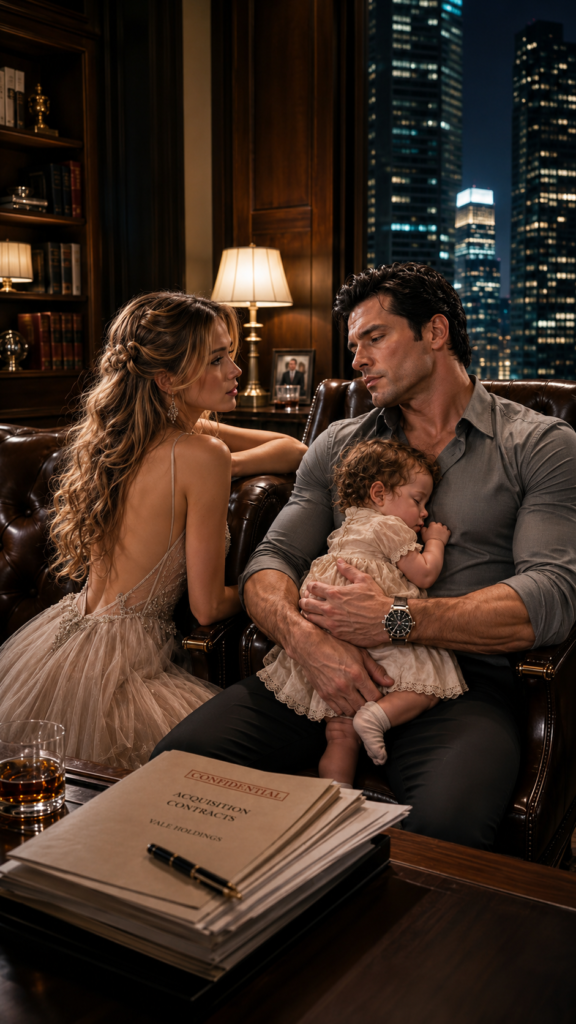
Alejandro Altamirano was asleep in his leather chair.
And Lucía was nestled against his chest.
His expensive jacket covered her like a blanket. The little girl’s tiny hand clutched his white shirt, and one of Alejandro’s hands rested on her back, firm, protective, as if he weren’t holding the daughter of an employee, but something sacred.
Mariana couldn’t breathe.
She had never seen that face on him.
Without hardness.
Without ice.
Without that wall that made everyone tremble.
When Alejandro opened his eyes, Mariana felt her life slipping away.
He looked first at Lucía. Then at her.
“She was cold,” he said softly. “She calmed down when I held her.”
“Sir, I’m sorry… I’ll leave right now. I didn’t mean to…”
“No.”
One single word.
Calm.
Definitive.
Alejandro pointed to the chair in front of him.
“Sit.”
Mariana obeyed, her legs trembling.
“Why aren’t you firing me?” she asked barely.
Alejandro looked at the girl, and something in his face cracked.
“Because someone should have helped her before life forced her to hide her daughter in an office.”
Tears filled Mariana’s eyes.
Then he asked:
“And the father?”
Mariana tensed.
“He left.”
Alejandro didn’t insist. He called for the diaper bag to be brought up and ordered everyone to leave them alone.
When Lucía stirred in her sleep, she made a tiny fist against his shirt.
Alejandro lowered his gaze.
“My little brother used to sleep like this,” he whispered. “With that same serious face, as if even dreaming made him angry.”
Mariana felt a strange punch in her chest.
“What was your brother's name?”
Alejandro lifted his gaze.
“Mateo.”
Mariana’s blood ran cold.
The man who had loved her, gotten her pregnant, and abandoned her was named Mateo Parker.
PART 2
Mariana didn’t say anything at first.
She just looked at Lucía, still asleep against Alejandro’s chest, with her black curls stuck to her forehead and that little mouth puckered that always reminded her of the man who vanished without saying goodbye.
Alejandro noticed the change on her face.
“What’s wrong?”
Mariana pressed her hands against her knees.
“Nothing.”
“Doesn’t look like nothing.”
She swallowed hard.
She had spent nearly two years hating that name in silence.
Mateo Parker.
The mechanic with greasy hands who worked in a shop in Doctores. The man who brought her esquites when she got off late from her old job. The one who laughed at any nonsense. The one who cried when she told him she was pregnant.
The one who promised to stay.
And then disappeared.
Without a message.
Without a call.
Without a damn explanation.
“The father of Lucía was also named Mateo,” Mariana finally said.
Alejandro froze completely.
The office, with its enormous windows and Mexico City sparkling below, seemed to run out of air.
“Last name?”
Mariana hesitated.
“Parker.”
Alejandro frowned.
“My brother didn’t have the last name Parker.”
“I know.”
“He had the last name Altamirano.”
Mariana felt old rage burning in her throat.
“Well, he never told me that.”
Alejandro carefully adjusted Lucía against his chest, as if he were afraid of waking her.
“Describe him.”
Mariana let out a bitter laugh.
“Why? So you can tell me I’m making it up?”
“To know the truth.”
She looked at him directly.
“He had a scar here.”
She touched her left eyebrow.
Alejandro paled.
“He got it at nine, in Valle de Bravo. He fell off a bike.”
Mariana felt the floor move beneath her.
“He liked the horrible machine coffee. He said good coffee was for people who didn’t have real problems.”
Alejandro’s jaw tightened.
“That’s what he said.”
“He listened to old songs in the early morning.”
“By José José.”
Mariana covered her mouth with one hand.
Alejandro stood up very slowly, still holding Lucía, and walked toward the window.
For the first time, he didn’t look like a millionaire.
He looked like a broken brother.
“Mateo died a year and eight months ago,” he said.
Mariana felt like someone was stabbing her in the chest.
“No.”
“Yes.”
“No, he abandoned me.”
Her voice cracked.
“He got me pregnant and left as if I were nothing. As if my daughter were nothing.”
Alejandro closed his eyes.
“That’s what they made us all believe.”
Mariana stood up.
“Who?”
Alejandro didn’t answer right away.
He went to his desk, picked up his cell phone, and dialed.
“Cancel my meetings for the day. All of them.”
Then he looked at Mariana.
“I need you to come with me.”
“To where?”
“To my mother’s house.”
Mariana felt distrust immediately.
“No. I’m not going to bring my daughter into a rich family that didn’t even know she existed.”
“My family isn’t what you think.”
“Neither is mine, sir.”
Alejandro looked down at Lucía.
“Call me Alejandro. And please, Mariana… if that girl is Mateo’s daughter, my mother knows more than she said.”
Alejandro’s mother was Regina Altamirano.
In magazines, she appeared as an elegant lady, founder of associations, an impeccable woman with a perfect hairstyle and porcelain smile.
In person, she was colder than her son’s office.
When Mariana entered the mansion in Las Lomas with Lucía in her arms, Regina didn’t look at the girl first.
She looked at her cheap shoes.
Then her uniform.
Then her face.
“Alejandro, what does this mean?”
“It means you possibly have a granddaughter.”
Silence fell heavily.
Regina let out a small, dry laugh.
“Don’t be ridiculous.”
Mariana felt humiliation rise to her face.
“I didn’t want to come either, ma’am.”
Regina looked at her with disdain.
“I believe that.”
Alejandro stepped forward.
“Her father was Mateo.”
Regina didn’t flinch.
That was the first detail that froze Mariana’s blood.
An innocent mother would have asked, cried, doubted.
Regina just pressed her lips together.
“Mateo was mentally ill in his last months. He hung around with anyone.”
Mariana shuddered.
“Don’t talk about him like that.”
“And who are you to tell me how to talk about my son?”
“I am the woman he loved when you didn’t even know where he was.”
Regina smiled.
“Oh, honey. All men say that when they want to get with someone.”
Alejandro slammed his palm on the table.
“Enough!”
Lucía woke up and started crying.
Mariana hugged her immediately.
“Shh, my love, shh.”
But hearing the cry, Regina recoiled just slightly.
A minimal movement.
As if that sound frightened her.
Alejandro noticed.
“You knew.”
“I don’t know what you’re talking about.”
“You knew Mateo had a daughter.”
Regina lifted her chin.
“Mateo had nothing. Mateo was confused, drugged by those people at the shop, manipulated by women who wanted money.”
Mariana felt her blood boil.
“I never asked for a dime.”
“Because you didn’t know who he was.”
The phrase came out too quickly.
Alejandro looked at her as if she had just confessed.
“How do you know she didn’t know?”
Regina fell silent.
And then a voice was heard from the hallway.
“Because I told her.”
It was a woman in her sixties, dressed in a gray uniform. She had been working in that house for many years. Her eyes were red, as if she had carried a secret for too long.
“Carmen,” Regina said with a threat.
The employee didn’t lower her gaze.
“Enough, ma’am. That girl isn’t to blame.”
Alejandro stepped closer.
“What do you know?”
Carmen took a deep breath.
“Mrs. Regina had young Mateo followed when he left home. She knew about the shop, knew about Mariana, and knew about the pregnancy.”
Mariana felt her legs give out.
“What?”
Carmen nodded sadly.
“Young Mateo wanted to come back to tell you, Mr. Alejandro. He said he was going to confront his mother, that he wanted to acknowledge his baby and marry Mariana even if it cost him everything.”
Alejandro clenched his fists.
“And then?”
Carmen looked at Regina.
“Mrs. Altamirano locked him up for three days at the house in Cuernavaca. She took away his phone. She told Mariana, from his phone, that Mateo had left and didn’t want to know anything.”
Mariana put a hand to her chest.
The room began to spin.
“No…”
“Then they forged some messages,” Carmen continued. “They made young Mateo believe that Mariana had accepted money to abort and disappear.”
Mariana let out a sob.
“I never did that!”
“I know, girl. I saw everything.”
Alejandro looked like he was about to break.
“Why didn’t you tell me?”
Carmen cried.
“Because the lady threatened to put my son in jail. I was scared. But I kept copies.”
Regina stood up.
“Ungrateful old woman.”
Carmen pulled a USB drive from her apron.
“Here’s everything. Audios. Messages. Transfers. The name of the lawyer who fabricated the documents.”
Alejandro took the drive with a trembling hand.
Mariana hugged Lucía tightly enough that the girl stopped crying and just looked at her with her big eyes.
Regina finally lost her mask.
“And what did you want me to do? Allow my son to throw away his last name for a cleaning girl? Mateo was an Altamirano. That girl would have been an embarrassment.”
The silence was brutal.
Mariana felt that word cut her skin.
Embarrassment.
Alejandro looked at his mother as if he didn’t recognize her.
“The only embarrassment here is you.”
Regina laughed with rage.
“Don’t be naive. That woman is here for money.”
Then Mariana did something no one expected.
She walked to the table, pulled out an old, folded, worn photo from her bag, and placed it in front of Alejandro.
It was Mateo at a neighborhood fair, carrying a ridiculous stuffed bear. On the back, in his handwriting, it said:
“For my daughter, even though she isn’t born yet. I promise she will never lack for her dad.”
Alejandro took the photo.
And broke.
He didn’t cry loudly.
His eyes just filled, and he lowered his head, as if all his power couldn’t bring back the only brother he had ever loved.
“He did want Lucía,” Mariana whispered. “I knew it. But I got tired of defending a ghost.”
Alejandro looked at his mother.
“Today you will hand over everything. The accounts, the documents, the names. And tomorrow my lawyers will file a complaint.”
Regina paled.
“I’m your mother.”
“No. You are the woman who let my brother die believing that no one loved him.”
That was the second truth that emerged that afternoon.
Mateo hadn’t died in a simple accident.
According to Carmen, after escaping from the house in Cuernavaca, Mateo drove desperately toward the city looking for Mariana. He was crying, sleepless, with his phone just recovered and several false messages in his head.
The crash happened on the highway.
Regina always said it was because of irresponsibility.
But the truth was crueler: Mateo died trying to return to his daughter.
Alejandro’s lawyers acted quickly.
The audios revealed threats. The false messages proved manipulation. The transfers showed payments to the lawyer and the driver who watched over Mariana for months.
Regina Altamirano, the grande dame of the covers, ended up entering to testify with dark glasses while reporters shouted her name outside the prosecutor's office.
But the most powerful moment wasn’t that.
It was three weeks later, when a DNA test confirmed with 99.9% that Lucía was the daughter of Mateo Altamirano.
Alejandro arrived at Mariana’s apartment with the envelope in hand.
He didn’t come with bodyguards.
He didn’t come with a luxury truck.
He climbed the broken stairs of the building carrying a bag of sweet bread and a doll for Lucía.
Mariana opened the door cautiously.
“I’m not here to take anything from you,” he said before she could speak. “Nor to buy forgiveness. Nor to intrude where I’m not welcome.”
She looked at him in silence.
“I’m here to ask for permission to be her uncle.”
Lucía, from the floor, recognized him and wobbled toward him.
“Uncle,” she babbled, not yet understanding the weight of that word.
Alejandro brought a hand to his mouth.
Mariana felt the pain loosen just a little.
It didn’t disappear.
That kind of wounds don’t just vanish because the truth comes out.
But they stop rotting when someone finally names them.
With time, Mariana accepted help, but not charity.
Alejandro paid for a safe daycare in Lucía’s name, created a trust with the inheritance she was entitled to as Mateo’s daughter, and offered Mariana the chance to study management within the same company.
She never cleaned offices again.
But she also didn’t become a decorative figure in the Altamirano family.
Every dollar was signed, legal, transparent.
Because Mariana had learned that even love needs boundaries when money is involved.
Regina lost her place in the foundation, her magazine friendships, and her son’s obedience.
Sometimes she sent letters asking to see Lucía.
Mariana never tore them up.
She kept them in a box.
One day, when Lucía grew up, she would decide.
Because a mother also shows love by not inventing other people's hatreds.
On Lucía's second birthday, Alejandro brought a small box.
Inside was an old medal of Saint Jude, worn at the edges.
“It was Mateo’s,” he said. “He had it when he left home. Carmen kept it.”
Mariana took it with tears in her eyes.
Lucía grabbed the medal, looked at it, and then squeezed it in her tiny fist.
Exactly as she slept.
Like Mateo.
As if blood remembered what the lie tried to erase.
Alejandro stepped aside so no one would see he was crying.
Mariana saw him and said nothing.
She just placed a hand on his shoulder.
Because sometimes justice doesn’t bring back the dead.
Sometimes it just cleans their name.
And in a city where many believe money buys the truth, a two-year-old girl ended up proving that the most powerful thing wasn’t a millionaire surname.
It was a mother who never stopped seeking answers.
And an uncle who discovered too late that family isn’t protected by hiding secrets, but by confronting those who dare to destroy it.





