PART 1
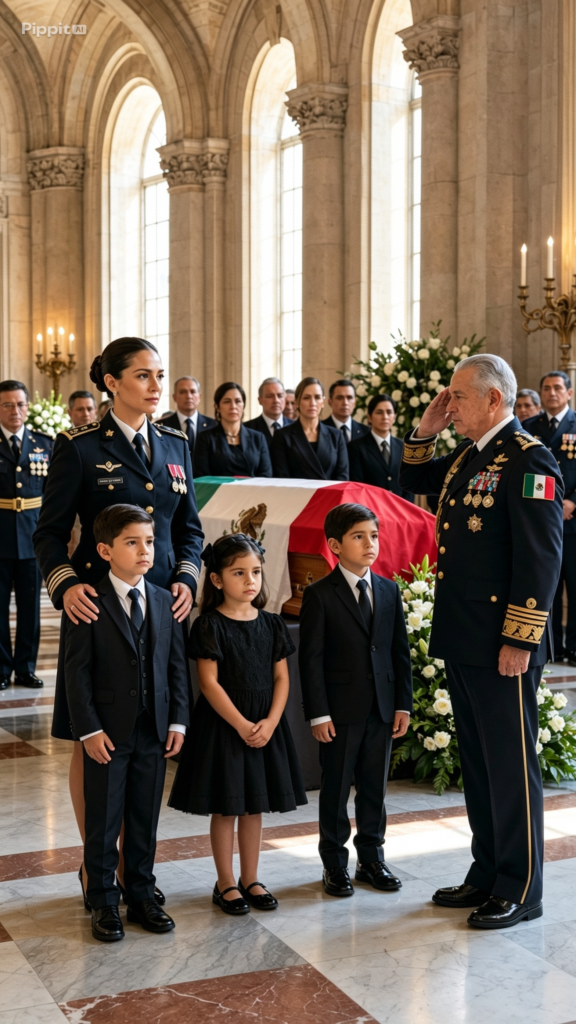
They covered Iván Ríos's coffin with the flag of Mexico, as if he were a hero fallen in a secret mission.
The cold rain fell over the Military Pantheon of Mexico City. The soldiers stood firm, the journalists adjusted their cameras, and in the front row, Tania Robles cried as if her world had ended.
One hand rested on her pregnant belly, the other clutched a white handkerchief. Beside her, doña Beatriz, Iván's mother, stroked her hair with a tenderness she had never shown to her three true grandchildren.
In the back, almost hidden among the crowd, stood Captain Mariana Solís.
Impeccable uniform. Dry gaze. Shoulders squared.
Beside her were Diego, Leo, and Sofía, her seven-year-old triplets, holding her hand, not understanding why everyone was crying for a man they barely remembered.
Iván had been their father.
But Mariana had learned to live as a widow long before she saw him in a coffin.
Seven years ago, Iván left without looking back. He left only a chilling phrase:
—This life is too small for me, Mariana.
He took off with Tania, a younger woman who worked in an office near Polanco. While Mariana struggled with premature babies, military shifts, diapers, fevers, and medical debts, the Ríos family erased her as if she had never existed.
Doña Beatriz once told her in court:
—An ambitious woman can never be a good wife. My son needs someone who knows her place.
Since then, Mariana asked for nothing. No money. No visits. No pity.
She raised her children alone and served in military intelligence, where her job was to detect threats before they turned into tragedies.
The Tuesday before, while preparing three lunchboxes, the television announced:
“Iván Ríos, former Army officer, dies during a classified operation at the northern border. He will be honored with military honors.”
Minutes later, Mariana received a message from doña Beatriz:
“Don’t you dare bring those charity kids to the funeral. Tania is the only widow Mexico should see. Stay back, where you always belonged.”
Mariana almost didn’t go.
But her children deserved to say goodbye to their father, even if that father had abandoned them.
That’s why she was there, in the last row, under the rain.
Up front, Tania cried for the cameras. Doña Beatriz embraced her. Don Arturo, Iván’s father, spoke with a reporter about “his son’s sacrifice for the homeland.”
Then a black truck from SEDENA arrived.
A division general stepped out, his face graver than death. He carried a folded flag in his arms.
Doña Beatriz pushed Tania forward.
—Go, my girl. Receive what is yours and our grandson’s.
Tania stood trembling, extended her hands, and sobbed:
—Thank you, general. Iván died protecting us.
But the general didn’t stop.
He walked past her as if she didn’t exist.
A murmur ran through the pantheon.
—What’s going on, dude? —someone whispered.
The general walked to the last row, stood before Mariana, and raised his hand in a perfect salute.
—Captain Solís.
Mariana instinctively returned the salute.
Then the general spoke loudly so everyone could hear:
—I’m not here to hand over the flag of a hero to a grieving widow. I’m here to deliver a classified report on Iván Ríos.
And at that moment, no one could believe what was about to happen…
PART 2
The silence was so heavy that even the rain seemed to stop.
Tania slowly lowered her hands. Her face, bathed in theatrical tears just a minute ago, turned completely white.
Doña Beatriz stood up abruptly.
—What do you mean classified report? General, you are mistaken. My son was a hero.
The general didn’t look at her.
His eyes remained fixed on Mariana, as if everything else were mere noise.
—Captain Solís, I regret that you had to find out here, but Iván Ríos did not die defending Mexico.
A photographer stopped shooting. A reporter lowered the microphone. The honor guard soldiers tightened their jaws.
—He died in an abandoned warehouse near Nuevo Laredo —the general continued— during an illegal trade of military information. His buyers executed him when they discovered that part of the files were protected.
Mariana felt Sofía’s hand squeeze hers.
She said nothing.
She couldn’t.
The general opened a folder sealed with red tape.
—Iván attempted to sell active coordinates of an intelligence unit. Not just any unit. The one where you work, captain.
A brutal murmur exploded among those present.
Doña Beatriz shouted:
—Lies! That’s nonsense! My son would never do that!
The general barely turned his head.
—Your son attempted to deliver the location of 18 Mexican agents, including the mother of his three children.
Mariana felt a cold blow to her chest.
Iván had not only abandoned her.
He had wanted to kill her.
Tania took a step back, but a federal agent among the crowd gently held her arm.
Doña Beatriz began to cry, now genuinely.
—No, no, no… you want to destroy us.
—You destroyed yourselves —the general replied.
He pulled out another sheet.
—The first deposits from that operation, totaling 12,000,000 pesos, did not go directly to Iván. They were divided among three shell accounts. One managed by Don Arturo Ríos. Another by doña Beatriz. And another by Tania Robles.
The front row erupted into chaos.
Don Arturo tried to stand and walk toward the exit, but two agents from the Attorney General’s office intercepted him before he took five steps.
—This is abuse of authority —he growled—. You don’t know who you’re messing with!
One of the agents handcuffed him.
—Yes, we do, sir. That’s why we’re here.
Tania began to tremble.
—I didn’t know anything. Iván told me it was money from a consulting deal.
The general looked at her for the first time.
—we also have your messages, Mrs. Robles. The audio where you tell Iván: “Get Mariana out of the picture and there will be no one to fight for the pension.”
Tania let out a moan.
Doña Beatriz looked at her with hatred, as if she were just now discovering that the woman she had protected had also used her.
But the worst blow was yet to come.
The general lifted a third sheet.
—And about Iván’s supposed child…
Tania placed both hands on her belly.
—Don’t you dare!
The general didn’t lower his voice.
—The medical test seized in your apartment shows ten weeks of pregnancy. Iván had been out of the country for five months. Furthermore, there are conversations with another man where you acknowledge that the baby wasn’t Iván’s, but that “a Ríos child was worth more than any job.”
The crowd erupted in murmurs.
—No way! —a woman shouted from the back—. What a piece of work.
Doña Beatriz clutched her chest, but no one rushed to support her.
For seven years, she had called Mariana’s true children “charity kids,” while stroking the belly of a woman who was deceiving her.
Mariana looked down at Diego, Leo, and Sofía. They were all scared, but she knelt in front of them and spoke softly.
—Don’t look over there. Look at me. You’re safe.
Diego asked in a shaky voice:
—Did Dad want to hurt you?
Mariana swallowed hard.
She wanted to lie. She wanted to protect him.
But she understood that her children had already lived through too many foreign lies.
—Yes, my love. But he couldn’t.
The general signaled.
The honor guard advanced toward the coffin. In front of everyone, they removed the Mexican flag that covered Iván’s body.
There was no music. No shots in the air. No honors.
Just the dry sound of the fabric peeling away from the wood.
Doña Beatriz screamed as if her skin were being ripped off.
—No! It’s my son! He’s a Mexican soldier!
The general responded without anger, but with a firmness that froze everyone:
—A soldier who sells out his own people no longer deserves the symbols of the homeland.
The agents took Don Arturo away first. Then doña Beatriz, who kicked and screamed in the mud, her black makeup running down her face.
As she passed close to Mariana, she spat venomous words:
—You did this. You always wanted to take everything from us.
Mariana didn’t reply.
Because for the first time, she understood something: she didn’t need to defend herself from a family that had just been laid bare before all of Mexico.
Tania was last.
She no longer cried like a widow.
She cried like someone who had just lost the theater, the money, and her freedom all in one afternoon.
Before they put her in the patrol car, she looked at Mariana and whispered:
—He said you were the problem.
Mariana held her gaze.
—No. I was proof that he was never the man you sold.
After the funeral, Mariana took her children home. She made them hot chocolate, helped them take off their wet clothes, and waited for them to fall asleep.
But that night, she couldn’t rest.
The general had handed her an encrypted memory drive recovered from Iván’s belongings. In a secure room of her unit, Mariana opened it.
There were accounts, names, transfers, contacts.
And an audio file named:
MARIANA_FINAL.
Mariana froze.
She played it.
Iván’s voice filled the room.
—I don’t want any mistakes. Mariana’s unit must disappear completely. Make it look like an external attack. My children will be better off without a mother who fills their heads with soldier ideas.
Mariana closed her eyes.
She didn’t cry.
Not yet.
She listened to the entire audio because a part of her needed to kill forever the ghost of the man she once loved.
At the end of the file, another voice responded:
—When the payment is released, we clean it up.
There was the real twist.
Iván hadn’t just sold information.
He had put a price on Mariana’s life to keep the pension, the narrative of the grieving hero, and a new family manufactured for the cameras.
But his plan failed due to something he never took seriously: the intelligence of the woman he always wanted to make feel less.
Weeks earlier, Mariana had detected strange accesses to her unit’s geolocation system. She didn’t know they were coming from Iván, but she installed a second security barrier, a filter she programmed herself during sleepless nights after putting her children to bed.
That filter saved 18 lives.
Including her own.
Three years later, Mariana was no longer a captain. She was a major, coordinating a cyber intelligence program at the Heroico Colegio Militar.
Her children were ten years old. Diego played soccer. Leo built model airplanes. Sofía said she wanted to be “stronger than mom,” even though everyone knew that was tough.
Doña Beatriz and Don Arturo were sentenced for treason, money laundering, and criminal association. The Ríos family fortune was frozen. Their name, once flaunted at elegant events, turned into a warning.
Tania agreed to testify to reduce her sentence. She was released years later without money, without a borrowed surname, and without cameras waiting for her tears.
One afternoon, during a ceremony at the Military College, the same general approached Mariana.
He was already retired, but still commanded respect.
—Major Solís —he said—, Iván’s last contact was arrested in Dubai. The network is dismantled. Your family is safe.
Mariana took a deep breath.
She looked at her three children running under the sun, free from the shadow of a father who had confused blood with property.
Then she understood that justice doesn’t always come quickly, cleanly, or as one wishes.
Sometimes it arrives in the rain, in front of a coffin, when everyone expects to see a woman humiliated… and ends up watching those who wanted to bury her alive fall instead.
The flag was never for the pregnant mistress.
Nor for the traitor in the coffin.
It was to remember that a mother can hold three children with one hand, defend her country with the other, and still have the strength to kneel before no one.
And the question lingered among all who heard the story:
Does family defend itself even when it betrays… or does true loyalty begin when one dares to speak the truth?





