PART 1
"You promised my mom would get paid today. So why did you leave her crying again?"
The voice was small, but it cut through the cantera hallway like a blow.
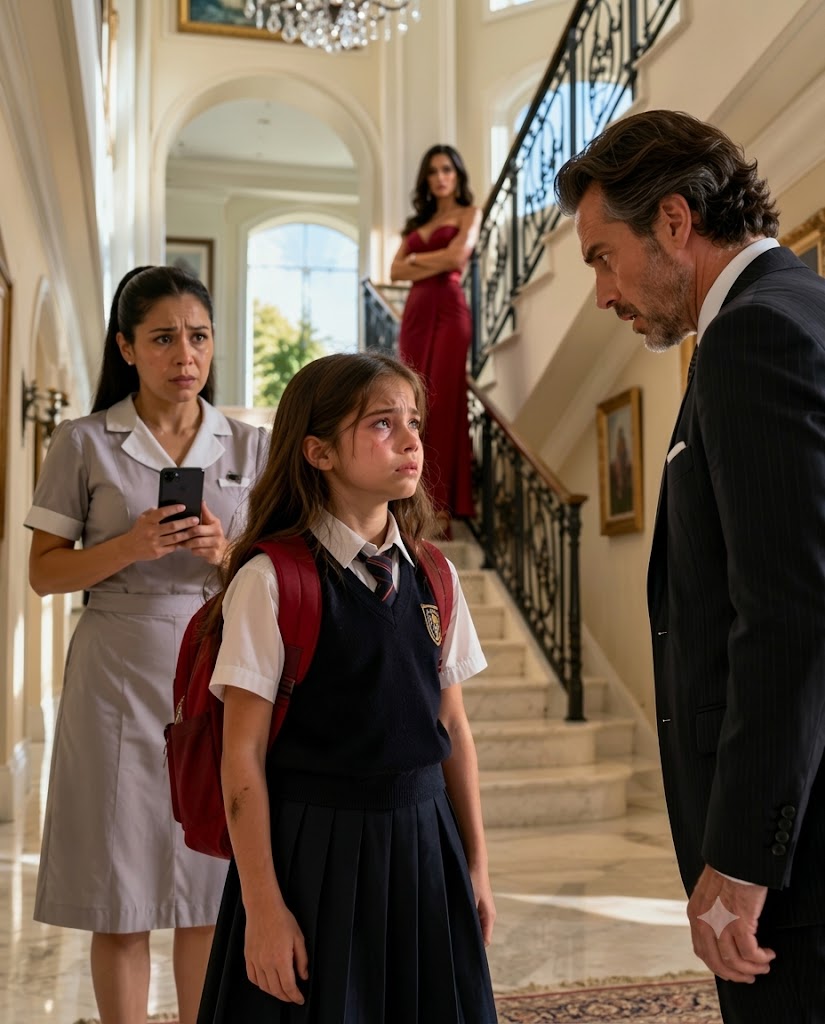
Rodrigo Salvatierra stopped in front of the main staircase of his house in Bosques de las Lomas. He had just ended a video call with partners from Monterrey, his tie loosened and his head buzzing with huge numbers, when he noticed a girl standing by the service door.
She looked about nine years old, wearing a public school uniform, her shoes worn out, and a purple backpack that seemed too big for her small frame. She didn’t seem rude. She looked exhausted from seeing injustices.
"Are you talking to me?" Rodrigo asked, surprised.
"Yes, sir. To you."
A few steps away, a woman in a blue apron clasped her hands to her chest.
"Lupita, no, please —" she whispered. "Don’t get involved."
But Lupita didn’t back down.
"My mom has worked here since before the sun came up. She cleans bathrooms, washes sheets, irons shirts, makes sure everything smells nice when you have guests. And she hasn’t been paid in three months."
Rodrigo frowned.
"Who is your mom?"
The woman lowered her gaze.
"I’m Carmen Ríos, sir. I apologize. My daughter shouldn’t have spoken to you like that."
Rodrigo didn’t look at Carmen with anger. He looked at her as if he had suddenly noticed something that had always been right in front of him.
"Is what she says true?"
Carmen tightened the rag she held in her hand.
"Yes, sir. But Mrs. Patricia said it was a bank delay. Mr. Octavio, the administrator, assured me everything would be settled today."
"Mrs. Patricia?" Rodrigo repeated.
"Your wife, sir."
The air changed.
From the kitchen, someone stopped stirring pots. A gardener peeked his head out and then quickly hid. Everyone knew something. Everyone was scared.
Lupita took another step forward.
"My mom didn’t want to come with me, but the man in charge of the rooms spoke to her very harshly. He says that if she doesn’t pay today, he’ll change the lock tomorrow. And I don’t want to sleep on the street, sir. I really don’t."
Carmen shut her eyes, humiliated.
"Daughter…"
At that moment, Carmen’s cellphone began to ring. On the screen, it read: “Don Memo Rentals.”
The woman turned pale.
"I can’t answer right now."
"Answer," Rodrigo said in a low voice. "Put it on speaker."
Carmen looked at him as if this was too humiliating. But Lupita had already pressed the button.
"Hello?"
A man’s voice exploded in the hallway.
"Carmen! That’s enough. You owe me three months. Today was the last day. If you don’t bring the money before nine, I’m putting your things out on the patio."
"Don Memo, please. I’m at work. They told me I’d be paid today."
"That’s what you told me last week. I have another family waiting for the room."
"My daughter lives with me."
"Then let your boss lend you the money. I’m not paid with pity."
The call ended.
Carmen lowered the phone, red with shame. Lupita didn’t cry. She just looked at Rodrigo as if she were judging him with all the dignity that adults had lost.
"Did you hear?" she asked.
Rodrigo took a moment to respond.
"Yes. I heard."
At that instant, Octavio, the administrator, appeared with a black folder under his arm and a false smile plastered on his face.
"Mr. Rodrigo, I was just about to look for you."
Rodrigo didn’t take his eyes off Carmen.
"Bring me the complete payroll for the staff. Now."
Octavio swallowed hard.
"There’s a delicate issue with that."
"People worked. People get paid. What’s delicate about it?"
Octavio glanced nervously at the staircase.
"Mrs. Patricia asked to handle those payments personally."
Rodrigo felt a strange chill run down his back.
"Where is my wife?"
"In her dressing room. She’ll be down in a few minutes to head to Polanco."
"For what?"
Octavio lowered his voice.
"To a private betting table."
Carmen opened her eyes wide. Lupita squeezed her backpack to her chest.
Rodrigo walked toward his office without saying more. He opened the drawer where he kept a blue notebook for household expenses, a notebook he rarely reviewed because he trusted Patricia.
As he flipped through the pages, he found names of employees marked as “paid,” strange signatures, duplicate withdrawals, and transfers without receipts.
Then he saw a figure written in red ink.
38 million pesos.
Rodrigo looked up just as Patricia descended the staircase in a silver dress, ultra-thin heels, and a designer handbag.
She smiled as if nothing were wrong.
"Sweetheart, why does everyone have that look on their faces?"
And no one in that house could breathe when Rodrigo closed the blue notebook and asked her what she had done with the money.
PART 2
Patricia Salvatierra froze halfway down the stairs.
For the first time, her perfect smile failed to mask her fear. She was made up, perfumed, ready to enter a private room in Polanco where other women with heavy surnames wagered amounts that for any common family would amount to a lifetime.
"What money are you talking about?" she asked, trying to sound offended.
Rodrigo held up the blue notebook.
"Carmen’s salary. Lidia’s, Rosendo’s, Imelda’s, everyone who works here. Of the transfers marked as paid when no one received anything. And these 38 million pesos that don’t add up."
Octavio looked down.
Carmen wanted to take Lupita by the shoulder to leave, but Rodrigo stopped her.
"You’re staying. This conversation started because of you, and it’s going to end with you hearing the truth."
Patricia let out a dry laugh.
"Oh, Rodrigo, what a drama. They’re just administrative delays. Service people always need everything urgently. Rent, school, medicine. If you give them money every time they cry, they’ll climb all over you."
Lupita looked at her with a mix of rage and confusion.
"My mom didn’t cry to get anything for free. She cried because she worked."
The statement left the hallway in silence.
Rodrigo felt something old break inside him. He remembered his own mother, in Iztapalapa, coming home from cleaning offices with swollen feet. He remembered the boss who always said, "Tomorrow." He remembered one night when he, as a child, pretended to sleep while his mother cried because they couldn’t make rent.
And now, in his own house, someone was repeating that same cruelty.
"Where is the money, Patricia?"
She slowly descended the last steps.
"I moved it. I was going to return it."
"You gambled it?"
Patricia pressed her lips together.
"I lost some hands. Then I borrowed to recover. Then there was another table. It got out of control, okay? But it’s not that serious. You can cover it with one call."
"It wasn’t my money."
"Everything here is yours."
"No. That salary was theirs. That foundation wasn’t your casino."
Carmen lifted her gaze upon hearing the word foundation.
Patricia paled.
"What does the foundation have to do with this?"
Rodrigo noted the tremor in her voice. That small second where a person betrays themselves before putting on another mask.
"Octavio," Rodrigo said, "call Julián. Have him bring the account statements for the house, the family business, and the Salvatierra Foundation for the last six months."
Patricia lost her composure.
"You can’t do this to me."
"Of course I can."
"I’m your wife."
"And Carmen is a worker you left homeless. Lupita is a girl who had to come and demand what you’ve hidden. Don’t talk to me about family if you don’t understand the slightest bit of decency."
Patricia looked at him with hatred.
"Are you going to humiliate me for a maid?"
Rodrigo took a step toward her.
"Don’t ever use that word in my house again."
Octavio attempted to intervene.
"Sir, it might be better to handle this discreetly. A scandal like this…"
"The scandal isn’t that it gets out," Rodrigo interrupted. "The scandal is that it happened."
That night, the mansion didn’t sleep.
Julián, the accountant, arrived with a laptop, folders, and receipts. He reviewed each transfer one by one. Meanwhile, Rodrigo ordered immediate payment for all staff: overdue salaries, overtime, and an additional month as compensation.
Carmen received her deposit before ten.
When she saw the bank message, she covered her mouth.
"Sir… there’s much more here than what they owed me."
"It’s not much," Rodrigo replied. "It’s late. And when payment is late, it also hurts."
Lupita checked her mom’s phone and then looked at Rodrigo.
"So we’re going to stay in the room."
"Yes," he said. "And if that man threatens you again, you call me directly."
He handed her a card with his number handwritten on it.
Carmen began to cry, but this time not out of fear.
"I’m sorry for all this."
"Don’t apologize for asking for what’s yours."
Shortly after, Julián entered the office with a tense expression.
"Rodrigo, the payroll is just part of it."
Patricia, sitting on a sofa, stiffened.
"Shut up, Julián."
Rodrigo didn’t look at her.
"Go on."
Julián opened a folder.
"There are withdrawals from the Salvatierra Foundation recorded as support for housing, scholarships, and medical treatments. But many invoices are fake. Several receiving accounts belong to shell companies. And two large deposits went to an account linked to an online betting house."
Rodrigo closed his eyes.
"How much?"
"38 million pesos, summing payroll, household accounts, and foundation resources."
Carmen covered her mouth. Lupita didn’t understand the figure, but she understood her mom’s face.
Rodrigo stared at the blue notebook.
That figure wasn’t just money. It was scholarships that didn’t arrive. Rent for families who were about to be evicted. Medicine that someone didn’t buy. Food that didn’t appear on poor tables. It was exactly the kind of help he had promised to give because one day his mother had no one to turn to.
"You’re going to return every peso," Rodrigo said.
Patricia stood up.
"I will, but without reporting it. We can fix it as a family."
"No."
"No?"
"This isn’t fixed with an awkward dinner and a pretty apology. It’s audited, reported, and repaired."
"You’re going to destroy my name."
"You did that when you turned other people’s hunger into poker chips."
Patricia began to cry, but Rodrigo no longer knew if it was remorse or fear of losing luxury.
The next day, the house awoke different. Not because the walls had changed, but because the silence of the staff was no longer obedience: it was anticipation. They waited to see if Rodrigo was serious.
And he was.
He gathered everyone in the garden. There were cooks, drivers, gardeners, cleaning staff, and security. Many had worked for the Salvatierra family for years without daring to say anything.
"What happened here was an abuse," Rodrigo said. "It wasn’t a bank error or a minor delay. My name was used to lie to you, and money that was already yours was taken. That won’t happen again."
No one applauded. It was too heavy for that.
"From today on, every payment will have direct receipts. Overtime recorded. Clear vacations. Reviewed insurance. And an anonymous channel to report any abuse, even if it comes from my family."
Rosendo, the gardener, raised his hand timidly.
"What about Mr. Octavio?"
Rodrigo looked at the administrator, who was standing aside.
"He is suspended while his involvement is investigated."
Octavio wanted to protest, but no one defended him.
The biggest blow came three days later, at the Salvatierra Foundation meeting. The table was filled with businessmen, lawyers, and friends with long surnames. They all understood image. They all feared a headline.
Rodrigo placed the report in front of them.
"There was a diversion of resources. The money will be fully reimbursed. Furthermore, we will file a formal complaint."
An older advisor, Don Eugenio, adjusted his glasses.
"Rodrigo, think this through. If this gets out, the media will destroy your wife, your company, and the foundation. We can repay the money and close the matter internally."
Rodrigo stared at him.
"If Carmen had taken five thousand pesos from this house, what would you do?"
No one answered.
"You would report her," a lawyer said, almost in a whisper.
"Then if the one who took 38 million wears diamonds, does the law become discreet?"
The silence weighed more than any shout.
Don Eugenio sighed.
"It could cost you the direction of the group."
"A chair isn’t worth more than a promise."
The complaint was filed that same week.
The news exploded on a Friday morning: "Businessman's wife diverted resources from foundation and domestic employee salaries." By noon, reporters were outside the mansion. By afternoon, comments on Facebook were ablaze.
Some said Rodrigo was exaggerating for exposing his wife. Others said that finally, someone rich had stopped protecting their own. Many domestic workers recounted similar stories: months without pay, “forgetful” employers, promises that never arrived.
Patricia had to sell jewelry, a property in Valle de Bravo, and shares in personal investments to return the money. She wasn’t held in preventive custody because she cooperated and repaired the damage, but she faced charges, fines, probation, and mandatory community service.
The first time she arrived at a support center for evicted women, she heard a lady say she lost her room because her employer paid late for two months.
Patricia froze.
That night, she went to Rodrigo’s office without makeup, without jewelry, without that armor of an untouchable lady.
"Today I understood something," she said with a broken voice. "I saw amounts. I never saw the people waiting for those amounts."
Rodrigo closed the folder he was reviewing.
"That was what everyone was trying to tell you."
"Will you forgive me?"
He took a moment to respond.
"I don’t know. There are damages that money covers. Others only time confronts. And some leave scars forever."
Patricia cried silently.
Months later, Carmen was still working in the house, but she no longer walked with her head down. She had an updated contract, timely payments, and the peace of knowing her daughter wouldn’t have to hear the landlord threaten them because of someone else.
One afternoon, Lupita came to the garden with a folded sheet.
"Mr. Rodrigo, I made you a drawing."
He opened it.
It was a simple house, not a mansion. It had an open door, a smiling lady, a girl with a backpack, and a man in a suit standing beside. Above, in crooked letters, it said:
"A house where no one begs for their salary."
Rodrigo stared at the paper for a long time.
"It’s a very beautiful house."
"It’s a fair house," Lupita corrected. "Because people get paid when they work."
Carmen felt embarrassed.
"I’m sorry, sir. Sometimes she speaks too much."
Rodrigo shook his head gently.
"No. Sometimes children say what adults silence out of fear."
That same month, the Salvatierra Foundation created a support program for domestic workers with housing issues, overdue payments, or labor abuse. The first school scholarship was for Lupita, not out of pity, but for her grades and for a letter she wrote.
The letter said she wanted to be a lawyer "so that no mom has to beg for money she already earned."
Rodrigo kept that letter alongside the blue notebook.
Because in the end, justice didn’t start in a courtroom or in a boardroom. It started in a hallway, with a nine-year-old girl looking a millionaire in the eye and asking him why he had lied.
And that question changed more than a house.
It changed the way everyone understood an uncomfortable truth: a person’s dignity doesn’t depend on the size of their bank account, but on how many promises they keep when no powerful person is watching.