PART 1
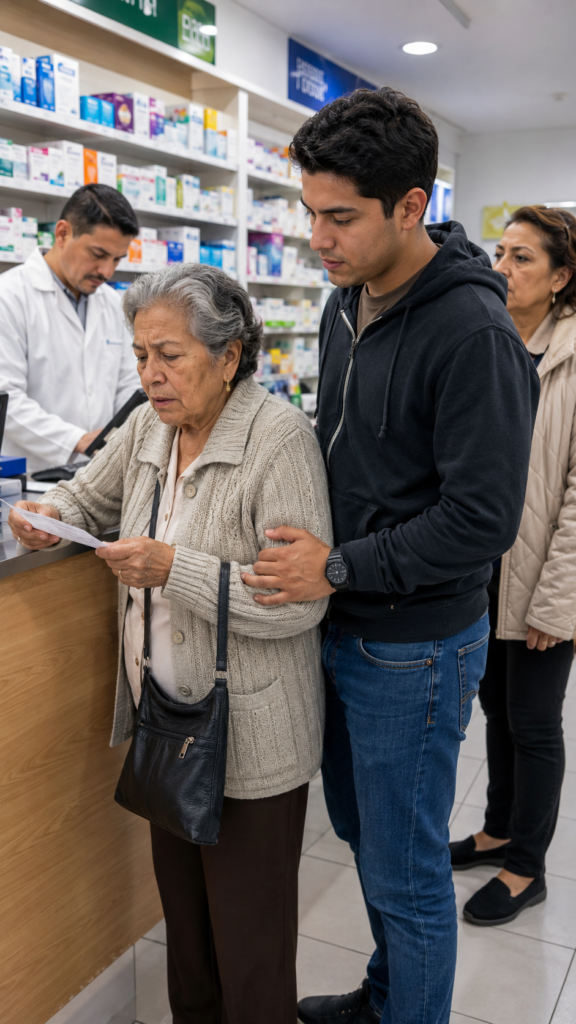
Elena Robles began to die in front of the pharmacy counter in the Narvarte neighborhood, while the cashier told her that her medicine was incomplete.
At 74, with thin hands, a grocery bag hanging from her arm, and a prescription folded four times inside her wallet, she had spent 40 years as a history teacher at a public secondary school. She had faced classrooms full of teenagers, angry parents, and arrogant principals.
But that morning, she could not face her own body.
The white lights of the pharmacy began to swirl like tops. The floor tilted beneath her. The cashier's voice turned into a buzz.
—Ma'am, are you going to pay or not? —someone behind her asked, annoyed.
Elena wanted to reply, but her legs buckled.
A woman with a designer bag and dark glasses grimaced.
—Oh, come on, something always happens when you're in a hurry.
No one moved.
Some watched. Others pulled out their phones. One lady even stepped back, as if old age could be contagious.
Then a tattooed hand grasped Elena by the elbow.
—Easy there, chief. I got you.
Elena barely lifted her gaze.
It was a young man, about 26, in a black hoodie, tattoos on his neck, shaved sides, with headphones dangling. He looked as if he hadn’t slept, but his eyes showed he was present.
—Don’t let her go —the cashier said, anxious.
—I’m not letting her go —he replied.
The young man's name was Mateo.
He paid for the missing medicine without asking Elena if he could. He took her to a bench outside, bought her water, and stayed by her until she stopped trembling.
—Do you have someone to pick you up? —he asked.
Elena lowered her gaze.
Her son Ricardo lived in Querétaro. He had a wife, two kids, appointments, obligations, and a guilt that always arrived by phone, never in person.
—I don’t want to bother anyone —she murmured.
Mateo let out a sad laugh.
—That’s what everyone says when they need help the most.
He drove her home in a gray Tsuru that sounded like an old blender. Elena wanted to give him money for gas, but he refused.
—Just rest. And don’t go out alone like this, okay?
She thought she would never see him again.
But three weeks later, when chemotherapy had left her bald, without appetite, and nearly powerless, Elena wrote in the group chat:
“I need a ride to the General Hospital on Tuesdays at 8:00. I can pay for gas. I also bake cookies.”
She received 18 praying hands emojis.
Seven messages of “God bless you.”
And no real offers.
Until a private message appeared.
“I’m Mateo, the one from the pharmacy. I’ll pick you up at 7:30. Don’t pay me anything.”
For five months, Mateo took her to every treatment. He waited outside with coffee in a thermos, a clean blanket, and a bag in case she felt nauseous.
The neighbors began to talk.
—That kid looks dangerous.
—Let’s hope he doesn’t rob her.
—And where’s her son?
Elena pretended not to hear.
But one Sunday, Ricardo arrived unannounced and found Mateo coming out of the kitchen with the house keys in his hand.
Ricardo pounced on him like a wild animal.
—What are you doing in my mother’s house, you jerk?
Mateo didn’t respond.
Elena struggled to rise, pale, weak, with a twisted scarf on her head.
And in that moment, Ricardo saw a letter from the hospital addressed to Mateo on the table, next to an old photograph of a grandmother.
The photo fell to the floor.
Elena picked it up.
And as she looked at it closely, she felt the air shatter inside her chest.
PART 2
The woman in the photo was not a stranger.
Elena recognized her even though more than 30 years had passed.
Her name was Amparo.
She had been the janitor at the secondary school where Elena taught for most of her life. A short woman, with a long braid, rough hands, and a tired smile, who always arrived before everyone else to mop classrooms and heat water on an old heating element.
Elena stared at the image as if someone had opened a buried door.
—Where did you get this photo? —she asked, her voice breaking.
Mateo clenched his jaw.
—She was my grandmother.
Ricardo remained tense, but he was no longer shouting.
—Your grandmother? —Elena said.
Mateo nodded.
—She always talked about a teacher named Elena. She said you once defended her job when they wanted to fire her for taking me to school when I was a kid.
Elena covered her mouth with a hand.
She remembered everything.
Amparo had no one to leave her grandson with. Mateo was about five years old, sitting on a bench in the yard with a backpack bigger than he was, eating a roll with beans.
A new principal wanted to fire her because she “gave a bad image.”
Elena stood in front of him and told him that if he fired Amparo, he would have to explain to the supervision why he punished a poor woman for caring for a child.
Amparo kept her job.
Mateo kept his grandmother close.
But later, Elena changed schools, retired, and life went on, as it always does: taking names, faces, and debts one doesn’t know they left behind.
—My grandmother said you were the first person who didn’t treat her like a nuisance —Mateo said—. I didn’t know it was you when I saw you at the pharmacy. I found out later when I saw your name on the prescription.
Elena closed her eyes.
Ricardo looked down.
The house filled with a heavy silence.
Mateo put away the hospital letter, but Ricardo managed to read it.
It was an acceptance for training as a medical emergency technician.
—Do you want to work in ambulances? —Ricardo asked, his voice now softer.
—Yes —Mateo replied—. I want to arrive when someone has no one to show up.
Ricardo swallowed hard.
—I thought you were taking advantage of my mom.
Mateo looked him straight in the eye.
—Yeah, I saw.
He didn’t say it rudely. He said it with weariness.
Elena sat down slowly.
—Ricardo, Mateo has taken me to every chemotherapy. He has waited hours without charging me a dime. He has seen me vomit, cry, and fall asleep like a child. And the first thing you did was see him as a thief.
Ricardo felt the blow.
—Mom, I just wanted to protect you.
—No —she said firmly—. You wanted to calm your guilt.
The phrase hit harder than any shout.
Ricardo opened his mouth but couldn’t defend himself.
Because it was true.
He called every day. Sent money. Asked about her studies. But when Elena had been afraid at night, when chemotherapy left her too weak to open a bottle of water, when loneliness sat in the living room like a cruel visitor, he wasn’t there.
Mateo was.
That day, there was no nice family meal.
There was truth.
Ricardo went out to the yard and cried silently. Elena watched from the window, but she didn’t go to comfort him right away. Sometimes children also need to be alone with what they did.
Mateo approached the door.
—Mrs. Elena, I should go.
—You’re not leaving because of other people’s shame —she said.
Ricardo heard.
He came back inside with red eyes.
He stood in front of Mateo.
—I’m sorry —he said—. For real. I saw you and thought the worst. I have no excuse.
Mateo remained silent for a few seconds.
—My grandmother said that nice people can also hurt, just with cleaner words.
Ricardo looked down.
—She was right.
From that day on, something changed in the family.
Ricardo began visiting every two weeks. He no longer brought expensive gifts to feel like a good son. He brought time. He washed dishes. Organized medicines. He learned to sit with his mother without filling the silence with excuses.
But the neighborhood continued to talk.
The woman with dark glasses, the same one who had complained at the pharmacy, lived two blocks down. Her name was Patricia, and she was the manager of the neighboring building.
One afternoon, at a neighborhood meeting, she dropped a comment in front of everyone.
—I’m just saying we have to be careful. Just because someone helps an old lady doesn’t mean they’re a saint. Those tattoos don’t come from church.
Elena, who almost never attended those meetings, asked to speak.
She stood up slowly, leaning on her cane.
—You’re right, Patricia. Tattoos don’t come from church. But cruelty doesn’t come from prison either. Sometimes it comes from well-groomed people who check their watches while someone is fainting.
The room froze.
Patricia paled.
Some neighbors exchanged uncomfortable glances, remembering they had all commented on Mateo without knowing him.
Elena didn’t shout.
That made it worse.
—That kid held me up when you all were sending emojis. He took me to the hospital when you were writing “stay strong.” He cared for me when my own family couldn’t or didn’t know how. So before you judge his neck, look at your heart.
No one applauded.
It wasn’t necessary.
Patricia stood up and left.
But life, so cruel, doesn’t take long to collect words.
Two weeks later, Patricia fell down the stairs at the market. She hit her head and became confused, sitting among bags of tomatoes and onions while people formed a circle around her.
Mateo was passing by in his Tsuru.
He wore his practice uniform, new boots, and the tattoos on display.
When he saw her, he ran.
—Ma’am, don’t move. Look at me. What’s your name?
Patricia tried to speak, but she could only mumble.
Someone said:
—That’s the lady who talked bad about you, dude.
Mateo didn’t even look back.
—Then all the more reason to help her.
He took her pulse, called for emergency services, kept the crowd back, and held her hand until the ambulance arrived.
Patricia cried in shame.
—I’m sorry —she managed to say.
Mateo looked at her calmly.
—Apologize to me later. Right now, breathe.
That phrase spread through the neighborhood like wildfire.
Not as gossip.
But as collective shame.
The chat group erupted:
“I can take Mrs. Elena on Thursdays.”
“I have extra adult diapers if anyone needs them.”
“My son can check Mateo’s car.”
“Who’s taking Mr. Chuy to the hospital?”
Elena read the messages in silence.
Not everyone suddenly became good. People don’t change like in a novel. But some stopped hiding behind emojis.
Meanwhile, Mateo continued studying.
It was hard for him. Not because he wasn’t intelligent, but because he came from nights of work, tight budgets, and a life where no one had told him, “You can,” without following up with “but who knows.”
Elena helped him study anatomy with the same patience she once used to teach the Mexican Revolution.
—Don’t memorize like a parrot —she said—. Understand. The body tells stories too.
Mateo laughed.
—You can even teach a lesson from the pancreas, ma’am.
—And you can draw hope from a stretcher, kid.
One Friday, the news came.
Elena was still in remission.
Not cured forever. Not invincible. But alive.
The doctor told her the tests were clean and that they could space out her check-ups.
Elena left the hospital wanting to cry, but not out of fear.
Mateo waited for her outside with two cups of esquites because he said good news in Mexico isn’t celebrated with salad.
—What did the doctor say? —he asked.
Elena looked at him.
—She said I’m still going to be a nuisance.
Mateo smiled like a child.
He hugged her carefully, but Elena squeezed him tightly.
—I’m not made of paper anymore —she said.
That same month was Mateo’s graduation ceremony.
A simple hall, white plastic chairs, noisy fans, and family taking photos with their phones. Mateo wore a light shirt, dark pants, and his arms were bare.
He didn’t hide his tattoos.
Ricardo arrived with Elena. He had driven from Querétaro in the early morning.
When Mateo’s name was called, he walked forward with a seriousness that broke the soul. He received his certificate and searched for Elena among the crowd.
She raised her hand.
Not as a teacher.
But as family.
After the ceremony, Mateo approached with shining eyes.
—Mrs. Elena, my grandmother would be so proud to see you here.
Elena shook her head slowly.
—No, Mateo. She would be proud of you.
Ricardo stepped closer too.
He held a small box.
—This is for your car —he said, awkwardly—. It’s not charity. It’s an apology with tires.
Mateo opened the box.
There was a receipt from the shop: the transmission for the Tsuru was paid.
Mateo pressed his lips together.
—I don’t know how to accept these things.
Elena touched his arm.
—Learn. It’s part of living too.
Mateo took a deep breath.
Then he hugged Ricardo.
It was awkward, quick, masculine, one of those hugs where no one knows where to put their hands.
But it was real.
Months later, Mateo had his first official shift in an ambulance.
That night, a call came in about an elderly woman who had fainted outside a pharmacy.
When he arrived, he saw the lady on the ground, surrounded by people who didn’t know what to do.
Mateo knelt beside her.
—Easy there, chief. I got you.
The phrase slipped out.
Like an echo.
Like a promise.
Like a hand traveling from one life to another.
Elena found out the next day. Mateo came to have coffee at her house, still with dark circles under his eyes, still smelling of the street and disinfectant.
—I arrived on time —he said.
Elena served him coffee.
—Of course you did.
He kept staring at the cup.
—Sometimes I feel like I’m still trying to save my grandmother.
—Maybe —Elena replied—. But along the way, you’re saving others too. And that counts as well.
Mateo nodded, with wet eyes.
That afternoon, Elena wrote a post on Facebook. She didn’t put a picture of him. She didn’t use his full name. She wasn’t looking for applause.
She wrote:
“Not all angels arrive dressed in white. Some come in hoodies, with tattoos, in an old car and with a broken heart. And sometimes the person you judge the most is the only one who stops when everyone else just watches.”
The post was shared thousands of times.
Some said it was an exaggeration.
Some confessed they had also judged someone by their appearance.
Some asked where the kids were when the parents got sick.
And there the discussion was born.
Because the story didn’t just talk about Mateo.
It talked about everyone.
About the children who love but don’t arrive.
About the neighbors who pray but don’t help.
About the people who criticize tattoos while carrying souls full of stains.
And about a 74-year-old woman who understood, almost dying under the cold lights of a pharmacy, that asking for help was not giving up.
It was choosing to stay alive.
Since then, whenever Elena sees an ambulance passing down the avenue, she stands still for a second.
She doesn’t know if Mateo is inside.
But she always thinks the same thing.
That the world doesn’t change because everyone becomes good.
It changes because someone decides to stop.
And because a hand, just in time, can do more than a hundred messages saying “stay strong.”





